
Sunday Essay · Oil, Sovereignty, Human Development
i. The Call
The phone call came from Houston. A Guyanese petroleum engineer — a man of our own, trained abroad, now working in the beating heart of the global offshore industry — had a question for the Guyana Business Journal. Would we be at the Offshore Technology Conference this year? OTC 2026. NRG Park. First week of May. The conference where his industry gathers to look itself over and where, this year, the President of Guyana would deliver the opening keynote.
He wanted us there. He wanted us watching. He wanted us asking questions.
He had just been home, he told me. He had attended the Guyana Energy Conference in Georgetown. He had returned to Houston with a feeling he could not shake. He phrased it carefully, as engineers do. He said he had left with the distinct feeling that we were not on the right trajectory on the HDI front.
the distinct feeling that we were not on the right trajectory on the HDI front.
The Human Development Index. The United Nations composite — health, education, income — that measures how a nation is doing at the work for which a nation exists. Not whether its GDP is growing. Not whether its consortium is performing. Whether its people are becoming longer-lived, better-educated, and materially more capable of the lives they might choose.
An engineer does not use the word trajectory casually. An engineer uses it because an engineer has spent a career watching curves bend — some toward completion, some toward failure, most revealing their ultimate destination long before the observer is ready to read what the early data is saying.
What he was telling me, in the courteous understated idiom of our profession at its best, was that the early data on Guyana’s oil era is saying something. The barrels are ascending. The FPSOs are coming online ahead of schedule. The GDP is compounding at rates for which the word unprecedented is barely adequate. And yet the lived experience of the Guyanese household — the variable the HDI exists to measure — is not ascending at a corresponding rate. Somewhere between the subsea wellhead and the kitchen table in Albouystown, the translation is slipping.
He asked me a simple question before we ended the call. If you were Ali, and you were walking up to that podium at NRG Park on May 4th, what speech would you give?
This essay is my answer.
I want to be careful about what that answer is, and what it is not. It is not a ghostwritten draft of anything the President will actually deliver. I hold no such brief. It is not, properly, a piece of advice. Presidents do not need advice from publishers. And it is not a critique of the speech the President will give — a speech none of us has yet heard.
It is a thought experiment. It is the speech I would hope to hear if I were the Guyanese engineer in the twelfth row at NRG Park, having flown in from his job at a major Houston consultancy to watch his head of state address his industry. It is a speech constructed to answer his trajectory question directly. It is a speech in which the HDI — the human condition of the Guyanese people — is not an afterthought, not a footnote, not a paragraph buried between sovereignty and climate, but the organizing concern of the address.
In short: it is what the GBJ believes an OTC 2026 opening address ought to sound like, if it is to be worthy of the moment Guyana is actually living through.
The speech follows. A few notes on the argument I try to make through it follow the speech. I ask the reader to read the speech first, as the engineer would — as a document offered, in its own right, to the OTC audience and to Guyana.
ii. The Speech
Opening Address · OTC 2026
The Partnership We Are Building
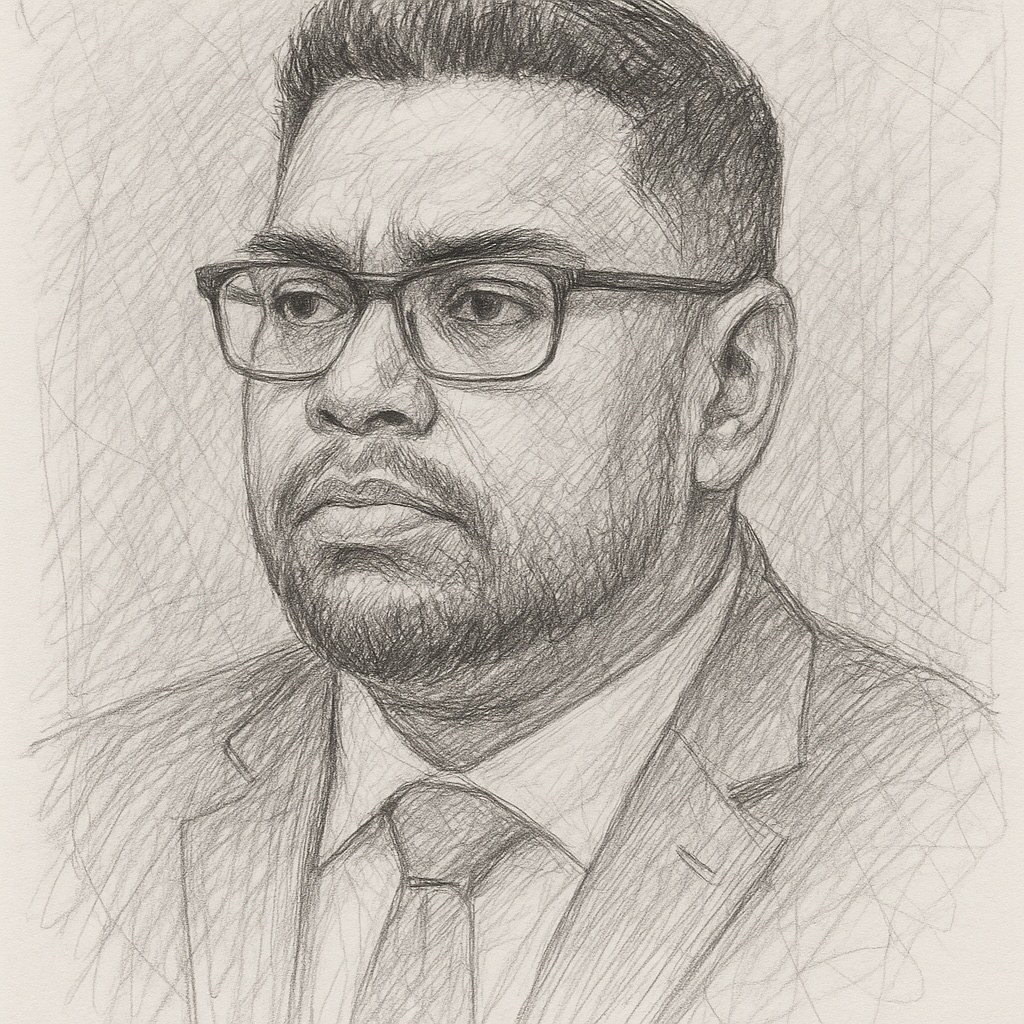
His Excellency Dr. Mohamed Irfaan Ali
President of the Co-operative Republic of Guyana
NRG Park, Houston · Monday, 4 May 2026
Mr. Chairman, distinguished members of the OTC Board, ministers, executives, engineers, colleagues — good morning.
I come to Houston this morning to speak about a partnership between my country and the companies represented in this room. I want to be clear from the outset about what kind of partnership that is.
It is a partnership between a sovereign nation that holds one of the most significant oil discoveries of the twenty-first century and a consortium of companies that has earned, through eleven years of high-quality execution, the privilege of developing that resource alongside us. It is a partnership of equals. It operates on terms of mutual interest, mutual benefit, and mutual respect. It is grounded in the right of the Guyanese people to determine, for themselves, what their country becomes during and after the oil era. And it is governed by a principle my administration holds to, unreservedly: the resource belongs to the people of Guyana, and every arrangement we enter into must answer, in the end, to them.
I want to put before this audience a question I believe this partnership — and only this partnership — is positioned to answer.
Can a producing state and a developing consortium, operating as equals, do something no prior oil arrangement has managed to do? Can we close the distance between the wellhead and the household? Can we make the Guyanese oil era the first in which the resource is extracted responsibly, the revenue is shared equitably, the capability is built locally, and the population of the producing nation arrives at the end of the boom measurably and widely better off — not by the macroeconomic indicators alone, but on every measure by which a nation’s condition is honestly assessed: longevity, education, opportunity, dignity, the daily life of the home?
I believe the answer is yes. I believe we are already doing the work. I want to speak this morning about what the work looks like — from the Guyanese side of the table, from the industry side, and at the point where the two meet.
Let me start with what the partnership has accomplished.
Eleven years ago, Guyana was not on the map of offshore energy. We were a small, forested, river-cut nation of eight hundred thousand people, better known for the poetry of Martin Carter and the political thought of Walter Rodney than for anything beneath our ocean. Today we produce 926,000 barrels of oil per day. We will cross one million this year. By the end of this decade, from eight approved developments on a single block, we expect 1.7 million. Our consortium — ExxonMobil as operator, Chevron through Hess, CNOOC as third partner — has brought four FPSOs online in five years, each under budget and ahead of schedule. Our economy grew 43.6 percent in 2024, and has kept growing.
That record is the consortium’s record. I want to say that plainly, because it is true and because the people in this room built it. The engineering, the capital, the operational discipline, the safety record — these are real, and they are remarkable, and Guyana acknowledges them.
I also want to say something else that is true. The GDP line and the HDI line are not the same line. The macroeconomic record and the human-development record are not the same record. A country can grow its economy at 43 percent in a year and still have a maternal mortality rate that shames it. A country can produce nearly a million barrels of oil per day and still have a hinterland poverty rate that its government cannot defend. A country can accumulate a Natural Resource Fund of several billion dollars and still have a grandmother whose pension runs out on the twenty-third of the month.
Guyana is that country, at this moment. We are not ashamed of the growth. We are not satisfied with the translation.
Let me speak honestly about the work that remains. A partnership strong enough to last is one whose partners can name, to each other, the things not yet done.
On the United Nations Human Development Index — the composite measure by which our international partners and, increasingly, our own citizens assess the quality of national life — Guyana’s trajectory is improving. It is not improving at a rate commensurate with our oil income. Our HDI ranking has risen. Our absolute HDI score has risen. The gap between our income index and our health and education indices has not closed at the pace our revenue would permit. Emigration of trained professionals — doctors, engineers, teachers, nurses — continues at a rate that constrains our capacity to deliver the services the revenue is meant to fund. These are facts. They are on the record. They are the trajectory question.
I will acknowledge what the debate itself concedes. In a country producing nearly a million barrels of oil every day, there remain households struggling to meet basic needs. There remain communities without reliable electricity, without adequate water, without functioning health posts. There remain children whose educational outcomes are determined by the accident of where they were born — in Georgetown or in the hinterland, on the coast or in the interior. The gap between the macroeconomic line and the household line is real, and it is the central challenge of Guyanese governance in this decade.
That is the trajectory question. It is the question my administration confronts every day. It is the question to which the revenue, the operational discipline, and the partnership are ultimately in service.
The goal I set for my country — and to which I invite our partners to work with us — is this: that the Guyanese oil era will be the first in history in which a producing nation uses its resource revenue to move every component of human development — health, education, income — measurably and consistently in the right direction, year over year, for the duration of the boom and beyond it. Not as a byproduct. Not as a residual. As the primary measure of success.
That is the Guyanese ambition. It is not a modest ambition. We do not intend to be modest about it.
What does that ambition require of the partnership? Four commitments, held in common by both sides of the table.
First: the human development of the Guyanese people as the measure of our shared success. This industry measures itself in barrels, in uptime, in lift costs, in reserves replacement, in returns to shareholders. Each of those matters. None of them is the measure I am proposing. The measure I am proposing is the HDI trajectory of the Guyanese people, reported annually, audited independently, and held in common by both sides of this partnership as the benchmark against which we assess whether the arrangement is working. I invite the companies in this room to adopt that benchmark alongside us. Not as a public-relations commitment. As an operational one.
Second: Guyanese capability as a joint product. The engineers who will run this basin for the next fifty years are sitting today in classrooms at the University of Guyana, at our technical institutes, in secondary schools in Lethem and Bartica and Linden. They are also sitting in offices in Houston and Calgary and Aberdeen, waiting to see whether the country they left is becoming the country they might return to. The partnership I am proposing invests in both populations — the students in the classrooms and the professionals in the diaspora — not as a local-content compliance exercise but as a shared strategic interest. A Guyanese-run basin is a more stable basin. A Guyanese-staffed industry is a more resilient industry. The capability we build together is not a cost to the consortium. It is a permanent strategic asset for the companies that helped build it.
Third: transparency as a jointly built system. The Production Sharing Agreement is the legal architecture of our commercial relationship and the instrument through which the Guyanese treasury is funded. Every dollar correctly accounted is a dollar available to a classroom, a clinic, a pension, a sea defense. We propose that we jointly build the next-generation transparency architecture — designed with our partners, not imposed on them — that reduces the cost and friction of audit on the operator side and raises the confidence of the Guyanese public on ours. Transparency designed in common serves both sides. Transparency designed adversarially serves neither.
Fourth: the transition as a shared horizon. Every company here knows the oil era has a horizon. Guyana’s hydrocarbon reserves will outlast most careers in this room — but not the careers of the children now entering our university. Those children will work in whatever economy Guyana has built alongside oil, or inherits after it. The companies that invest with us today in that economy — in the green grid, in coastal resilience, in offshore-wind feasibility, in agricultural modernization, in regional logistics — are the companies that will still be our partners in 2055. Those that decline will be remembered as partners of the first phase, nothing more. Both choices are legitimate. We want them made clearly.
A word about the relationship itself.
The partnership between Guyana and the Stabroek consortium has not been without disagreement. There have been moments when we have pressed hard — on cost recovery, on local content, on disclosure, on environmental standards, on the pace of Guyanese participation. There will be such moments again. That is the nature of a serious partnership between capable parties with large stakes on each side.
Guyana will honor every signed agreement, because a nation that does not honor its commitments forfeits its standing to ask others to honor theirs. We will also contest, through every legitimate mechanism available, any interpretation of those agreements that does not serve the Guyanese people. We will audit. We will test. We will push. We will litigate and arbitrate where the partnership’s own dispute-resolution mechanisms require it. And we will do all of that without rancor, because the other side of this partnership is not our adversary. It is our partner — a partner from whom we expect, and to whom we extend, the professional engagement appropriate to the scale of what we are building together.
The agreements Guyana negotiates going forward — on new developments, on new blocks, on the extensions and renewals the coming decades will bring — will be negotiated from the informational and institutional standing we have built during this first phase. They will reflect the fuller experience, on both sides, of what this partnership can be at its best. That is not a threat. It is what a partnership between equals looks like as it matures.
A word on climate.
Guyana’s coastline sits, through much of its length, below sea level. Georgetown is protected by a sea wall first engineered by the Dutch three centuries ago. The great flood of 2005, and the flooding of the decade since, are memories my generation carries in the bones. We are producing oil while standing on the front line of what oil has done.
Our answer to that fact is not apology; the arithmetic of our position does not call for apology. Eighty-five percent of our land is under standing forest. We are, in net terms, a carbon-negative state. Our answer is deployment. We use the revenue of the present to build the resilience of the future — sea defenses, a substantially renewable grid, forest conservation at jurisdictional scale, agricultural adaptation. Every engineering firm in this hall that wishes to be part of that work is welcome at the table on equal terms.
A word on sovereignty.
Approximately two-thirds of Guyana’s land mass, and the waters overlaying much of our proven reserves, are the subject of a territorial claim by our western neighbor. That claim has no standing in international law. It was adjudicated in 1899. The matter is before the International Court of Justice.
In March 2025, a coast-guard vessel of that neighbor entered Guyanese waters and approached an operating FPSO. Those waters are not disputed. They are Guyanese — recognized by the OAS, the Commonwealth, CARICOM, and the judicial organ of the United Nations. Guyana’s territorial integrity is not a matter on which we seek anyone’s indulgence. We defend it through the full range of diplomatic, legal, and security instruments available to us, and we have the solidarity of principled governments and institutions that understand that an international order in which small states can be claimed by larger ones is an order in which no one is safe.
What will Guyana look like when oil is no longer our leading export?
A country in which every child born in a hinterland village has the same prospect of becoming a doctor, an engineer, or a jurist as every child born in Bel Air. A country in which the grandmother’s pension reaches the end of the month. A country where the distance from any Guyanese village to its nearest functioning clinic is measured in minutes, not rivers. A country where a young Guyanese engineer, trained abroad, can come home — and find a career commensurate with the one she would have had elsewhere. A country whose coastline we engineered ourselves, with partners of our choosing. A country whose forests, still standing, still absorbing, generate income that does not depend on the barrel. A country that feeds and helps power its region.
That is the Guyana we are building. It is the Guyana the Guyanese people voted for, twice — in 2020 and again in 2025. It is the Guyana to which we invite our diaspora home and our partners to share in the building.
I close with what this partnership looks like from the Guyanese side of the table.
We come to every conversation with this industry as a sovereign partner. We bring a world-class resource, a stable jurisdiction, a disciplined state, a welcoming population, and a national ambition commensurate with the scale of what lies beneath our waters. We ask, in return, that our partners bring their best — their best engineering, their best capital discipline, their best transparency, their best commitment to the Guyanese workforce and the Guyanese supply chain, and their best thinking about the transition we will make together.
This partnership is not an act of charity in either direction. It is an arrangement of mutual interest between capable parties, each bringing something the other cannot do without, each accountable for what they contribute, each benefiting in proportion and in fairness from what we build together.
The measure of that partnership, at the end of it, will be this: did we use the extraordinary resource Guyana brought to the table, and the extraordinary capabilities the industry brought to the table, to build something the world has not seen before? Did we lift the Guyanese household across every component of human development? Did we build Guyanese capability? Did we strengthen the Guyanese region? Did we make the transition together? Did we arrive at the end of the petroleum century with a stronger Guyana — not a hollowed one — and with an industry whose reputation had been elevated by the partnership, not diminished?
I believe we can. I believe we will. On behalf of the Co-operative Republic of Guyana, I invite the companies, the engineers, and the colleagues in this room to do this work with us, on terms worthy of what each of us brings to the table.
Ladies and gentlemen — OTC 2026 is open.
Thank you.
iii. What This Speech Is Trying to Do
I owe the engineer in Houston, and every Guyanese reader of this journal, an account of the architectural choices I have made in the speech above. A thought experiment is only useful if the thinking behind it is visible.
The speech puts human development — not GDP — at the center. The engineer’s trajectory question is not a question about whether the Guyanese economy is growing. Everyone knows the Guyanese economy is growing. His question is whether the growth is translating into the three things the HDI measures: longer lives, more years of schooling, and a decent income fairly distributed. The honest answer, as of 2026, is: partially, and not yet at a rate commensurate with our oil income. The speech says that out loud. It names emigration of trained professionals as part of the trajectory problem — a detail the engineer himself embodies, and one every Guyanese reader will recognize. It reframes the partnership’s purpose not as the maximization of barrels but as the movement of every component of human development, year over year, in the right direction.
The speech addresses the industry as partner, not patron. The sovereign-equals framing is deliberate. Guyana did not become a petroleum producer by virtue of anyone’s generosity. Guyana became a petroleum producer by virtue of what lies beneath Guyana’s waters — which is, in commercial terms, the most valuable thing the Stabroek consortium owns a stake in. The speech refuses the posture of gratitude-as-default. It honors the consortium’s operational record, because that record is real and remarkable; it declines to thank the consortium for the privilege of allowing Guyana to sell them our own oil. These are not the same thing. A speech that confuses them forfeits the standing to make any of the harder asks that follow.
The speech converts four familiar talking points into four commitments held by both sides. Local content becomes capability as a joint product. Transparency becomes a jointly built system. The energy transition becomes a shared horizon. Human development becomes the measure of shared success. Each of these reframings is deliberate. The talking-point version of each is a one-sided ask — something Guyana wants from the industry. The commitment version is a mutual obligation — something both sides are accountable for. The difference is not rhetorical. It is structural. A one-sided ask can be acknowledged and deferred. A mutual commitment requires a response.
The speech names the 2016 PSA only by implication, and deliberately. The full GBJ case on the 2016 Production Sharing Agreement — its terms, its comparators, its audit history, its renegotiation possibilities — is a subject for another essay and, indeed, for the several essays this journal has already published on it. A presidential keynote at OTC is not the forum to re-open that file in detail. It is, however, the forum to signal — as the speech does in the agreements going forward paragraph — that the next contracts Guyana signs will not be the contracts of 2016. That paragraph is the speech’s quiet hinge. Every person in the room who negotiates contracts for a living will know what it means.
The speech does not pretend the HDI trajectory is good. This is the hardest choice, politically. The temptation — in any speech delivered to an industry audience on behalf of a producing nation — is to celebrate the numbers that celebrate, and bury the numbers that don’t. The engineer who called me would have recognized the bury. He would have walked out, again, with the same distinct feeling. The speech I have written does not bury. It acknowledges that the HDI progression has lagged the income progression. It names the IDB figures without collapsing before them or dismissing them. It locates the trajectory problem where the trajectory problem actually sits — which is in the gap between the balance sheet of the Natural Resource Fund and the kitchen table of the grandmother whose pension runs out on the twenty-third of the month.
The speech keeps faith with the Guyanese diaspora. My engineer friend in Houston is not, in this moment, a foreign professional. He is a Guyanese professional working abroad. There is a difference. The speech closes the way it does — a country where a young Guyanese engineer, trained abroad, can come home — and find a career commensurate with the one she would have had elsewhere — because that is the sentence he deserves to hear from his President. It is also the sentence on which the next phase of Guyanese development will depend. No small producing nation has ever built a serious industrial and intellectual capacity without bringing its own people home. Our diaspora is watching to see whether our leadership understands this. The speech, as I have written it, says we do.
iv. A Note to the Engineer in Houston
This essay is for you, brother. And for every Guyanese engineer, nurse, teacher, doctor, and technologist in Toronto, in New York, in London, in Miami, in Calgary, in Singapore, who is watching the trajectory from a distance and asking whether the country you left is becoming the country your children might someday return to.
The answer, on the data we have today, is that it is not yet becoming that country. The macroeconomic line is rising fast. The human-development line is rising more slowly than the macroeconomic line. That gap — between the GDP trajectory and the HDI trajectory — is the Guyanese problem of the twenty-first century. It is the problem on which our political leadership, our public intellectuals, our civil society, our private sector, and, yes, our international partners in the oil industry will be judged.
A speech cannot close that gap. A president cannot close that gap alone. A consortium cannot close that gap alone. What can close that gap is the sustained, serious, transparent work of a country that refuses to mistake a rising oil-revenue line for a rising national condition — and that insists, year by year, on measuring itself against the only benchmark that finally matters, which is the life available to its ordinary citizen.
The speech above is what I believe an OTC 2026 keynote ought to sound like if it is to keep faith with that benchmark. Whether the actual speech delivered on May 4th will sound like it, none of us knows yet. The GBJ will be watching. I suspect, brother, you will too.
That Guyana is still possible. It is not yet inevitable. The difference between those two words is the work.
And whatever is said from that podium, our work — yours in Houston, mine in Brooklyn, ours together on the pages of this journal — is to keep asking the trajectory question. To keep the HDI lit up on the dashboard. To keep the household at the center of the national conversation about the barrel. To refuse the easy story in which the rising tide of oil revenue has already done its work. And to insist, from every podium, every page, and every phone call, on the Guyana our parents and grandparents believed we could one day become.
That Guyana is still possible. It is not yet inevitable. The difference between those two words is the work.
❦
Terrence Richard Blackman is Publisher of the Guyana Business Journal and Professor and Chair of Mathematics at Medgar Evers College, City University of New York.
Sunday Essay Series · © 2026 Guyana Business Journal · In service of the Guyanese household.
