
Sunday Essay · Law & Governance
The Price of Sovereignty: What the Court of Appeal Did Not Say, What the Permit Already Said, and What the Next Parliament Must
By Terrence Richard Blackman, Ph.D. · May 17, 2026

Brooklyn, New York
A nation about to mark the sixtieth anniversary of its independence may reasonably be expected to give some thought to what independence actually means 1. The flag at half-staff on the courthouse, the speeches at the National Park, the polished commemorative volumes — these are the visible artifacts of a sovereign condition. But sovereignty is not a parade. Sovereignty is the capacity of a people to set the terms on which strangers extract their wealth, to compel performance against power, and to ensure that the obligations conferred upon those not yet born are obligations they would themselves have chosen. Sixty years is long enough for that capacity to be tested. It is also long enough for the test to have a clear answer.

$332.2B
ExxonMobil Total Revenue (2025)
$24.7B
Guyana Nominal GDP (2024)
$145B
Deepwater Horizon Total Economic Impact
$2B
Current Guarantee Amount in Permit
The Court of Appeal handed down its answer this week. On May 7, 2026, three justices unanimously overturned Justice Sandil Kissoon’s 2023 landmark ruling that the Liza Phase 1 Environmental Permit required ExxonMobil Guyana Limited to provide an unlimited parent company guarantee from its parent corporations to cover all costs arising from an offshore oil spill 2. The appellate decision returned us to a financial assurance arrangement that names two billion dollars in the permit, sits alongside a six-hundred-million-dollar per-incident insurance policy, and rests on a layered statutory framework whose breadth is real but whose adequacy is contested 3. The court’s reasoning was that the permit, having not contained the word unlimited, could not be read to require an unlimited guarantee. On the narrow legal question of whether Justice Kissoon was entitled to inscribe a word by interpretation, reasonable jurists can differ. On the question that actually matters — whether what now stands in place of the Kissoon ruling is adequate to the risk Guyana is now carrying — the answer is no. This essay is an argument for why.
I write into a public conversation that has, in the days since the ruling, produced three serious published voices and several more in correspondence. Mr. Joel Gravesande, the Guyanese engineer and doctoral researcher whose work is in biocrude upgrading, hydrotreating, and sustainable aviation fuels, has produced a careful technical primer on what a Parent Company Guarantee is, how it functions in global oil and gas practice, and why unlimited PCGs are exceptionally rare. Dr. Vincent Adams, the former Executive Director of the Environmental Protection Agency and the originator of the very PCG policy now in dispute, has answered with a textual rebuttal arguing that the unlimited liability principle was already embedded in the permit at clauses 14.1 and 14.10 4. Mr. Joel Bhagwandin, in a letter to the editor dated May 13, has written the strongest single statement that the broader regulatory architecture — the Petroleum Activities Act 2023, the Oil Pollution Prevention, Preparedness, Response and Responsibility Act 2025, the strengthened EPA permits — has made the unlimited PCG question unnecessary. Each of these contributions deserves a serious hearing, and what follows is offered as the reading I have arrived at after sitting with all three. I am grateful that they wrote. The country is the better for the conversation.
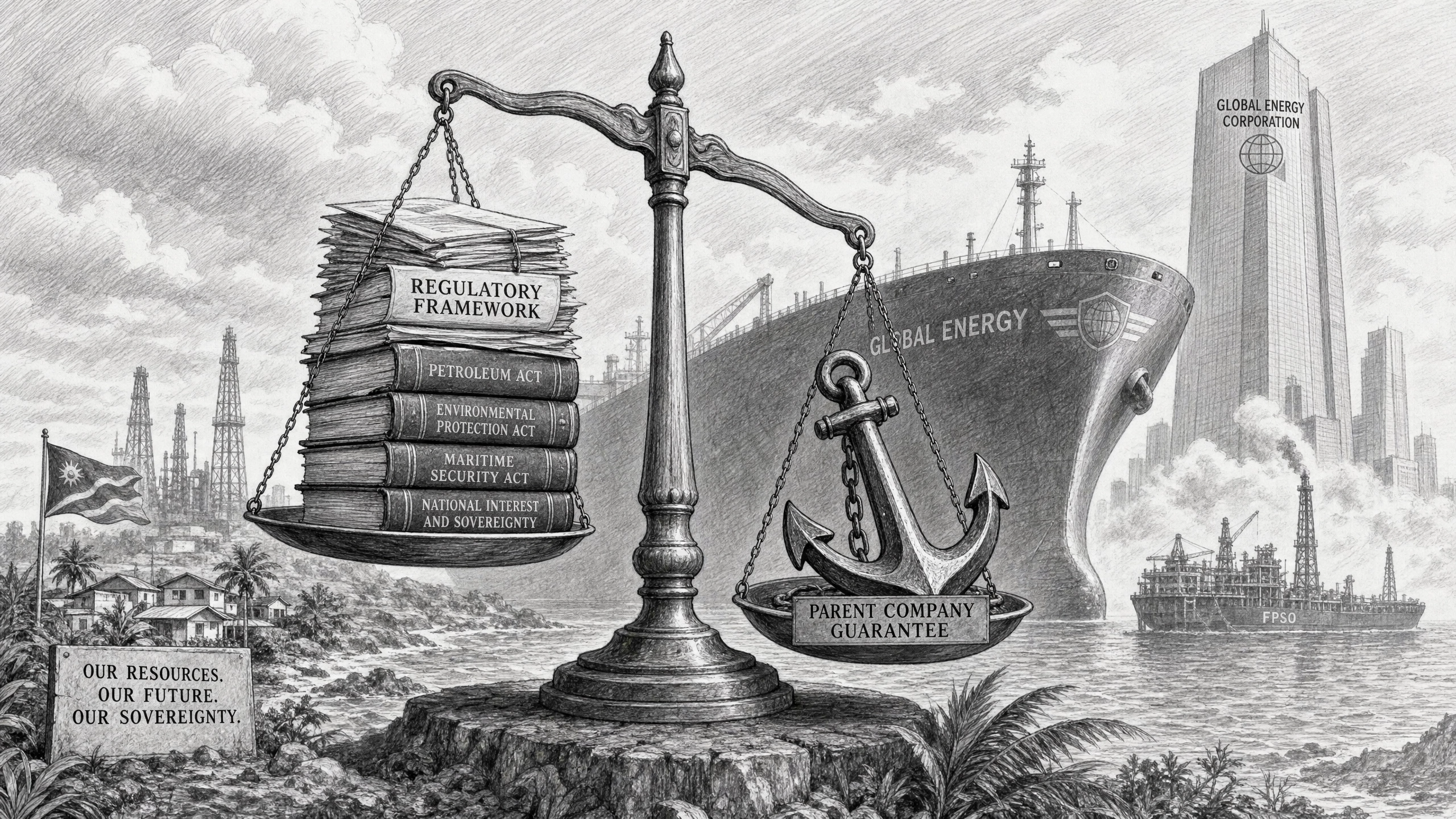
The argument I want to make is structural, and it begins with a single observation that none of the existing contributions has put plainly. The parent company guarantee is not one financial assurance mechanism among several. It is the only instrument in the entire architecture that reaches the balance sheet of ExxonMobil Corporation itself. The Petroleum Activities Act regulates EMGL. The 2025 Oil Pollution Act regulates EMGL. The strengthened EPA permits, with their nine-day capping-stack obligations and their carbon-charge provisions and their NEBA and SIMA requirements, regulate EMGL. The insurance policies and indemnification clauses run from EMGL. Every layer of the framework that Mr. Bhagwandin enumerates, and every safeguard that Mr. Gravesande celebrates as adequate by international standards, operates on the same asset-light operating subsidiary. EMGL has few local assets, as Mr. Gravesande himself concedes, and under the terms of the Production Sharing Agreement its fixed and movable assets are designed to revert to the Government of Guyana at the conclusion of the contract — a structure that further reinforces, rather than relieves, the parent’s strategic distance from operational liability. A subsidiary structured to be judgment-proof against catastrophic liability is not an accident of corporate housekeeping. It is a deliberate legal architecture, common across the industry, designed precisely to ring-fence the parent from the liabilities of the operation. The PCG is the one instrument that pierces that veil. It is not interchangeable with the rest. It is the rest’s only backstop.

It is the only veil-piercer in the architecture. Instruments of that kind do not have substitutes.
If that observation is granted, then the central question is not whether the framework is materially stronger than its predecessor, which Mr. Bhagwandin demonstrates persuasively, but whether it is materially adequate to the magnitude of the risk it is meant to bear. These are different questions. A framework can be stronger than the one before it and still inadequate to the disaster it is meant to insure against. The improvement is real. The adequacy is not established.
Before turning to the arithmetic, the comparative claim at the heart of Mr. Gravesande’s primer deserves a closer look, because the inference it draws from international practice is the opposite of what the comparison would suggest. Unlimited parent company guarantees are not required in Norway, the United Kingdom, the United States, Brazil, Australia, or Trinidad and Tobago. This is factually correct. They are not required there because in those jurisdictions the parent is the permit holder. ExxonMobil operates under its own name in the United States. BP operated under its own name in the United Kingdom and bore the full weight of the Deepwater Horizon liability because there was no asset-light subsidiary to absorb it on its behalf. The instrument that protects the small state — the unlimited parent company guarantee — exists in Guyana, and is unusual in the comparator jurisdictions, for precisely the same structural reason: the subsidiary architecture that makes the PCG necessary here is the architecture those jurisdictions do not permit there. To cite the absence of the instrument in jurisdictions where the underlying corporate architecture is different is to argue that an umbrella is unusual on a sunny day. The rarity of the instrument is not evidence of its inappropriateness. It is evidence of how unusual the architecture is that requires it.
Consider the arithmetic. The Deepwater Horizon blowout at the Macondo prospect in the Gulf of Mexico, the most relevant analogue in the recent history of the industry, flowed for eighty-seven days and released approximately 4.9 million barrels of crude 5. British Petroleum’s direct exposure in fines, settlements, cleanup costs, and natural resource damages reached approximately sixty-five billion dollars by 2018 6. When factoring in the concurrent loss of market capitalization — which reached one hundred and five billion dollars in shareholder value destroyed — the total economic impact on the company exceeded one hundred and forty-five billion dollars 7. The distinction matters: the sixty-five billion represents what BP actually paid out of its treasury; the broader figure represents what the event cost the entity as a going concern. Neither figure was, or could have been, accurately estimated in advance. The current arrangement names two billion dollars in the permit as the parent company guarantee amount, alongside a six-hundred-million-dollar per-incident insurance policy. There is no statutory floor. The two-billion figure is, in its own terms, an estimate, and the Court of Appeal’s direction that the parties negotiate a specified sum calculated by a formula describes a formula that does not exist. There has never been a formula. The only honest method of estimating provision for an event of catastrophic scale is to look at the last catastrophe of catastrophic scale and to provision for at least its magnitude. The Court did not do this. The current arrangement does not do this either. A guarantee whose number is two billion against an exposure profile measurable in the tens or hundreds of billions is not financial assurance. It is a rounding error.

The figure of two billion dollars deserves a place in the public record, because it did not arrive by neutral actuarial analysis. According to Dr. Adams, the two-billion figure was the amount ExxonMobil itself proposed in 2019, accompanied by insurance documentation, when it first sought to substitute a capped instrument for the parent guarantee the EPA was then demanding 4. The regulator, under Dr. Adams’s leadership, rejected the proposal as inadequate. Six years later, the same figure has reappeared, this time as the number in the permit and as a reference point in the appellate ruling. A figure that the regulator rejected as too small has been quietly reanimated as the operative number. The negotiating history is not incidental. It is the story.
The everyday analogy that Mr. Gravesande’s primer offers — the parent co-signing for a child’s small business and risking ruin from an unlimited guarantee — has rhetorical force but is structurally inverted. It positions Exxon, one of the largest publicly traded oil companies in the world, as the vulnerable homeowner. It positions Guyana, with a GDP a small fraction of Exxon’s annual revenue, as the bank making the demand. The actual relationship is the precise opposite. ExxonMobil Corporation reported total revenues and other income of $332.2 billion for fiscal year 2025 8. Guyana’s nominal GDP in 2024, per the International Monetary Fund’s 2025 Article IV Consultation, was approximately $24.7 billion 9. The ratio is more than thirteen to one. The honest analogy is a multi-billion-dollar conglomerate creating a thinly-capitalized subsidiary to operate in a small town, and the town asking whether the parent will stand behind the consequences. In that framing, the request for a meaningful guarantee is not aggressive. It is elementary prudence.

The honest analogy is a multi-billion-dollar conglomerate creating a thinly-capitalized subsidiary to operate in a small town, and the town asking whether the parent will stand behind the consequences. In that framing, the request for a meaningful guarantee is not aggressive. It is elementary prudence.
The history of one operational requirement in the permit makes the direction of recent change visible. The capping stack — a fifty-to-one-hundred-ton piece of subsea equipment designed to seal a blown-out wellhead — was invented after the Macondo disaster, in direct response to a well that flowed for eighty-seven days because no such tool existed. When Stabroek operations were being permitted, Dr. Adams and his colleagues at the EPA pressed the operator on how quickly the equipment could be mobilized. The operator’s initial answer was twenty days. The regulator rejected that figure. Negotiations produced an agreed mobilization window of five days, with a binding requirement in the original Yellowtail permit that the operator submit a plan demonstrating capacity to reach three days within two years. The arithmetic of the original requirement was thus effectively three days, with five days as a transitional ceiling. The equipment was to be staged south of Trinidad, which was the only location from which the five-day window was logistically achievable. After the change of administration in 2020, that requirement was quietly amended. The three-day plan was removed. The five-day window was tripled to nine days. The point of recovering this history is not to relitigate the amendment. The point is that the regulator did not negotiate the architecture upward over time; the regulator negotiated it downward. Six extra days of an uncontrolled discharge is not an administrative detail. At the Macondo flow rate, six days is several hundred thousand barrels of additional oil in the water column. The framework that Mr. Bhagwandin describes as having been widened and deepened has, on this specific operational requirement, been measurably narrowed and weakened 4.

The regulator did not negotiate the architecture upward over time. The regulator negotiated it downward.
It is, moreover, elementary prudence that the academic literature now supports more thoroughly than the public debate has acknowledged. Zacharias and colleagues, in a paper published in the Journal of Marine Science and Engineering in early 2026, ran 47,500 probabilistic simulations of offshore spills in the adjacent Foz do Amazonas basin and found, with high confidence in the underlying drifter validation, a predominant northwestward transport toward the Guianas and the Lesser Antilles, with seasonal beaching probabilities along French Guiana and Brazilian Amapá exceeding fifty percent during the first four months of the year 10. The molecular forensics paper published in Environmental Science & Technology this year documented an empirical case in which oil from the 2019 Brazil spill was traced eight thousand five hundred kilometers along precisely this current system — South Equatorial to North Brazil to Guyana to Caribbean to Loop Current — before stranding on the coast of southeastern Florida two hundred and forty days after release 11. Stabroek’s own modeling, conducted by ERM and by Acorn International for each of the eight oil developments, agrees on the country list: Trinidad and Tobago first, then Grenada, St. Vincent and the Grenadines, Barbados, St. Lucia, Martinique, Dominica, Guadeloupe, Montserrat, Antigua and Barbuda, St. Kitts and Nevis, St. Barthélemy, Saba, the U.S. Virgin Islands, and under unmitigated scenarios Aruba, Bonaire, Curaçao, Venezuela, the Dominican Republic, Haiti, and Jamaica. The probability of condensate stranding on the coast of Tobago in the wet season, per the Longtail Environmental Impact Assessment, is sixty to seventy percent (Longtail EIA, 2026) 12. Arrival can occur within five days. The Tobago oil spill of February 2024, caused by a barge under tow from Panama to Guyana, demonstrated in real time how rapidly material released in this oceanographic regime crosses jurisdictional boundaries 13 14. Within nine days the slick had reached Venezuelan waters. Within three weeks it had affected Bonaire 15. The vessel was unmanned and untraceable. The fingerprinting came later.

The Institute for Energy Economics and Financial Analysis, in work by Tom Sanzillo, did the arithmetic that the EIAs were not required to do. IEEFA reviewed the value of the economies of several neighboring islands and coastal countries identified in the environmental impact assessment in the path of a plume and found more than $140 billion in economic activity at risk 16. That figure is an estimate of annual economic activity in the affected territories, not a properly modeled loss function — the latter has never been performed, because the Environmental Protection Agency did not require it. Mr. Bhagwandin will rightly observe that an aggregate exposure figure is not the same as an expected loss figure, and he would be correct. The point, however, is not that the figure is precise. The point is that the order of magnitude is fundamentally incompatible with a two-billion-dollar guarantee. We are insuring against a risk whose lower-bound aggregate exposure is seventy times the upper-bound figure of the assurance.

I want to be careful at this point about what I am and am not claiming. I am not claiming that the framework Mr. Bhagwandin describes is worthless. I am not claiming that the engineering progress Mr. Gravesande inventories is unimportant. The 2025 Oil Pollution Act is a legislative achievement, though Dr. Adams reads it more sceptically than I have — as a measure designed in part to substitute the broader framework for the specific PCG protection Justice Kissoon’s ruling had clarified — and the closeness of the parliamentary vote (33–32) suggests the country was not of one mind about it. The nine-day capping-stack mobilization is an improvement over the absence of such a requirement, though as just noted it is a regression from the three-day arrangement it replaced. The polluter-pays principle, codified and enforceable, is a real legal advance. The indemnification clauses in the Petroleum Activities Act, the ministerial powers under Sections 73 to 76, the decommissioning fund in Part IX — these are not nothing. The narrative that the present government has been wholly captured by the operator is a narrative that does not fully survive contact with the statutory record. The architecture has been built. Whether it is materially stronger on every dimension than it was when production began in 2019 is a closer question than the public debate has acknowledged, but stronger on most dimensions it is.
What I am claiming is that the architecture, however strong, regulates the body of the distribution and not the tail. It reduces the probability of catastrophic events. It does not provision for their consequences when prevention fails. It improves the regulator’s ability to compel performance in the ordinary case. It does not address the structural asymmetry between a small state and a global major when performance must be compelled against a counterparty whose annual revenues exceed the regulator’s national budget by an order of magnitude 8 9. The architecture also leaves a related question unresolved. ExxonMobil’s Stabroek operations involve hundreds of subcontractors operating under EMGL. In the United States system, when a contractor hires subcontractors, the contractor bears full liability for the subcontractors’ actions, and subcontractor selection is subject to regulatory approval. In Guyana, EMGL bears the liability — and EMGL is the asset-light subsidiary whose insolvency the framework cannot survive. A spill caused by a subcontractor’s failure flows up the chain only as far as the entity that cannot pay it. The Peruvian government, after a twelve-thousand-barrel Repsol spill in 2022, was reduced to imposing a travel ban on company executives to keep them within reach of the courts 17. The Nigerian claimants suing Shell over Niger Delta spills spent two decades in British litigation establishing a principle the Guyanese permit was supposed to settle by contract 18. These are not theoretical concerns. They are the operating record of the industry. The parent company guarantee is the one instrument in the framework that pre-positions the financial backstop before the moment of enforcement crisis, against the one entity capable of paying. Capping it, or leaving its ceiling to be negotiated after the disaster, is to remove the only instrument that does not depend on after-the-fact enforcement against an asymmetric counterparty.

Dr. Adams’s textual reading of the permit is, in this light, more than a lawyer’s argument about wording. Clauses 14.1 and 14.10 of the EPA permit commit the permit holder to all costs associated with a spill, and require the parent and co-venturers to furnish legally binding agreements undertaking to provide adequate financial resources to meet those obligations if EMGL fails to do so. “All” is a quantifier without ceiling. The conceptual content of unlimited liability is present in the permit even when the orthographic form of the word is not. The Court of Appeal’s reasoning that liability for pollution damages does not automatically require unlimited financial assurance silently elides the operative phrase. Liability for all costs is precisely what unlimited financial assurance is supposed to secure. Dr. Adams is not arguing that judges should invent obligations from the air. He is arguing that they should not subtract obligations the document already plainly contains. The man who wrote the policy is in an unusually strong position to know what the policy was meant to say.
If the textual argument is right — and I think it is — then the public conversation has been miscast. We are not debating whether to add a new protection. We are debating whether the appellate court has the authority to remove a protection the permit already contained. That is a different question, and it is a question on which the Caribbean Court of Justice has standing to weigh in. The CCJ has been our jurisdiction’s instrument for constitutional clarification at the most difficult moments. It would not be the worst use of that instrument to ask whether all costs in a permit means what the words say, or whether it means whatever the subsidiary can pay before declaring insolvency. The petitioners — Mr. Frederick Collins of Transparency Institute Guyana Inc. and Mr. Godfrey Whyte — have indicated their intention to file. Whatever the CCJ decides, the country will be better served by the constitutional clarification than by the appellate ruling left to stand alone.
But the deeper question is not for the courts. It is for the Parliament, and through the Parliament for the public on whose authority the Parliament acts. If the existing framework can be read against its plain words, then the words must be made unmistakable. The path forward is not litigation. It is legislation. A clear statutory regime specifying the form, amount, duration, and enforcement architecture of financial assurance for offshore operations is overdue. That regime should be informed by international practice — by the cautionary cases of Nigeria, Peru, and Mexico, by the institutional examples of Norway, the United Kingdom, and the United States — but it should not be constrained by the convenience of operators or the comfort of the regulated. Guyana’s situation is not Norway’s situation. Our protections need not, and should not, be identical to theirs.
The constitutional argument for this legislative action is, I think, stronger than is generally appreciated. Articles 40, 39, and 13 of the Guyanese Constitution articulate, respectively, the right to be free from want, the duty of environmental protection, and the obligation to consider future generations in the management of the country’s resources 19. I have written elsewhere, in the Free From Want essay published earlier this year, that these articles do not function as decorative preambles 20. They are positive obligations of the state, and they constrain what a regulator or a court may treat as adequate when the catastrophe in question would affect not only present citizens but the inheritance of those not yet born. A two-billion-dollar guarantee against a one-hundred-and-forty-five-billion-dollar exposure is not a policy choice within the discretionary space the constitution leaves the executive. It is a constitutional failure of the duty to provide for those who will inherit the country we are presently building.
The Caribbean dimension of the question makes the constitutional failure regional as well as national. The waters that carry the Stabroek crude carry it toward jurisdictions that have no formal seat at the table when Guyana’s regulator negotiates with the operator. The Tobago fisherman whose family business will be destroyed by a slick that arrived from the southwest in five days has no standing in the EPA’s permit-condition discussions. The Grenadian hotelier whose tourism economy will collapse for a decade has no voice in the appellate court’s reading of clauses 14.1 and 14.10. CARICOM exists, on paper, to coordinate precisely such transboundary questions. CARICOM has not been a meaningful presence in the public deliberation over the architecture of liability for the Stabroek operation. That absence is one of the things that the next Parliament — and the next generation of Caribbean diplomats — must remedy. Sovereignty over what enters and leaves a country’s waters is precisely the kind of sovereignty that small island states pooled CARICOM to defend.
Sixty years ago this month, the colonial flag came down at the Public Buildings and the green and gold and red rose for the first time over an independent Guyana. The founding generation, with whatever its limitations, understood that the inheritance they were claiming for their successors was not principally the land itself. The land had always been there. The inheritance was the institutional capacity to set the terms on which the land would be used. Independence was not the achievement. Independence was the precondition for the achievement. What we did with it — whether we built courts that could be relied upon to read documents as they were written, regulators that could be relied upon to enforce what they had negotiated, Parliaments that could be relied upon to legislate against the inadequacies of the moment — that was the achievement, and that achievement is still in progress.
The Court of Appeal has clarified what the current permit says. The harder work, of saying what the next permit must say and what the present permit was meant to say all along, belongs to us. It belongs to the petitioners who will, if they choose, take this question to the Caribbean Court of Justice. It belongs to the parliamentarians, of whatever party, who will, if they choose, introduce the statutory amendments that make the words of the permits unmistakable in the future. It belongs to the regulators, of whatever administration, who will, if they choose, refuse to renegotiate downward what their predecessors negotiated upward. It belongs to the public, of whatever generation, that will, if it chooses, hold the institutions to the standard the constitution sets rather than the standard the operator prefers.
The price of sovereignty is not paid once, at the lowering of the colonial flag. It is paid continuously, in every document signed, every clause interpreted, every ceiling negotiated, every standard set or abandoned. Sixty years is long enough to know what the price has been. It is also long enough to decide that the country can afford it.
The price of sovereignty is not paid once, at the lowering of the colonial flag.
It is paid continuously, in every document signed, every clause interpreted, every ceiling negotiated.
Terrence Richard Blackman, Ph.D. Terrence Richard Blackman, Ph.D. is Founder and Publisher of the Guyana Business Journal and Professor and Chair of the Department of Mathematics at Medgar Evers College, City University of New York. A former Dr. Martin Luther King Jr. Visiting Professor at MIT and Member of the Institute for Advanced Study at Princeton, he is a regular contributor on issues of governance and development in Guyana. His family has lived in Guyana for seven generations.
References
- Department of Public Information, Guyana. “Government of Guyana to celebrate 60th Independence Anniversary.” April 10, 2026. dpi.gov.gy
- Demerara Waves. “Court of Appeal overturns High Court’s ruling on ExxonMobil, EPA’s financial guarantees.” May 7, 2026. demerarawaves.com
- Kaieteur News. “Appeal Court overturns Justice Kissoon’s ruling on unlimited parent company guarantee for oil spill.” May 8, 2026. kaieteurnewsonline.com
- Adams, V. “Appeal Court confused unlimited parent company guarantee with oil spill insurance.” Kaieteur News, May 13, 2026; additional historical context on the capping-stack permit history and the 2019 financial-assurance negotiation provided by Dr. Adams in his capacity as the originating EPA regulator. kaieteurnewsonline.com
- NOAA Fisheries. “Deepwater Horizon 10 Years Later: 10 Questions.” April 13, 2020. fisheries.noaa.gov
- Reuters. “BP Deepwater Horizon costs balloon to $65 billion.” January 16, 2018. reuters.com
- McGuire, W. “Penalties for industrial accidents: The impact of the Deepwater Horizon oil spill on BP.” National Library of Medicine / PMC. 2022. nih.gov
- ExxonMobil Corporation. “ExxonMobil Announces 2025 Results.” January 30, 2026. exxonmobil.com
- International Monetary Fund. “Guyana: 2025 Article IV Consultation — Staff Report.” May 7, 2025. imf.org
- Zacharias, D. C., et al. “Oil Spill Trajectories and Beaching Risk in Brazil’s New Offshore Frontier.” Journal of Marine Science and Engineering. 2026. mdpi.com
- James, B. D., et al. “Long-Range Transport of Oil by Marine Plastic Debris: Evidence from an 8500 km Journey.” Environmental Science & Technology. 2026. acs.org
- ExxonMobil Guyana Limited. “Longtail Development Project Environmental Impact Assessment.” Environmental Protection Agency, Guyana. 2025. epaguyana.org
- Bellingcat. “How a Leaking Barge Became an Oil Spill Disaster Off the Tobago Coast.” February 20, 2024. bellingcat.com
- ITOPF. “GULFSTREAM, Trinidad and Tobago, 2024 — Case Study.” 2024. itopf.org
- BBC News. “Oil spill spreads across Caribbean from Tobago to Bonaire.” February 27, 2024. bbc.com
- Kaieteur News. “Countries within pathway of potential oil spill from Guyana have US$140B of economic activity at risk.” May 28, 2023. kaieteurnewsonline.com
- Associated Press. “Peru bans Repsol execs from leaving country after oil spill.” January 28, 2022. apnews.com
- Amnesty International. “Global: Nigerian residents take Shell to UK High court following 10-year fight for justice.” February 10, 2025. amnesty.org
- Constitute Project. “Guyana 1980 (rev. 2016).” constituteproject.org
- Blackman, T. R. “Free From Want: The Constitutional Argument the Oil Era Demands.” Guyana Business Journal. April 30, 2026. guyanabusinessjournal.com
Supported By
We are grateful for the partnership and support of individuals and organisations committed to advancing Guyanese and Caribbean development and human capital investment.
Metallica Commodities Corporation
For over two decades, Metallica Commodities Corporation has connected producers and consumers of non-ferrous metals across the Americas, Africa, and Asia. Headquartered in New York with offices in Peru, Canada, Tanzania, and Guyana, MCC brings institutional expertise and global reach to resource-rich markets, with a deep understanding that sound governance determines whether natural wealth generates broad-based prosperity.
The GBJ Sunday Essay is supported by MCC and is not written on its behalf. The views expressed are those of the author.
METALLICACC.COM ↗Pebble Stream™
Pebble Stream™ is a US-based cloud-computing company that transforms complex Excel models into secure, enterprise-scale cloud applications through patented “pebblization” technology. Founded by Bediako George and backed by over 25 years of financial and accounting expertise, the company processes one billion tax calculations monthly and counts a Big Four accounting firm among its clients. For Guyanese and Caribbean businesses, Pebble Stream offers the scalability a rapidly growing economy demands.
This GBJ article is sponsored by Pebble Stream™ and is not written on its behalf. The views expressed are those of the author.
PEBBLESTREAM.COM ↗Caribbean International Shipping Services
Ship with Confidence: Your Trusted Logistics Partner
For over 30 years, Caribbean International Shipping Services has been the trusted choice for businesses and individuals shipping from the Southeast USA to the Caribbean and Latin America. Specialising in household relocations, commercial goods, and online order consolidation, their experienced team delivers weekly ocean and air freight services to over 20 destinations — reliably and stress-free.
📞 770-322-3111
CARIBSHIPATL.COM ↗MCCGUSA
Management Consulting, Project Management, Real Estate
Founded in 1990, MCCGUSA (formerly Management Consulting and Controls Group) is a premier consulting and project management firm serving clients across the United States and internationally. A Certified MBE, DBE & Hub Zone Business, MCCGUSA provides management consulting, project management, financial advisory, and real estate services — with national affiliates and international representation in the Caribbean and Latin America.
📞 212-269-6126
MCCGUSA.COM ↗Individual Supporters
Courtney Allen | All Te Networks | Corine Locke | Tony Harris | Roderick Alsopp | Dr. Michelle Luard | Clarence Bone
🇬🇾 Please support the Guyana Business Journal & Magazine today
