Webinars
A Guyanese-American clinical psychologist offers a psychological companion to the legal diagnosis of inheritance gridlock.
By Terrence Richard Blackman, Ph.D. · May 18, 2026
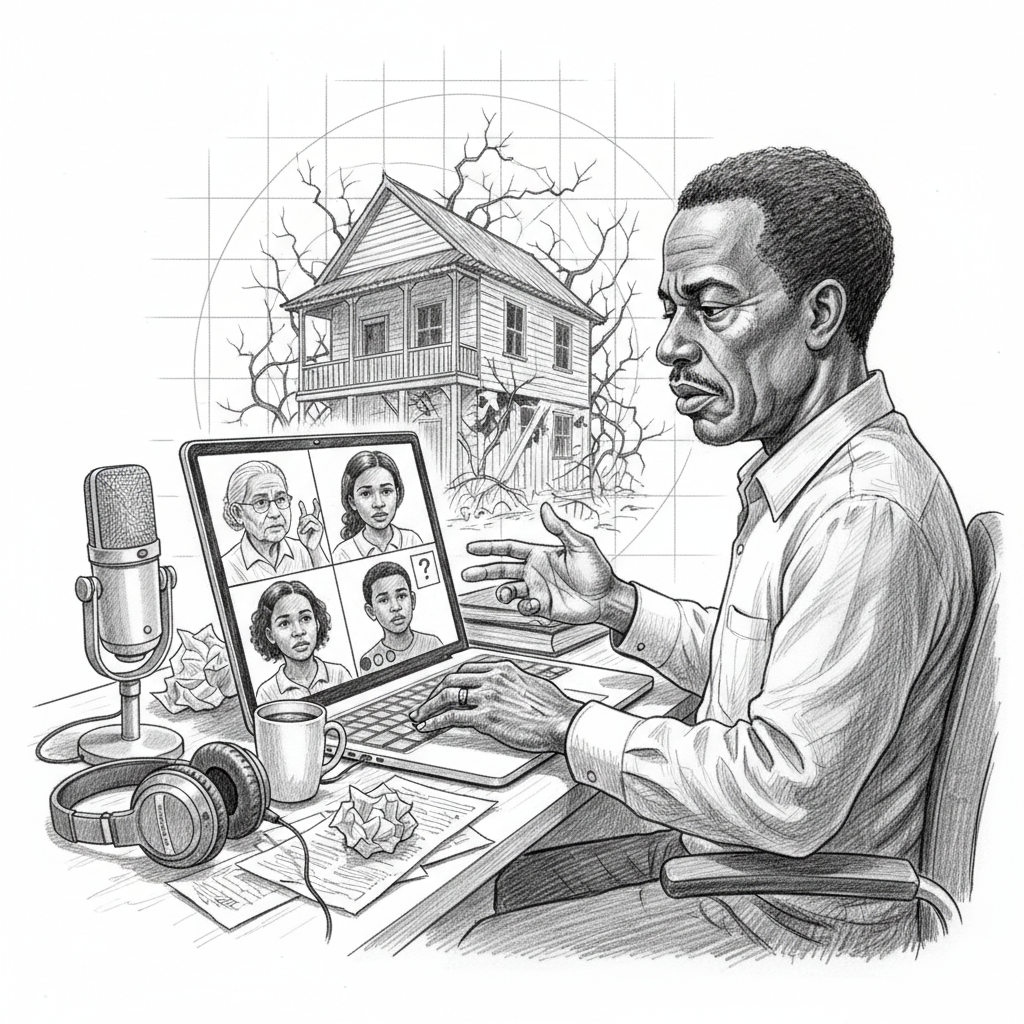
A few weeks ago in this space, attorney Nigel Hughes laid out the legal anatomy of the inheritance gridlock — the systematic destruction of generational wealth in Guyanese families through intestacy, fractional undivided shares, and the slow administrative paralysis that consumes a family home one generation at a time. His diagnosis was clean. His prescriptions — monetize, corporatize, plan, communicate — were sound. Yet as I tried to write that conversation up, I kept returning to something Hughes, as a lawyer, could only gesture toward. He spoke of “family-owned properties with various issues,” and we all know what that phrase is doing. It is doing the work of not naming the kitchen-table arguments. The siblings who have not spoken in fifteen years. The mother who will not write a will because, in her mind, to write one is to invite her own death.
Avoidance as a Symptom, Not a Failing
Dr. Caldeira’s central clinical insight reorganized everything that followed. The avoidance that animates the inheritance gridlock — the refusal to write the will, the decades of silence around the family property, the diaspora child who lives a successful life in Brooklyn but leaves the Guyana house to rot — is not a character flaw, and it is not idiosyncrasy. It is a recognizable symptom of trauma.
Persistent avoidance, she explained, is a hallmark feature of post-traumatic stress, and Guyanese families carry a great deal of trauma in their inheritance — the long shadow of enslavement and indentureship, the disruptions of colonial rule and migration, layered atop the individual interpersonal traumas any family also accumulates over its lifespan. We may keep functioning. We may earn the degrees, build the careers, send the remittances. But in the background, the avoidance keeps doing its work, and it shows up most visibly precisely where the stakes are highest — around money, debt, and dying. The three hardest conversations.
When Raymond McMillan, watching live, asked the question I think many in the audience were thinking — how can people who have built rational, successful lives abroad leave Guyanese assets fallow for decades? — Dr. Caldeira pushed back on the premise. The behavior is not rational; the behavior only looks rational on paper. Underneath the avoidance there is almost always an emotional reason, and very often that reason is something about Guyana itself that the person has not gone back to face.
Land as Triumph, Not Only Trauma
One of the most important refinements Dr. Caldeira offered came when I asked about the symbolic weight of land. I had assumed the weight was largely a weight of trauma — land as the inheritance of bondage and dispossession. She corrected me gently. For many Guyanese families, the land is also tied to a profound sense of triumph. To own a piece of ground was to no longer be ground. The first generation to acquire a home, a plot, a deed, did so against the full weight of history. When we ask the next generation to sell or restructure that property, we are asking them to perform a psychological transaction whose terms most of us have never named.
This is why families freeze. Not because they are foolish, and not because they do not understand the math. But because the math is asking them to liquidate something whose value was never economic to begin with.
A Path Forward: From Trauma to Tools
Dr. Caldeira did not leave us in the diagnosis. The second half of the hour was as practical as the first half was clinical, and four ideas in particular deserve to travel beyond the webinar.
First, listen to understand. Guyanese culture rewards debate; we love to challenge. But the family conversation about inheritance is not a debate to be won. Dr. Caldeira offered a simple discipline: when a parent or sibling says something difficult, repeat it back. *Is this what you said? Tell me more.* That small skill, practiced often enough to become natural, may be the single most useful tool a family can deploy.
Second, solve the solvable problems. Most families approaching an inheritance dispute try to settle every grievance at once — birth order, gender, who did the work, who left, who stayed. Dr. Caldeira urged a different approach. Identify what everyone can agree on. Almost every Guyanese family can agree that the original work of the parent or grandparent who acquired the asset deserves to be honored, and that the family deserves to benefit from that work. Build outward from that one shared point. Leave the unsolvable conflicts for another conversation, or for another generation.
Third, start with regular family meetings. The pandemic taught many Guyanese families to gather on Zoom on a Sunday afternoon. Dr. Caldeira’s recommendation was to keep that habit and use it. Half an hour. Light agenda. No heavy decisions in the first sitting. The goal is not to resolve the inheritance question in a single meeting; the goal is to make the family a body capable of having the conversation when the time comes.
Fourth, separate the emotional attachment from the business transaction. This may be the deepest practical insight Dr. Caldeira offered, and the one that ties her psychological frame back to the legal-economic frame Nigel Hughes laid out. The attachment to land and home is real, and it deserves to be honored. But it is not the same conversation as the legal and economic transaction at hand. Families that try to settle both in a single breath usually settle neither. The work, as Dr. Caldeira put it, is to do both simultaneously but distinctly — to hold the emotional in one register and the transactional in another, and to let strong family connections and productive conversations carry both forward. The two do not cancel each other. Properly held, they require each other.
For families already in serious conflict, professional support matters — and Guyana now has more of it than a generation ago: a mental health unit at the Ministry of Health, clinical psychology training at the University of Guyana, and an updated Mental Health Act, championed by our fellow Queen’s College classmate Dr. Frank Anthony, that finally retired the colonial-era statute criminalizing attempted suicide. Practitioners in private practice are oversubscribed, which is itself, paradoxically, evidence of progress.
And for those of us in the diaspora, where access to clinical resources is often greater, there is a particular contribution to be made. A family member abroad can consult a family therapist not only for their own benefit but as a guide and resource for the family — someone whose professional insight travels back across the countries and time zones the family itself spans. In families that have been stretched across continents for decades, that bridge function is its own kind of repair.
The Two Truths We Must Hold Together
The challenge, perhaps, is learning to hold two truths together at once.
The family home is both memory and instrument. The family itself is both wound and resource. The history we inherit is both burden and gift. Dr. Caldeira asked us to add one more pair to that list: we can embrace, with our full intellectual force, the academic and economic intelligences that have served us well, and at the same time we can embrace the emotional intelligence we have too often left untrained. These are not competing investments. They are the same investment.
Repair, she insisted, is possible. The only condition under which it is not possible is the presence of violence or its threat — there she was unflinching. Everywhere else, repair is on the table.
The inheritance gridlock will not be unlocked by lawyers alone, nor by economists alone. It will be unlocked, family by family, by people willing to sit at a kitchen table and say to one another the things our parents and grandparents could not bring themselves to say. The legal instruments will follow. The wealth will follow. But first, the conversation.
“Repair is possible. We have all the resources available to us now. We should access them.”
Terrence Richard Blackman, Ph.D. is Professor and Chair of the Department of Mathematics at Medgar Evers College, City University of New York, and Founder/Publisher of the Guyana Business Journal. He hosts the *Transforming Guyana* webinar series, through which this conversation with Dr. Nathilee Caldeira was originally broadcast.
Supported By
We are grateful for the partnership and support of individuals and organizations committed to advancing Guyanese and Caribbean development and human capital investment.
Metallica Commodities Corporation
For over two decades, Metallica Commodities Corporation has connected producers and consumers of non-ferrous metals across the Americas, Africa, and Asia. Headquartered in New York with offices in Peru, Canada, Tanzania, and Guyana, MCC brings institutional expertise and global reach to resource-rich markets, with a deep understanding that sound governance determines whether natural wealth generates broad-based prosperity.
The GBJ Sunday Essay is supported by MCC and is not written on its behalf. The views expressed are those of the author.
METALLICACC.COM ↗Pebble Stream™
Pebble Stream™ is a US-based cloud-computing company that transforms complex Excel models into secure, enterprise-scale cloud applications through patented “pebblization” technology. Founded by Bediako George and backed by over 25 years of financial and accounting expertise, the company processes one billion tax calculations monthly and counts a Big Four accounting firm among its clients. For Guyanese and Caribbean businesses, Pebble Stream offers the scalability a rapidly growing economy demands.
This GBJ article is sponsored by Pebble Stream™ and is not written on its behalf. The views expressed are those of the author.
PEBBLESTREAM.COM ↗Caribbean International Shipping Services
Ship with Confidence: Your Trusted Logistics Partner
For over 30 years, Caribbean International Shipping Services has been the trusted choice for businesses and individuals shipping from the Southeast USA to the Caribbean and Latin America. Specialising in household relocations, commercial goods, and online order consolidation, their experienced team delivers weekly ocean and air freight services to over 20 destinations — reliably and stress-free.
📞 770-322-3111
CARIBSHIPATL.COM ↗MCCGUSA
Management Consulting, Project Management, Real Estate
Founded in 1990, MCCGUSA (formerly Management Consulting and Controls Group) is a premier consulting and project management firm serving clients across the United States and internationally. A Certified MBE, DBE & Hub Zone Business, MCCGUSA provides management consulting, project management, financial advisory, and real estate services — with national affiliates and international representation in the Caribbean and Latin America.
📞 212-269-6126
MCCGUSA.COM ↗Individual Supporters
Courtney Allen | All Te Networks | Corine Locke | Tony Harris | Roderick Alsopp | Dr. Michelle Luard
🇬🇾 Please support the Guyana Business Journal & Magazine today
