
Sunday Essay · Diaspora Policy & Governance
On President Ali’s Invitation, Ireland’s Road Map, and the Architecture Guyana Has Not Yet Built
By Terrence Richard Blackman, Ph.D. · May 8, 2026

In early 2026, President Irfaan Ali addressed a diaspora audience following the presentation of Budget 2026 and said something that deserves to be taken seriously — and then examined seriously, which is a different thing. “You have many Guyanese over there who have worked all their life,” he said, “and they have the certification in elderly care. Here’s the opportunity to come here now — the government will even co-invest with you.” He expanded on this theme in May 2026 during a keynote address at Rice University’s Baker Institute for Public Policy in Houston, Texas, noting that returning professionals should view the move as a short-term sacrifice for long-term gain, and that the pace at which a returning professional’s income and opportunities will develop in Guyana will far outstrip what they might experience abroad.
43.8%
Guyana GDP growth in 2024 — among the fastest in the world (World Bank)
36.4%
Share of Guyana’s native-born population living abroad — the world’s largest diaspora by percentage (Forbes/UN, 2022)
€17.5M
Ireland’s annual diaspora budget (2026) — the highest ever allocated
~$50M
Guyana’s approximate oil revenue in a single week (2024) — the fiscal capacity to fund a diaspora strategy is not in question
These are generous sentences. They are also, in their generosity, the full extent of what the Government of Guyana has offered the diaspora in terms of a framework for return. A promise to co-invest. An assurance that Guyana is now “a safe, investable and opportunity-rich nation.” A declaration that Budget 2026 removes long-standing barriers to ownership and offers equal access to investment, tax relief, and government co-financing.
These are not nothing. The investments in regional hospitals — in Bartica, in Lethem, in Moruca, in New Amsterdam — are real. The security allocations are real. The healthcare workforce expansion is real. The GBJ’s commitment to structural analysis requires that we acknowledge what the structure has actually produced.

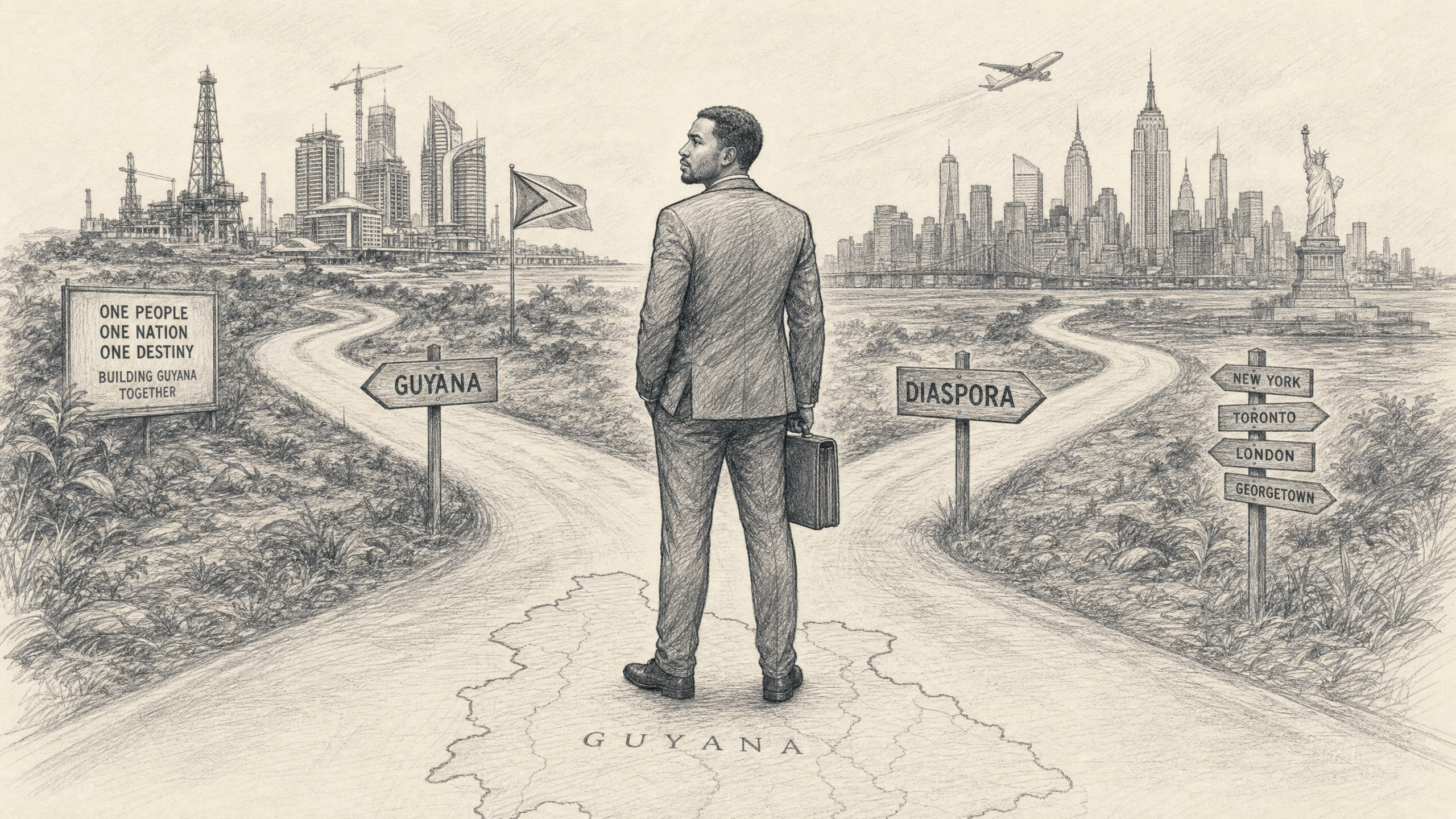
But a co-investment offer is not a diaspora strategy. An invitation is not an architecture. And the distance between what President Ali has articulated this year and what Ireland has spent twenty years building is not a distance of resources or intent. It is a distance of institutional seriousness. That distance is the subject of this essay.
I. The Invitation Without the Infrastructure
When President Ali says the government will co-invest with returning diasporans, he is making an economic proposition addressed to people who have capital, skills, and certifications. It says: bring what you have built abroad, and we will meet you with resources. That proposition has a fundamental problem: it begins at the wrong end of the relationship.
It assumes that the diaspora is ready to return — that the decision has been made, the trust established, the institutional conditions in place to receive and protect what the returning professional brings. It assumes, in other words, that the work of rebuilding the relationship between the Guyanese state and its scattered people has already been done, and that what remains is simply the economic transaction. It has not been done. The relationship has not been rebuilt. The trust has not been re-established. And no amount of co-investment offers will substitute for the sustained, structured, funded engagement that a serious diaspora strategy requires — engagement that begins not with an economic proposition but with a human one: we know you are out there, we have been thinking about what you need and what you could contribute, and we have built the institutions that make the relationship mutual.

The historical context of this displacement is critical. World Bank data reveals consistently negative net migration for Guyana since 1960, with a dramatic acceleration during the Burnham era, peaking at nearly 20,000 emigrants per five-year period in the late 1980s.[5] This sustained exodus has resulted in Guyana having the world’s largest diaspora relative to its native-born population, standing at 36.4 percent as of 2022.[6] Approximately 323,052 Guyanese live in the United States, 84,275 in Canada, and 40,872 in the United Kingdom — a total diaspora estimated at over 430,000 persons, against a resident population of roughly 800,000.
Diaspora policy is not primarily about migration. It is about whether the state possesses the institutional sophistication to organise distributed human capital across borders. That is a much more ambitious enterprise than the usual “come home and invest” discourse.

Ireland’s current diaspora budget stands at seventeen and a half million euros annually — the highest ever allocated.[2] The Emigrant Support Programme has provided over two hundred and sixty-five million euros in grants to community organisations in fifty-three countries since 2004.[3] None of this is charity. Every euro is an investment in the proposition that the Irish abroad are an extension of the national family, carrying an obligation of care and a legitimate claim on national identity regardless of what passport they now hold.

Guyana’s oil revenues in 2024 reached approximately 2.6 billion US dollars, translating to roughly 50 million US dollars per week.[4] The fiscal capacity to build an equivalent programme — scaled appropriately for the Guyanese diaspora — is not in question. What is in question is whether the government understands what such a programme would actually require.
II. What the Ireland Document Teaches
Ireland’s Diaspora Strategy 2026–2030 is organised around five threads. Each, held against the Guyanese reality, functions not as a template but as a diagnostic.
Wellbeing and Advocacy. Ireland commits to supporting the most vulnerable members of its diaspora through a network of funded community organisations, welfare services, and legal advocacy structures in every major city where Irish emigrants have settled. When President Ali addresses the diaspora, he speaks to those who are ready and able to return — those with capital, certifications, and the flexibility to relocate. The Guyanese who left in the Burnham years are now elderly, in some cases isolated, carrying histories of displacement that the Guyanese state has never acknowledged or addressed. Ireland asks what they need, and then funds the answer.
Identity and Culture. Ireland invests in sport, language, storytelling, and cultural programming in Irish communities worldwide, recognising that cultural continuity is the connective tissue of diaspora engagement. The Guyanese diaspora has cultural assets at least as rich — cricket networks, religious communities, literary and musical traditions, the storytelling inheritance of Afro-Guyanese and Indo-Guyanese communities that survives in church halls in Brooklyn and community centres in Brixton. These are almost entirely self-sustaining, receiving nothing from the Guyanese state, and as the first generation ages, the second generation’s ties thin — not through hostility but through institutional silence.
Connection and Contribution. The GBJ has been publishing, over the past several weeks, essays on Clarence Trotz and Keith Wilson — on the classroom in Georgetown that produced a man who built NASA’s laser communication infrastructure, on the chain of causation from a physics lesson in 1963 to a beam travelling three hundred and seven million miles through space. Dozens of Keith Wilsons have written in since — Guyanese professionals of distinction, working in aerospace and medicine and law and architecture and finance, carrying decades of expertise that Guyana has never formally acknowledged and never systematically attempted to engage. Ireland would have found Keith Wilson. It would have put him in a directory, connected him to STEM Guyana or the University of Guyana’s physics department, and created a structured pathway for contribution that did not require him to build the bridge from both ends alone.

Historically, the diaspora’s contribution has been primarily financial. Remittances peaked at 24.4 percent of Guyana’s GDP in 2005.[7] While the absolute value remains significant at over 500 million US dollars annually, the percentage has fallen to 3.2 percent in 2023 as oil revenues inflate the overall GDP. The challenge now is to transition from relying on financial remittances to harnessing intellectual and professional capital.
Departure and Return. Ireland’s return barriers — housing prices, school waitlists, cost-of-living concerns — are the barriers of a successful small economy. They are tractable. They respond to policy. Guyana’s return barriers are different in kind. The meritocracy problem: whether professional excellence will be rewarded or subverted by political loyalty networks. The institutional independence problem: whether universities and civil service are places where a person’s work is protected from political interference. The rule of law problem: whether contracts will be honoured and disputes resolved by independent courts. These are not barriers a co-investment offer can dissolve. They are structural conditions requiring sustained governance reform — and until they are addressed, the diaspora professional with genuine options will continue to calculate, correctly, that return carries risks the President’s invitation does not name.


GBJ Data Note: Ireland’s CPI score is 76/100; Guyana’s is 40/100. The 36-point gap is not merely a reputational problem — it is the single most powerful deterrent to the return of highly skilled diaspora professionals who have built careers in rule-of-law environments.
Sharing Our Experience. Ireland commits to sharing its twenty years of institutional learning with nations that are building their own diaspora engagement frameworks. The Irish Abroad Unit of the Department of Foreign Affairs and Trade has said, in writing, that this knowledge transfer is part of the strategy. This is a direct and concrete opening for Guyana. The expertise exists. The offer has been made. What is required is the decision to pursue it.
II-B. Why Guyana Has Not Built This — And Why That Explanation Is Not an Excuse
A balanced reading of this argument requires acknowledging something the Ireland comparison can obscure if we are not careful: Ireland and Guyana did not arrive at this moment from equivalent starting points, and the absence of a Guyanese diaspora strategy is not simply a failure of political will in the abstract. It has specific historical, demographic, and structural explanations — and naming them honestly does not weaken the argument for building the strategy. It clarifies what building it would actually require.
Ireland’s diaspora relationship, for all its complexity, has always been organised around a relatively coherent national identity. The Irish abroad share a cultural and linguistic inheritance, a common historical narrative of displacement and resilience, and a relationship to the homeland that colonial history — however brutal — did not fracture along ethnic lines in the way that Guyana’s was. Guyana’s diaspora is not one community. It is several, organised by ethnicity, by the political circumstances of departure, by generational distance, and by the radically different experiences of Afro-Guyanese, Indo-Guyanese, and Amerindian communities in their respective countries of adoption.
The ethnic dimension of Guyanese political life also shapes why diaspora engagement has remained underdeveloped in a more specific sense. Diaspora policy in Guyana has historically been instrumentalised — deployed selectively, organised around ethnic solidarity rather than civic belonging, and treated as an electoral resource during campaign cycles rather than a national asset requiring continuous stewardship. Both major parties have done this. Neither has built the cross-ethnic, institutionally serious framework that a genuine national diaspora strategy requires — because building it would mean treating the diaspora as citizens rather than as constituents, and that is a different and harder political project.
Building a genuine diaspora strategy would mean treating the diaspora as citizens rather than as constituents. That is a different and harder political project — and it is the one that the oil era now demands.
There is also the question of institutional capacity. Ireland’s diaspora strategy is administered by a dedicated unit within a fully functional foreign ministry, coordinated through a mature embassy and consulate network, and evaluated against measurable targets by an experienced civil service. Guyana’s foreign service and civil service, whatever their recent improvements, are not yet the equivalent. A Guyanese strategy must be scaled to Guyana’s actual institutional capacity, designed to grow with that capacity, and structured so that it does not collapse under its own administrative weight in the early years. These are real constraints. They are not, however, arguments against building the strategy.
III. What a Serious Strategy Would Look Like
President Ali’s recent statements, from the Budget 2026 discussions to his address at the Baker Institute, represent the beginning of a conversation that needs to become a document, a budget, an institution, and a constitutional commitment.
A constitutional foundation. Ireland’s strategy rests on Article 2 of the Irish Constitution, which pledges to cherish the special affinity with people of Irish ancestry living abroad. Guyana’s Article 155(1)A disqualifies from Parliament any person holding citizenship of another country. Where Ireland’s constitution says you are ours wherever you are, Guyana’s says your civic belonging here is conditional. No diaspora strategy can be built on that contradiction without addressing it. The form that constitutional reform should take — dual citizenship recognition, diaspora voting rights, or some form of associated civic status — is a legitimate debate. But the debate must be had.
A dedicated institutional home. A strategy requires a permanent institutional home — a dedicated office, a minister with explicit portfolio responsibility, a budget line that survives changes in government, and accountability mechanisms that measure outcomes against targets. Not a committee. Not a task force. A permanent institution with a mandate that extends beyond the electoral cycle.
A funded support programme. Grants to community organisations in the cities where Guyanese diaspora communities are concentrated — New York, Toronto, London, Atlanta, Miami, Houston — to build the welfare, cultural, and civic infrastructure that makes diaspora community life sustainable and connected. The annual budget required, scaled to the Guyanese diaspora, is a fraction of what the oil revenues generate in a single week. The return, measured in sustained engagement and professional network activation, would compound across decades.
A diaspora directory and knowledge-mapping exercise. Before Guyana can channel diaspora expertise toward national development, it needs to know what expertise exists. The GBJ, through its webinar series and growing network of diaspora respondents, has begun the informal version of this work. A government partnership could systematise it.
A return framework that addresses the real barriers. The framework would need to include: a meritocracy audit of the civil service; transparent criteria for government contract awards; an independent review of university governance and academic freedom; legal protection mechanisms for professional independence; and a public commitment to separating party loyalty from state opportunity. These are governance reforms, harder than budget allocations — and they are the prerequisites for a return framework that will actually work.
IV. The Invitation Deserves an Answer
I want to end by taking President Ali’s recent invitations at their word — because I think the sentiment behind them is genuine, and because genuine sentiment, properly institutionalised, can become something real. He said Guyana is now safe, investable, and opportunity-rich. The evidence for that claim is more substantial than it was five years ago. The regional hospitals are being built. The economy is growing. The infrastructure investment is real.
But safety, investability, and opportunity are necessary conditions for return — not sufficient ones. What the diaspora professional needs, beyond a safe and growing economy, is confidence that the state is serious. That it has thought systematically about what return requires. That it has built, or is actively building, the institutions that will receive expertise, protect independence, and make contribution compound rather than dissipate.
President Ali offered co-investment. Ireland offers something structurally different: a constitutional commitment, a dedicated ministry, a funded support programme, a diaspora directory, a return framework, and twenty years of institutional learning it is prepared to share. The difference is not generosity. Both governments are generous in their stated commitments. The difference is that Ireland has organised its generosity into a system. Guyana has not. What it has offered the diaspora so far is an invitation. An invitation, however warmly extended, is not a strategy.
Ireland wrote the strategy. The road map exists. The diaspora is waiting. It has been waiting for sixty years. It will not wait indefinitely.
The wealth is here. The diaspora is here. The road map exists.
What remains is not to imagine what we might do, but to account for what we have not yet built.
Terrence Richard Blackman, Ph.D. Terrence Richard Blackman, Ph.D. is Founder and Publisher of the Guyana Business Journal and Professor and Chair of the Department of Mathematics at Medgar Evers College, City University of New York. A former Dr. Martin Luther King Jr. Visiting Professor at MIT and Member of the Institute for Advanced Study at Princeton, he is a regular contributor on issues of governance and development in Guyana. His family has lived in Guyana for seven generations.
Editor’s Note: The Guyana Business Journal is prepared to facilitate a formal dialogue between Guyanese civil society, the diaspora community, and both the Government of Guyana and the Irish Abroad Unit on the development of a Guyanese Diaspora Strategy. Responses and proposals are welcome at guyanabusinessjournal.com.
References
- World Bank Open Data. “GDP growth (annual %) — Guyana.” Accessed May 2026. data.worldbank.org
- Government of Ireland. “Ireland’s Diaspora Strategy 2026–2030.” Department of Foreign Affairs. ireland.ie
- Government of Ireland. “Emigrant Support Programme.” Department of Foreign Affairs. ireland.ie
- U.S. Energy Information Administration (EIA). “Brazil, Guyana, and Argentina support forecast crude oil production growth.” December 2025. eia.gov
- World Bank Open Data. “Net migration — Guyana.” Accessed May 2026. data.worldbank.org
- Forbes / Stabroek News. “Guyana has world’s biggest diaspora — Forbes report.” November 13, 2022. stabroeknews.com
- World Bank Open Data. “Personal remittances, received (% of GDP) — Guyana.” Accessed May 2026. data.worldbank.org
- World Bank. “Worldwide Governance Indicators.” Accessed May 2026. worldbank.org
- Transparency International. “Corruption Perceptions Index 2025.” February 2026. transparency.org
- Baker Institute for Public Policy. “The Future of Guyana: A Conversation with Guyana President H.E. Mohamed Irfaan Ali.” May 4, 2026. bakerinstitute.org
Supported By
We are grateful for the partnership and support of individuals and organisations committed to advancing Guyanese and Caribbean development and human capital investment.
Metallica Commodities Corporation
For over two decades, Metallica Commodities Corporation has connected producers and consumers of non-ferrous metals across the Americas, Africa, and Asia. Headquartered in New York with offices in Peru, Canada, Tanzania, and Guyana, MCC brings institutional expertise and global reach to resource-rich markets, with a deep understanding that sound governance determines whether natural wealth generates broad-based prosperity.
The GBJ Sunday Essay is supported by MCC and is not written on its behalf. The views expressed are those of the author.
METALLICACC.COM ↗Pebble Stream™
Pebble Stream™ is a US-based cloud-computing company that transforms complex Excel models into secure, enterprise-scale cloud applications through patented “pebblization” technology. Founded by Bediako George and backed by over 25 years of financial and accounting expertise, the company processes one billion tax calculations monthly and counts a Big Four accounting firm among its clients. For Guyanese and Caribbean businesses, Pebble Stream offers the scalability a rapidly growing economy demands.
This GBJ article is sponsored by Pebble Stream™ and is not written on its behalf. The views expressed are those of the author.
PEBBLESTREAM.COM ↗Caribbean International Shipping Services
Ship with Confidence: Your Trusted Logistics Partner
For over 30 years, Caribbean International Shipping Services has been the trusted choice for businesses and individuals shipping from the Southeast USA to the Caribbean and Latin America. Specialising in household relocations, commercial goods, and online order consolidation, their experienced team delivers weekly ocean and air freight services to over 20 destinations — reliably and stress-free.
📞 770-322-3111
CARIBSHIPATL.COM ↗MCCGUSA
Management Consulting, Project Management, Real Estate
Founded in 1990, MCCGUSA (formerly Management Consulting and Controls Group) is a premier consulting and project management firm serving clients across the United States and internationally. A Certified MBE, DBE & Hub Zone Business, MCCGUSA provides management consulting, project management, financial advisory, and real estate services — with national affiliates and international representation in the Caribbean and Latin America.
📞 212-269-6126
MCCGUSA.COM ↗Individual Supporters
Courtney Allen | All Te Networks | Corine Locke | Tony Harris | Roderick Alsopp | Dr. Michelle Luard | Clarence Bone
🇬🇾 Please support the Guyana Business Journal & Magazine today
