
Commentary
A reflection on civility, objectivity, rationality, and responsibility — from the Washington Hilton to Georgetown.
By Terrence Richard Blackman, Ph.D. · April 27, 2026
On Saturday evening, in a ballroom at the Washington Hilton, the President of the United States was hurried from his table as gunfire sounded in the lobby. A man with a shotgun had breached the perimeter of the White House Correspondents’ Dinner. A Secret Service officer was struck and saved by his vest. The suspect was taken into custody. By the public accounting, this is the fourth attempt on Donald Trump’s life in less than two years — Butler in July 2024, the Florida golf course that September, Mar-a-Lago in February, and now the Hilton.

4th
Attempt on President Trump’s life in less than two years
3/4 million
Population of Guyana, where hate travels fast and everywhere
A Reflection on Civility, Objectivity, Rationality, and Responsibility — From the Washington Hilton to Georgetown
I begin here not to enter the American quarrel over who incited what. That quarrel has its own machinery, and I have no wish to be conscripted into it. I begin here because the pattern is unmistakable, and patterns travel. We do not live in countries where political violence is locally manufactured. We live inside a global atmosphere in which hate has become entertainment, demonization has become a commodity, and the figure of the opponent has been re-rendered — algorithmically, profitably, relentlessly — into the figure of the enemy. That atmosphere has consequences. The consequences are not bounded by Pennsylvania or Palm Beach.
They are not bounded by Georgetown either.
Outrage
Consider the architecture. The cable segment that rewards heat over light. The column that pays the writer for the wound rather than the thought. The platform whose business model converts outrage into engagement, and engagement into revenue. The political formation whose mobilization strategy depends on producing, and reproducing, an enemy intimate enough to despise. None of this is accidental. It is the design.
A useful frame, borrowed from probability: each individual act of demonization is small. Each post, each segment, each headline shouting in red. But aggregate them across an information ecosystem, integrate them across millions of consumers and a thousand feedback loops, and the cumulative probability of violence does not merely rise — it approaches certainty. Stochastic, the scholars call it. We don’t know who. We don’t know when. We know what. The Washington Hilton on Saturday is not an anomaly within the system. Properly understood, it is an inevitable output of the system.
The hard question is not whether we condemn the man with the shotgun. We do. The hard question is what kind of public square produces him. And whether we — the editors, the columnists, the publishers, the citizens — are tending that square or trampling it.
The cumulative probability of violence does not merely rise — it approaches certainty.
Guyana’s Grammar of Hate
This is where Guyana enters the meditation, because we are not exempt and we are not innocent.
We live, too, inside an information economy in which the daily column too often substitutes mockery for argument, ethnic coding for analysis, and personal score-settling for the patient work of holding institutions to account. We have a public discourse in which a political opponent is rarely a fellow citizen with a different theory of the good. He is a thief, a tribalist, a traitor. She is a stooge, a sellout, a fraud. The vocabulary is not new — Walter Rodney named it; Lloyd Best mapped it; Percy Hintzen explained its political economy. But the velocity is new. WhatsApp groups, Facebook reels, anonymous columnists writing under the cover of pseudonym — these are accelerants. What used to take a season now takes an evening.
I think often of Courtney Crum-Ewing, who stood at a Diamond corner with a megaphone and was shot dead for it. I think of the architecture of impunity that absorbed that killing without flinching. I think of the rhetorical climate in which a man with a megaphone became, in some quarters, a legitimate target. The line from speech to violence is not always direct. But it is rarely far.
Guyana’s politics is not America’s politics. The stakes are not identical, and the levers of power are not identical. But the grammar is the same — the grammar that turns disagreement into demonology, opponents into enemies, and institutions into spoils. And the consequences, scaled to our smaller and more intimate civic life, can be even more corrosive. In a country of three-quarters of a million, a hate that travels fast travels everywhere.
In a country of three-quarters of a million, a hate that travels fast travels everywhere.
The GBJ Wager: Civility, Objectivity, Rationality, Responsibility
Which brings me to the Guyana Business Journal — to what we publish, and why, and to the four words that have organized our editorial life since the beginning.
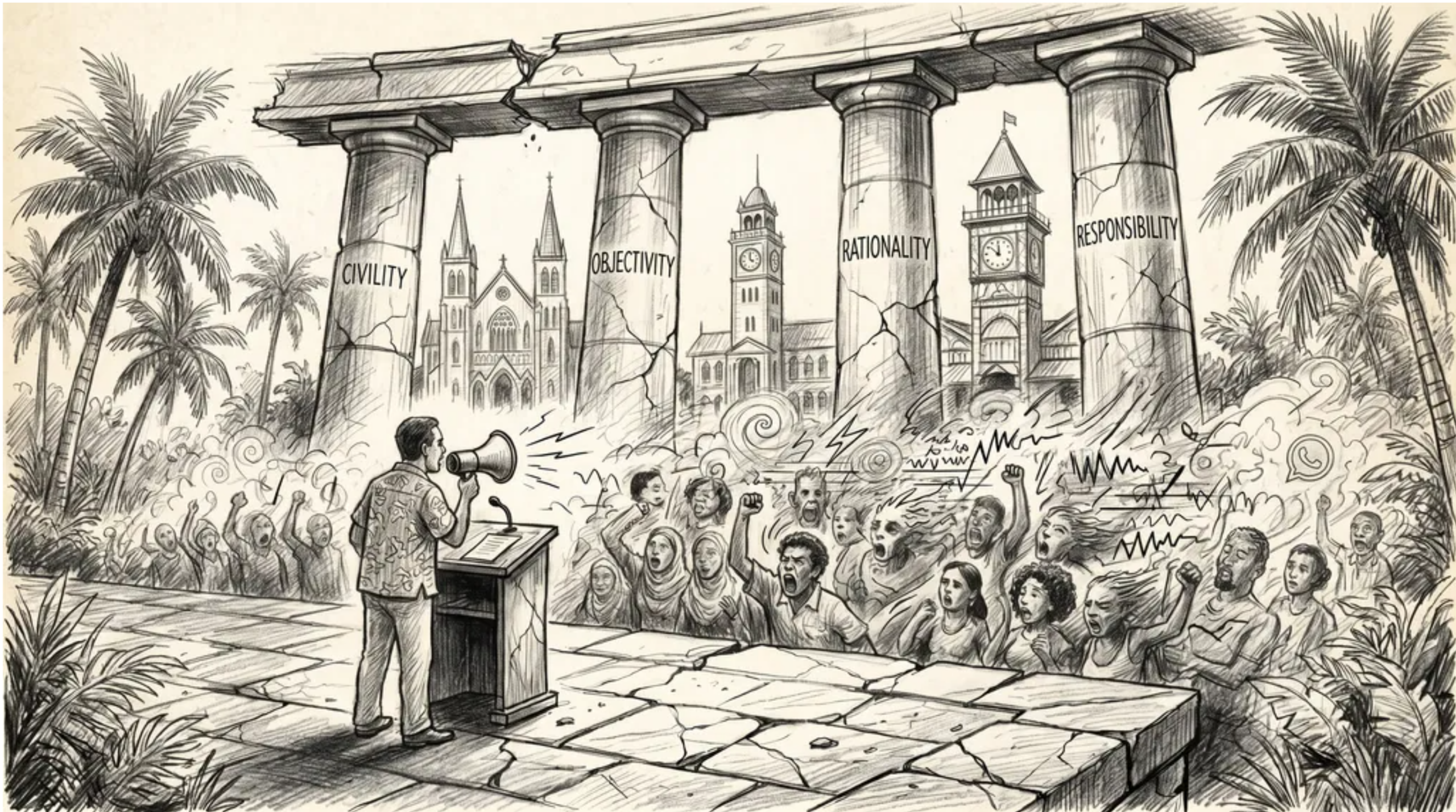
Civility. Not politeness. Not deference. Not the suppression of hard truths. Civility, as we mean it, is the structural commitment to address the citizen on the other side of the page as a moral equal — even when, especially when, the argument is sharp. Civility is what makes argument possible at all. Without it, what looks like argument is only the rehearsal of contempt.
Objectivity. Not the false balance that treats every claim as equally weighted. Objectivity is the discipline of letting the evidence discipline the writer. It is the willingness to publish what the data say rather than what the partisan would prefer to hear. It is the refusal to be the megaphone of a faction — any faction, including one’s own.
Rationality. Not coldness. Not the abdication of moral feeling. Rationality is the commitment to argument over assertion, to causal claim over conspiracy, to the patient construction of a case that a thoughtful reader of any persuasion can be asked to weigh. Rationality is what protects the reader from the writer’s appetites.
Responsibility. This is the heaviest of the four. The publisher’s chair is a moral position. What we make thinkable is what, eventually, becomes doable. Responsibility means that the editor stands behind every column the way a builder stands behind a beam — knowing that the structure above it will, in time, be loaded.
These are not house-style preferences. They are an account of what journalism is for in a young state during an oil-era transformation, in a region carrying the long memory of plantation political economy, and in a global moment when the entertainment of hate is among the most profitable exports of the information industries.
Civility, objectivity, rationality, responsibility: these are not the manners of a tea-room. They are the load-bearing walls of a free society.
The Ceiling of Hate
I want to close with the President’s own words from Saturday night, because they belong in this reflection. Mr. Trump, after he was hurried from the Hilton ballroom, said: “In light of this evening’s events, I ask all Americans to recommit to resolving our differences peacefully.” I do not quote him to endorse him; my readers know my views and need not be reminded of them. I quote him because even a figure long associated with combustible rhetoric, when the gunfire is in the next room, finds himself reaching for a sentence he has not always reached for. There is a lesson in that reach.
The lesson is that the entertainment of hate has a ceiling, and the ceiling is a corpse. We pay for the spectacle eventually. The bill is rarely paid by the loudest.
The project before us — in the United States, in Guyana, in any republic worth keeping — is not to make our public discourse dull. It is to make it serious. Civility, objectivity, rationality, responsibility: these are not the manners of a tea-room. They are the load-bearing walls of a free society. We tear them down at our peril, and we rebuild them only when the cost of their absence has become unbearable.
GBJ’s wager is that we can rebuild them before the bill comes due. That wager is the reason we publish. It is also the reason this column is signed.
The entertainment of hate has a ceiling, and the ceiling is a corpse. We pay for the spectacle eventually.
Terrence Richard Blackman, Ph.D. Terrence Richard Blackman is the Founder & Publisher of the Guyana Business Journal.
Supported By
We are grateful for the partnership and support of individuals and organizations committed to advancing Guyanese and Caribbean development and human capital investment.
Metallica Commodities Corporation
For over two decades, Metallica Commodities Corporation has connected producers and consumers of non-ferrous metals across the Americas, Africa, and Asia. Headquartered in New York with offices in Peru, Canada, Tanzania, and Guyana, MCC brings institutional expertise and global reach to resource-rich markets, with a deep understanding that sound governance determines whether natural wealth generates broad-based prosperity.
The GBJ Sunday Essay is supported by MCC and is not written on its behalf. The views expressed are those of the author.
METALLICACC.COM ↗Pebble Stream™
Pebble Stream™ is a US-based cloud-computing company that transforms complex Excel models into secure, enterprise-scale cloud applications through patented “pebblization” technology. Founded by Bediako George and backed by over 25 years of financial and accounting expertise, the company processes one billion tax calculations monthly and counts a Big Four accounting firm among its clients. For Guyanese and Caribbean businesses, Pebble Stream offers the scalability a rapidly growing economy demands.
This GBJ article is sponsored by Pebble Stream™ and is not written on its behalf. The views expressed are those of the author.
PEBBLESTREAM.COM ↗Caribbean International Shipping Services
Ship with Confidence: Your Trusted Logistics Partner
For over 30 years, Caribbean International Shipping Services has been the trusted choice for businesses and individuals shipping from the Southeast USA to the Caribbean and Latin America. Specialising in household relocations, commercial goods, and online order consolidation, their experienced team delivers weekly ocean and air freight services to over 20 destinations — reliably and stress-free.
📞 770-322-3111
CARIBSHIPATL.COM ↗MCCGUSA
Management Consulting, Project Management, Real Estate
Founded in 1990, MCCGUSA (formerly Management Consulting and Controls Group) is a premier consulting and project management firm serving clients across the United States and internationally. A Certified MBE, DBE & Hub Zone Business, MCCGUSA provides management consulting, project management, financial advisory, and real estate services — with national affiliates and international representation in the Caribbean and Latin America.
📞 212-269-6126
MCCGUSA.COM ↗Individual Supporters
Courtney Allen | All Te Networks | Corine Locke | Tony Harris | Roderick Alsopp | Dr. Michelle Luard
🇬🇾 Please support the Guyana Business Journal & Magazine today
