
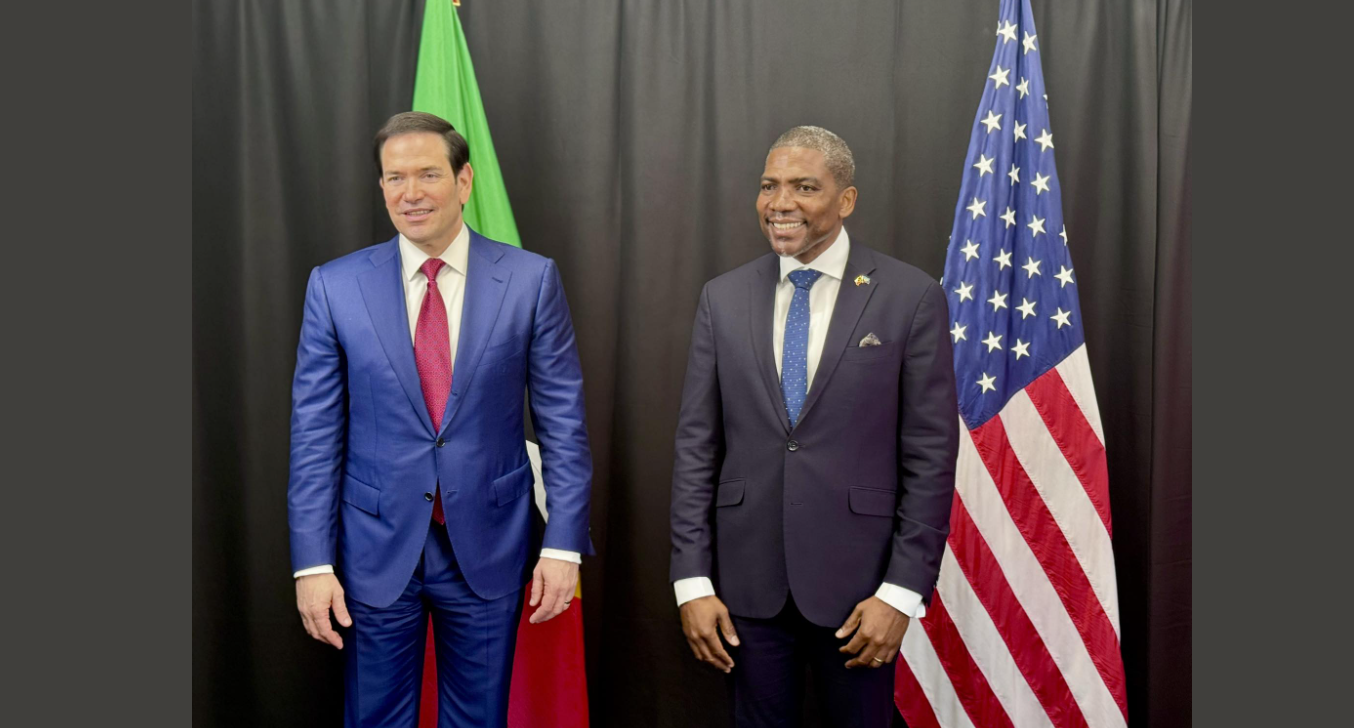
Secretary of State Marco Rubio flew overnight from the State of the Union to address CARICOM in Basseterre — the first such visit in a decade. What he said mattered. What he chose not to say may matter more.
Secretary of State Marco Rubio arrived in Basseterre yesterday on less than four hours of sleep, having flown directly from the State of the Union address. He was in good humor. He joked about colleagues doubting that St. Kitts and Nevis constituted a “work trip,” and acknowledged, with practiced self-deprecation, that it had been a decade since a secretary of state had shown up at a CARICOM heads of government meeting.[1] He then laid out an agenda that Caribbean leaders would do well to parse carefully — not only for what it contained, but for what it conspicuously omitted.
The Three Pillars
Rubio’s address to the 50th Regular Meeting of the Conference of CARICOM Heads of Government rested on three explicit pillars: transnational security, energy partnership, and regional economic investment. Each deserves scrutiny.[1]
On security, Rubio was emphatic and detailed. He named the threat — transnational criminal organizations whose funding and firepower “rival if not exceed that of many of the nation-states that they threaten.” He acknowledged, importantly, that the weapons fueling Caribbean violence are largely purchased in the United States. He pointed to the Mexican cartels’ increasingly militarized posture as a cautionary model. This was not mere diplomatic courtesy. This was a secretary of state who understands that the Caribbean’s security architecture is fragile, and who appears to recognize that American culpability in the arms pipeline is part of the equation.
On energy, Rubio was inviting but vague. He spoke of “extraordinary opportunities” and affirmed that the United States wants to be a partner in responsible energy development. For Guyana, sitting atop what may be the most significant offshore petroleum discovery of the twenty-first century, this language is simultaneously welcoming and watchful. The question is not whether Washington wants to partner with the Caribbean on energy. The question is: partnership on whose terms?
“The shelf life of American attention to the region tends to be short. Caribbean leaders have heard versions of this promise before.”
— GBJ Editorial
On economic investment, the rhetoric was warm: the stronger and more prosperous the CARICOM nations are, the stronger and more prosperous the United States will be. This is the kind of sentiment that reads well in a communiqué. Whether it translates into reduced trade barriers, expanded market access, investment in Caribbean infrastructure, or meaningful technology transfer remains to be seen. Caribbean leaders have heard versions of this promise before. The shelf life of American attention to the region tends to be short.
The Venezuela Subtext
The most revealing section of Rubio’s address concerned Venezuela. He was unapologetic. He described the post-Maduro situation in terms that would have been “unimaginable” two months ago: the release of political prisoners, the closure of the Helicoide detention facility, oil revenues finally flowing toward public services. He credited the interim authorities, led by Delcy Rodríguez, with concrete progress. And he argued — this is significant — that a stable, prosperous, and eventually democratic Venezuela would be “an extraordinary partner and asset” to CARICOM nations, particularly on energy.[1]
This framing is doing heavy diplomatic work. Rubio is asking Caribbean leaders, many of whom have deep reservations about the January 3 operation, to look past the means and evaluate the results. It is a pragmatist’s argument. It is also, for several CARICOM members, an uncomfortable one — not because the results are unwelcome, but because the precedent of unilateral military intervention in a sovereign Western Hemisphere state sits uneasily with the founding principles of the Caribbean community itself.
For Guyana, the Venezuela calculus is uniquely layered. Georgetown has spent decades managing the existential territorial claim that Caracas maintains over Essequibo — a claim that Maduro escalated with alarming theatrics in late 2023 and into 2024. A weakened, internally focused Venezuela is, in the short term, a Venezuela less likely to press that claim. But a Venezuela whose political trajectory is shaped by Washington’s preferences is not automatically a Venezuela that respects the International Court of Justice process that Guyana has championed. President Ali, who was present in Basseterre, will know this arithmetic better than anyone.
But the Venezuela conversation cannot be separated from its most devastating downstream consequence, which brings us to what may be the most significant absence in Rubio’s address.
“Rubio offered partnership in one breath while presiding over a policy of engineered humanitarian crisis in the next. That contradiction CARICOM must name plainly.”
— Guyana Business Journal Editorial
The Crisis He Would Not Name: Cuba
On the same day that Rubio stood in Basseterre speaking of partnership and shared prosperity, the United Nations Resident Coordinator in Havana, Francisco Pichón, was warning from his office that Cuba faces “acute humanitarian risks” and potential “collapse” as its fuel reserves continue to fall.[2] This was not coincidence. It was context. And Rubio’s refusal to address it substantively was the most conspicuous silence of his remarks.
The facts are stark. Since the January 3 seizure of Maduro, the United States has exercised near-total control over Venezuelan oil exports and has used that control to sever Cuba’s primary fuel lifeline. Executive Order 14380, signed on January 29, declared a national emergency and authorized tariffs against any nation that supplies oil to Cuba.[3] Mexico, which had been providing roughly 44 percent of Cuba’s imports, suspended shipments under pressure — though Mexican President Claudia Sheinbaum described the decision as a “sovereign” one not made under US direction.[4] The result, according to crisis analysts, is a reduction of approximately 90 percent in Cuban fuel imports.[5]
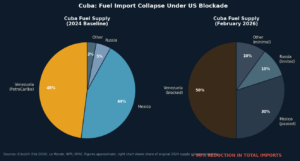
Sources: Crisis24 (February 2026); Le Monde; NPR; OFAC. Figures approximate. Right chart shows share of original 2024 supply volume remaining.
The humanitarian consequences are not hypothetical. They are unfolding now, in real time, ninety miles from Florida and squarely within the Caribbean basin that Rubio claims to prioritize. Blackouts in Havana now stretch for hours; outside the capital, they last up to twenty hours a day.[6] Hospitals are running on fumes — in some cases, literally, with ambulances unable to find fuel to respond to emergencies.[7] Havana’s international airport can no longer refuel outbound aircraft, severing one of the last supply routes for medicine and humanitarian cargo. Garbage collection has halted in parts of the capital because trucks are out of diesel. The annual Festival del Habano, a cigar festival that brings hard currency to the island, was postponed indefinitely in February due to what organizers described as “the complex economic situation.”[8]
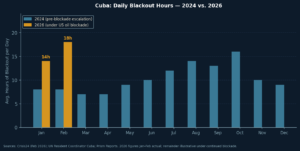
Sources: Crisis24 (February 2026); UN Resident Coordinator Cuba; Prism Reports. 2026 figures January–February actual; remainder illustrative under continued blockade.
The UN Secretary-General has used the word “collapse.”[2] UN human rights experts have called the fuel blockade “a serious violation of international law” and warned that deliberately creating shortages of essential goods may constitute collective punishment of civilians. Canada has pledged C$8 million (approximately US$6.7 million) in food aid.[9] Russia is discussing emergency fuel deliveries. Mexico, caught between solidarity and self-preservation, sent two ships of humanitarian supplies while its president insisted the decision to halt oil was “sovereign.”[4] Meanwhile, on the same day as Rubio’s address, four Cuban nationals were killed in a confrontation with Cuban border troops after a Florida-registered speedboat attempted to approach the island’s northern coast — a grim indication of how rapidly the situation is militarizing.[10]
“Whatever one’s view of the Cuban government, the deliberate strangulation of an island’s fuel supply — with full knowledge that it will cripple hospitals, halt food distribution, and plunge millions into darkness — is not a policy that any Caribbean leader can observe in silence.”
— GBJ Editorial
Rubio said nothing about any of this. He spoke at length about energy as an “extraordinary opportunity” for the Caribbean. He praised Venezuela’s progress. He did not mention that the instrument of American leverage over Venezuela — control of its oil exports — is being simultaneously wielded as a weapon of deprivation against eleven million Cuban civilians. He did not mention that the stated objective of U.S. policy, confirmed by administration officials, is regime change in Havana by the end of 2026.
Jamaica’s Prime Minister Andrew Holness, who was in the room, had urged CARICOM the day before Rubio’s address to address the humanitarian crisis in Cuba “with clarity and courage.”[11] It was a direct, measured rebuke — the kind of statement Caribbean leaders make when the gap between a visiting dignitary’s rhetoric and the region’s reality has grown too wide to politely ignore.
For the Caribbean, Cuba is not an abstraction. It is a neighbor. Cuba has sent doctors to CARICOM nations for decades — training physicians, staffing rural clinics, providing healthcare capacity that many small island states could not otherwise afford. Whatever one’s view of the Cuban government, the deliberate strangulation of an island’s fuel supply — with full knowledge that it will cripple hospitals, halt food distribution, and plunge millions into darkness — is not a policy that any Caribbean leader can observe in silence and retain moral standing. That Rubio offered partnership in one breath while presiding over a policy of engineered humanitarian crisis in the next is a contradiction that CARICOM must name plainly.
What Else Was Not Said
Rubio did not mention climate change. He did not mention sea-level rise. For an audience of Caribbean heads of government, many of whom lead nations whose very existence is threatened by climate disruption this century, this silence is no oversight. It is a policy signal. The current administration’s posture on climate is well known. But the Caribbean cannot afford to let its most urgent existential concern be treated as an ideological preference in Washington. The physics of atmospheric carbon does not observe partisan boundaries.
Rubio did not mention Haiti in substantive terms, despite the fact that Haiti’s crisis — political, humanitarian, and security — represents CARICOM’s most acute collective challenge. He alluded to Haiti only glancingly, under the umbrella of transnational criminal organizations. For a region that has been calling for sustained international engagement on Haiti for years, this was thin.
Rubio did not mention the deportation flights that have strained relations between Washington and several Caribbean governments. He did not mention the reports of U.S. interdiction operations in Caribbean waters that have resulted in the deaths of fishermen. He spoke of partnership and shared prosperity, but he did not address the policies that, from the Caribbean side of the table, look more like imposition than partnership.
And Rubio did not mention China, though Beijing’s growing economic footprint in the Caribbean — in infrastructure, telecommunications, and development finance — is one of the principal reasons Washington has rediscovered its interest in the region. The omission was diplomatic, but the subtext was legible. When a secretary of state flies overnight from the State of the Union to address CARICOM, one of the unstated reasons is that the United States has noticed it has competition in its own hemisphere.
CARICOM’s Minimum Agenda for the Reinvigoration
What the Caribbean Must Do
Rubio closed by describing U.S.-Caribbean relations as something he intends to “reinvigorate” rather than “reset.” The distinction is welcome. It implies continuity and deepening rather than the condescension of starting over. But the Caribbean must bring its own agenda to this reinvigoration, rather than simply receiving Washington’s.
That agenda should include, at a minimum: binding commitments on climate finance, not aspirational language; concrete market access for Caribbean goods and services in the U.S. economy; respect for the sovereignty and territorial integrity of CARICOM member states, including Guyana’s; and a Haiti strategy that goes beyond counternarcotics to address governance, food security, and democratic restoration.
“The Caribbean’s challenge now is to convert the symbolism of Rubio’s overnight flight into durable structural commitments. The region has been here before. The warm words came. The follow-through did not.”
— Guyana Business Journal Editorial
Rubio’s visit was significant. A secretary of state showing up matters. The gesture communicates priority, and priority creates leverage. But leverage is only useful if it is exercised. The Caribbean’s challenge now is to convert the symbolism of Rubio’s overnight flight into durable structural commitments. The region has been here before. The warm words came. The follow-through did not. This time, CARICOM must ensure that the conversation does not end when the secretary’s plane lifts off from Robert L. Bradshaw International Airport.
— ✦ —
References
- U.S. Department of State. (2026, February 25). Secretary of State Marco Rubio at the 50th Regular Meeting of the Conference of CARICOM Heads of Government. state.gov
- UN News. (2026, February 26). Humanitarian pressures grow as Cuba continues to struggle with energy shortages. news.un.org
- The White House. (2026, January 29). Executive Order 14380: Addressing Threats to the United States by the Government of Cuba. whitehouse.gov
- NPR. (2026, January 28). Mexican president says her country has paused oil shipments to Cuba. npr.org
- Crisis24. (2026, February 18). Cuba — Steady Decline into Humanitarian Disaster. crisis24.com
- Prism Reports. (2026, February 19). Fuel squeeze deepens blackouts and closures across Cuba. prismreports.org
- KSBW / AP. (2026, February 22). Cuba’s health care system pushed to the brink by US fuel blockade. ksbw.com
- France 24. (2026, February 14). Cuba cancels cigar festival amid economic crisis. france24.com [Note: Habanos S.A. officially described the event as “postponed indefinitely.”]
- CBC News. (2026, February 25). Ottawa announces $8M to Cuba amid growing humanitarian crisis. cbc.ca
- The New York Times. (2026, February 25). Cuba Says Troops Kill 4 and Wound 6 on Florida Speedboat. nytimes.com
- Jamaica Observer. (2026, February 25). Holness urges Caricom to address Cuba crisis ‘with clarity and courage.’ jamaicaobserver.com
Terrence R. Blackman, Ph.D., is Founder and Publisher of the Guyana Business Journal and Professor and Chair of the Department of Mathematics at Medgar Evers College, CUNY. He is a former Dr. Martin Luther King, Jr. Visiting Professor of Mathematics at MIT and a former Member of the School of Mathematics at the Institute for Advanced Study, Princeton.
Submit Your Perspective
The Guyana Business Journal Editorial Board welcomes reflections, analysis, and submissions on Guyana’s economic development, governance, and business landscape.
Support Independent Journalism
Guyana’s transformation demands independent scrutiny. The Guyana Business Journal has no political sponsor and no corporate owner. Our commitment is to thoughtful analysis, transparency, and accountability — whoever holds power.
If our work informs and challenges you, consider making a contribution — better yet, a monthly one.
Supported By
We are grateful for the partnership and support of individuals and organizations committed to advancing Guyanese and Caribbean development and human capital investment.
Metallica Commodities Corporation
For over two decades, MCC has operated at the intersection of natural resource extraction and global logistics, trading all non-ferrous metals, including copper, lead, zinc, nickel, cobalt, gold, and other precious metals across continents. With representative offices in Peru, Canada, Tanzania, and Guyana, MCC has witnessed firsthand how institutional quality determines whether resource revenues generate broad-based prosperity or concentrated advantage. The company’s experience in jurisdictions where oil and mineral wealth have transformed budgets — sometimes strengthening democratic governance, sometimes undermining it — informs their understanding that critical institutional conversations matter. As Guyana navigates its own resource-driven fiscal expansion, MCC recognizes that the frameworks governing how these unprecedented revenues are debated, allocated, and overseen will shape outcomes for decades. We’re grateful for their support of these critical institutional questions.
The GBJ Sunday Essay is sponsored by MCC and not written on its behalf. The views expressed are those of the author.
Caribbean International Shipping Services
Ship with Confidence: Your Trusted Logistics Partner
Experience stress-free international shipping with Caribbean International Shipping Services. For over 30 years, we have been the reliable choice for businesses and individuals shipping from the Southeast USA to the Caribbean and Latin America. From commercial goods to household relocations, our expert team handles it all. Let us manage the logistics so you can focus on what matters.
📞 Call 770-323-1111 to learn more
Individual Supporters
Courtney Allen | All Te Networks | Corine Locke | Tony Harris | Roderick Alsopp | Dr. Michelle Luard


1 comment
Magnificent goods from you, man. I’ve understand your stuff previous to and you’re just too great. I actually like what you have acquired here, certainly like what you are saying and the way in which you say it. You make it entertaining and you still care for to keep it wise. I can not wait to read much more from you. This is actually a great web site.
Comments are closed.