
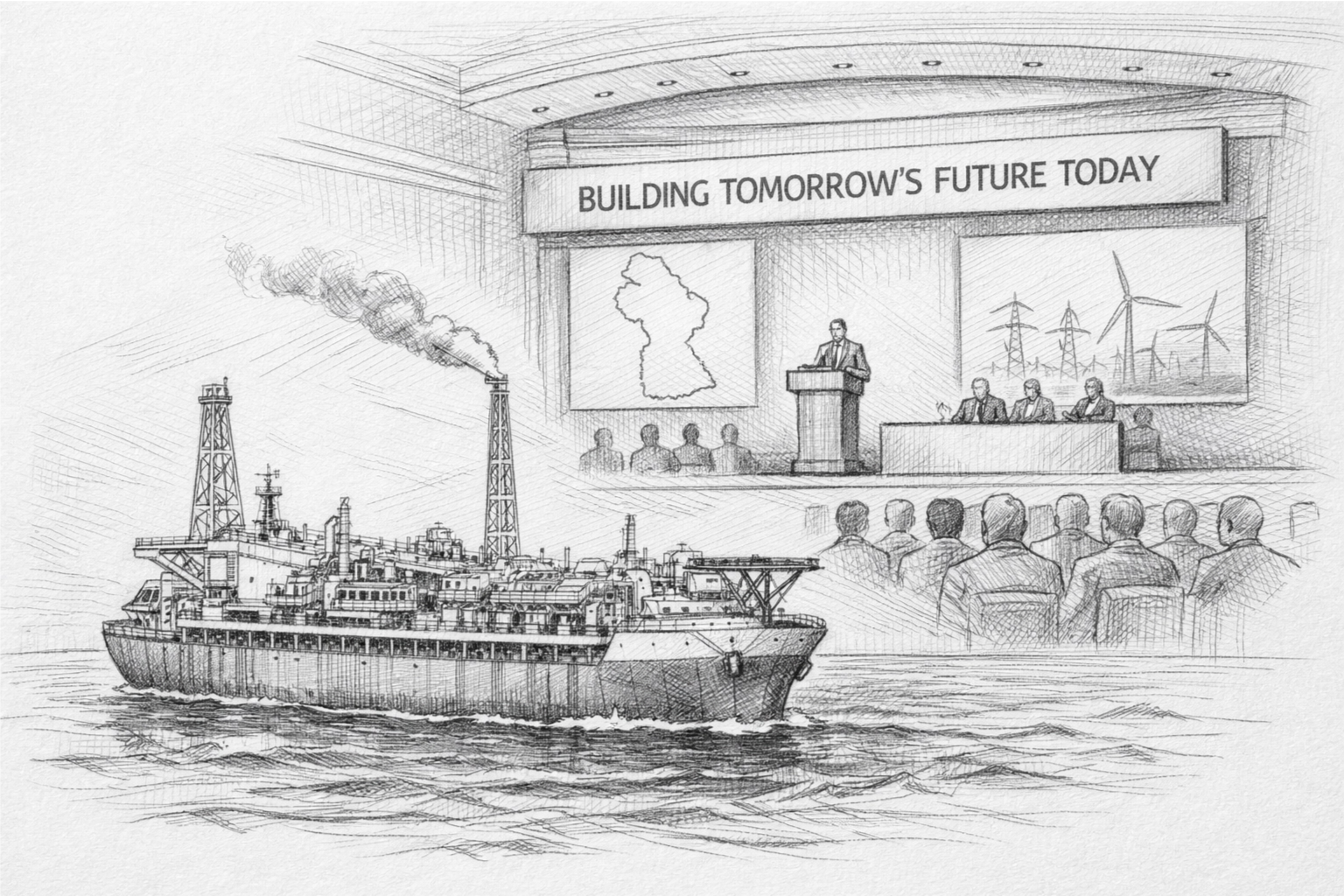
On the eve of Guyana’s fifth annual Energy Conference, the Guyana Business Journal convened a conversation that cut through the promotional veneer to examine what this marquee event—and the governance structure it represents—actually delivers for the nation. Dr. Vincent Adams, former EPA Director with decades of US Department of Energy experience, joined me for an unflinching assessment that moved far beyond conference logistics to interrogate the fundamental architecture of how Guyana manages its oil wealth. What emerged was not merely a critique of an event, but a diagnostic of governance capture, institutional abandonment, and the dangerous gap between rhetoric and reality in Guyana’s energy sector.
The Conference as Symptom
The 2026 Energy Conference promises impressive credentials: ten thousand attendees, two hundred exhibitors, speakers including President Ali and regional heads of state, all gathered under the aspirational banner of “Building Tomorrow’s Future Today.” The graphics are beautiful, the sponsorship packages expensive—ExxonMobil and Chevron each contributing $150,000 as platinum sponsors—and the topics sound cutting-edge: artificial intelligence in oil and gas, supply chain resilience, digital transformation, carbon capture.
Yet Dr. Adams identified something striking in his initial assessment: “Not a single member of the opposition was invited to this conference.” This exclusion carries particular weight given the conference theme. As he observed, “I thought that the members of parliament, all of the opposition, was part by constitution of that government that would be building this future today, but none of them—even though a lot of foreigners were invited—not a single one of them were invited.” When half the constitutional government is systematically excluded from the country’s premier energy forum, the question becomes unavoidable: whose future is actually being built?
The exclusion extends beyond political representation to economic accessibility. Small businesses face entry costs of US$4,600 plus transportation and hotels—totaling one to two million Guyanese dollars per attendee. General admission runs US$400. Dr. Adams put it plainly: “Those small businesses cannot afford it. The ordinary citizen, the John Public who would like to come and attend and listen and learn—they’re basically locked out or priced out. So we’ve got a conference that does not have participants from the local community, which is to me counter to the whole intent of such a very important and critical conference.”
The result is a conference funded by the companies it should be scrutinizing, inaccessible to the citizens whose resources are being extracted, and closed to half the constitutional government. This is not mere oversight. It is structural design that reveals who actually sets Guyana’s energy agenda.
Corporate Capture of the National Agenda
Dr. Adams articulated what the conference structure makes explicit: “Who is setting that agenda for tomorrow except that it is being set by these major companies?” When ExxonMobil contributes $150,000 in sponsorship, it purchases more than booth space and speaking slots. It purchases influence over what gets discussed and what remains conspicuously absent from the agenda.
The conference topics—AI, digital transformation, carbon capture—sound sophisticated. But as Dr. Adams noted, sophistication without foundation is dangerous: “We’re putting stuff on autopilot without even learning to fly yet.” Guyana lacks basic regulatory capacity, has conducted no baseline environmental studies, maintains no adequate oil spill response plan, and employs zero EPA staff with petroleum engineering training. Yet the conference invites attendees to marvel at artificial intelligence applications while these fundamentals remain unaddressed.
I asked Dr. Adams what he found wrong with discussing advanced technologies. His response cut to the core: “It’s not a problem really, all of that sounds good, but we’re putting the cart before the horse because we have not even taken care of the basic issues. Fifty-eight percent of Guyana live in poverty. We’ve got corruption at the highest level. Child malnutrition is very high. So who is really setting the future agenda? These companies are basically setting the conference, setting up the agenda, and they will not want anything on that agenda that is not totally or almost totally in their interest.”
The corporate interest is straightforward: “Pump as much oil as possible, make as much profit as possible, and as quickly as possible.” This is not villainy—it is fiduciary duty to shareholders. The failure lies not with ExxonMobil for pursuing its mandate, but with Guyana’s government for ceding its own. As Dr. Adams emphasized repeatedly, “I’ve always said I’ve never been mad at Exxon. Exxon is doing what they’re supposed to be doing—to make a bigger bottom line as possible. However, we are not performing our responsibility in the best interest of our people.”
The Basics Still Missing
What should be on the conference agenda but isn’t? Dr. Adams laid out the fundamentals with the precision of someone who has actually built regulatory frameworks in the world’s most demanding energy jurisdiction. His first priority: “Capacity building. One of the things severely lacking in Guyana—especially in a new country that is so limited in its resources—is to share lessons learned and experiences, bad, good and indifferent. What has been successful, what has been pitfalls throughout the world.”
The regulatory infrastructure remains skeletal at best, dangerously absent at worst. The EPA, responsible for authorizing all offshore oil and gas operations, “does not have a single person, not a single person at that organization, with even five minutes of training in petroleum engineering or petroleum science or anything to do with petroleum.” This is not hyperbole for effect. Dr. Adams was director of that agency and established, with World Bank support, a petroleum expertise unit to remedy this gap. It was cancelled when the administration changed.
Similarly cancelled: the University of Guyana petroleum engineering program, developed in partnership with UWI and the University of Trinidad and Tobago, which would have produced graduates one to two years ago. Also abandoned: a seventeen-institution technical training consortium designed to build skilled workforce capacity across regions. Also eliminated: the requirement for on-site government monitoring of operations twenty-four hours a day, seven days a week.
Dr. Adams described his philosophy when heading the EPA: “Our mantra was to make sure that we always had more firepower in terms of expertise than the contractor.” The current approach represents “the complete opposite.” When I asked about the shift, he was direct: “There was a difference when people like myself were there and now. Exxon understood and was reasonable enough to accept what we’ve got to give in the interest of the country of Guyana. But now things have shifted in the opposite direction where Exxon is controlling everything.”
Environmental Governance in Retreat
The environmental implications of this institutional retreat are not theoretical. Dr. Adams detailed operational practices that violate Guyana’s own environmental regulations with apparent impunity. Gas flaring, prohibited except for emergencies under the Environmental Impact Assessment, now proceeds with minimal fines serving as de facto licensing fees. The principle of environmental protection has been “put on its head—because that flared gas has over two hundred contaminants, toxic chemicals in it, and it goes up there and forms acid rain that falls back and damages the entire environment, water and everything else.”
More fundamentally, operators are reinjecting clean ocean water into reservoirs while dumping produced toxic radioactive hot water into the ocean. This practice, cheaper than the required reinjection of produced water and gas, results in the destruction of “millions of eggs, fish eggs” through water intake systems. No baseline environmental study exists to measure the impact. The baseline study was in the 2020 EPA budget but never executed.
Should any of this be discussed at an energy conference themed “Building Tomorrow’s Future Today”? Dr. Adams thought so: “How to develop a safe and environmentally sound culture—that’s every single conference, engineering and otherwise, you go to anything to do with engineering all over the world. The most important topic is how do you develop a safe and environmentally sound culture.” Yet the 2026 agenda addresses none of it.
The Decommissioning Time Bomb
Perhaps most troubling was Dr. Adams’ discussion of what he called “the big elephant in the room that nobody is paying attention to”: decommissioning. Guyana is paying ExxonMobil billions of dollars upfront, before projects even begin, for eventual decommissioning of facilities that will be left on the seafloor. The problem is that plugged wells worldwide have proven to leak again over time. In California and elsewhere, major companies have addressed this liability by selling aging fields to shell companies with no assets, leaving cleanup costs to the public.
“When they pack up and gone and they said they’d clean up,” Dr. Adams warned, “there is no coming back for us when those wells are leaking at the bottom of the ocean. We’ve got no technical expertise to certify proper decommissioning. They pack up and leave, and maybe the day after, something happens and those wells blow. We got oil coming from the bottom of the ocean. There is no guardrails against that.”
This is not speculation about distant future problems. It is predictable consequence based on documented experience elsewhere. Yet decommissioning technology, liability frameworks, long-term monitoring requirements, and financial guarantees receive no conference attention. The reason is straightforward: these topics do not serve corporate interests in maximizing near-term extraction while minimizing long-term liability.
Local Content: The Gap Between Law and Reality
I asked Dr. Adams about local content requirements, given Guyana’s legislation setting targets for Guyanese ownership and employment. His response was unsparing: “The government brags about we’ve done a local content legislation. It doesn’t mean anything. It’s just stuff on paper that you brag about.”
The documented reality includes Guyanese workers paid below minimum wage, eating leftover food after others finished—issues that made newspaper headlines with minimal official response. Eighty to ninety percent of spending flows to foreign companies. Most high-skilled jobs go to expatriates. Local firms struggle with qualification standards that “seem designed to exclude them,” while foreign companies receive waivers for not meeting requirements.
Dr. Adams offered an alternative model from his US Department of Energy experience: the mentor-protégé program. Contractors in disadvantaged areas had to demonstrate that fifty percent of spending would benefit local communities. When contractors protested lack of qualified local workers, the solution was mandated training programs: “You’re going to hire them anyway, and we’re going to give you three years for you to bring them up. Within three years they’re going to be ready for whatever contracts you have in the future.” Award fees were tied to performance with strict reporting requirements.
“When you just leave it loose with a handshake,” he observed, “there’s no enforcement.” Guyana has the handshake. It lacks the enforcement.
The National Resource Fund Debate
Our conversation took an unexpected turn when I asked about the National Resource Fund. Dr. Adams offered a contrarian perspective: “I’m not a big fan of an NRF.” His reasoning drew on household economics: “You’re not going to go invest if your family doesn’t have food on the table or you can’t pay your rent. You invest what is extra.”
He then corrected widespread misunderstanding of the Norway model that Guyana claims to follow. Norway legislated its sovereign wealth fund twenty-one years after oil discovery. The first withdrawal came forty-seven years after first oil. What did Norway do with oil revenues during those decades? “Made sure that you become a rich country first. Invest in your people.” The fund now holds two trillion dollars, but only after building comprehensive national capacity.
This represents a fundamental challenge to current policy, which prioritizes foreign portfolio investment while fifty-eight percent of Guyanese live in poverty and child malnutrition remains high.
The counterargument Dr. Adams encountered when raising this position years ago was revealing: officials claimed that keeping money in the general fund would invite “massive corruption.” His response captured the absurdity: “Could you imagine making policies because we are afraid of people being corrupt?” The solution to corruption is not to park resources offshore, but to build institutions that prevent and prosecute it.
What Changed and Why
A pattern emerged throughout our conversation: initiatives that were underway during Dr. Adams’ EPA tenure were systematically cancelled after the administration change in 2020. The petroleum expertise unit at EPA. The University of Guyana engineering program. The technical institute consortium. The mentor-protégé contractor requirements. The on-site government monitoring. The environmental enforcement regime.
Dr. Adams’ assessment of the difference was stark: “Things have shifted in the opposite direction where Exxon is controlling everything. They’re doing everything as cheaply as possible so that they can have their maximum profits.” When I suggested this seemed concerning, he elaborated: “All of that has been cancelled. So that is what it is. I would say not in defense of Exxon—that’s their job. They’re there to make money. I would say that it’s our responsibility as government to exercise power.”
This represented more than policy disagreement between administrations. It reflected a fundamental choice about who governs Guyana’s oil sector: the constitutional government of Guyana, or the corporations extracting its resources. Dr. Adams recounted that when he was at EPA, he told ExxonMobil directly: “We will not accept anything less than what you have to abide with in the US.” Their response? “Okay, that’s fine with us.”
The implication is unavoidable. ExxonMobil will comply with rigorous standards when required to do so. The current government chooses not to require compliance. As Dr. Adams observed, “These major companies, they’re going to go as far as they can get away with. And when you bring it to their attention, they’re reasonable companies and they’re going to back off and do what is reasonable. But if you allow them to, they’re going to take everything.”
The Politics of Division
When audience member Cosford Robertson asked about mechanisms to heal Guyana’s ethnic and political divisions, Dr. Adams connected this directly to the conference: “Because when the PPP leader is in power, the PNC people—and it’s always about fifty-fifty—fifty percent are not going to trust or support you, and vice versa. So we could never have unity until we decide to heal that. And this conference is showing there’s no intention of healing when you do not invite a single member of the opposition to the most important sector that you showcase to the world.”
The exclusion sends a message that transcends conference invitations. It signals that political opponents are not legitimate stakeholders in national resource management. This guarantees that when power shifts—as it inevitably does in democracies—the incoming administration will view the current framework as illegitimate and requiring replacement. The result is policy instability, institutional discontinuity, and recurring destruction of capacity-building initiatives that take years to establish.
Dr. Adams proposed an institutional solution: an Inspector General’s office modeled on US practice. Such an office would be independent of government, appointed by civic society rather than political leadership, with authority to investigate and file charges. “We had a hotline,” he recalled from his US experience. “We could not even take a soda from a contractor because somebody is going to see and call that hotline, and the next thing you know you’ve got twelve inspector generals investigating. You’re in serious trouble if that is the case.”
The key requirement is independence. Technical committees must be staffed by qualified professionals, not politicians, and they must be “accountable to an independent organization” rather than the government of the day. Without this structural independence, any commission or oversight body will simply become another site of political contestation rather than a mechanism for professional governance.
The Venezuela Factor
One issue that did warrant conference attention but received none: the implications of potential Venezuela sanctions relief under the Trump administration. Dr. Adams offered a prediction: Trump’s “drill baby drill” policy, combined with Venezuela already adding hundreds of thousands of barrels to global supply and Russian oil returning when the Ukraine war ends, would create an oil glut driving prices down. This would satisfy America’s interest in lower domestic prices while directly impacting Guyana’s revenue projections.
“That should be part of that planning,” he noted, “the sovereign wealth fund and everything else.” Yet the conference agenda included no serious stress-testing of revenue assumptions, no scenario planning for price volatility, no discussion of how to manage expectations and budgets in a lower-price environment. These are precisely the conversations a genuine policy forum would facilitate. Their absence confirms the conference’s primary function as promotional rather than analytical.
A Conference That Could Have Been
Dr. Adams painted an alternative vision of what an energy conference genuinely serving Guyana’s interests would look like. Lessons learned sessions examining both successes and failures from oil-producing nations worldwide. Capacity building frameworks showing concrete pathways from current deficits to functional expertise. Environmental safety culture development drawing on global best practices. Decommissioning technology and liability discussions preparing for end-of-field-life realities. Local content enforcement mechanisms with teeth. Emergency response planning with regional coordination. Transparency protocols and independent auditing standards.
“Here’s what’s interesting,” he observed. “If I was on the government side, this here would have been good cover for me. Because if I’ve got the Terrence Blackmans and the rest of the experts in the world coming to this conference and saying, ‘Hey, you know what, we think this is what should be done,’ that would be providing cover for me if I’m the government not wanting to face Exxon. Then I could tell Exxon, ‘Here are what our experts are saying. You can’t put me in that bind where I could go against them.'”
Instead, the government has chosen to avoid expert scrutiny entirely, to price local stakeholders out of participation, and to exclude constitutional opposition from the conversation. The result is a conference that serves corporate public relations objectives while systematically avoiding the substantive governance questions on which Guyana’s long-term prosperity depends.
What We Did Not Discuss
Even in a conversation that extended well beyond the scheduled hour, critical issues remained only partially addressed or unexamined. We did not fully explore the implications of Guyana having no real-time production monitoring, relying instead on operator-reported data. We touched only briefly on the University of Guyana’s marginalization from the conference despite being the logical institutional anchor for petroleum expertise development. We did not examine the regional opportunity to position Guyana as a Caribbean petroleum education hub, serving the six million people across CXC-exam countries and potentially building Aberdeen-style global expertise capacity.
The question of contract renegotiation received only passing mention, though Dr. Adams noted it was “one of the things that has been cancelled.” The specifics of what was negotiable, what leverage Guyana possessed, and what terms might have been achievable remained unexplored. Similarly, while we discussed the National Resource Fund’s questionable prioritization, we did not detail what specific education, healthcare, and infrastructure investments should take precedence, what their costs would be, or what timelines would be realistic.
These gaps reflect not conversational failure but topic vastness. Guyana’s energy governance challenges are comprehensive, touching everything from technical engineering standards to constitutional power-sharing arrangements. That a two-hour conversation with the country’s most credentialed energy professional could only scratch the surface suggests the scale of work required.
The Path Forward
As our conversation drew to a close, I attempted to synthesize what had emerged. The 2026 Energy Conference is primarily a commercial and promotional event rather than a policy development forum. Its theme of “Building Tomorrow’s Future Today” offers broadly aspirational rhetoric without operational specifics. The business model creates subtle but real constraints on content through corporate sponsorship dependence. Critical topics—environmental oversight, local content enforcement, decommissioning frameworks, regulatory capacity building—remain conspicuously absent from the agenda.
Dr. Adams agreed with this summary, emphasizing: “The most important thing to me is strong institutions to govern this. And the other thing is this conference is supposed to be sharing knowledge and information to inform the decision-making of the nation, and all the decision-makers in parliament—the opposition, which is part of the constitutional government—should have been part of here.”
He concluded with the decommissioning warning: “That is the big elephant in the room that nobody is paying attention to. And that should be part of the conference in terms of what technologies are being developed and what resources do we need to start developing our plan for it.”
Beyond Partisan Politics
In my closing remarks, I tried to articulate what the Guyana Business Journal seeks to accomplish through conversations like this one. We aim to move beyond partisan logic—the endless contest of APNU versus PPP versus WIN—to recognize that all these entities are subsets of Guyana. If Guyana survives and prospers, these political formations will survive. But the reverse is not true: these entities can persist and even thrive while Guyana as a cohesive nation fails.
The conference poses but does not answer a fundamental question: whose future is being built, and for whom? Until Guyana’s people, through their full constitutional representation, can genuinely participate in answering that question, tomorrow’s future will remain someone else’s property.
For those attending the conference, I offered simple advice: “Ask some hard questions and don’t let the uncomfortable silence shut down the topics. It’s always important when you’re participating in something not just to go along to get along, but to ask the questions and engage your parliamentary representatives.”
For the broader public, I proposed tracking mechanisms: a six-month and one-year follow-up assessing what conference commitments actually materialized, and an “energy governance scorecard” evaluating performance across key dimensions. These tools would provide accountability beyond the promotional moment, measuring outcomes against rhetoric.
The Sponsorship Question
One final note on the webinar’s sponsor, Metallica Commodities Corp. I emphasized at the outset that while MCC sponsored the event, it was not done on behalf of MCC, and the company had not interfered with editorial prerogatives. This distinction matters. Corporate sponsorship of public discourse is inevitable and often necessary. What determines its legitimacy is whether sponsors demand editorial control or respect journalistic independence.
MCC’s experience in jurisdictions where resource wealth has both strengthened and undermined democratic governance gives the company particular insight into “the necessity for critical conversations.” Their willingness to support such conversations without demanding friendly coverage represents a model of corporate responsibility worth acknowledging. It stands in sharp contrast to conference sponsorships that purchase agenda control and topic exclusion.
Similarly, I thanked Caribbean International Shipping Services for thirty years of reliable logistics work and support for substantive dialogue. These acknowledgments are not mere courtesy. They signal that critical analysis need not exist in commercial isolation, that businesses can support independent journalism without corrupting it, and that Guyana’s private sector includes actors who understand that genuine national development serves everyone’s long-term interests.
The Spectacle and the Substance
The 2026 Energy Conference will proceed tomorrow with or without this critique. It will feature impressive speakers, expensive exhibits, networking receptions, and professionally produced proceedings. President Ali will deliver remarks. Regional heads of state will attend. The theme of “Building Tomorrow’s Future Today” will be invoked repeatedly. Participants will leave with business cards, photographs, and perhaps some new contacts.
What the conference will not do—what it is structurally designed not to do—is address the fundamental questions on which Guyana’s energy future actually depends. It will not examine why the EPA lacks petroleum expertise or how to rapidly build that capacity. It will not scrutinize environmental enforcement retreat or discuss restoring rigorous oversight. It will not develop local content mechanisms with teeth or establish frameworks for verified skills transfer. It will not plan for decommissioning liabilities or stress-test revenue assumptions against oil price volatility.
It will not do these things because addressing them seriously would require acknowledging that Guyana’s current governance approach serves corporate extraction interests more than national development needs. It would require including voices—opposition politicians, independent experts, excluded local businesses—that might question comfortable arrangements. It would require moving beyond promotional performance to substantive policy debate.
Dr. Adams expressed this with characteristic directness: “We welcome investment, but it has to be on fair terms. These major companies, believe it or not, they’re going to go as far as they can get away with. And when you bring it to their attention, they’re reasonable companies and they’re going to back off and do what is reasonable. But if you allow them to, they’re going to take everything.”
Guyana is currently allowing them to take everything. Not through force or fraud, but through willing abdication of governmental responsibility to set and enforce standards. The energy conference, with its corporate-funded agenda and systematic exclusion of accountability voices, simply makes this abdication visible.
The prescription remains clear even if politically difficult. Build institutions first—EPA capacity, regulatory independence, oversight mechanisms with real authority. Invest in people today through education, training, and healthcare rather than parking resources in foreign portfolios while citizens live in poverty. Include all stakeholders in energy governance, transcending political divisions to recognize that oil wealth either benefits all Guyanese or threatens all Guyanese. Demand transparency in contracts, revenues, environmental data, and enforcement actions. Plan for the end by establishing decommissioning standards and post-oil economic foundations now.
None of this will emerge from a conference whose sponsors profit from the current arrangement and whose agenda excludes those who might challenge it. Change will require political courage to prioritize national interest over corporate accommodation, civic pressure to make energy governance a defining issue, and institutional construction that outlasts election cycles.
As I told Dr. Adams in closing, “We’re speaking in a national interest rather than in the partisan political interest.” That remains the work. The conference will showcase Guyana to the world. But the substance of energy governance—the unglamorous construction of regulatory capacity, the patient building of technical expertise, the disciplined enforcement of environmental standards, the inclusive development of policy frameworks that serve citizens rather than corporations—happens elsewhere, if it happens at all.
Until that substance receives the attention, resources, and political commitment currently devoted to spectacle, Guyana’s energy future will indeed be built tomorrow. The question is: for whom?
📝 Submit Your Perspective
The Guyana Business Journal Editorial Board welcomes reflections, analysis, and submissions on Guyana’s economic development, governance, and business landscape.
💚 Support Independent Journalism
Guyana’s transformation demands independent scrutiny. The Guyana Business Journal has no political sponsor and no corporate owner. Our commitment is to thoughtful analysis, transparency, and accountability—whoever holds power.
If our work informs and challenges you, consider making a contribution—better yet, a monthly one.
Independent analysis depends on an engaged public. Thank you for standing with us.
Supported By
We are grateful for the partnership and support of individuals and organizations committed to advancing Guyanese and Caribbean development and human capital investment.
Metallica Commodities Corporation
For over two decades, MCC has operated at the intersection of natural resource extraction and global logistics, trading all non-ferrous metals, including copper, lead, zinc, nickel, cobalt, gold, and other precious metals across continents. With representative offices in Peru, Canada, Tanzania, and Guyana, MCC has witnessed firsthand how institutional quality determines whether resource revenues generate broad-based prosperity or concentrated advantage. The company’s experience in jurisdictions where oil and mineral wealth have transformed budgets—sometimes strengthening democratic governance, sometimes undermining it—informs their understanding that critical institutional conversations matter. As Guyana navigates its own resource-driven fiscal expansion, MCC recognizes that the frameworks governing how these unprecedented revenues are debated, allocated, and overseen will shape outcomes for decades. We’re grateful for their support of these critical institutional questions.
The GBJ Sunday Essay is sponsored by MCC and not written on its behalf. The views expressed are those of the author.
Caribbean International Shipping Services
Ship with Confidence: Your Trusted Logistics Partner
Experience stress-free international shipping with Caribbean International Shipping Services. For over 30 years, we have been the reliable choice for businesses and individuals shipping from the Southeast USA to the Caribbean and Latin America. From commercial goods to household relocations, our expert team handles it all. Let us manage the logistics so you can focus on what matters.
📞 Call 770-323-1111 to learn more
Individual Supporters
Courtney Allen | All Te Networks | Corine Locke | Tony Harris | Roderick Alsopp

