
Jan 18, 2025
📢 Please support the Guyana Business Journal & Magazine today
Boston, Massachusetts-On Sunday, January 18, 2026, I found myself in a place both magnificent and humbling—Marsh Chapel at Boston University—where the Second Sunday after Epiphany coincided with the annual celebration of Dr. Martin Luther King Jr.’s legacy. The Gothic architecture, soaring organ pipes, and luminous rose window created a setting that reminded me that some struggles —struggles that require reverence, discipline, and resolve —demand sacred space.
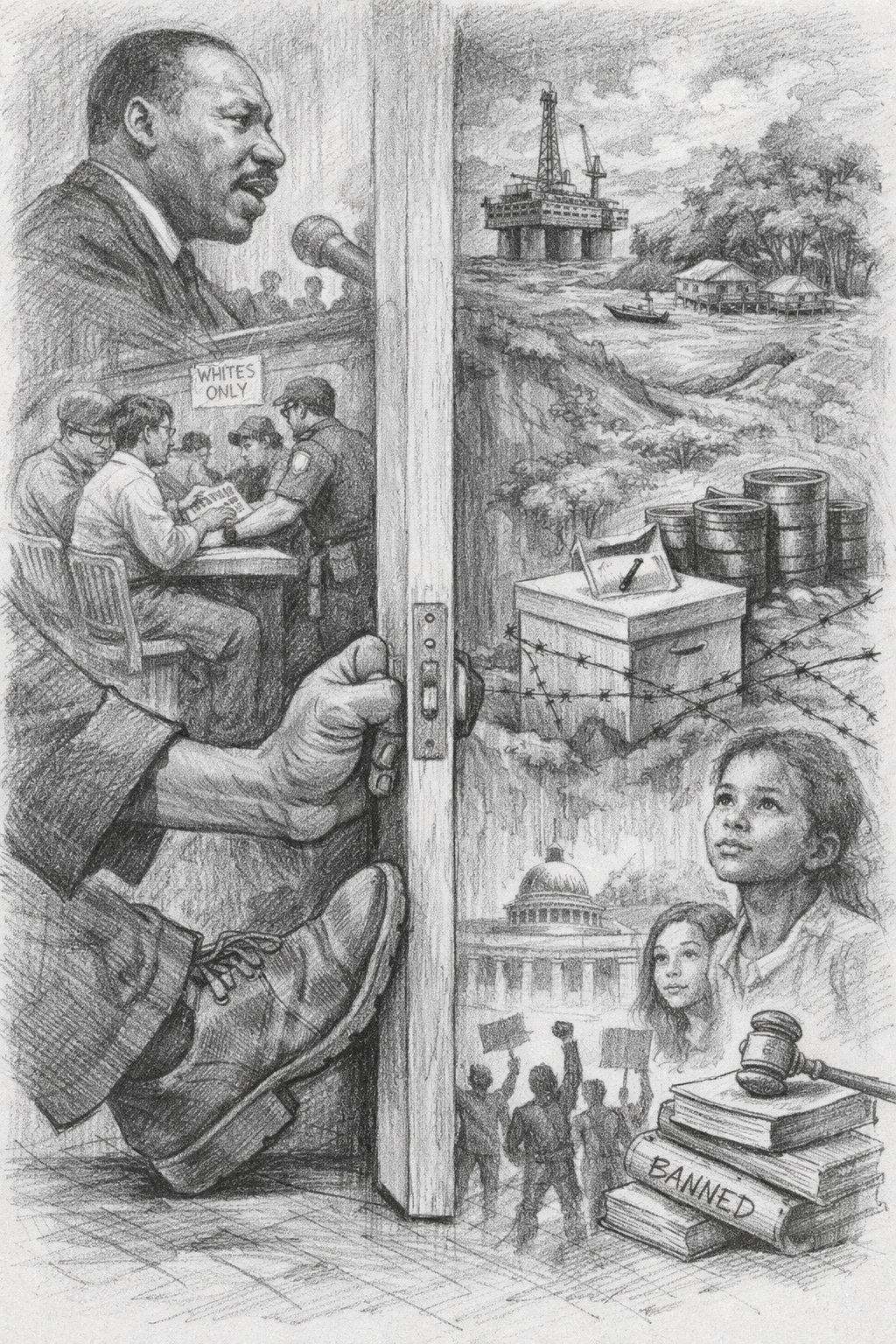
The morning was transformed from commemoration to confrontation in the sermon by Professor Harold D. Cox of the BU School of Public Health. His message, organized around the deceptively simple idea of “putting your foot in the door,” was anything but abstract. It was a demand for persistence, for moral courage, and for an unwillingness to retreat when justice is inconvenient. Though preached in Boston, it spoke directly to Guyana’s present moment and to democratic fragilities unfolding across both nations.
Cox grounded his sermon in Luke 11:5–8, where Jesus tells of a man who knocks persistently on his neighbor’s door at midnight, seeking bread for unexpected guests. The neighbor, already in bed with his family, refuses—until the knocking continues. The door opens not because of friendship, Jesus explains, but because of persistence. Cox named it plainly: righteous defiance. Justice does not arrive because the powerful feel generous. It arrives because ordinary people keep knocking, keep pushing, and refuse to move.
When Cox shared his own family history, the sermon’s moral force became evident. His father, a United Methodist minister, participated in the Woolworth’s lunch-counter sit-ins of the 1960s. As a child, Cox could not understand why his family never sat at the counter, despite the smells of pies and coffee. The reason was simple: Black people were not allowed. When his father and others sat anyway, they were arrested. Cox recalled the day his father returned home from jail and held his sons, repeating quietly, “I love you.” He did not call it activism or protest. He simply understood that a door was closing—and he refused to step back.
That story crystallized the sermon’s core truth: resistance to injustice is not theoretical. It is personal, costly, and animated by love for those who will inherit the world we shape.
Cox then named the doors closing in contemporary America. Doors are closing on families unable to pay rent; on immigrants seeking opportunity; on LGBTQ+ youth through legislation and silence; on people of color through the erasure of history—books banned, museum exhibits questioned, conversations shut down; and on democracy itself through voter suppression and institutional usurpation, inertial and decay. These are not symbolic doors, Cox insisted. They are doors of safety, dignity, and survival. The congregation recognized what many of us sense but are struggling to name: democratic backsliding is no longer hypothetical.
Listening from the pews, I could not help but draw parallels to Guyana.
The door of transparent oil governance remains under constant pressure. Despite Natural Resource Fund legislation and formal oversight, unresolved questions persist about beneficial ownership, contract terms, and whether oil revenues meaningfully reach ordinary Guyanese. Will this door remain open through persistent civic demand, or close quietly through opacity and elite capture?
The door of inclusive development is also under strain. Oil wealth has produced a two-track economy—those connected to the boom and those left behind. In Georgetown, Linden, and rural communities, citizens ask whether prosperity is national or selective. Inequality, if unaddressed, will permanently close doors.
Our democratic integrity remains fragile, and the question is whether Guyana will defend the mechanisms that kept the democratic door open—independent electoral management, civil society vigilance, adherence to the country’s laws, and international scrutiny—or allow them to erode through fatigue and normalization.
Press freedom and civic space face threats: legal intimidation, strategic silence, and self-censorship. These are the mechanisms by which doors close without ceremony. Environmental sustainability, too, is at risk as oil-driven development accelerates. Forests, rivers, and coastal communities face pressures that could shut the door on ecological resilience for generations.
Cox did not offer easy answers. He offered a framework. Stay curious. Ask hard questions. Know your neighbor, because love without knowledge is abstraction. Tell your stories—especially those that break your heart just enough to compel action. For Guyana, that means documenting how oil wealth does—or does not—transform lives. It means amplifying the voices of Amerindian communities, youth priced out of housing, and families struggling despite national growth.
Above all, he insisted we must act. Volunteer. Speak when silence is safer. Vote. Give. Choose one door and hold it open. But understand this: if justice does not cost you something—if it does not make you uncomfortable—you are likely not doing the work justice requires. His father risked arrest. Dr. King gave his life. Justice has never been convenient.
The liturgy itself reinforced this call. The Exodus reading reminded us that God hears the cries of the oppressed but works through human agents who must step forward despite fear. Ephesians urged us to stand firm, recognizing that injustice is sustained not only by individuals but by deeper systems and powers. Epiphany—the season of divine manifestation—demands response. Light encountered but not acted upon becomes judgment.
Dr. King’s work, Cox reminded us, is unfinished. This is not nostalgia. It is a responsibility. For Guyana, independence, constitutional democracy, and resource wealth are not endpoints. They are opportunities—and tests.
King’s vision of the beloved community was never confined to America. It imagined a world where dignity is universal—where injustice is confronted, whether it appears in Mississippi or Mahaica, Alabama, or Sophia.
Perhaps the sermon’s hardest truth was this: comfort is justice’s greatest enemy. Justice is not a value we debate; it is a verb. In Guyana, oil prosperity tempts us to settle for improvement rather than equity, silence rather than scrutiny. But the Woolworth’s counter reminds us that patriotism sometimes requires disruption—knocking at midnight when retreat would be easier.
Moving between Brooklyn, Boston, and Georgetown, I see the parallels clearly. Both nations face democratic tests. Both must decide whether the values they proclaim will be the values they defend. To my American citizens: the doors closing around immigration, history, housing, and voting are real. Keep your foot in the door. To my fellow Guyanese: oil wealth will either open doors for all or entrench new hierarchies. Only our action decides which.
The service closed with the Gloria Patri—a reminder that justice must be reclaimed by every generation. Doors once forced open can close again if pressure fades. Yet we do not struggle alone. The God who heard cries in Egypt, who sent prophets to demand justice, who embodied love in action, stands with those who refuse to move.
Leaving Marsh Chapel this morning, walking down Commonwealth Avenue where Dr. King once walked as a doctoral student, Cox’s charge stayed with me: put my foot in the door—here, now, in 2026—and keep it there until someone is fed, housed, seen. Hold it open with courage and righteous defiance. Then justice will not merely arrive. It will enter and take up residence.
This is the work before us—in Guyana, in America, wherever doors are closing on human dignity. The question is not whether we have resources or power. The question is whether we have the persistence, courage, and love to keep knocking.
Dr. King held the door open. His generation held it open. Now it is our turn.
Will we keep our foot in the door?
Terrence Richard Blackman is Professor and Chair of the Department of Mathematics at Medgar Evers College, CUNY, and Founder and Publisher of the Guyana Business Journal. He worships at Marsh Chapel when visiting Boston.
Editor’s Note
This essay grows out of a Martin Luther King Jr. Sunday sermon delivered at Marsh Chapel, Boston University, and reflects on its resonance far beyond that sacred space. Drawing on biblical metaphor, personal memory, and contemporary political realities, the piece invites readers to consider what it means to persist—to keep one’s “foot in the door”—when justice is threatened by complacency, comfort, or power.
By placing the American civil rights struggle in conversation with Guyana’s present crossroads in the era of oil and democratic testing, the essay underscores a central conviction of Guyana Business Journal: that development without accountability, prosperity without inclusion, and democracy without vigilance are doors that quietly close. The reflections that follow are offered not as nostalgia or moral display, but as a call to responsibility—one that asks each generation to decide whether it will merely inherit hard-won freedoms or actively hold them open.
— Guyana Business Journal Editorial Team
📢 Please support the Guyana Business Journal & Magazine today
The Guyana Business Journal Editorial Board welcomes reflections and submissions at terrence.blackman@guyanabusinessjournal.com
Supported By
We are grateful for the partnership and support of individuals and organizations committed to advancing Guyanese and Caribbean development and human capital investment.
- Courtney Allen
- All Te Networks
- Corine Locke
- Tony Harris
- Richard Alsopp


1 comment
Your piece on Dr. Cox’s sermon which highlighted the necessity of using sustained action to obtain desirable societal reforms is moving and well written. It is recommended reading for any person who is committed to working towards a better world, and more particularly to Guyanese seeking to change the a wretched social and economic system.
A fine piece.
Comments are closed.