The Longest Beam
On Clarence Trotz, Keith Wilson, and the Human Capital We Keep Sending Away
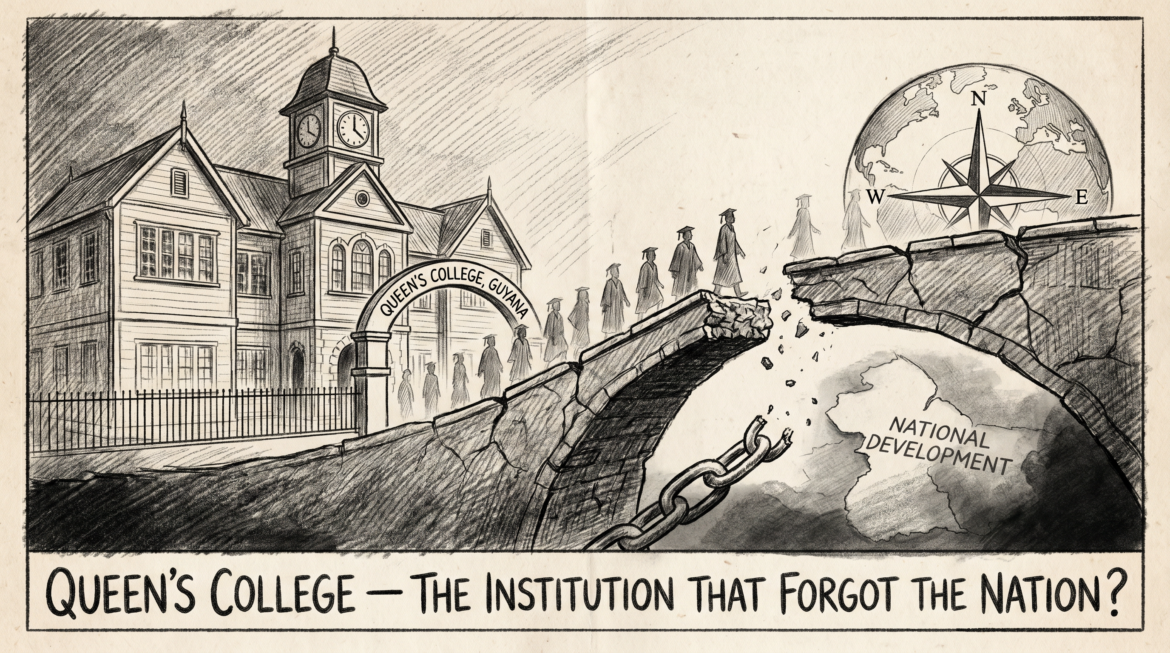
Queen’s College, Georgetown, Guyana — where Clarence Trotz taught physics in the 1960s · GBJ Editorial Art
There is a photograph I keep in my mind. It is not a real photograph — no one took it — but it is as vivid to me as anything I have seen with my own eyes. It is a classroom in Georgetown, sometime in the early 1960s. A physics teacher stands at the front. He is precise, unhurried, rigorous. He is teaching his students something that most people believe cannot be taught: how to see.
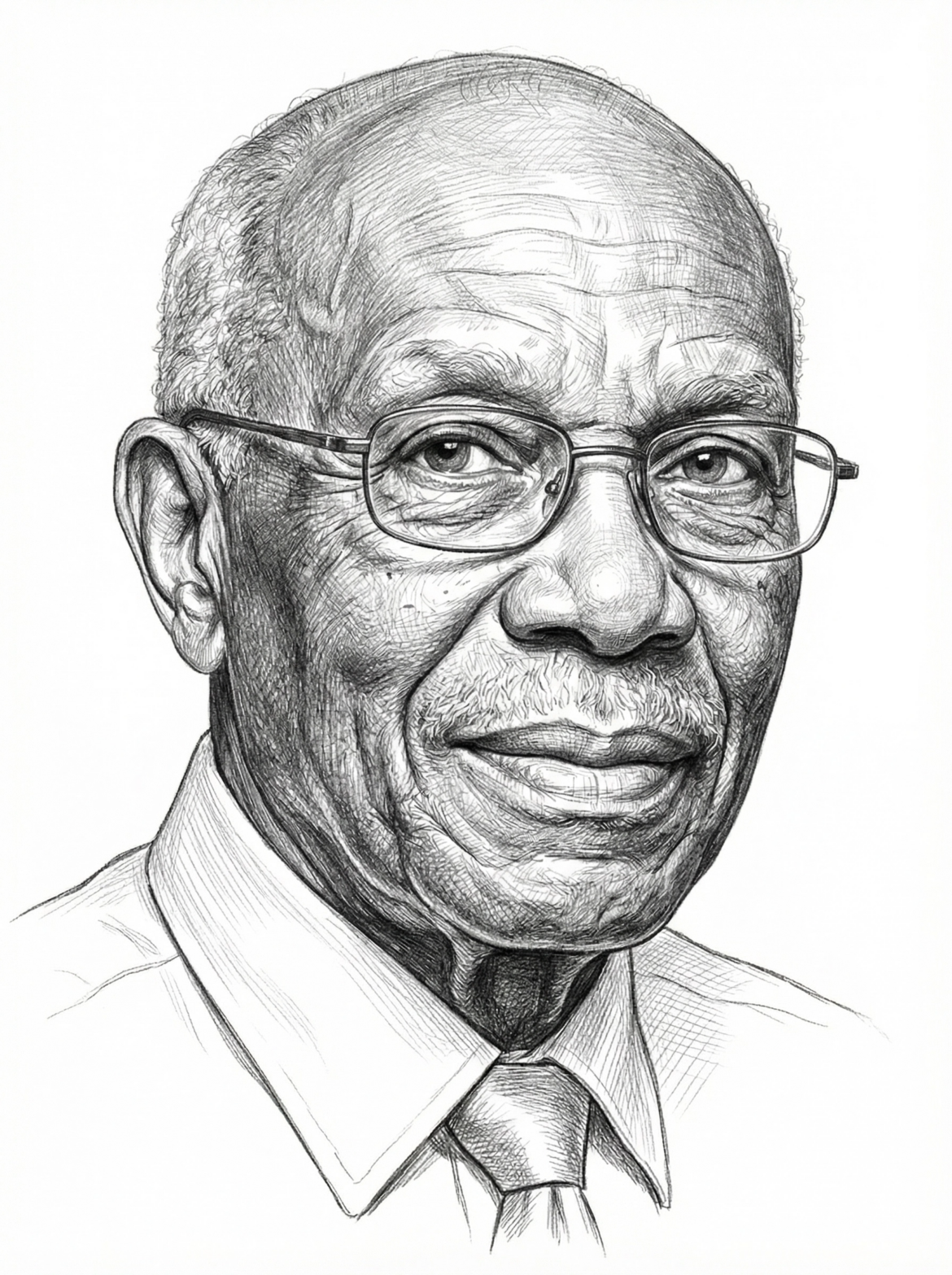
The teacher’s name is Clarence Trotz.
This past week, the Guyana Business Journal hosted Mr. Trotz for a conversation as part of our ongoing series on education and human capital development. He is 92 years old. He rose that morning, as he does every morning, and performed his calisthenics in bed — stretching his legs, extending his arms, giving thanks for the privilege of another day. He is currently preparing a young man from Bartica — a young man who wants to become a surgeon — for his CAPE Unit 2 Physics examinations in May 2026. There is no one in Bartica to teach him. So Clarence Trotz, at 92, does it himself, over Microsoft Teams, without being asked, without being paid, without ceremony.
I want you to sit with that for a moment before we go anywhere else.
The Moment That Stopped the Broadcast
About forty minutes into our conversation, I did something I had not planned. Days earlier, I had received a message from a man named Keith Wilson — Dr. Keith E. Wilson, PhD, a consultant in radio frequency and optical satellite communications, writing from Evans, Georgia. He had been a student of Clarence Trotz at Queen’s College between 1963 and 1966. His sister Elizabeth had seen our announcement and passed it along to him. He wrote to say he wanted to say a few words.
I brought him onto the programme, live, unscripted. What followed was one of the most extraordinary moments in the three-year history of this platform.
“The one that touched me most was physics, and it did so because you taught it.”
— Dr. Keith E. Wilson, PhD, NASA Jet Propulsion Laboratory (ret.), to Clarence Trotz, live on air
Keith Wilson went on to earn a doctorate in physics in 1980. He then joined NASA’s Jet Propulsion Laboratory in California, where he became an optical communications engineer. In December 1992, he led a team of NASA and United States Air Force scientists and engineers to demonstrate, for the first time in human history, the propagation of a laser beam from Earth to a spacecraft in flight. The spacecraft was on its way to Jupiter. The beam travelled one and a half million kilometres. The spacecraft took a photograph of Earth from the dark side, and on that photograph you could see the spots — the actual pulsed laser dots — transmitted from the ground. Each team had pulsed at a different repetition rate, so there was no confusion about who had done what to whom.
Twelve years after the 1992 demonstration, Keith Wilson built NASA’s first and only optical communications telescope at Table Mountain — a one-metre instrument currently used to receive transmissions from the Artemis spacecraft orbiting the Moon, and to send uplink beams to the Psyche spacecraft at 307 million miles from Earth. Both are world records in the transmission of information across the cosmos.
And at the root of it all — in the soil from which this extraordinary career grew — is a classroom in Georgetown, Guyana, in the 1960s, where a man named Trotz removed the mystique of physics and opened a boy’s eyes to the wonders of the discipline.
The Architecture of Opportunity
Mr. Trotz was himself once a “rustic.” He was born in Essequibo — the Cinderella County, he called it, with characteristic precision and characteristic wryness. In 1945, when he sat the scholarship examination, Essequibo was allotted one or two places. Demerara received fifteen or twenty. Berbice, ten to twelve. This was not an accident. It was architecture. The distribution of opportunity was itself a political choice — a structural decision about whose children would get to become.
The Scholarship Allocation — Guyana, 1945
- Essequibo
1–2 places allotted · Trotz scored 63.5% — the highest in the county · received the one scholarship - Demerara
15–20 places allotted - Berbice
10–12 places allotted
Trotz had the highest percentage in Essequibo — 63.5%, a number he still remembers — and so he was the lucky one. He received the one scholarship. A rustic became a Queen’s College boy. A Queen’s College boy went to Cambridge, to Selwyn College. A Cambridge man came back and stood at the front of a classroom in Georgetown and taught physics in a way that a boy named Keith Wilson would not forget for the next sixty years.
QC and the Nation It Could Have Built
I asked Mr. Trotz a question I had been carrying for some time: is there a gap between the nation Queen’s College should have built and the nation we actually have?
He did not hesitate, though he chose his words with characteristic care.
“Queen’s College was meant to prepare men — and now women — for service, first and foremost, to their country. I am disturbed to know that there are so many who have done so well, who have not seen fit to serve Guyana in any regard for any length of time.”
— Clarence Trotz, Former Headmaster, Queen’s College of Guyana
He said he felt embarrassed about it. That was the word he used. Not angry. Not resigned. Embarrassed. The word of a man who still believes, at 92, that the obligation was real and that its non-fulfilment reflects on the institution that produced them — and on him, personally, as a steward of that institution.
I think he is right to feel it that way. And I think the rest of us should feel it too.
But I want to press on this a little, because I do not think the failure is simply one of individual character or civic loyalty. The failure is also structural. When a society produces excellence and then offers that excellence no adequate home — no institutions of sufficient quality to deploy it, no remuneration that honours it, no policy framework that values it — it should not be surprised when the excellent leave. Guyana did not only lose Keith Wilson. Guyana exported Keith Wilson, at its own expense, to NASA. And NASA, reasonably and gratefully, put him to work.
The question is not why he left. The question is what we were prepared to offer him if he had stayed.
Georgetown Need Not Be the Hub
Toward the end of our conversation, Mr. Trotz spoke about what I believe is the most urgent structural challenge in Guyanese education — and one that the current oil revenues give us a once-in-a-generation opportunity to address.
He said that every region of Guyana should have its own educational institutions: its own O-level and A-level schools, its own teacher-training capacity. He said it should not be necessary for a young person from Bartica, or from Lethem, or from the interior, to travel to Georgetown to receive an education. He invoked the American land-grant college model — institutions planted in every state, in every county, so that geography does not determine destiny.
“Every region should be seen to be independent of Georgetown. Georgetown need not be the hub.”
— Clarence Trotz
He said this not as an abstraction, but because he knows what it costs. He knew the Amerindian students who came to Queen’s College from the interior in the 1970s and 1980s. He knew how difficult it was for them — the disorientation, the social distance, the disadvantage of being far from home in a city that did not quite know what to do with them. And he has watched, for decades, as that problem has remained unaddressed.
The young man in Bartica who wants to be a surgeon: there is no one there to teach him physics. So a 92-year-old man in Georgetown does it over Microsoft Teams. That is a beautiful story. It is also an indictment of every government that has held power in this country since independence.
A Personal Note
I was a student at Queen’s College during the tenure of Clarence Trotz as Headmaster. When Keith asked me — were you also a student of Mr. Trotz? — I did not take his physics course, but the answer is still yes. To be formed by an institution is to be formed by the person who holds it to a standard. The particular insistence that defined his classroom — that what you see is an impression, not a certainty; that even a fact may be 99.9% true but not 100%; that the discipline of a subject is also a discipline of thought — that insistence was in the air of the school itself. It shaped the culture in which I learned. When I speak of mathematics as a way of seeing, I am speaking a language whose grammar Trotz helped to set.
He said something extraordinary in our conversation that I do not want to pass over lightly. He said: “Physics helped me to understand that nothing that you thought was so was always so — it might have been a little different from so.” And then he pressed further: to see something, he said, is not to know it. It is to receive an impression that the brain renders as knowledge. “You see an atom? No, you’re not. You can’t see an atom. You can get the impression of an atom being there.”
This is epistemology. This is philosophy of science. This is what a trained mind does when it has spent a lifetime inside a discipline it loves: it begins to see the discipline as a lens on reality itself. And it passes that lens to its students. And those students take it to Cambridge, and to JPL, and to the Moon.
The Literacy Crisis
There is one more thing I want to say, and it is the thing Mr. Trotz said that I believe deserves the widest possible audience.
He is worried about literacy. He is worried that Queen’s College — the institution that defined itself, for over a century, by its eloquence, by its commitment to the written word, by its school magazine and its literary culture — is no longer writing. “Are we encouraging literacy?” he asked. “We are not encouraging literacy at all.” He spoke of pictures without captions, of images without context, of a visual culture that has displaced the written record. “What’s behind the pictures? You see a picture. What’s it about? You don’t know.”
He is 92, and he has just completed the fourth volume of his history of Queen’s College. He began this project because the gap between Norman Cameron’s 1951 history and the next record was, in his words, “becoming disturbingly and ridiculously large for a school as prestigious as Queen’s College.” He felt that someone had to carry the relay.
He is right about the literacy crisis. And it extends beyond Queen’s College. Across the Caribbean, we are producing a generation of young people who are extraordinarily fluent in images and extraordinarily weak in argument — who can communicate feeling with great efficiency, but who have not been trained to construct a case, to marshal evidence, to sit with a problem long enough to say something true about it.
Physics cannot save them from that. But a physics teacher who loves words, who writes history, who speaks with precision, who demands of his students that they not mistake an impression for a fact — that teacher can.
That teacher is Clarence Trotz.
After the stream ended, in the few minutes of unguarded conversation that followed, I said something I meant, and that I want to say again here, for the record:
You cannot make it up. And you do not need to. The story is true.
The question — the only question that matters for Guyana in this moment — is what we intend to do about it.
The Guyana Business Journal’s “Transforming Guyana: New Voices, New Visions” webinar series continues. Mr. Trotz’s four-volume history of Queen’s College is available through the Toronto Chapter of the Queens College Alumni Association. STEM Guyana, which co-sponsored this programme, does extraordinary work across all ten regions in Guyana in moving Guyanese young people toward the sciences. Invest in them.
The following organisations made this conversation possible.
A global commodities firm connecting producers and consumers of non-ferrous metals across the Americas, Africa, and Asia. Offices in New York, Peru, Canada, Tanzania, and Guyana.
A US-based cloud computing company that transforms complex financial models into enterprise-scale applications. Processing over one billion tax calculations monthly.
A full-service freight and logistics provider with deep roots in the Caribbean basin, offering reliable shipping solutions across the Americas and beyond.
A premier MBE- and DBE-certified management consulting and project management firm serving clients across the United States, Caribbean, and Latin America since 1990.
STEM Guyana advances science, technology, engineering, and mathematics education across Guyana, building the human capital foundation the nation’s development demands.
Support independent journalism in Guyana. Donate to the GBJ →