Hess Corporation has discovered a new oil reserve at the Lancetfish-1 well on the Stabroek Block in offshore Guyana. The well, located around 4 miles southeast of the Fangtooth discovery, was drilled by the Noble Don Taylor in 5,843 feet of water and found approximately 92 feet of oil-bearing sandstone reservoir. Additionally, Hess has disclosed that Kokwari-1 exploration well was drilled in the first quarter of the year but did not find commercial quantities of hydrocarbons. Hess has a 30% stake in the Stabroek Block, ExxonMobil is the operator with a 45% interest, and CNOOC holds a 25% stake. In 2023, ten wells are planned for the Stabroek Block.
guyanabusinessjournal
Mapping Guyana’s Path Between Climate Change and Energy
A reflection Ulric Trotz’ White Paper
By Scott B. MacDonald
April 19, 2023
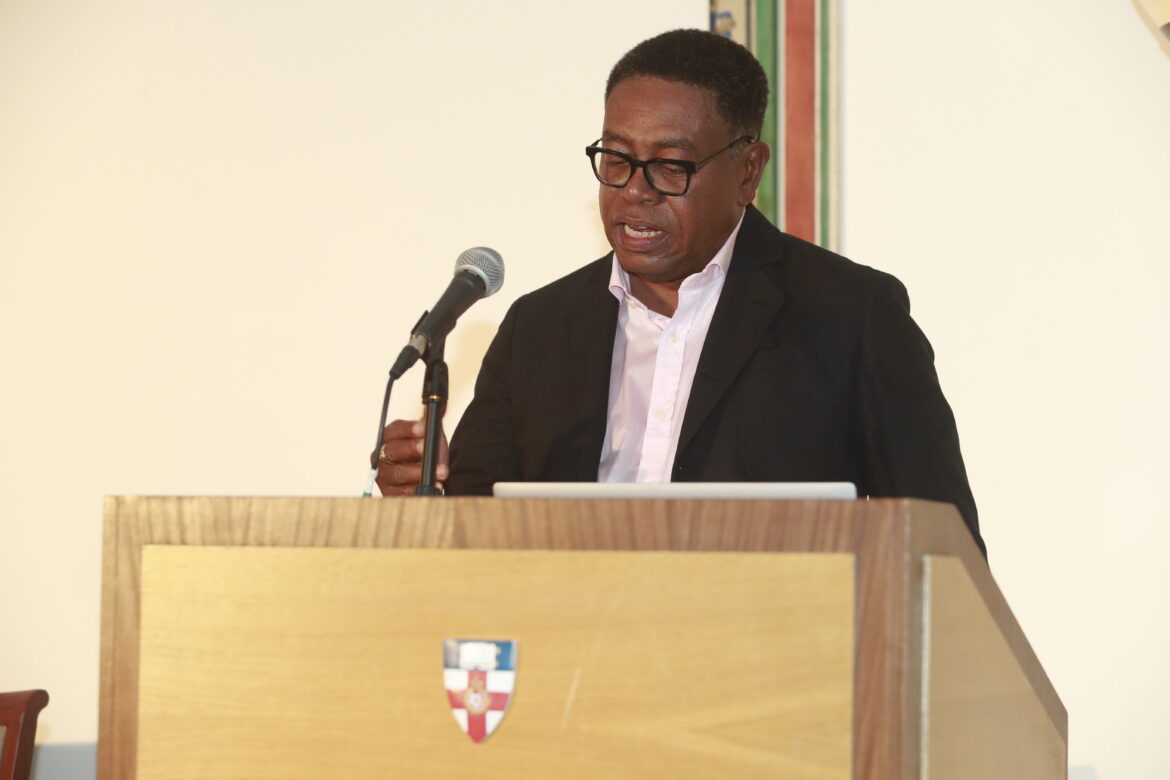
Climate change and energy transition have converged as the two major forces shaping the world in the early 21st century. In the Caribbean, the newly minted petro-state, Guyana, finds itself pulled by both forces, a subject adroitly tackled by Ulric Trotz, former Science Advisor to the Caribbean Community Climate Change Centre in Belize. Sponsored by the Guyana Business Journal and Caribbean Policy Consortium, Trotz’s white paper, On the Intersection of Energy Development and the Environment in Guyana, is timely and on point.
Prior to the 2015 discovery of oil and gas reserves Guyana was regarded as a “poor vulnerable developing country.” As such, it became one of the persistent voices for an international accord to deal with climate change, something which helped push the global community to the Paris Agreement in 2015. Ironically that was the same year Guyana discovered its hydrocarbon wealth. Trotz makes the case that the revenues generated by oil and gas exports should be used to finance Guyana’s transition. This is particularly significant, in that without hydrocarbon revenues, sufficient financing for that transition would probably be difficult or impossible to obtain, a reality that confronts most countries in the Caribbean, many of which are heavily in debt.
Trotz argues that Guyana is working to straddle the divide between helping reduce global carbon and tapping oil and gas wealth. He has little use for the argument to leave the resources in the ground; rather his preference is to use those commodities to finance the shift from fossil fuels to renewables. Trotz believes that the energy transition is going to take time (probably longer than current timetables), financial help from the advanced economies is lagging (and may never match developing country needs), and environmental problems must be dealt with sooner than later.
At home in Guyana, the government is implementing its Low Carbon Development Strategy (LCDS) and Climate Resilient Strategy and Action Plan (CRSAP). The CRSAP places an emphasis on building climate resilient agricultural systems, enhancement and maintenance of the country’s sea defense, public health adaptation to climate change, and strengthening of drainage and irrigation systems. Equally important are measures to upgrade the country’s electricity generation and transportation systems.
The regional approach is based on CARICOM and focuses on the development of energy and food security, constructed around the “internalizing of supply chains for the inputs to support these, and by utilizing the resources from Guyana, Suriname and Trinidad and Tobago.” Thought should be given to determining “the feasibility of rehabilitating the Point Lisas petrochemical facility in Trinidad and Tobago for fertilizer production to support the food security program and other natural gas petrochemicals and explore the possibility of supplying natural gas from the Guyana basin for use by the Point Lisas facility which would avert the need to negotiate access through a pipeline from Venezuela.” Considering that Guyana, Suriname and Trinidad and Tobago are CARICOM members with substantial oil and gas reserves, they should be the countries to provide the rest of the regional membership with fossil fuels, instead of reactivating Venezuela’s Petrocaribe program.
Recent developments on this front are encouraging, including an effort for greater coordination of energy and food policies between Guyana, Suriname and Trinidad and Tobago, a sustained effort to tackle Guyanese-Surinamese issues conducted at the highest levels, and discussions over of how best to streamline regional oil and gas production. Trotz clearly falls on the side of the argument that Guyana does not need to build its own refinery as Trinidad’s refinery has been mothballed for several years. He also warns: the construction of a Guyanese refinery runs the risks “of locking in heavy emissions for years to come and end up as stranded assets at the end of the transition period.”
While oil and gas have a role to play in the transition period, Trotz believes that it is essential to develop its solar, wind and tidal power. Moreover, there should be “supporting programs for waste to energy generation utilizing domestic waste, wood waste from the sawmilling industry and rice husk from the rice industry.” To this list should be added support for a national biomass program for domestic, institutional, and industrial use.
Trotz ends his report with several recommendations, most of which are commonsensical and straightforward. The moist weight of these are to uphold the highest standards for the development and production of oil and gas; the fast-tracking of the implementation of the four priority areas identified in the CRSAP and LCDS (sea defense, drainage and irrigation, agriculture, and health care); and advancing the development of institutional capacity to monitor and regulate the oil and gas industry. Two other items stand out – the need for CARICOM to better coordinate food and energy policies and the promotion of a greater sense of ownership by the Guyanese people of the development of their hydrocarbon industry and the transition to renewables.
It is important for Guyana’s population to believe that it has a stake in the development of the national energy program, how this relates to their daily life, and how the energy transition will take place and impact them. And they need to have confidence that the wealth generated from oil and gas will be used prudently and with transparency. History can serve up many examples of how oil and gas have become a curse instead of a blessing. Guyanese have only to look next door to Venezuela, where the wealth generated by oil led to the erosion of most other economic sectors, a deep stain of corruption, and ultimately authoritarian government. For Guyana, it is essential to get it right and Trotz provides a thoughtful discussion of the country’s options during a period of sweeping transformation.
Dr. Scott B. MacDonald is the Chief Economist at Smith’s Research & Gradings, a fellow of the Caribbean Policy Consortium and a research fellow at Global Americans. His most recent book is The New Cold War, China and the Caribbean (2022).
Media Advisory: Transforming Guyana, Episode XI, Empowering the future, Guyana’s Youth & The Emerging Oil and Gas Economy
Production of the Guyana Business Journal & Caribbean Policy Consortium.
The Guyana Business Journal (GBJ) & Caribbean Policy Consortium host Transforming Guyana Episode XI, Empowering the Future, Guyana’s Youth and the Oil & Gas Economy, on Wednesday, April 12, 2023, at 10:30 AM EST.
Speakers:
- Terrence Blackman: Founder, Guyana Business Journal
- David E. Lewis: VP, Manchester Trade Ltd. Inc. & Co-Chair, Caribbean Policy Consortium
- Elson Low: Economic and Youth Policy Advisor to the Leader of the Opposition, Guyana
- Karen Abrams: Founder, STEMGuyana
- Ronald Austin Jr.: Columnist, Researcher, Historian
- Florence Alexi Larose: Consultant |Sustainable Development| Community Building| Rural Development| Indigenous Peoples|
- Please note Ms. Larose was unable to attend.
Relevant Quotations:
- Dr. David Lewis:
- “The people who are above that age [30 years] and are now sort of riding this wave, eventually will move on. But the new generation is the one that’s really going to be the one-hundred percent technology generation and new energy generation in Guyana, just as has happened here in the USA with the technology generation.”
- “What’s going to equalize Guyana in a flat world is not just the money from oil and gas. It is how Guyana uses that money from oil and gas to really leverage financial resources and invest in the new areas such as technology, invest in the new geniuses and really move up.”
- Elson Low:
- “…we could find quite a bit more oil before all of this is said and done. So there is a strong possibility that Guyana will become the country with the most barrels of oil per person in the entire world. And I know that that might sound, to some, astonishing but I’d like to remind them that right now, Guyana is the country with the second most barrels of oil per person in the entire world. That, to me, really means we have to take a step back and evaluate what the future will look like and what young people’s role will be in this radically, radically different future.”
-
- “This really is quite a train that is leaving the station and it is a great opportunity for young people, but it poses some very serious challenges for young people as well.”
-
- “How do we get from the current situation where you have various crises and various concerns, to a situation where you have a wealthy society where young people benefit hugely? First of all, training and education…In addition to that, the acquisition of housing and assets is something we need to pay close attention to ensure young people have the opportunity to acquire assets. If we’re thoughtful, if we recognize the types of challenges – and if we design specific interventions to deal with those challenges – we can move from being a country where there’s a lot of anxiety about the future… to a society in which young people have tremendous opportunities and capacities.”
-
- “If we don’t provide them [young entrepreneurs] that opportunity to scale, that opportunity to compete, that opportunity to build their businesses, it will be very difficult for them to be able to compete with any corporations that are established. We need to make sure bright and innovative young people have access to capital.”
- Karen Abrams:
- “What we [STEMGuyana] looked at is what was going on in the country and we identified an employment mismatch. Not in numbers – raw numbers – we have enough people to work in the oil and gas or any industry here. The problem is young people with the requisite skills…We have this growing oil economy, but it’s not just the oil economy – it is the fact that agriculture needs talent; mining needs talent; education needs talent; the healthcare industry needs talent.”
-
- “We have billions of dollars today and will have many more billions tomorrow. We need to get enough young people in the pipeline so that in 5, 10, 15 years they can be contributing meaningfully to the development of Guyana.”
-
- “You can’t optimally develop an economy in a small society, tiny population and then have a significant portion [females] of your young people not contributing to the development of the country…Technology in the hands of girls helps to break the cycle of poverty, helps to solve problems impacting the community, and, again, girls make up half the population – it’s just the right thing to do.”
-
- “I am not confident that innovation is done well through government…I want the government to provide a solid infrastructure and to provide a level playing field and be willing to connect in a meaningful way with innovators. Provide the infrastructure for innovators to come in and do amazing things.”
- Ronald Austin Jr.:
- “When I consider youth development in any context, especially oil and gas, I think you have to have several steps in place. First, I think it is important you come up with a developmental master plan which would receive buy-in from the entire society…In my view, you have to consider that youth cannot be seen in an isolated circumstance; it is connected to your development master plan, it is has to be considered an important part of the process.”
-
- “If you’re going to have a framework, within which you come up with policies directed to youth connected to a master plan, there has to be continuity. In my estimation, for you to have that there has to be a) buy-in and b) you have to have some legislative protection insofar as that is possible in the Guyana context. The second thing is you have to consider the structure of this intervention. And as you do that, I’m of the view that you have to do a serious, serious situation analysis and you have to, from a policy standpoint, have the ages of youth. You have to pin that down.”
-
- “If you have your development vision, your interventions have got to be connected. If your eventual vision is where you’re using the revenues from the oil and gas economy to develop a knowledge-based economy then your interventions have to go mirror that aim or objective.”
Terrence Blackman, Ph.D., Founder & CEO Guyana Business Journal terrence.blackman@guyanabusinessjournal.com
Dr. David E. Lewis, Fellow and Co-Chair, Caribbean Policy Consortium DavidLewis@ManchesterTrade.com
ExxonMobil has announced the arrival of the Prosperity FPSO, Guyana’s third oil production vessel, which will commence production in the Payara field of the Stabroek Block later this year. The production manager of ExxonMobil Guyana, Mike Ryan, expressed his excitement about contributing to the energy future of Guyana and creating opportunities for the nation’s growth and prosperity. The Prosperity, constructed by SBM Offshore, has an initial production capacity of approximately 220,000 barrels of oil per day and a storage volume of two million barrels.
The Prosperity FPSO joins the Liza Destiny and Liza Unity FPSOs, which currently produce more than 380,000 barrels daily. Production from the Prosperity vessel is expected to push daily production to some 600,000 barrels daily in 2024.
Navigating the Futuristic Crossroads: Should We Keep Up the Momentum or Phase Out Future Developments in Oil & Gas?
Re: Intelligently spacing out oil & gas developments
By
Joel Bhagwandin
Dear Editor,
I thank the Economic Advisor to the Leader of the Opposition for engaging me in the aforementioned topical debate. Readers would recall that in sections of the media, it was reported that the opposition is proposing the phasing out of oil and gas development or slowing down the pace of development. However, in his response to the undersigned’s article that appeared in certain sections of the media, he’s clarified that the opposition’s position is to “intelligently space out” future oil and gas developments. It remains unclear, however, as to what exactly this means for the opposition and how they propose to do so.
The Economic Advisor failed to illustrate by way of any analysis or economic modeling, at least at a high level, how intelligently spacing out future developments would work in practice―without disrupting the economy’s momentum. Notwithstanding, since the opposition’s clarification on this matter has proved unhelpful―the opportunity is presented to further develop the argument in support of the Government’s strategy to ramp up the pace of development in the sector over the medium term.
As explained in the undersigned’s recent column, the project lifecycle in the oil and gas industry includes three stages―namely, exploration, development, and production, spanning, on average, 30-40 years. In the case of Guyana, for example, exploration before the discovery of oil in commercial quantities lasted fifteen (15) years, followed by the development stage, which spanned another five (5) years before moving into production. And according to the terms of the production license, this is another twenty (20) years to produce the resource. In other words, it took twenty years before a single barrel of crude oil was produced to generate revenue from the sale/monetization of the resource in the Stabroek Block.
With this in mind, given the nature of the industry―that is, the petroleum geology of the fields, the engineering, and the economics, among other factors, developments in the industry are naturally and sufficiently spaced out. Bearing in mind that the geology and economics of each field are often times not the same. The aim, therefore, is to encourage and facilitate ongoing exploration in the sector. In so doing, should there be future commercial finds, by the time those new discoveries are developed, these should start to produce simultaneously―or to coincide with the decline curve of the currently producing fields.
In other words, if the Government opts to “intellectually space out” future developments, whatever this means if, for instance, it means that new exploration will be permitted every five years and new production licenses will be issued every three-four years, then the current producing fields will eventually start to decline. Hence, in the absence of new developments on stream, by the time production starts to decline, the country will have to endure declining production, which would translate into a loss of revenue to the national treasury and an overall decline in economic activities across the oil and gas value chain.
To the contrary, there are case studies of other petroleum-producing countries in the region, namely, Trinidad and Tobago and Venezuela, that, for various reasons, did not facilitate undisrupted ongoing exploration. The result in both cases is a declining economy, thus engendering a plethora of economic problems and challenges in these two countries. Additionally, there are several other global factors to consider that sufficiently justify the need to maintain the current pace of development. These are:
- In the Global oil outlook to 2040 report (2021) by McKinsey & Company, it is projected that new oil drilling is needed to meet demand by 2040. It states that by 2040, exploration and production companies need to add 38 MMb/d if new crude production from unsanctioned projects is to meet new demand. The newest production is expected to come from offshore and shale resources.
- Even in an accelerated energy transition scenario, McKinsey sees the need for new oil drilling by 2040. While most offshore regions will be under pressure in an accelerated energy transition scenario, the sector will still require new production of nearly 23 MMb/d to meet demand by 2040. Demand in a 1.5oC-pathway will force shut-ins.
The implications for Guyana based on scenarios (a) and (b) above are such that Guyana could lose out on the opportunity to be part of the global supply chain during this period―after which (beyond 2040, i.e.) the uncertainties in the global crude market will only deepen.
- By spacing out future developments to benefit from higher profit oil in the short-term (theoretically); having regard for the risks and volatility of the industry, capital raised for future developments may have to come from external sources versus internal sources of financing. This can be problematic in terms of the cost of capital for oil and gas development and scarcity of capital for oil and gas development in the future, which would only compound the cost of capital.
The current and future developments are financed from the operating cash flows from current operations, which is enabled by the lack of ring-fencing, viz-á-viz, the 75% cost recovery ceiling. Consequently, the cost of this form of financing is cheaper than raising capital externally through debt and equity financing.
That said, it should be noted that there are two types of ring-fencing: one relates to the geology and commercial viability of the wells―in terms of whether the exploration cost for a dry well is allowed to be recovered from another commercially viable well within the same field, or should it be disallowed and treated as a sunk cost. The other type of ring-fencing- the more contentious form―relates to the fiscal regime. For tax purposes, ring-fencing typically applies in determining the taxable income per field, thereby effectively disallowing future field developments to be financed from the operating cash flows generated from other existing/producing fields.
It is against this background that the proposal by the opposition to “intelligently space out” future developments in oil and gas has not been thoroughly informed. Accordingly, the case is made out herein, demonstrating that the opportunity cost to the country, in the long-term, is likely to far exceed the benefit.
Yours sincerely,
Joel Bhagwandin
Financial and Public Policy Analyst
Navigating the Futuristic Crossroads: Should We Keep Up the Momentum or Phase Out Future Developments in Oil & Gas?
Dear Editor,
I note with disappointment comments by a certain Joel Bhagwandin, in which he attempts to argue that the Opposition’s plan to phase out future developments is ill-advised. The problem is that the Opposition has no plan to phase out future developments and has never said anything to that effect. Compounding his confusion, Mr. Bhagwandin presents two scenarios from his imagination: oil production climbs to 1,000,000 barrels daily, and oil production is frozen at 350,000 barrels daily. He proceeds to demonstrate that under the scenario of only producing 350,000 barrels of oil daily, Guyana would have less revenue than if 1,000,000 barrels of oil per day were produced. It doesn’t take a genius to tell you that.
What is amusing is that Mr. Bhagwandin seems to have put so much effort into an analysis that has nothing to do with the opposition’s advocacy. It is possible that he did not read the Opposition’s remarks on this issue or did not understand them in his rush to respond. We never said that all future oil developments should be “phased out,” but rather that through intelligently spacing them out, we can increase the share of profit oil the country receives. This is because as each existing development is gradually paid off from cost oil, the percentage of profit oil rises. When other developments come on stream, at a slower rate than the current mad rush, we will be able to maintain a higher rate of profit oil because costs are incurred at a slower rate. I am disappointed to see Mr. Bhagwandin respond to something he perceives rather than what I said. It cuts the conversation short, denying the Guyanese people the opportunity to engage in intelligent dialogue. I would advise him to read more slowly on the next occasion. It may serve him well.
Yours,
Elson Low,
Economic and Youth Policy Advisor to the Leader of the Opposition
Navigating the Futuristic Crossroads: Should We Keep Up the Momentum or Phase Out Future Developments in Oil & Gas?
By
Joel Bhagwandin
Summary
Any attempt to gradually phase out new developments will cause the momentum in the industry to be disrupted at the expense of slowing down economic activities in the broader economy and throughout the oil and gas value chain―only for supposedly higher short-term gains to the national treasury. The analysis herein demonstrates that with the continued rapid development to facilitate the ongoing approval of projects, the momentum in the economy can be maintained with minimal disruption in the economy―save and except those that may be attributed to other external, economic, political, and geopolitical factors that may arise while accruing over the longer-term, higher economic rent flowing into the national treasury.
Background
The author noted with interest the contentions proffered by the economic advisor to the Leader of the Opposition in phasing out future developments in the Stabroek block. This argument aims to maximize Guyana’s share of profit eventually.
Discussion and Analysis
It appears, however, that the aforesaid position was not informed by any analysis or proper study of how the industry works to understand the intricacies of the project lifecycle and/or, at minimum, an economic model of the Stabroek block.
The lifecycle of these projects includes three stages- exploration, development, and production spans- on average, 30-40 years. In the case of Guyana, for example, exploration before the discovery of oil in commercial quantities lasted fifteen (15) years, followed by the development stage, which spanned another five (5) years before moving into production. And according to the terms of the production license, this is another twenty (20) years to produce the resource. In other words, it took twenty years before a single barrel of crude oil was produced to generate revenue from the sale/monetization of the resource.
An elementary understanding of oil and gas decline curves is a prerequisite before engaging in any such discussion or debate. In this respect, in the petroleum economics literature, the decline curve basics state that when oil and gas are initially produced, it is known as primary production. Though a few exceptions exist, production from a strong water-drive reservoir may initially be flat. However, as oil or gas is produced, the water moves toward the well and eventually begins to be produced, at which time oil or gas production begins to decline. In cases where the production is limited to production facilities, the production is curtailed (CED engineering).
“As time passes, the reservoir pressure declines when the well can no longer produce at the curtailed rate, and production begins to decline. Water or other fluids (gas, CO2, etc.) may be injected into the reservoir to increase production and reserves in oil and gas wells. This is more common in oil reservoirs than gas reservoirs. Injecting fluids requires additional wells to be drilled or some existing producing wells to be converted to injection wells. The purpose of these injected fluids is to increase the reservoir pressure and push oil and gas to the production wells. If this occurs during or after primary production, this is known as secondary recovery. If some secondary recovery has already been done, it is known as tertiary recovery. The oil and gas production from secondary and tertiary recovery projects will typically increase until some point in time and then eventually decline as those injected fluids, along with oil and gas produced.” (CED engineering). Further, “regardless of whether a well is under primary, secondary, or tertiary production, it should be evident that production from wells will eventually decline. That being the case, this course will present information about methods used to forecast production decline. These methods are known as decline curve forecasts” (CED engineering).
With the aforementioned in mind, it, therefore, follows that any attempt to gradually phase out new developments will cause the momentum in the industry to be disrupted at the expense of slowing down economic activities in the broader economy and throughout the oil and gas value chain―only for supposedly higher short-term gains to the national treasury. Alternatively, by ramping up production, inter alia, encouraging ongoing exploration and development of the resource at a rapid pace, over the longer term, higher economic rent is more likely to be accrued in the form of the Government’s share of profit oil, all things being equal.
For illustration purposes, the undersigned ran some quick calculations considering the following assumptions:
- In scenario one, oil is produced at the current rate of production of 350,000 bbls/d, and all other developments are halted,
- In scenario two, oil is produced at 1,000,000 bbls/d from ten FPSOs
- The average price of US$75,
- Payback period of 5 years,
- Profit oil during cost recovery at 12.5%, and profit oil post cost recovery at 30%,
- The production life of the projects is 20 years, and
- The first fifteen years of production is flat before declining in the outer years towards the end at 25% per annum―thereafter.
The findings demonstrated that in the first scenario―Guyana’s cumulative profit oil will amount to US$54 billion over the 20 years period. Conversely, in the second scenario, as described above, the cumulative profit of oil over the 20 years period will amount to US$80.3 billion.

Scenario one: Author’s Calculation
The second scenario demonstrates that with the continued rapid development to facilitate the ongoing approval of projects, the momentum in the economy can be maintained with minimal disruption in the economy save and except those that would be attributed to other external, economic, political, and geopolitical factors that may arise.

Scenario Two: Author’s Calculation
Finally, it is left now up to the readers/Guyanese to determine―in view of the foregoing background―which of the two scenarios is the better or preferred alternative for the country, given the country’s development needs and the aggressive pursuit of creating sustainable and increasing prosperity for the country and its people.
About the Author
Joel Bhagwandin is a financial and public policy analyst. He is also an entrepreneur with over fifteen years of experience in the financial sector; corporate finance; financial management; consulting, and academia. He has provided insights and analyses on various public policy, economic, and finance issues in Guyana for the past 6+ years. He has authored more than 300 articles covering a variety of thematic areas. Joel has also written extensively on the oil and gas sector. Joel holds an MSc in business management with a specialism in banking and finance from Edinburgh Napier University. He is currently pursuing his second and third masters: 1) MBA (Finance) (Top-up) through Edinburgh Napier University, and 2) MSc. in Finance (Economic Policy) through the University of London.
References:
__________
- https://www.cedengineering.com/userfiles/Forecasting%20Oil%20and%20Gas%20Using%20Decline%20Curves.pdf.
- https://www.eia.gov/analysis/drilling/curve_analysis/.
- https://www.guyanastandard.com/2023/04/06/govt-s-plans-to-fast-track-oil-industry-for-15-years-reckless-opposition/.
From Black Gold to Green Fields: The Promise of Guyana’s Oil Wealth in Supporting Agriculture
By
Dr. Carolyn Walcott & Dr. Terrence Blackman
Guyana, a small country on the Atlantic coast of South America, is in the throes of a significant economic transformation. The 2015 discovery of large oil and gas reserves off its coast completely changes the country’s trajectory. Guyana is forecasted to produce 1.7 million barrels per day (bpd) of oil by 2035. It is expected to earn billions of dollars in revenue, with some estimates suggesting that the country is likely become one of the wealthiest in the region.
However, Guyanese must know the potential pitfalls of relying solely on oil revenue, and they must explore ways to use this newfound wealth to support other sectors of the economy. One priority area deserving of amplified support is the agricultural sector. With suitable investments, Guyana’s oil wealth could catalyze sustainable farming practices, boost agricultural productivity, and transform the country into a green oasis. Prompted by Episode IX of the Guyana Business Journal and Caribbean Policy Consortium Series Transforming Guyana, we reflect on the promise of Guyana’s oil wealth in supporting agriculture and the potential challenges ahead.

(n.d.). Guyana’s Exports (2020) Total: $2.99B. The Observatory of Economic Complexity. Retrieved March 21, 2023, from https://oec.world/en/profile/country/guy
Oil is the backbone of Guyana’s 2023 economy. Crude oil accounts for approximately 40% of the nation’s exports. While large oil reserves have the potential to bring in billions of dollars in revenue, it also poses significant risks. The volatility of oil prices means that Guyana’s economy could be severely impacted if oil prices plummeted. Additionally, an economic overreliance on oil can lead to a neglect of other sectors of the economy, resulting in an unbalanced economy that is vulnerable to shocks. Therefore, diversifying the economy beyond oil revenue is crucial for Guyana’s long-term economic stability.
Agriculture is a critical sector that must play a decisive role in diversifying Guyana’s economy. By investing in agriculture, Guyana can reduce its reliance on oil revenue, boost its economic resilience, and create new socioeconomic growth and development opportunities.
A critical appraisal of Guyana’s agriculture sector requires retrospection, incorporating the colonial occupancy, the plantocracy, the enslaved labor force drawn from the African transatlantic slave trade, and the indentured laborers from East Asia. Guyana has had a long history of agriculture, with sugar as king. However, it was recently reported that The Guyana Sugar Corporation (GuySuCo) has set one of its lowest production targets in years. The target for the 2023 first crop has been set at 16,000 tons. Last year’s first crop had a production target of 20,261 metric tons, but the corporation only managed to produce 13,076 metric tons of sugar. The era of sugar is over. Despite these challenges, agriculture still has enormous potential in Guyana. The country’s fertile soil and favorable climate make it an ideal location for various crops, including rice, which accounted for approximately 9% of the country’s 2020 exports, fruits, vegetables, and spices. There is also significant potential for livestock production, particularly in the poultry and dairy sectors.
Despite its potential, the agricultural sector in Guyana faces several challenges. One of the most pressing is the need for more infrastructure. Many farmers in Guyana need access to basic infrastructure such as roads, irrigation systems, and storage facilities. Otherwise, this makes it difficult to transport goods to market and store them properly, leading to significant losses. Another challenge facing the agricultural sector in Guyana is the need for more access to credit. Many small-scale farmers in the country need help to access the financing they need to invest in their farms and improve their productivity.
In a sense, the privileging of the colony’s plantation sector, above others, undermined Guyana’s small-scale farming through the lack of financing and the development of necessary supporting infrastructure for optimal production. Over a century later, the small farming sector faces real financing challenges and climate change. Senior lecturer at the University of Guyana’s Faculty of Agriculture and Forestry, Dr. Elroy Charles, has suggested that early warning systems are necessary for farmers to implement measures to mitigate climate change, even as they consider diversifying. He also believes that effective zoning is needed for agriculture, housing, and mining, as these intersect with increased agriculture production. In the meantime, the agriculturalist offered that small farmers require assistance with low-interest rates through a facility such as the now-defunct Guyana Agricultural Industrial Bank (GAIBANK).
Sustainable farming practices are crucial for the long-term health of the agricultural sector in Guyana. These practices help to preserve the country’s natural resources, improve soil health, and reduce the use of harmful chemicals. Oil revenue will be crucial in supporting sustainable farming practices in Guyana. By investing in research and development, the government can catalyze the identification and promotion of sustainable farming practices appropriate for Guyana’s unique climate and soil conditions. Additionally, by funding training and education programs, the government can help farmers adopt these practices and improve their productivity.
Agro-processing and value-added agriculture can also significantly boost the profitability of the agricultural sector in Guyana. By processing raw agricultural products into finished goods such as juice, jams, and sauces, farmers are likely to capture more of the value of their products and create new growth opportunities. Cheaper electricity—soon to be powered by natural gas and hydro—is essential for an internationally competitive food processing industry. Additionally, the government can create a favorable regulatory environment for the agricultural sector. This includes policies that promote land tenure security, protect the environment, and provide industry investment incentives.
Collaboration between the private and public sectors is crucial for supporting the agricultural sector in Guyana. The private sector can play a key role in investing and providing technical expertise. Additionally, collaboration between farmers is crucial for improving productivity and profitability. Farmers can reduce costs and improve their bargaining power by forming cooperatives and sharing resources.
A country’s resource wealth does not necessarily guarantee national development. But oil brings hope. Guyana’s oil wealth can transform the country’s economy, but it poses significant risks. Diversifying the economy beyond oil revenue is crucial for long-term economic stability, and agriculture has the potential to play a vital role in this diversification.
However, the agricultural sector in Guyana faces significant challenges, including, critically, a need for more infrastructure and access to credit. Oil revenue will be crucial in addressing these challenges and supporting development as a new agricultural sector emerges that centers its role alongside the oil and gas industry.
Dr. Carolyn Walcott is a media and communications educator and scholar with a diverse background in journalism education, international communication, and media development. She received her undergraduate degree in Communication and her Graduate Diploma in International Studies at the University of Guyana. She completed her M.A. in Communication and Development at Ohio University and her Ph.D. in Communication at Georgia State University. Her research agenda focuses on media pedagogy and practice, national identity, rhetoric, and political communication.
Dr. Terrence Richard Blackman is a member of the Guyanese diaspora. He is an associate professor of mathematics and a founding member of the Undergraduate Program in Mathematics at Medgar Evers College. In addition, he is a former Dr. Martin Luther King Jr. Visiting Professor at MIT and a member of The School of Mathematics at The Institute for Advanced Study. He previously served as Chair of the Mathematics Department and Dean of the School of Science, Health, and Technology at Medgar Evers College, where he has worked for more than twenty-five years. He graduated from Queen’s College, Guyana, Brooklyn College, CUNY, and the City University of New York Graduate School.
Is the practice of apartheid present in Guyana?
By
Neville J. Bissember
Article I of the 1973 International Convention on the Suppression and Punishment of the Crime of Apartheid declares that ‘apartheid is a crime against humanity and that inhuman acts resulting from the policies and practices of apartheid and similar policies and practices of racial segregation and discrimination, as defined in article II of the Convention, are crimes violating the principles of international law…’
The Convention defines the crime of apartheid in Article II by comparing a number of examples to ‘…similar policies and practices of racial segregation and discrimination as practiced in southern Africa’, which have the stated purpose of ‘…establishing and maintaining domination by one racial group of persons over any other racial group of persons and systematically oppressing them’. It remains the case that the policy which prevailed in twentieth-century southern Africa, specifically South Africa and Rhodesia (now Zimbabwe), has always been the litmus test for the existence or otherwise of this despicable, degrading, and dehumanizing practice known as apartheid.
While Article II rightly includes in the definition of apartheid acts such as murder, inflicting serious bodily and mental harm, arbitrary arrest, and illegal imprisonment that are aimed at a racial group or groups, it also includes acts that are more policy-oriented, such as:
‘Any legislative measures and other measures calculated to prevent a racial group or groups from participation in the political, social, economic, and cultural life of the country and the deliberate creation of conditions preventing the full development of such a group or groups, in particular by denying to members of a racial group or groups basic human rights and freedoms, including the right to work, the right to form recognized trade unions, the right to education, the right to leave and to return to their country, the right to a nationality, the right to freedom of movement and residence, the right to freedom of opinion and expression, and the right to freedom of peaceful assembly and association; and
Any measures, including legislative measures, designed to divide the population along racial lines by the creation of separate reserves and ghettos for the members of a racial group or groups, the prohibition of mixed marriages among members of various racial groups, the expropriation of landed property belonging to a racial group or groups or to members thereof.
Furthermore, the Rome Statute of the International Criminal Court defines a crime against humanity by a number of acts ‘…when committed as part of a widespread or systematic attack directed against any civilian population, with knowledge of the attack’. Apartheid is listed as one such crime and is characterized as ‘…inhumane acts …committed in an institutionalized regime of systematic oppression and domination by one racial group over any other racial group or groups and committed to maintain that regime’.
History.com would tell any social media junkie who is easily led down the path of sensationalism and race-baiting that apartheid, or “apartness” in the language of Afrikaans, was a system of legislation that upheld segregation against non-white citizens of South Africa. After the National Party gained power in South Africa in 1948, its all-white government immediately began enforcing existing policies of racial segregation. Under apartheid, nonwhite South Africans – a majority of the population – were forced to live in separate areas from whites and use separate public facilities. Contact between the two groups was limited. Despite strong and consistent opposition to apartheid within and outside of South Africa, its laws remained in effect for 50 years. In 1991, the government of President F.W. de Klerk began to repeal most of the legislation that provided the basis for apartheid.
By 1950, the government had banned marriages between whites and people of other races and prohibited sexual relations between Black and white South Africans. The Population Registration Act of 1950 provided the basic framework for apartheid by classifying all South Africans by race, including Bantu (Black Africans), Coloured (mixed race), and white.
As an aside, let me call out the Guyana Police Force for still insisting that in this 21st century, per their “protocols’’, someone making a report at a station is obliged to state their race! Granted that in cases of describing a missing person or a suspect, such information may be relevant, but apart from the name, address, and contact information of the person making the report, their race and even their age is of absolutely no consequence to the arrest and/or eventual prosecution of an offender, save and except in cases of say, the rape of a minor: Stuckinthepast.com!
Continuing, a series of Land Acts set aside more than 80 percent of the country’s land for the white minority and “pass laws” required non-whites to carry documents authorizing their presence in restricted areas. To limit contact between the races, the government established separate public facilities for whites and non-whites, limited the activity of nonwhite labor unions and denied non-white participation in national government.
In Guyana, there is no comparable policy, whether legislative or otherwise, to institutionalize any of the acts listed above in the various categorizations of apartheid, e.g., separate land reserves and ghettos, prohibition of mixed marriages or sexual relations between races, limiting access to public spaces like hotels, restaurants, and malls or public washrooms, based on race.
To the contrary, Guyana is Party to various International Human Rights Conventions, including the 1973 Apartheid Convention cited earlier. Protection of a number of fundamental rights is also available under the Guyana Constitution, and more recently, legislation has been enacted on discrimination and hate speech, incitement, and other contentious acts.
The foregoing information on the internationally recognized crime of apartheid, which is in the public domain and creates a stark contrast when juxtaposed with the local situation, has not prevented various commentators from seeking to cast that awful specter associated with the practice across the racially charged demographics of Guyana. Indeed images of houses being bulldozed in the predominantly Afro-Guyanese Mocha area to make way for road construction and developmental work, notwithstanding previous notifications and advisories, have unfortunately conjured up memories of Soweto and incredulously led one critic to label Guyana “the bruk down capital of the world.” However, that is where the similarity if at all, begins and ends.
Constitutional protection in Guyana against deprivation of property is provided in Article 142(1) as follows: ‘No property of any description shall be compulsorily taken possession of, and no interest in or right over property of any description shall be compulsorily acquired, except by or under the authority of a written law and where provision applying to that taking of possession or acquisition is made by a written law requiring the prompt payment of adequate compensation.’ In other words, the State has the authority to compulsorily acquire lands for public purposes such as road building, as is the case in Mocha, provided that compensation that is prompt, adequate, and effective is paid to those dispossessed. In the US, this is referred to as eminent domain.
Whether by coincidence or contrivance, “People memory in Guyana short!”: in 1966, when newly-independent Guyana launched its development thrust, the government announced plans to construct the West Bank Demerara Highway, which would require the compulsory acquisition of property (sound familiar, if you were to fast forward to the current Mocha situation?). A landowner, Ms. Olive Jaundoo, fearing that she would lose her Constitutional protection and be deprived of her agricultural lands and a sand pit, approached the courts for redress, thereby writing independent Guyana into the pages of Caribbean jurisprudence in the (in)famous case of Jaundoo v. the Attorney General of Guyana.
By the time the case reached the Privy Council five years later in 1971, this is what Their Lordships had to say: ‘The construction of the new road upon the Land has long since been completed. Whether or not this was in contravention of the Landowner’s fundamental rights under the Constitution has not yet even been considered by the High Court of Guyana or by the Court of Appeal. The only matters which have been so far considered are two questions of procedure’. So much for prompt adequate and effective compensation!
In fact, in a feat of judicial dexterity, to which Justice P. A. Cummings dissented, the court fiddled while Nero burned, pontificating on nice procedural issues of the manner in which the plaintiff should have approached the Court – whether by Writ of Summons or Notice of Motion – and Mrs. Jaundoo lost her property. So those who scream from the top of their voices now about apartheid and “brukking down” and constitutional protection, in an effort to work their supporters up into a frenzy, should pause to reflect on from whence we in Guyana cometh, as regards compulsory acquisition of property, particularly for the purpose of road building.
In a separate but not unrelated instance, criticism has been recently lobbed in the direction of Barbados Prime Minister Mia Mottley, for devaluing the role of Forbes Burnham in the Southern African liberation struggle. To his supporters and to those among us who are instigators of apartheid-mania, I urge them to do some deep introspection: from the first-hand accounts of colleagues in the UN who fought in those liberation struggles before joining the South African and Zimbabwean Foreign Services, I estimate that a similar disservice is being done here by devaluing the epic achievements against the oppressors when spurious claims are made by comparison about apartheid in Guyana. As the brother of a late member of the Officer Corps of the Guyana Defence Force who played his role in Guyana’s material support during that period, I say, Shame on Them!
In so far as it is reprehensible and incongruous for supporters of a political party in a West Indian territory, which championed the cause of the Southern African liberation movements, to be trivializing those struggles by comparing them to occurrences of lawful compulsory acquisition of land, it is equally the case when a near-extinct political party, fighting to be relevant, could be susceptible to the charge of sowing the seeds of disunity and racial strife. From being a Party that practiced big-tent, democratic and unifying politics, whose senior leadership comprised both Afro-Guyanese and Indo-Guyanese who were focused on removing Forbes Burnham from power, that Party metamorphosed into a coalition partner with its age-old rival, the PNC, even lending support to some of the latter’s 2020 election shenanigans, which it had devoutly opposed during the last century and early 21st century. To now seek to pit Afro-Guyanese civilians and uniformed ranks against a predominantly Indo-Guyanese government must have Walter turning in his grave! Again, it is apposite to reflect on from whence we cometh.
Another irresponsible allegation sometimes made here in loosely worded speech is the existence of ethnic cleansing. This term, which has been examined and categorized in international fora, finds definitions in the UN lexicon thus: “rendering an area ethnically homogeneous by using force or intimidation to remove persons of given groups from the area” or “… a purposeful policy designed by one ethnic or religious group to remove by violent and terror-inspiring means the civilian population of another ethnic or religious group”.
As is the case with apartheid, it cannot escape the notice of the local purveyors of racial doom that ethnic cleansing is usually the result of a centrally driven policy, but none such has ever been implemented in Guyanese society. So, just as how, if you wanted to see apartheid, you had to look at race relations in South Africa between Whites and Blacks before 1994, so too, with ethnic cleansing, you cannot look beyond the brutality and barbarism that occurred in the former Yugoslavia in 1991/92 between Serbs and Croats, or Rwanda and Burundi in 1994 between Hutu and Tutsi, to see anything approximating either despicable practice.
While the threshold for a policy of apartheid has never been met in Guyana, what remains to be said is that the Constitution in Article 149 protects from discrimination on the grounds of race. Although qualitatively racial discrimination needs to be distinguished from the abhorrent system of apartheid, the option of bringing a constitutional motion is always available to those who feel strongly that the current administration is disadvantaging them, be it in the award of contracts, employment, house lot allocation, treatment by the police and so on. This is so, provided that their case is evidence-based and well documented, and they can establish damage or loss of opportunity caused by such acts or omissions alleged to be discriminatory.
Those who preach the hate speech that characterizes apartheid should revisit its history, particularly the composition of the various Cabinets of Governments throughout 20th-century South Africa. For most of that period, the Cabinet consisted of only Whites, until in 1984, for the first time, President Pieter W. Botha included a Coloured and an Indian, but no Blacks. In 1988, President Botha proposed for Blacks to be in Cabinet. In 1992, Parliament vetoed a proposal of President F.W. de Klerk for Blacks to be included in Parliament. Two years later, the African National Congress led by Nelson Mandela came to power, with Mandela becoming the first black President of South Africa. Ole people say, “time longer than twine.”
In reflecting on the largely homogeneous composition of the South African Parliament during the apartheid era, this has to be contextualized against the composition of the country’s broader population, which averaged 68% Black and 20% White, with the remainder being Coloureds and Asians. Hence the total disparity between the races as regards political office and population composition is patent.
In contrast, it should be pointed out that, besides the fact that the composition of Guyana’s population is much more evenly distributed between Afro-Guyanese and Indo-Guyanese, there has never in Guyana been a post-independence Cabinet, under any administration, which was composed of persons of only one race. As with the previous government’s Cabinet, the Cabinet of President Ali is composed of persons of African, Amerindian, Indian, Portuguese, and mixed heritage – diverse and inclusive. Denial of access to political power, or even the right to vote, was one of the infamous hallmarks of the apartheid system, which is not the case in Guyana.
One can conclude that as the threshold for the existence of a policy of apartheid has never been met in Guyana, references and analogies, and comparisons to it as regards what is happening in Guyana are good political fodder for certain political bases, but nothing more. Some may argue that this conundrum has less to do with high-sounding theories and international law principles and more with desperate race-baiting and grassroots politics on the ground in this highly charged political environment that was bequeathed to us by our colonizers.
Nevertheless, this nonsensical and misleading talk of apartheid in Guyana should cease, and we – both the Government and the Opposition – should get on with the business of running the country, through the use of creative conflict resolution strategies and the recalibration of the vision of nation-building and development, by putting flesh on the bones of slogans like Social Cohesion and One Guyana.
Oh yes, and a lil more hand-shaking and less “cussing down” and shouting across the divide at each other instead of holding civil and principled exchanges would go a long way too…
The Guyana Business Journal (GBJ) & Caribbean Policy Consortium welcome you to Episode XI of the Webinar Series, Transforming Guyana, Wednesday, April 12, 2023, at 10:30 AM EST.
Panelists: Karen Abrams, Founder STEMGuyana; Ronald Austin Jr., Columnist; Florence Alexi Larose, Consultant on Sustainable Development, Community Building, and Rural Development for Indigenous Peoples; and Elson Low, Economic and Youth Policy Advisor to the Leader of the Opposition, Guyana.
Please Register Here
Livestream
Essential Questions: How can we systemically and systematically empower young Guyanese, especially marginalized youth, to play a more active role in contributing to and benefitting from national development spurred by the emerging Oil and Gas economy?
How do we engage younger generations in the diaspora through the effective use of technology, social media, and innovative approaches to mentoring?
Moderators
Dr. David Lewis & Dr. Terrence Blackman.