
A GBJ Series · Beyond the Resource Curse
Article 8 of 12
The Norway deal, Indigenous consent, and a resource that pays by standing still.
This essay is part of the twelve-part series “Beyond the Resource Curse.” Read the foreword, “The Autonomous Imagination.”
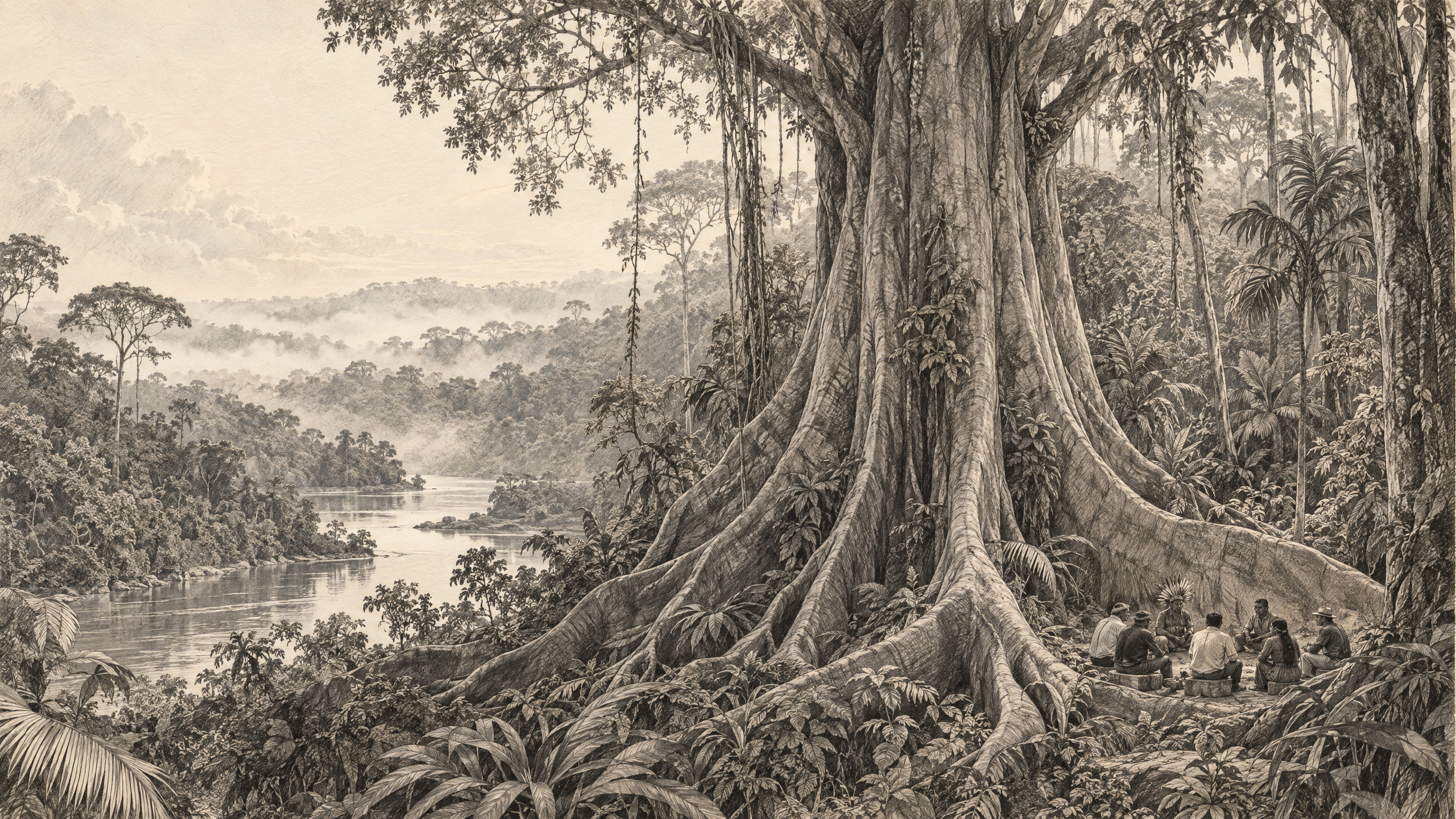
I spent real years of my working life sitting in rooms with foresters, government officials, and village leaders, trying to help this country write policy for the eighty-five percent of itself that is still standing forest. I want to tell you what that work taught me, because the forest has become, in its own quiet way, the newest test of the autonomous imagination this series keeps returning to — and it is a test we are still in the middle of, not one we have already passed or failed.
The Deal That Was Ahead of Its Time
Back in 2009, Guyana signed an agreement with Norway that was, in honesty, one of the more imaginative pieces of policy this country has produced in my lifetime. The idea was simple to say and hard to execute: pay Guyana not to cut down its forest, because a standing forest holds carbon the whole world needs held, and a nation poor in cash but rich in trees should not have to choose between development and keeping that forest intact. The Low Carbon Development Strategy, and the payments that came with it, put Guyana on the map as a country trying something other resource nations were not even attempting. Wan tree standing does do more wuk than a hundred cut down and sold.
I was proud of that agreement, and I remain proud of the thinking behind it. But I also watched, from inside the stakeholder consultations I helped lead, exactly how hard it is to turn a good idea at the treaty level into something that feels real and fair at the village level. That gap is the whole subject of this piece.
Whose Consent, and What It Actually Means
Here is where I have to be honest about something I saw up close. Much of Guyana’s forest sits on land that Indigenous peoples have lived on, managed, and depended on for far longer than the word “Guyana” has existed. Any serious forest policy — the LCDS then, the Green State Development Strategy since, the more recent conversations around carbon credit sales to companies looking to offset their emissions — has to pass through a question that is not just legal but moral: did the people who actually live in that forest consent to what is being done with it, and did they consent with real information and real bargaining power, or did they simply not object loudly enough to stop it?
I sat in consultations where this question was handled with real seriousness, and I sat in others where it was closer to a formality — a box ticked so the larger deal could proceed. Free, prior, and informed consent is a phrase that sounds simple in a policy document and is enormously difficult to deliver in practice, especially across dozens of Indigenous communities with different languages, different relationships to the land, and different levels of access to the technical detail buried inside a carbon credit agreement. A forest policy that gets the atmosphere right and gets the people living inside the forest wrong has not actually solved the problem it claims to solve.
The Living Text
I mentioned Wilson Harris earlier in this series, and I want to return to him here, because nothing in Guyanese thought prepared me better for this work than his insistence that our landscape is not empty space waiting to be used, but something closer to a living text — a thing that is already speaking, already remembering, already in relationship with the people who have always lived inside it. A forest policy written only in the language of carbon tonnage and dollar value per hectare cannot hear that text at all. It measures the forest the way a bauxite company once measured ore — as a quantity to be extracted, just extracted more slowly this time, and dressed in the language of conservation instead of industry.
The forest, unlike bauxite or gold, offers Guyana something genuinely rare: a resource that can generate revenue precisely by not being extracted. That is, in principle, an escape route from the whole pattern traced so far. But it is only an escape route if the money that flows from keeping the forest standing actually reaches the communities who protect it, actually builds durable institutional trust, and actually treats Indigenous knowledge as expertise rather than as an obstacle to be consulted and then worked around.
A Test Still Being Written
I do not know yet how this chapter ends, and I want to be honest about that rather than pretend an old man has all the answers. The carbon credit sales continue. The Green State Development Strategy is still, in places, more strategy than reality on the ground. What I do know, from decades of sitting in those rooms, is this: a forest that is properly valued, properly governed, and genuinely co-managed with the Indigenous peoples who know it best is one of the few resources this country has that could actually break the pattern instead of repeating it. Whether we let it do that, or whether we let the same old habits of extraction and thin consultation reassert themselves in greener clothing, is still an open question. The forest is patient. It has outlasted every government that has ever claimed to speak for it. The question is whether we will finally learn to listen to it before it has to outlast us too.
The forest is patient. It has outlasted every government that has ever claimed to speak for it.
— N.P.
Next Wednesday: Article 9 of 12, “Sugar’s Ghost.”
Beyond the Resource Curse — A GBJ Series
The Guyana Business Journal is supported by:
Metallica Commodities Corporation
metallicacc.com
Sponsorship supports independent Guyanese analysis; sponsors play no role in the Journal’s editorial decisions.
Pebble Stream™
pebblestream.com
Sponsorship supports independent Guyanese analysis; sponsors play no role in the Journal’s editorial decisions.
Caribbean International Shipping Services
caribshipatl.com · 770-322-3111
Sponsorship supports independent Guyanese analysis; sponsors play no role in the Journal’s editorial decisions.
MCCGUSA
mccgusa.com · 212-269-6126
Sponsorship supports independent Guyanese analysis; sponsors play no role in the Journal’s editorial decisions.
…and by individual supporters of independent Guyanese analysis: Courtney Noel | All Te Networks | Corine Locke | Tony Harris | Roderick Alsopp | Dr. Michelle Luard | Clarence Bone
