
Opinion · The Sunday Essay · Rule of Law
The Crown and the Cell
A State Visit, a remand, and what 1954 teaches about an official assurance that a case is criminal, not political.
Guyana asks the Crown to account for its past. The same standard of accountability applies, in the present, to Guyana’s own institutions.
By Terrence Richard Blackman, Ph.D. · Sunday, 1 November 2026
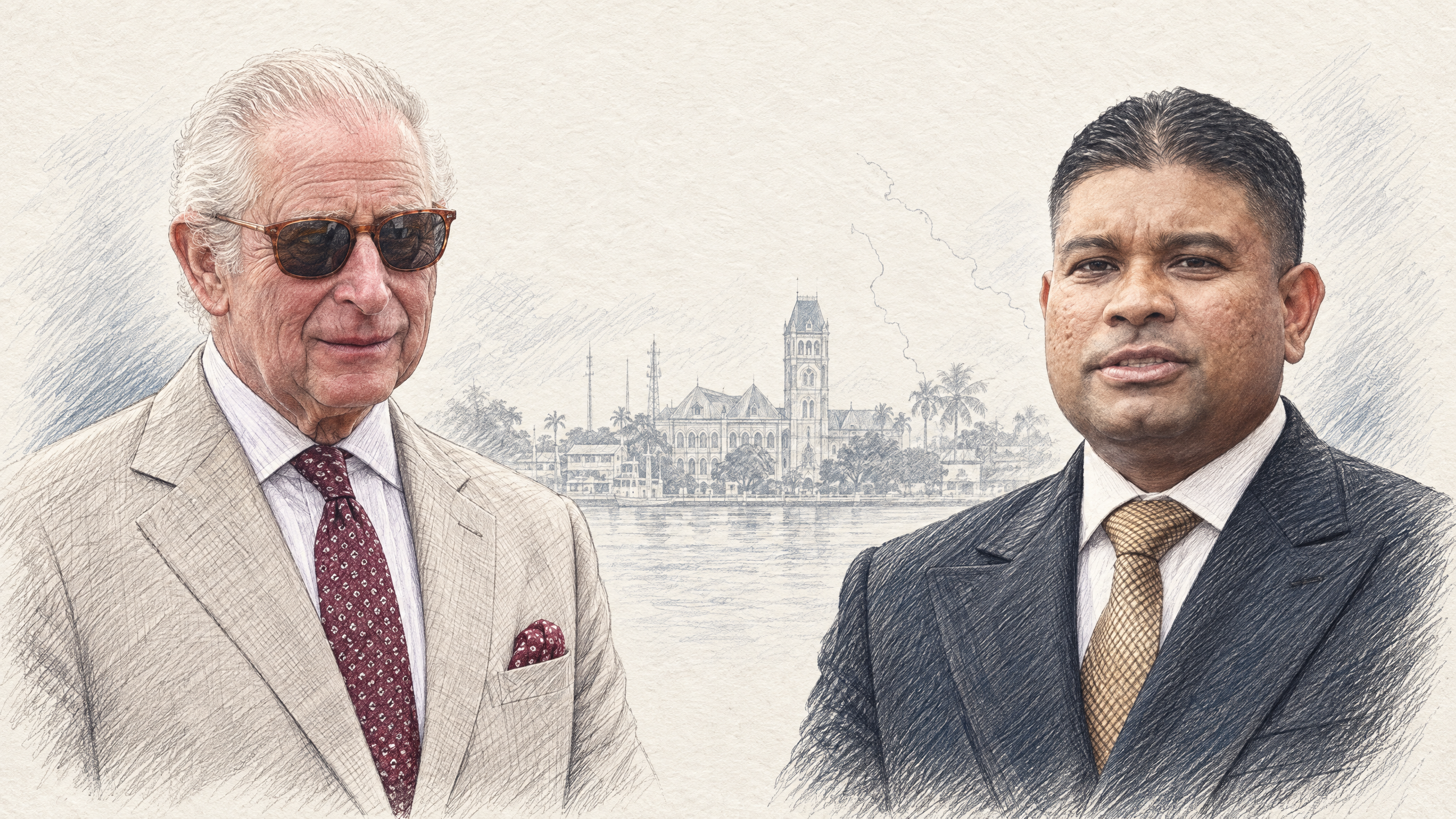
Boston, Massachusetts — On Thursday evening, a king sampled a specially made rum at State House. Late on Friday afternoon, as his visit ended, a magistrate remanded the Leader of the Opposition to prison. The two events fell within the same royal visit, and the calendar is sometimes the most honest editor a nation has.
I. Two Processions
King Charles III arrived on Thursday, 29 October, for a two-day State Visit marking sixty years of Guyana–UK relations. It was also his first visit as monarch. On Friday he commended Guyana’s forest conservation and met Indigenous leaders and British and local investors. His final engagement was at the Kingston seawall, before he left for Antigua and Barbuda.
Meanwhile, near State House on Thursday, supporters of We Invest in Nationhood (WIN) gathered. They called for the release of Opposition Leader Azruddin Mohamed and, in the same chants, for reparations for the descendants of the enslaved. Then a second group arrived with placards calling for his extradition. Police kept the two apart.
II. The Cell
Police arrested Mr. Mohamed at his Eccles home on Wednesday, 28 October. Officers charged him and Constable Ryan Greene, 20, jointly under the Cyber Crime Act. Police allege that Constable Greene helped obtain and supply surveillance footage of the 12 October incident. They further allege that the footage reached Mr. Mohamed in connection with an alleged GY$800,000 payment. Previously, Mr. Mohamed had displayed the footage at a news conference in support of his account of 12 October. Then, on 30 October, Magistrate Abigail Gibbs refused bail to both defendants and remanded them until 24 November.
He has also faced several detentions and arrests since September. On 3 September police detained him, released him and detained him again. The drone-related investigation near Leonora involved a property next to the President’s private residence. On 16 October, police charged him and two employees with firearm, ammunition and obstruction offences arising from 12 October. All three received bail. Separately, Mr. Mohamed and his father are contesting a United States extradition request. It rests on allegations, including fraud and money laundering, connected to their gold business. The Caribbean Court of Justice has allowed that process to continue; the allegations remain unresolved.
The cybercrime charge, the firearm-related charges and the extradition request are separate proceedings, and no court has yet decided any of them. The law presumes every defendant innocent and entitles each to a fair hearing before an independent and impartial court; Guyana’s Constitution guarantees as much.
III. What the Crown Did Here
Guyana’s colonial past had more than one master. For example, Berbice was Dutch when Coffy, often rendered Cuffy, became one of the leaders of the 1763 revolt. Two dates from the British record bear on this week.
Jack Gladstone and other enslaved leaders planned the August 1823 uprising in Demerara at Success, an estate the absentee John Gladstone owned. His father, Quamina, was a major figure; however, he urged restraint and a non-violent work stoppage. In the repression that followed, colonial authorities decapitated some executed rebels and displayed their heads on poles, including at Plaisance.
In the April 1953 election, the first under universal adult suffrage, the People’s Progressive Party won 18 of the 24 elected seats. That October, Britain sent warships and troops. On 9 October, only months after the legislature opened, Governor Alfred Savage announced the suspension of the constitution and the removal of the elected ministers. The colonial government restricted and detained leaders; among the detained were Martin Carter and Sydney King, later Eusi Kwayana, who died in October. In April 1954, police arrested Cheddi Jagan, then restricted to Georgetown, at Mahaicony for leaving the city. A court sentenced him to six months.
IV. “No Political Prisoners as Such”
In July 1954, Jennie Lee, the Labour MP for Cannock, asked in the House of Commons about prison conditions for Jagan and his jailed colleagues. Henry Hopkinson, the Minister of State for Colonial Affairs, replied: “At the moment, there are no political prisoners as such.” Those in prison, he said, had come before the courts in the ordinary way for offences under the Emergency Orders. The courts had sentenced them for breaking the law, not for political activities. He also noted that Jagan’s sentence was without hard labour. Lee, however, answered that her concern was for PPP members still held in Georgetown, jailed, as she saw it, for political reasons.
That was a minister’s characterisation, and it should give every Guyanese pause, whatever their party. Indeed, he could point to convictions under emergency law: Jagan had broken a restriction order, and a court had convicted him. The deeper injustice lay upstream, in a state that had set aside the people’s choice and then managed the consequences through emergency law. Formal legality was therefore the Crown’s defence, and history has not found it sufficient.
The deeper injustice lay upstream, in a state that had set aside the people’s choice and then managed the consequences through emergency law.
— T.R.B.
V. Not 1953
2026 is not 1953. Then, a foreign power removed an elected government. Now, Mr. Mohamed faces specific allegations that no court has decided. The lesson of 1954 is, accordingly, narrower: an official assurance that a case is criminal rather than political cannot settle the question by itself. Equally, an accused politician’s claim of persecution cannot establish that a prosecution is politically motivated. In the separate context of extradition, section 8 of Guyana’s Fugitive Offenders Act requires objections of political character or purpose to be considered when they are properly raised. For that reason, a process that is reasoned, as open as law permits, accurately reported and capable of lawful review serves public confidence best.
VI. What an Apology Asks
Before the visit, President Ali told ITV News that a formal apology and reparatory justice should follow the King’s earlier expressions of regret for slavery. That demand is right.
An apology in that sense is an institutional act. It names a wrong precisely, accepts that an institution committed it, and commits that institution to repair and to safeguards against repetition.
Moreover, a second wrong, which the President did not name, belongs to the same history: the Crown’s use of police, courts and detention against Guyana’s elected leaders in 1953 and 1954. Slavery and the suspension of a constitution are different wrongs. Yet both require institutions to answer for how they used power.
Two propositions follow, and each stands on its own. First, Britain’s responsibility for slavery does not depend on how any Guyanese government behaves today. Second, that responsibility gives no Guyanese government a pass on how it treats its own opposition. Historical accountability and present accountability are each necessary; neither can be traded for the other.
VII. The Symmetry Test
Rotate the axes of the plane and the length of a vector does not change. A fair legal system should be invariant in the same way: it applies the same legal standards, evidentiary discipline and procedural safeguards whatever the accused person’s political identity. Equal treatment does not by itself prove that a decision is just, but unequal treatment in materially comparable circumstances is a reason for public concern.
Published reports attribute several reasons to Magistrate Gibbs for refusing bail, including Mr. Mohamed’s other pending proceedings and concern that the defendants were likely to commit a further offence if released. However, defence counsel dispute the decision and have said they will seek review. Similarly, Constable Greene’s lawyer has argued that footage of public streets is not national-security data.
The reported question of how the footage was obtained is distinct from the competing accounts of the 12 October incident. Mr. Mohamed says he was the target of an assassination attempt; the police allege instead that someone discharged a firearm near the residence of Senior Superintendent Prem Narine, head of Special Branch, and the firearm charges against Mr. Mohamed rest on that account. No court has resolved the two.
VIII. What the Public Must See
The public can apply the symmetry test only if it can see the reasons and the record. Three matters therefore bear on that.
- Press access. Demerara Waves, News Source and Kaieteur News reported that police barred reporters from the Sparendaam courtroom. News Source also reported that officers cited instructions whose source was unclear. However, none of the reports identified a judicial closure order, and defence counsel said he had not known that police had excluded reporters. The police and the court should clarify the legal basis for any restriction.
- The record of the bail ruling. News outlets reported the reasons. The question is whether the court can make the official ruling, or an accurate record of it, available, consistent with law and court practice.
- Independence of the investigation. Mr. Mohamed alleges that Mr. Narine fired on his car on 12 October. Police dispute that account. Mr. Narine is also a witness in the extradition proceedings. The question is who is investigating these competing allegations, and what arrangements keep that investigation independent of those involved.
Guyana owes Constable Greene the same protections of fair process, careful reporting and the presumption of innocence.
An official assurance that a case is criminal rather than political cannot settle the question by itself. Equally, an accused politician’s claim of persecution cannot establish that a prosecution is politically motivated.
— T.R.B.
In R v Sussex Justices, ex parte McCarthy, delivered on 9 November 1923, Lord Hewart wrote that justice should not only be done, but should manifestly and undoubtedly be seen to be done. It is still the common law’s best-known expression of the value of apparent impartiality, and one of the better things the Crown left us.
IX. Two Stories
The King is not the subject of this essay; a constitutional monarch would not ordinarily comment on his host’s courts. Nor is Mr. Mohamed’s guilt or innocence, which belongs to the courts.
Instead, the subject is us. On Thursday, Guyana told the world a confident story: an oil state, sixty years independent, pressing a former empire to account for its past. Then, on Friday, a second public story unfolded in a courtroom that, according to multiple news reports, police barred journalists from entering. Both belong to the public record of the week.
We honour the generation of 1953 not by reciting its suffering at royal receptions, but by building institutions that would have protected it.
Terrence Richard Blackman, Ph.D., is Dean (Interim) of the School of Science and Allied Health and Professor of Mathematics at Medgar Evers College, City University of New York, and a former Visitor in the School of Mathematics at the Institute for Advanced Study, Princeton. He is the founder and publisher of the Guyana Business Journal. The views expressed here are his own and do not represent Medgar Evers College or the City University of New York.
Note on Sources
Links in the text give the sources at the relevant sentences. The Hopkinson and Lee exchange is from Hansard, HC Deb 28 July 1954, vol 531 cc571–6. Reporting on the proceedings reflects the position as of publication; the matters described remain before the courts.
GBJ is supported by
Metallica Commodities Corporation
metallicacc.com
Pebble Stream™
pebblestream.com
Caribbean International Shipping Services (CISS)
caribshipatl.com · 770-322-3111
MCCGUSA
mccgusa.com · 212-269-6126
Sponsors have no role in GBJ’s editorial decisions. The views in this essay are the author’s alone.
With thanks to our individual supporters: Courtney Noel | All Te Networks | Corine Locke | Tony Harris | Roderick Alsopp | Dr. Michelle Luard | Clarence Bone
