
THE SUNDAY ESSAY · MIGRATION & THE NEW GUYANA
Many Waters, One River?
The streams of Black migration to Guyana, and what they mean for Afro-Guyanese unity now
Four streams of Black migration made Guyana’s African population. None of them made it one people. Institutions did that work, and their work has come undone.
BY TERRENCE RICHARD BLACKMAN, PH.D. · SUNDAY, 8 NOVEMBER 2026
In This Piece
I. A Son of the Sugar Economy
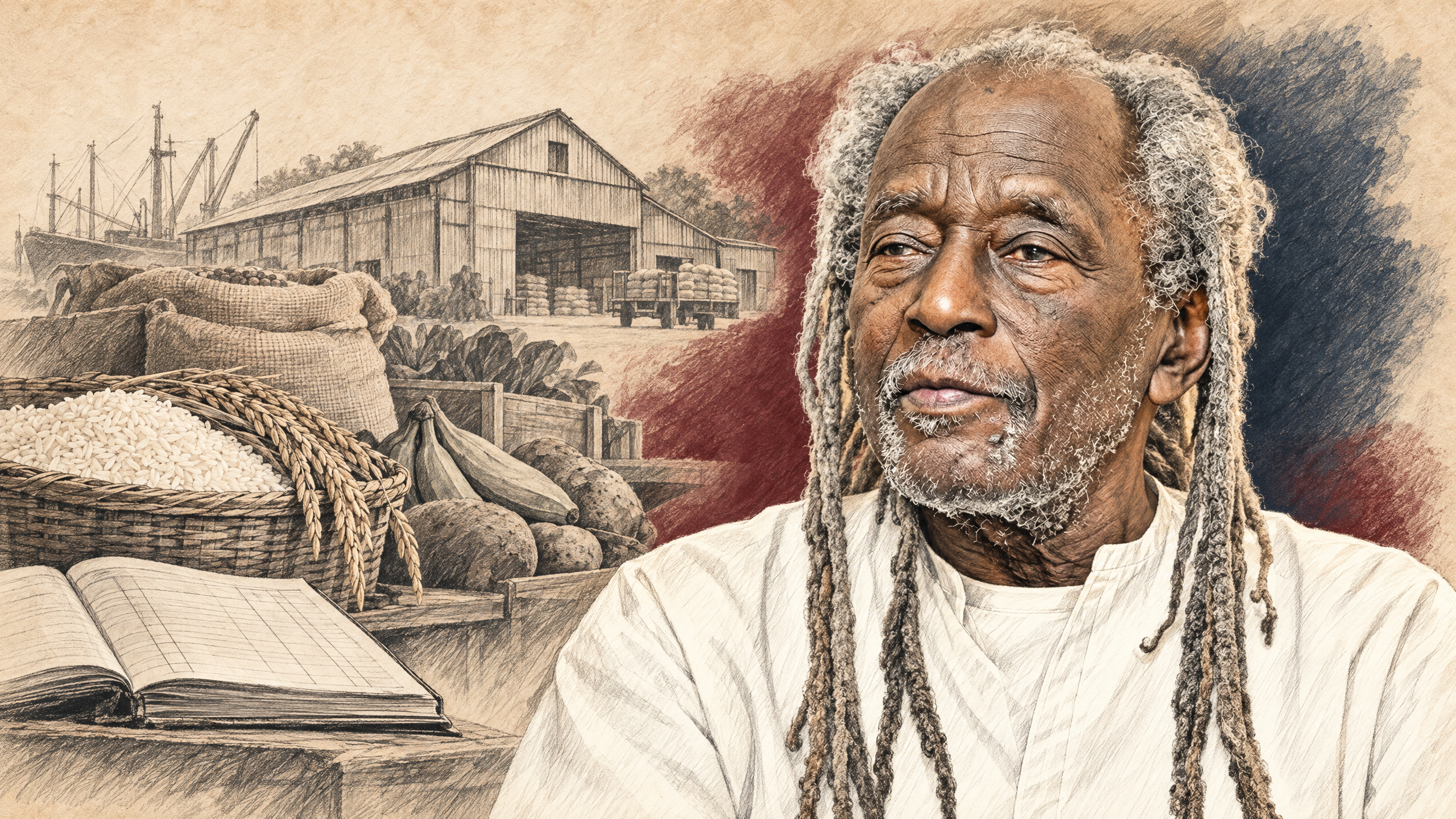
Brooklyn, New York — Eusi Kwayana was born Sydney Evanson King at Lusignan, on the East Coast Demerara, on 4 April 1925. His father was a pan boiler. He presided over the crystallisation of sugar in the vacuum pan. By the measure of his trade, he was one of the most skilled men in a sugar factory. In the 1920s recruiters signed him to work in Angola. He died in Mozambique while the boy was still young. The son of Africans brought to this coast in chains watched his father carry hard-won skill back to Africa, under contract, in the service of the same crop. The sugar economy stood at both ends of that family.
That boy became the conscience of a nation. He wrote the official songs of all three of its major parties: “O Fighting Men” for the PPP, “Battle Song” for the PNC, “People’s Power” for the WPA. No other Guyanese politician holds that distinction, as Moses Bhagwan and Nigel Westmaas note. He was a minister in the 133-day PPP government of 1953, at twenty-eight. The PNC expelled him in 1961 after he raised the wound between Africans and Indians in public. Earlier he had proposed a joint premiership of the two ethnic parties. He spent the rest of a very long life trying to close that wound. He died at his home in Atlanta, Georgia, on 10 October, at 101 years and six months. His body was to lie in state in Georgetown in November.
A Season of Upheaval
He died in a season of upheaval. APNU, the coalition anchored by the PNCR, sits third in Parliament with twelve seats. Turnout at the last election fell to 58.4 per cent from 72.6, though the register had grown by 96,000 names in the same period. The Leader of the Opposition, whose party was months old when it took sixteen seats, is on remand in prison.
It would be easy to read all this as a people coming apart. I want to ask a better question. What institutions would allow Afro-Guyanese people to pursue shared interests while remaining free to disagree politically?
The question matters because unity is not the same as voting alike. A community can split its vote across several parties and still be strong. What it needs is organisations of its own, shared demands and the capacity to defend its interests. A community can also vote as one bloc and have almost no influence over the party it votes for.
Guyana, by tradition, means “land of many waters.” The African population of this country is not a single river. It is a confluence of streams that arrived at different times, under different terms, and mingled over generations. Unity among them was never an inheritance. It was an achievement, built by institutions. This essay is about how that achievement was built, and what rebuilding it would require.
Unity among them was never an inheritance. It was an achievement, built by institutions.
— T.R.B.
II. The Streams
The first came under the Dutch. The Dutch brought enslaved Africans to Berbice, Essequibo and Demerara from the Gold Coast, the Bight of Benin and West Central Africa. In February 1763 they rose in Berbice, and within days most of the colony’s private plantations were in revolt. Their leader, Coffij, styled himself Governor of Berbice. He wrote to the Dutch governor proposing to divide the colony rather than return to slavery. Suppressing it took reinforcements from Suriname, St Eustatius and Barbados and a 660-man expedition from the States-General. It also took Indigenous allies and the rebels’ own quarrels. The Dutch captured the last rebel captain in April 1764. Some 1,800 enslaved people died. Since 1976 Philip Moore’s fifteen-foot bronze on the Square of the Revolution has carried the date. The country has called it the Cuffy monument ever since.
The second, and much larger, came under the British. British Guiana was one of the hungriest markets in the Americas in the last decade of the legal trade. Trevor Burnard and Randy Browne calculate that some 268 voyages landed at least 70,000 captives there. They arrived between the British occupation of 1796 and the closure of the trade on 1 January 1808. That was more than a fifth of all Africans carried to the Caribbean on British ships in those years.
After 1808 planters added a smaller tributary. They moved enslaved people from the older island colonies, at least 9,000 in the four years that followed, and smuggled more from the French islands. Many of the people on the East Coast estates when Demerara rose in August 1823 were members of this British-era generation.
The Third and Fourth Streams
The third came after emancipation. Between 1841 and 1865 British Guiana received some 13,000 Africans freed from slave ships. Most came through Sierra Leone or St Helena, and 1,578 came directly from Rio de Janeiro. Monica Schuler’s reconstruction of the immigration records gives 13,172 arrivals, nearly 8,000 of them Central Africans, Kongo above all. What set them apart from the colony’s other immigrants is that they arrived legally free. For the first nine years of the scheme they served no indenture at all. Only from 1850, and compulsorily from 1854, did contracts bind them, for one, then three, then five years. They arrived with their languages and their gods still close. They regrouped in the very villages the contracts aimed to prevent.
The fourth came by choice. From emancipation into the 1920s, free West Indians, above all Barbadians, crossed for wages. Walter Rodney’s 1977 paper on the trade identifies three distinct waves: 1835 to 1846, 1863 to 1886, and a last attenuated one in 1920 to 1928. Against them ran an Indian indenture traffic that continued almost without interruption from 1845 to 1917. Brian Moore estimates more than 20,000 arrivals before 1863 and another 25,000 between 1864 and 1885 under the planters’ bounty system.
By 1884 the police establishment stood at 624 officers and men. Of these, 295 were Barbadians and only 176 were British Guiana-born.
Streams That Mingled
These streams were never separate pools. They married one another, shared villages and congregations, and within a few generations most families held more than one of them. Where distinctions survived, they usually survived as class, schooling, colour and place rather than as remembered origin. The streams matter not because they still divide us, but because each entered a society arranged to receive it in a particular way.
Two currents complete the picture. Since the 1960s, hundreds of thousands of Guyanese have left. By one widely cited estimate, 36 per cent of the Guyanese-born population now lives abroad. That is the largest such share of any country of its size. The diaspora, of which I am part, is a stream flowing the other way. And new Black arrivals are coming now, from Haiti, West Africa, Jamaica and Cuba, for reasons we have barely begun to ask them about. They deserve to be heard in their own words before anyone, including me, names them a stream.
III. What the Streams Met
No stream arrived into empty country. Each entered a society already arranged, and that arrangement shaped what trust was possible.
The enslaved met a colonial security system that paid Indigenous men, routinely and in cash, to hunt down people who had fled. A Court of Policy report of 26 October 1795 distributed 2,893 guilders among named Arawak and Carib captains and 231 of their men. The rate matched what Dutch colonists received. As late as 1806 the Court of Policy offered two hundred guilders for every “Bush Negro” taken alive who had been less than two years in the bush. For the right hand of one killed, it offered one hundred. In 1763 Caribs and Arawaks blocked the Berbice rebels from planting gardens in the hinterland and combed the savannahs for runaways. Essequibo hired Carib and Akawaio fighters for “the promise of recompense” and paid, that November, for a quantity of right hands.
Ceremony and Gift
None of this was a treaty of the kind we now imagine. What bound the parties was ceremony and gift. In 1781 the Company proposed land deeds to chiefs who would make a yearly pledge. Each would bring a list of his men and aid the Dutch “at the first summons” in case of revolt, “for which trouble, some presents could also be made to them every year.” The explicit clause obliging a nation to return runaways belongs to the Maroon treaties of Suriname, not to the Indigenous compacts of the Guianas.
I do not claim that any of this explains today’s politics. It does remind us that distance between Africans and the first peoples of this land has a history older than any party. Employers who needed that distance made it.
The Village Movement
The freed villagers met indenture. After 1838 they pooled their savings and bought whole estates. On 7 November 1839, eighty-three free men and women from the estates of Dochfour, Ann’s Grove, Hope, Paradise and Enmore bought the abandoned cotton plantation Northbrook. It was five hundred acres on the East Coast Demerara, and they paid 30,000 guilders, about two thousand pounds. They renamed it Victoria. Two-thirds of the price came in hard dollars. A note of hand covered the balance, and they cleared it within three weeks.
Buxton followed in 1840, when a larger collective bought New Orange Nassau for about fifty thousand dollars. By 1850, Catherine Peters finds, Afro-Guyanese buyers had taken roughly twenty-four abandoned estates through groups of up to 168 people. Governor Barkly reported some seventeen thousand acres in their hands. By 1848 more than 44,000 people were living in the villages rather than on the estates.
The Planters’ Answer
The planters’ answer was immigration from Madeira, China and above all India, and Walter Rodney showed what it was for. The sugar strikes of 1842 and 1848, he wrote in the second chapter of A History of the Guyanese Working People, “strengthened the determination of planters to secure immigrant laborers whose conditions of indentured service excluded the right to seek out new employers and whose wage rates were also statutorily restricted.” Of the 1848 strike he is explicit: “The decisive factor in the eventual defeat of the Creole African strikers was the presence of alternative labor controlled by the estates.” In 1846 alone 5,975 Madeirans arrived, the largest annual figure in the whole Portuguese trade. During the strike, the new arrivals did the work.
The newcomers’ own lives were hard and their paths varied. Many indentured Indians suffered conditions not far from those the freed people had escaped. But the structure set group against group at the point where wages were decided.
The violence of the same years ran alongside that calculation rather than out of it. There were attacks on Portuguese immigrants in 1846, 1847 and 1848. Then came the Angel Gabriel riots of February 1856, when crowds sacked some 300 Portuguese shops over six days. The upheaval began in Georgetown and spread across all three counties. Those riots grew from competition in petty trade, unequal treatment before the courts and the humiliations of colonial law. It is worth keeping the two mechanisms apart, because they produced two different inheritances.
A Ladder and a Wound
In Georgetown, a ladder of colour, church and schooling sorted the population into ranks. The Barbadian arrivals found their places on it as immigrants rather than as Creoles. The word, in British Guiana, meant the locally born. In February 1868 Creole cane-cutters on the lower East Coast were threatening Barbadians for working harder and cheaper than they did.
Then came the wound we all inherited. The violence of 1962 to 1964 displaced Africans and Indians alike and resegregated once-mixed villages. Each community remembers what was done to it. Neither, on the whole, has been asked to remember what was done to the other.
It would be convenient to stop here and blame the colonial office. Race was indeed a colonial technology. But after 1966, leaders of both major parties chose to keep using the machine they inherited, because it delivered votes. Structural causes explain where distrust came from. They do not excuse those who have tended it since.
IV. The Box Hand
If unity is built by institutions, we should look closely at one that has never stopped working. It has no headquarters, no constitution and no party. Guyanese call it the box hand.
The mechanics are simple. A circle of people, very often women, agree to pay a fixed sum into a box each week or month. Each period, one member draws the whole pot, in an order the circle agrees. A trusted organiser, the box holder, keeps the list and holds the money between hands. There is no interest and no collateral. A market vendor uses her draw to buy stock. A nurse uses hers for a child’s school fees.
One correspondent to a Guyanese newspaper recalled the box she ran as a teacher. A trusted neighbour collected the same monthly sum from up to twelve savers. Each drew the whole year’s contribution in one lump, and the circle settled the drawing order in January. The holder, she added, would sometimes keep a small piece for herself.
An Old Practice, Many Names
The practice is old and its names travel. West Africans know it as esusu or susu, the Yoruba form documented by William Bascom in 1952 and the Igbo isusu by A. I. Nwabughuogu three decades later. Trinidadians call it sou-sou, Jamaicans partner, Barbadians the meeting turn, Haitians sol. Caroline Shenaz Hossein has interviewed hundreds of Caribbean women she calls Banker Ladies, in Guyana, Jamaica, Trinidad and Haiti. She treats these as regional names for one cooperative form. Most accounts trace the lineage across the Atlantic with the enslaved. Yet the careful comparison of Barbados and the Bahamas by Brent Stoffle and his colleagues warns that little direct evidence fixes where or when the Caribbean versions began.
The diaspora record is more concrete than the folk memory. In 1988 the New York Times reported on a Jamaican immigrant in Brooklyn who threw a hand of a hundred dollars a week. The proceeds had bought a house on Long Island. The same report found that a Guyanese sociologist named Bonnett had met the down payment on his first house through a susu. Observers then estimated that Brooklyn alone held thousands of susus. Eleanor Marie Lawrence Brown traces how Black West Indian migrants acquired property in New York. She finds susus “ubiquitous in West Indian migrant society from the early 1900s,” and notes that the same method financed the Guyanese village purchases of the 1840s.
Its spirit is the spirit of 1839, when freed people pooled their savings and bought Victoria.
What the Box Hand Teaches
Now ask of the box hand what we should ask of any institution. Who joins? People who know one another, across church, workplace and street, whatever party they vote for. Who controls the money? A person the circle chose, accountable to the circle, removable by the circle. How does it survive disagreement? By reputation: a member who defaults does not get into the next box. How does it survive a change of government? It never noticed one.
The box hand also shows the limits of trust that stays small. It can buy a stall, but not build a market. It can pay school fees, but not negotiate with a ministry. And its enforcement is social rather than legal. Jamaican courts have treated the partner as judicially cognisable, but I know of no Guyanese case. That tells you something about where these circles sit in relation to the state: outside its protection as well as outside its reach.
The Co-operative Republic
The obvious next step was the co-operative and the credit union, and Guyana took it, under a republic that wrote co-operativism into fundamental law. The 1970 constitution declared the new Co-operative Republic to be “in the course of transition from capitalism to socialism.” That clause survives in the constitution in force today. At the party’s special congress at Sophia in December 1974, Forbes Burnham claimed for the PNC “paramountcy over the Government.” He told every member that he must be “not merely a member, but an active member of a co-operative.”
The results are on the record. Gareth Curless has shown that the number of co-operatives expanded rapidly by the mid-1970s. Yet most existed to benefit from tax concessions and privileged access to land. Consequently, many became vehicles for individual accumulation rather than collective production. A ministerial task force reporting in 2017 conceded that societies had been “hurriedly registered before a proper viability study was done” and that “political decisions” had weighed against their operation. Of 198 societies it assessed, fifteen were sound and 150 were “irretrievable.”
That is one mechanism of institutional decline we can name: incorporation. What the box hand teaches is the alternative. Keep the money and the accountability in the hands of the members.
V. What Survives
Before asking what we should build, it is worth counting what is still standing, because the answer is not nothing. It is a landscape of institutions with three different profiles: those with members but no money, those with money but no independence, and those with neither.
The churches are the largest and oldest. They hold the buildings, the schools’ founding traditions, the funerals and the Sunday crowds. For two decades after 1964 they were among the few institutions that could assemble Africans and Indians in the same room without a party’s permission. They are also the most fragmented, and no one — not the state, not the academy — holds a reliable census of who attends what.
Below them sits a layer that outsiders rarely count. In January 2025 the Co-operatives Department reported 1,263 friendly societies on its register alongside 1,736 co-operatives. Friendly societies are the burial-and-benefit clubs that predate the welfare state and still bury the dead in most villages. The co-operatives are another matter. The same department reported only fourteen new societies registered in 2024. It observed that many on its books “appeared to be established to access grants or other benefits” — land, farming, rice cultivation, logging concessions. A register of 1,736 is not a movement. It is a filing cabinet.
The Credit Unions
The credit unions are the exception, and they are the most instructive institution in the country. The Guyana Co-operative Credit Union League dates from 1957, thirteen years before the Co-operative Republic. Some societies on the register are older still, dating from 1949. At the end of 2025 the World Council of Credit Unions counted twenty reporting credit unions in Guyana. They had 45,467 members, about US$47 million in members’ shares and savings, and US$69 million in assets. That is real money, raised from members, lent to members, and governed by members. It is the box hand’s logic at a scale where it can build a market rather than buy a stall.
But 45,467 members is roughly one Guyanese in eighteen, and the movement’s independence has a ceiling. In May 2018 the Chief Co-operatives Development Officer took control of the Guyana Public Service Co-operative Credit Union under the Co-operative Societies Act. The officer then replaced its management committee. When the committee went to court, the court dismissed its case for failing to use the statutory appeal to the minister. The law that registers a society also permits the state to dissolve it. That is what incorporation looks like as an instrument, and it is available to any government.
Members Without Leverage
Alongside these sit the village councils and neighbourhood democratic councils, the market and vendor associations, and the alumni bodies. There are the cultural organisations: the African Cultural and Development Association, founded in December 1992, has carried Emancipation and African Heritage Month for a generation. And there are the diaspora associations that raise money for funerals, schoolbooks and cricket grounds in villages most of their members left as children.
Now put the institutions in a row and ask the three questions. Almost all of them have members. Several have moral authority. Only the credit unions have members, money and a balance sheet. Not one of them can put a demand to a government and expect an answer.
That failure is not cultural. It is fiscal, and it has just become acute. In 2014, remittances to Guyana were worth about eight per cent of GDP. By 2023 they had risen to US$546 million and fallen to 3.2 per cent of GDP, because the economy beneath them had grown. Oil production averaged 891,000 barrels a day over the first eight months of 2026, and forecasters expect it to pass a million. The Natural Resource Fund held US$5.47 billion at the end of September. Oil money pays for about a third of a US$7.47 billion budget, and the IMF expects growth of 22 per cent this year. The diaspora’s chequebook, which once carried real weight, is now a rounding error beside the state’s.
Hub and Spokes
This is the structural reason incorporation recurs, and it is the reason the graph matters more than the argument. The colonial design built a hub and spokes: every group connected to the state at the centre and few connected to each other. Oil does not change that design. It thickens the hub. When the state is the largest source of contracts, jobs, land and licences in the economy, every institution that wants to matter drifts toward it. And every politician who controls it can buy more spokes than his predecessor could. Outreach that adds spokes to the hub is patronage. Outreach that helps communities build edges of their own is development.
Outreach that adds spokes to the hub is patronage. Outreach that helps communities build edges of their own is development.
— T.R.B.
There is a class dimension to this that the community’s own leaders rarely name. The Afro-Guyanese professional middle class has voted with its feet for two generations. Its institutions — the professions, the university, the churches’ educated lay leadership — are now substantially offshore. What remains is a political base that is poorer than its leadership and more dependent on the state than its leadership. A bloc that votes as one while its most mobile members have left is not a community exercising power. It is a clientele.
VI. Cohesion Is Not Obedience
Why, for sixty years, did so many Afro-Guyanese vote for one party? The kindest and most accurate answer is that it was insurance. In a winner-take-all system where trust between groups is low, people vote for the party they believe will protect them. They doubt the other side will share.
But every insurance policy invites three questions. What does it actually cover? Who manages the fund? And who audits the managers? A bloc that votes as one, with no organisation of its own to hold its leaders to account, has bought a policy it cannot enforce. At some point loyalty stops protecting the voter and starts protecting the leadership.
A bloc that votes as one, with no organisation of its own to hold its leaders to account, has bought a policy it cannot enforce.
— T.R.B.
What the Surveys Said
The survey record suggests many Afro-Guyanese reached that point long ago. LAPOP’s results for Guyana, presented in Georgetown in March 2015, put mean satisfaction with democracy at 28.5 for Afro-Guyanese and 48.1 for Indo-Guyanese on a hundred-point scale, against a national mean of 39.9. The same survey found trust in the police had fallen among every group but most steeply among Afro-Guyanese, from 41.5 in 2012 to 24.3 in 2014, against a fall from 51.3 to 41.5 among Indo-Guyanese. As Elizabeth Zechmeister told the Stabroek News at the time, “the drop has been most steep for those who identified as Afro-Guyanese.”
Those are also the last published ethnic breakdowns of either measure, which is a fact worth pausing on. LAPOP fielded Guyana only twice more, in 2016 and 2021. The 2016 report gives no ethnic crosstabs and does not chart satisfaction with democracy at all. The 2021 questionnaire dropped the police-trust item altogether and asked satisfaction with democracy of half a telephone sample. Run directly on the public 2016 microdata, the satisfaction gap has narrowed to about four points, well inside the margins of error. Meanwhile, police trust rose roughly twenty-nine points among Afro-Guyanese and sixteen among Indo-Guyanese. That left Indo-Guyanese still the more trusting of the force.
We have been arguing about a community’s political mood for a decade on the strength of one survey. And the instrument that produced it has fallen silent.
Exit, Voice and Loyalty
The economist Albert Hirschman taught that when an organisation fails its members, they can leave (exit), protest (voice) or stay and hope (loyalty). The 2025 election showed signs of all three. Turnout fell to 58.4 per cent from 72.6, though most of that drop was arithmetic. The register grew by 96,312 names while ballots cast fell by only 37,511. A party three months old, WIN, took sixteen seats and displaced APNU as the main opposition. Aggregate numbers cannot tell us exactly who abstained or who switched, or why. But they are consistent with a community that stopped renewing the old policy.
Exit, meanwhile, has already happened, and it has a price. The Guyanese diaspora is the largest in the world as a share of the native-born population of any country of comparable size. The remittances it sends are the clearest measure of what exit buys. They were worth eight per cent of GDP in 2014. They are now worth three. The diaspora did not stop sending; the state grew faster than the envelope. A people who left because the country could not use them have watched the country become rich without them. As a result, their money no longer buys the influence their numbers would once have commanded.
Voice is not failure. It is healthy for a community to shop among parties and make them compete for its votes. The failure is that there is no institution to gather that voice into demands anyone must answer. Instead the vote has gone looking for a new champion.
A New Champion
The Leader of the Opposition is Azruddin Mohamed, a gold exporter. His party was months old at the election and took sixteen seats and a quarter of the vote. He is also the subject of a United States extradition request. He is contesting it in committal proceedings that opened in January and had heard only two prosecution witnesses by November. Since 30 October he has been held at Lusignan Prison. A court refused him bail on a Cybercrime Act charge arising from leaked police surveillance footage, even as he remains on bail in the extradition case. The chain began with an exchange of gunfire on the night of 12 October outside the home of a senior police officer who is a witness in that case. He denies the charges, the accounts of that night differ, and no court has yet tried any of it.
Whatever its outcome, a channel that runs through one man’s fortunes is not a riverbed.
The governing party, for its part, has said it will make a dedicated effort in Afro-Guyanese communities. That is welcome competition, and voters should judge it by what it delivers. The question to put to it is not how many spokes it adds but whether it will fund the edges. Can a credit union lend without a minister’s permission? Can a village council hold a contract? Does an organisation that criticises the government keep its registration?
VII. The Riverbed
Let me return to Eusi Kwayana, because his life is not a slogan about unity. It is a record of how hard it is to build.
He organised Africans as Africans, through ASCRIA, founded in 1964, and asked them to take their culture and their economic future seriously. He served the Burnham government without pay, chairing the Guyana Marketing Corporation from 1967. In 1971 he left it over corruption it would not act on. Jane Kramer, writing in The New Yorker in 1974, reported that he walked out when Burnham refused to act on evidence involving two ministers. Instead, Burnham sent the file to an Ombudsman, where it disappeared.
Calling the Bluff
Then, in January 1973, with the co-operative republic three years old, ASCRIA issued mimeographed guidelines. They told landless families on the East Coast Demerara to “discover” the sugar lands Booker’s had abandoned. The guidelines instructed them to take only company land and to divide it equally where African and Indian communities wanted the same ground. Each area was also to form a people’s committee and write on the government’s forms: “No money for land. No deposit on land.” According to the historian Matthew Quest, more than two thousand people in villages from Lusignan to Bachelor’s Adventure fenced lots and began building.
The government’s answer was a forty-eight-hour ultimatum, then police violence, houses and provision plots burned, and trespass prosecutions. The campaign closed in February 1974 with a fast and vigil that ASCRIA called the Day of Redemption of Sugar Lands.
That is what calling the bluff of a co-operative republic looked like. He broke with one party, then another. Then, with Moses Bhagwan’s Indian Political Revolutionary Associates, he carried ASCRIA into a common movement, the WPA, alongside Walter Rodney and Andaiye. The WPA began as an alliance of four organisations in 1974 and proclaimed itself a party in July 1979.
Red Thread
Andaiye deserves her place in this story. In October 1986, while still a member of the WPA, she joined six other women to start what they then called the Women’s Development Project. It was an embroidery scheme in four Indo- and Afro-Guyanese communities that expected forty-eight women and quickly had 102. It took the name Red Thread about six months later and was never a party front. As she told Kamala Kempadoo, “we never reported to the party on what we were doing.” No one ever asked a woman how she voted.
When the income-generating phase collapsed as uneconomic in 1992, Red Thread turned to research and advocacy. Then came the work for which it became best known: counting women’s unwaged caring work. It began with a time-use survey in 2001 and 2002, in which 102 women in eleven coastal and interior communities kept their own diaries of the day. That politics produced concrete things. The government zero-rated basic food items, schoolbooks and medicine before VAT took effect in 2007. In 2013 Guyana ratified the domestic workers convention, the first in the region.
Much of the infrastructure that has kept Black communities standing rests on women whose names rarely reach print. Think of the box hand, the church committee, the school fund, the village network. Any rebuilding that ignores them will build on sand.
The Challenge
Kwayana’s path from ASCRIA to the WPA was not a clean deduction. It was a proof that had to be torn up and rewritten more than once, with every step contested. That is what self-organisation leading to wider solidarity looks like in practice.
So here is the challenge, and I put it to us as questions. Which of our existing institutions — the box hand, the credit union, the village council, the church, the professional association — can grow without any party capturing it? Can Afro-Guyanese organisations build shared demands that every party must answer, while their members remain free to vote as they choose? And when new Black arrivals settle among us, will our institutions open their doors to them, or treat them as the planters taught us to treat each other?
One Proposal
I have one proposal, and it follows from the argument rather than from sentiment. A community that cannot measure what it is owed cannot demand it. The polling I began in these pages last month should become a standing instrument, not a series of essays. It should ask the same questions every year and publish them in full, broken down by group. It should state the sampling and the uncertainty plainly, so that no one can pretend the numbers say more than they do. Add to it what the parties promise and what the ministries actually deliver: contracts awarded, jobs filled, titles issued, schools staffed. Then you have a scorecard that every party must answer and no party can capture, because its method is public.
That is a small thing next to a credit union with a hundred thousand members, or a diaspora endowment that funds institutions rather than funerals. But it is the kind of small thing institutions grow from. It is a record, kept by people accountable to one another, that outlasts a government.
Until the System Changes
In March 2020, a week after an election whose result GECOM would not declare for five months, Kwayana and Bhagwan issued a statement. It asked the two parties to form a government of national unity on the principle of parity. Its argument did not depend on who won. In the middle of it, in a single sentence of its own, they wrote: “Until the system changes, whoever wins, Guyana loses.”
The system has not changed. The streams are still flowing.
The riverbed is ours to dig.
Terrence Richard Blackman, Ph.D., is Dean (Interim) of the School of Science and Allied Health and Professor of Mathematics at Medgar Evers College, CUNY, a former Visitor in the School of Mathematics at the Institute for Advanced Study, Princeton, and Founder and Publisher of the Guyana Business Journal. The views expressed here are his own and do not represent Medgar Evers College or the City University of New York.
A Note on Sources
This essay draws on Richard Drayton’s 2023 interview with Eusi Kwayana (published 11 October 2026), the WPA statement and Kaieteur News reporting on his death. Moses Bhagwan and Nigel Westmaas wrote on the party songs (Stabroek News, 7 April 2025).
Section II draws on Marjoleine Kars on the Berbice rising (American Historical Review, 2016), Trevor Burnard and Randy Browne on the British slave trade to Guyana (NWIG, 2017), and Monica Schuler on liberated Central Africans. Walter Rodney’s A History of the Guyanese Working People, 1881–1905 (ch. 2) and his 1977 paper on Barbadian migration inform Sections II and III, as does Brian Moore on post-emancipation Guyana. On Indigenous policy, see Harold Weiske, Lawful Conquest? (2021), and Mary Noel Menezes. On the villages, see Catherine Peters and Juanita McAlmont.
On rotating savings, see William Bascom, A. I. Nwabughuogu, Caroline Shenaz Hossein, Brent Stoffle, Eleanor Marie Lawrence Brown and the New York Times (1988). On co-operatives, see Gareth Curless (IRSH, 2023), the 2017 ministerial task force and the Co-operatives Department’s January 2025 report. Credit union figures are from the World Council of Credit Unions. Economic figures are from the Bank of Guyana, the Ministry of Finance, the IMF and the World Bank.
Survey figures are from LAPOP’s 2014 Guyana results (presented March 2015) and its 2016 and 2021 technical materials. Election figures are from GECOM’s 2020 and 2025 returns. Kaieteur News and Stabroek News reported the Opposition Leader’s proceedings. Section VII draws on Jane Kramer (The New Yorker, 1974), Matthew Quest on the 1973 land campaign, Kamala Kempadoo’s interviews with Andaiye and Red Thread’s publications. The Kwayana–Bhagwan statement of 9 March 2020 appeared in Stabroek News the next day. The matters concerning the Leader of the Opposition remain before the courts, and the law presumes every defendant innocent.
WITH THANKS TO OUR SPONSORS
Metallica Commodities Corporation
metallicacc.com
Pebble Stream™
pebblestream.com
CISS
caribshipatl.com · 770-322-3111
MCCGUSA
mccgusa.com · 212-269-6126
Our sponsors support independent Guyanese journalism. They have no role in, and no influence over, GBJ’s editorial content.
Individual supporters: Courtney Noel | All Te Networks | Corine Locke | Tony Harris | Roderick Alsopp | Dr. Michelle Luard | Clarence Bone
