
Guest Contribution · Monetary Policy
On Guyana’s Fiscal Stance
Monetisation and the fiscal stance are not alternatives
A reply to Dr. Thomas Singh. Central-bank financing is not a distraction from the scale of government spending; it is one of the channels through which that spending reaches prices and the foreign-exchange market.
By Collin Constantine, Ramesh Gampat and Tarron Khemraj · 8 November 2026
Publisher’s Note
In October GBJ published Uses Are Not Sources, which held that Guyana’s foreign-currency shortage is structural, and Dr. Gampat’s Special Report on the oil economy. Dr. Thomas Singh has since challenged the monetary-financing explanation that runs through both. We publish this reply from three economists whose work he addressed, and the Journal will extend the same space to Dr. Singh should he wish to respond. Disagreement conducted with data, in public, is how a country learns to govern its own money. — T.R.B.
In This Piece
Dr. Thomas Singh, Director of the University of Guyana GREEN Institute, has evaluated, in the October 2026 issue of The Green Institute Monthly Newsletter, what he calls the “monetisation thesis” as an explanation for Guyana’s cost-of-living issues and local FX shortages (see here). His position is that these economic pressures are the consequences of the fiscal stance rather than monetary financing. He claims that focusing on monetisation misdiagnoses the problem and diverts attention from the scale of government spending.
This is an odd proposition, because monetary financing of government outlay is one of the mechanisms sustaining Guyana’s expansionary fiscal stance.
Evidence of Monetary Financing in Guyana
Monetary financing occurs when the central bank extends credit to the government, enabling expenditure without a corresponding mobilisation of private savings, tax revenues, or foreign financing. The size of monetary financing is measured by the change in Treasury bills held by the central bank (or central-bank claims on government) minus the change in government deposits at the central bank.
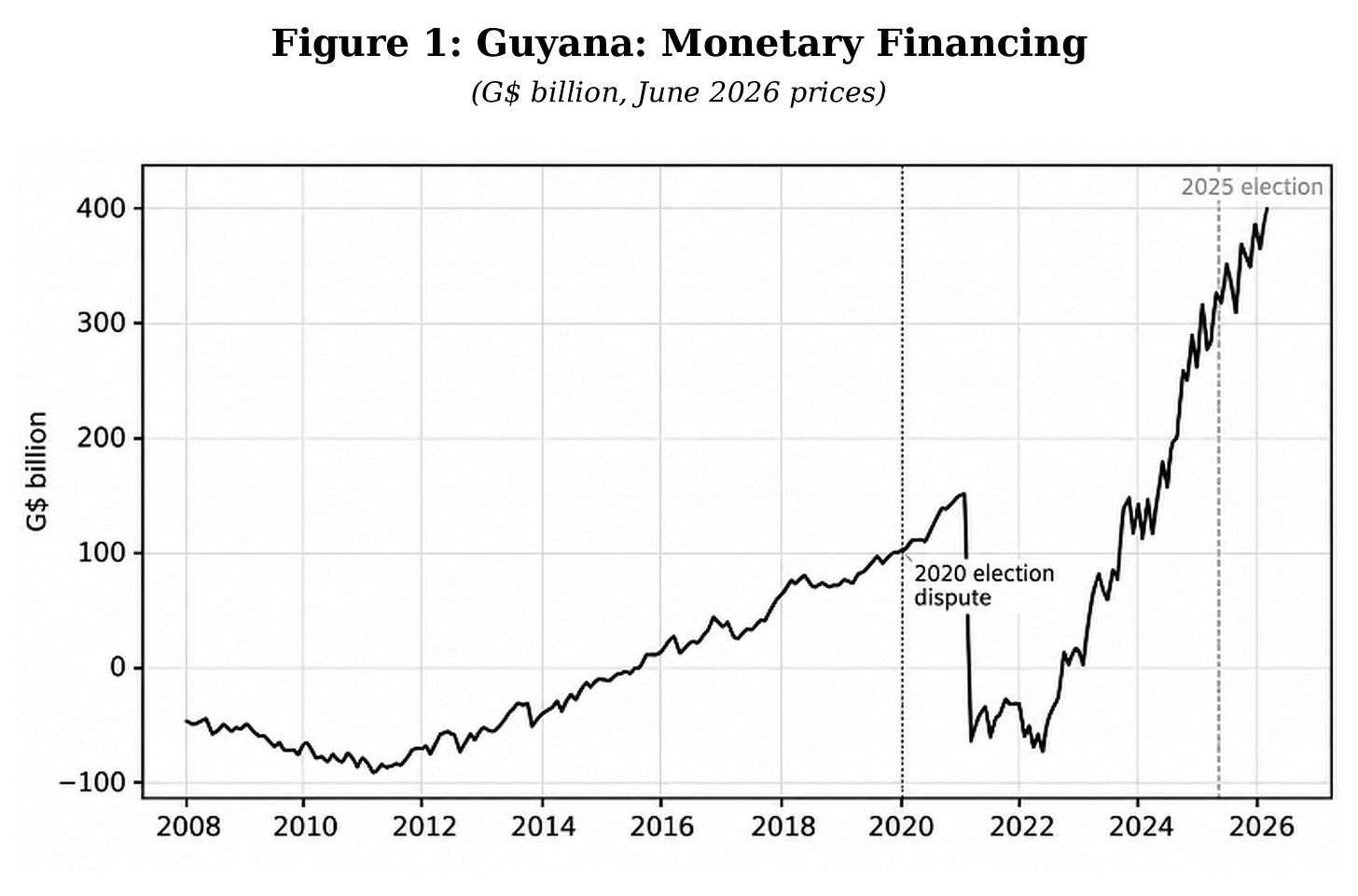
How significant is monetisation in Guyana? The evidence suggests that it is substantial; see Figure 1 (with data from the Bank of Guyana).
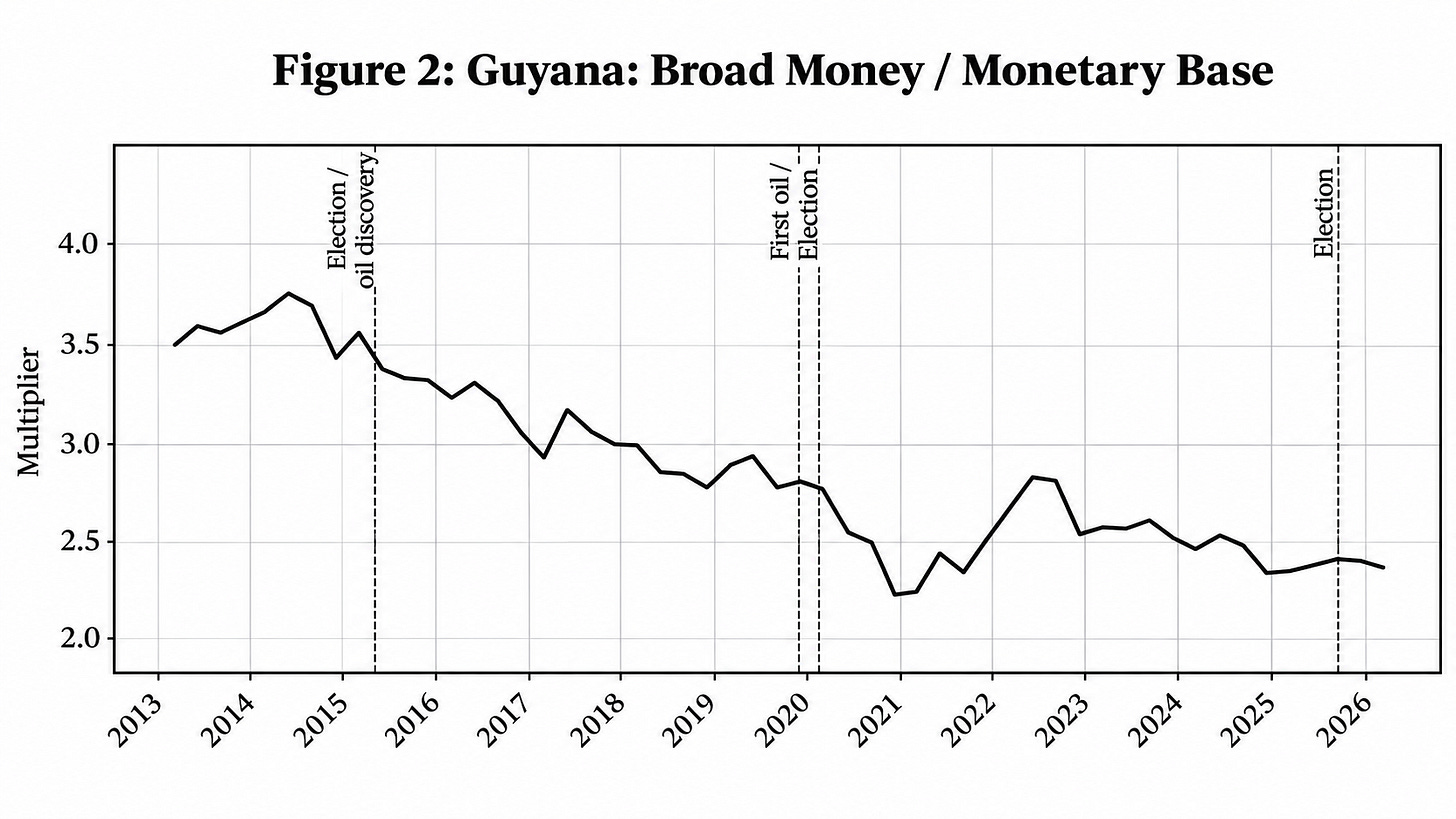
A familiar consequence of monetisation is that it reduces the money multiplier, as Figure 2 documents.
And how important are T-bills specifically? In 2021 the Bank of Guyana held less than 1 percent of outstanding Treasury bills; by the end of 2025 it held more than half. In our view, this is not a footnote.
Between end-2021 and end-2025 the Bank of Guyana took up G$445 billion of the G$682 billion increase in Treasury bills outstanding, about 65 percent: 61 percent in 2022, 75 percent in 2023, 70 percent in 2024 and 56 percent in 2025.
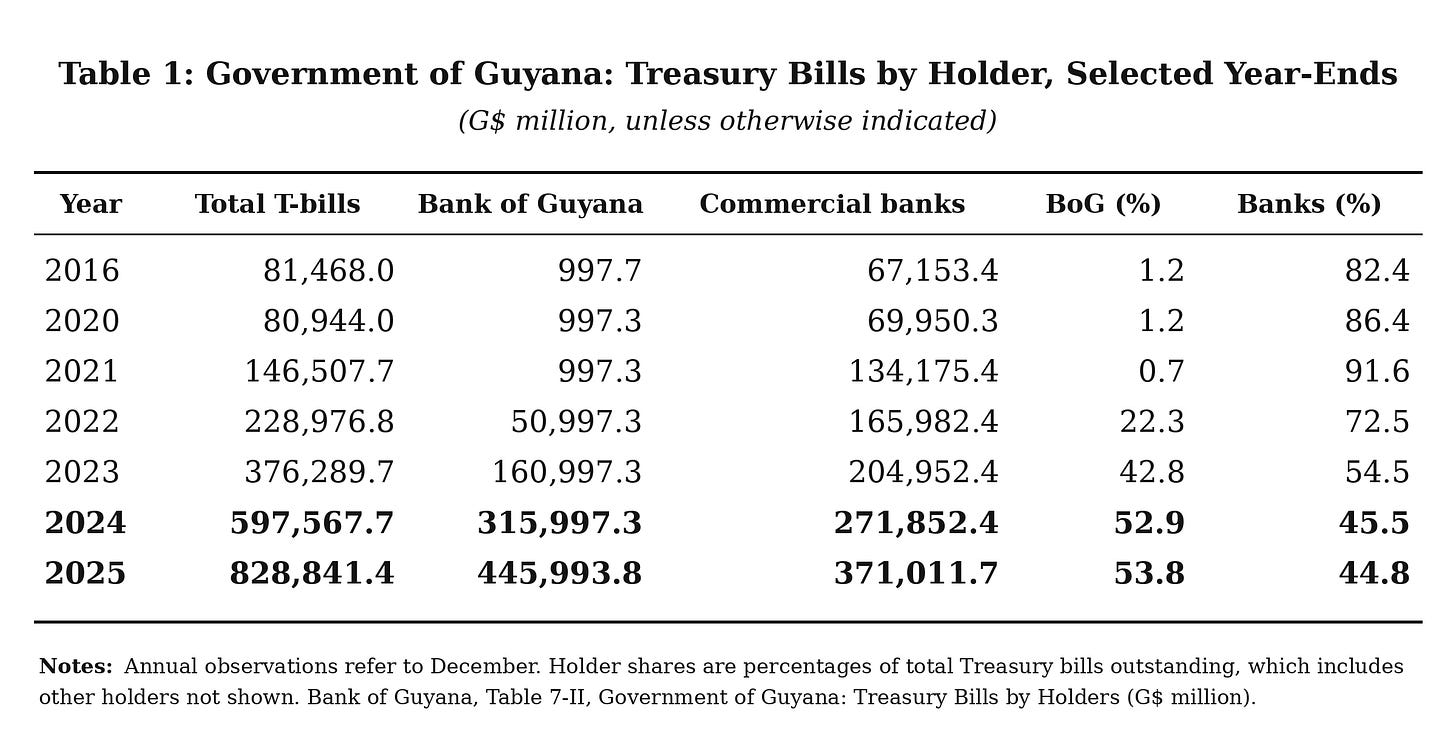
Two further points follow from Table 1. First, a net measure of central-bank credit can understate financing in the year it occurs. When the Bank buys Treasury bills, the proceeds are credited to the government’s account and spent later. This is why the Bank’s net credit to the public sector can fall, as the IMF reports for 2024, in a year when its holdings of bills rose by G$155 billion.
Second, as Khemraj has noted elsewhere, the Bank of Guyana Act 1998 restricts direct central-bank financing of government, while permitting transactions in government securities under specified conditions. How the Bank came to hold G$446 billion in Treasury bills issued for fiscal purposes deserves a public explanation.
How the Bank came to hold G$446 billion in Treasury bills issued for fiscal purposes deserves a public explanation.
— C.C., R.G. & T.K.
One disagreement concerns Singh’s mischaracterisation of the monetisation thesis. He writes: “The monetary-financing thesis is an argument about the foreign-exchange market, in which FX-backed spending is close to neutral, provided the Bank sells the matching dollars.”
But it is not.
On pages 2 and 3 of his newsletter, he presents the accounting mechanics of oil-financed or NRF-financed expenditure and suggests that the monetary-financing thesis mistakenly identifies these operations as deficit monetisation. However, the papers he critiques explicitly distinguish foreign-exchange-financed expenditure from government spending financed through central-bank credit.
To remove any ambiguity: direct monetary financing is independent of oil-financed or NRF-financed government spending. The monetisation thesis concerns the additional domestic purchasing power created through central-bank financing, which raises demand for both domestic and foreign goods and services.
A similar effect arises if spending in local currency is financed by NRF withdrawals but the foreign exchange is not absorbed through an expansion in non-oil imports (Aiyar, Berg and Hussain 2005). This is a case of indirect monetary financing, in which the central bank retains the forex as reserves. In 2022, for example, the BoG was a net buyer of foreign exchange, and in 2023 it sold only US$2 million, against NRF withdrawals of about US$1.6 billion over the two years. Khemraj’s June 2026 paper and Gampat (2024) used the term “monetisation” in this broader sense.
Here, we focus on direct central-bank credit to the government, as illustrated by Figure 1.
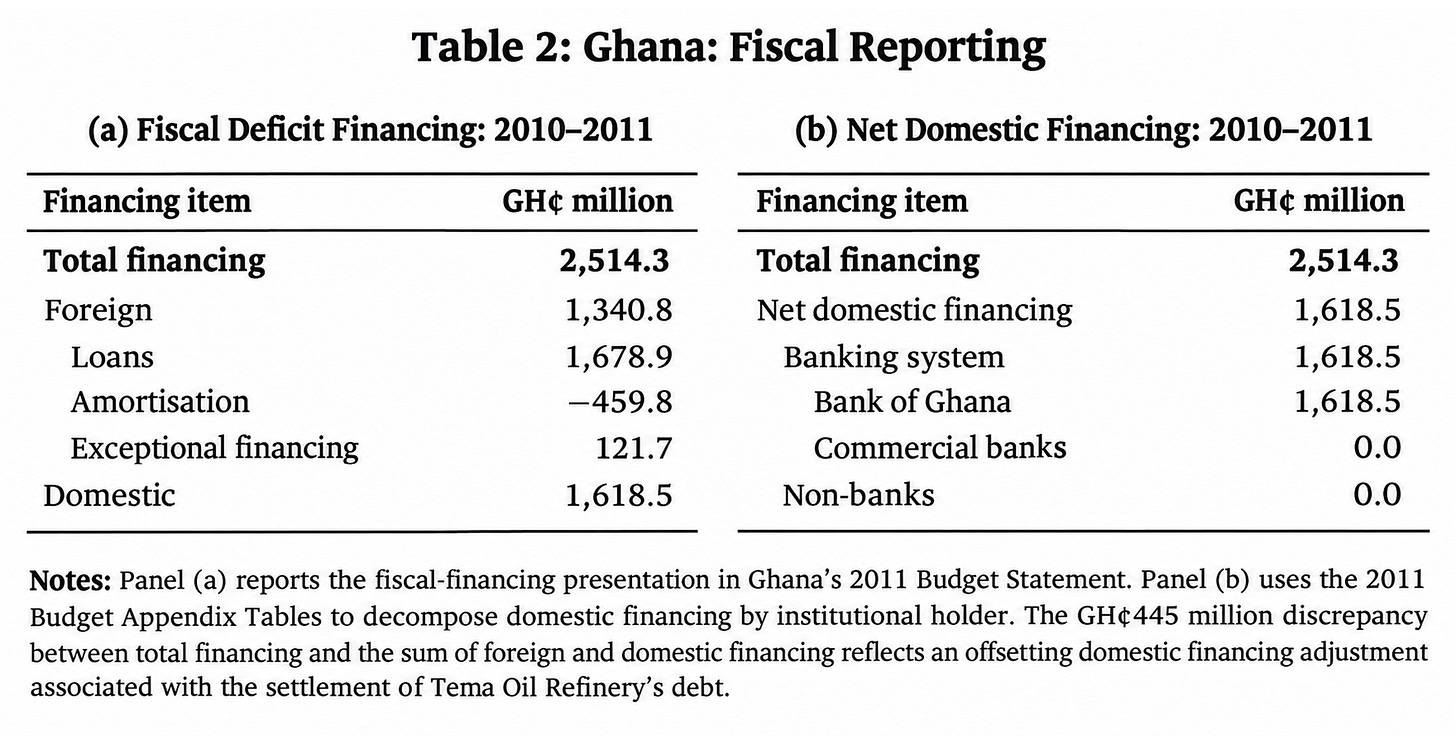
Before we move on, consider Table 2, which documents the extent of monetisation in Ghana in 2010–2011. Column (a) shows the aggregated reporting format, which hides important detail because domestic financing is not disaggregated. The disaggregated accounts in column (b), however, show that the entire net domestic financing of GH¢1,618.5 million came from the central bank, the Bank of Ghana.
Without this disaggregation, many will wrongly conclude that the banking system is financing the fiscal deficit.
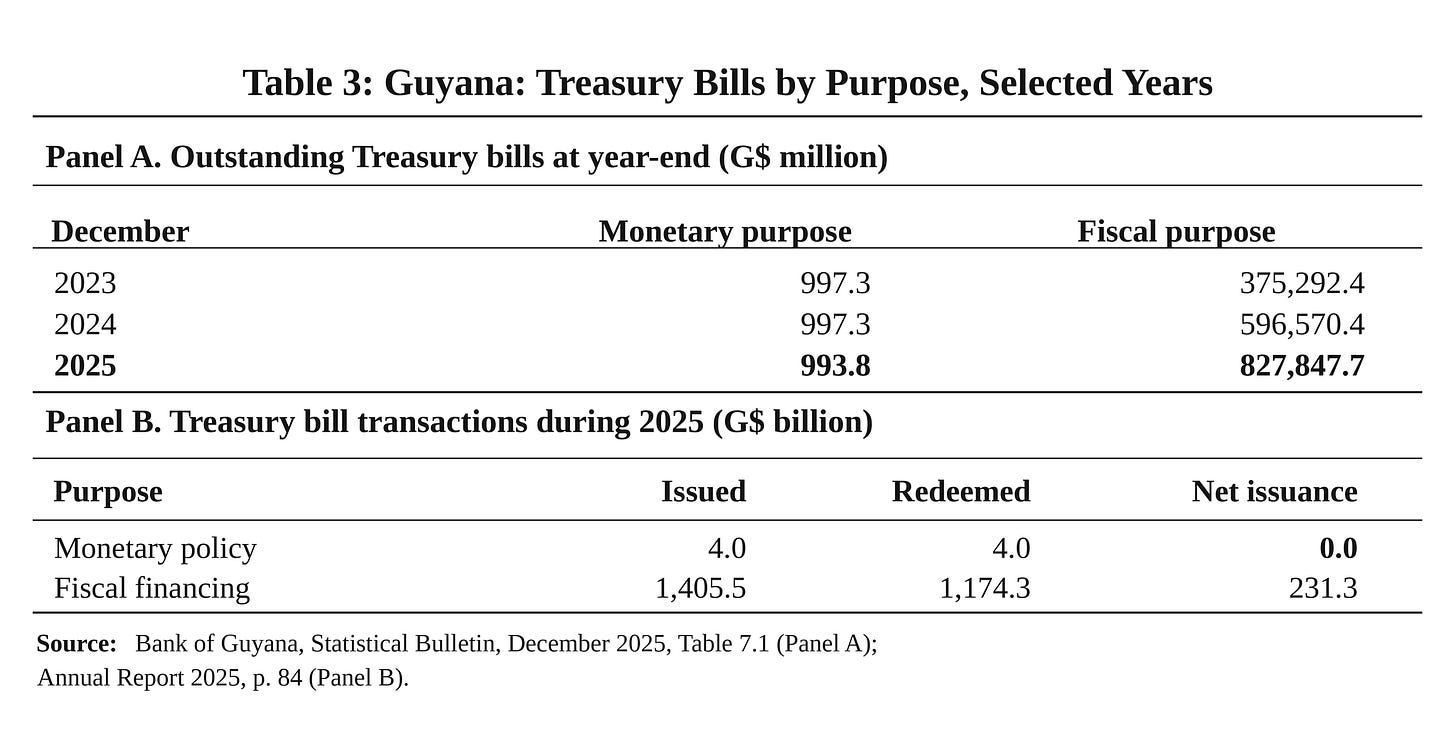
Singh’s newsletter explores additional themes. For example, he claims that Constantine’s measure of monetary financing “mixes ‘backed’ spending, sterilisation and ordinary borrowing … with any genuine monetisation.” But this criticism overlooks both the standard measure of monetary financing shown in Figure 1 and the official distinction between Treasury bills issued for fiscal and for monetary purposes. We direct readers to Table 3 below.
Singh also reports net issuance of about G$108.2 billion of monetary-purpose bills in the first half of 2026. But this follows years in which monetary-purpose bills outstanding stood below G$1 billion at every year-end, and it is small beside the G$446 billion of fiscal-purpose bills the Bank held at the end of 2025.
Local FX Shortages
How does the preceding discussion relate to local FX shortages? We first alert readers to the monetary approach to the balance of payments, which is well established in theory and evidence. This model explains that monetisation leads to FX shortages, measured by reductions in the stock of foreign reserves held at the central bank. While a powerful analytical framework, it is not disaggregated enough to explain local FX shortages alongside rising foreign reserves.
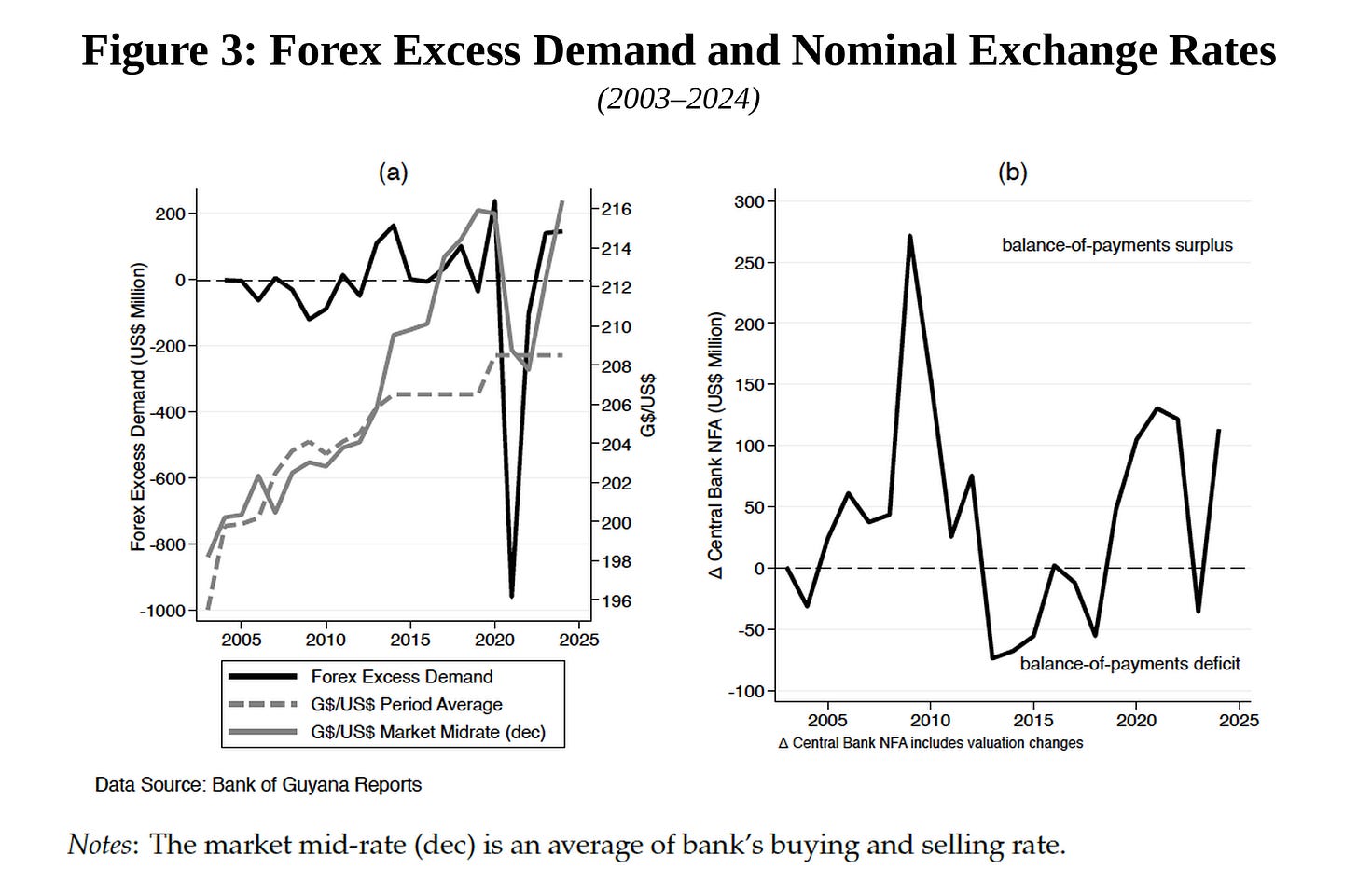
Constantine (2025) goes further to fill this gap. It develops a financial analogue to the goods-market identity: excess demand for foreign exchange equals the sum of financial sectoral imbalances. The identity defines the shortage as the sum of monetisation and net bank credit. The study documents a simple correlation of 0.89 between monetary financing and local FX shortages in Guyana. The significance of this correlation is that monetary financing closely tracks the measured FX imbalance, whereas net bank credit does not.
Constantine and Khemraj (2025) examine this relationship using monthly data from 2001 to 2024. The paper uses the volume of private foreign-exchange trading as the dependent variable, which is measured independently of the monetisation series. Unsurprisingly, it finds a significant long-run relationship between monetisation and foreign-exchange trading: a US$1 increase in monetisation is associated with a US$2.50 decline in private FX trading.
Figure 3, sourced from Constantine (2025), compares local FX excess demand, as measured by the accounting identity, with the observed nominal market exchange rate in Guyana. That FX excess demand accompanies a depreciating nominal exchange rate is unsurprising. Notably, the negative FX imbalance in 2021 coincided with an appreciation of the market mid-rate, which is to be expected. Singh cited the policy-brief version of this research, which also discusses dollarised public contracts and their limitations; we are happy to direct readers to it here.
Fiscal Reporting under Fiscal Dominance
We are also grateful for Singh’s probing, because it allows us to highlight in the public domain the difference between the economic and the legal substance of domestic borrowing. The fundamental principle of domestic borrowing is that public demand substitutes for private demand, easing inflationary pressure.
But under fiscal dominance, as in Guyana, domestic borrowing through the swap of excess reserves for T-bills is not borrowing in economic terms. The banking system does not lend excess reserves to the government, since those reserves were first supplied by the central bank when it financed government spending. In other words, there is no reduction in private demand to accommodate the expansion in public demand. Regrettably, this is a common error in the analysis of fiscally dominant economies; see here and here for further details.
Domestic borrowing through the swap of excess reserves for T-bills is not borrowing in economic terms.
— C.C., R.G. & T.K.
Monetary Aspects of the Dutch Disease
Singh’s concern about the inflationary consequences of oil-financed spending reflects the familiar Dutch disease thesis, a subject we have examined closely in our own research. Indeed, we have argued that overheating can show up in non-tradable prices and local FX shortages even when inflation remains subdued (see here and here). Our work, however, qualifies the Dutch disease claim because of two key omissions.
First, oil-financed spending leads to an expansion of non-oil imports, which have productivity and expansionary supply-side effects, including on non-tradables (see footnotes 2 and 3, and pp. 14–15 here for evidence). NRF-financed spending can therefore expand absorptive capacity. Second, for political-economy reasons (a public contract for each household, for example), governments tend to rely on monetary financing to fulfil these promises.
We argue that this additional spending power, which does not expand absorptive capacity, is the main driver of the pathologies often associated with the Dutch disease. Interested readers should consult here, here and here for additional details.
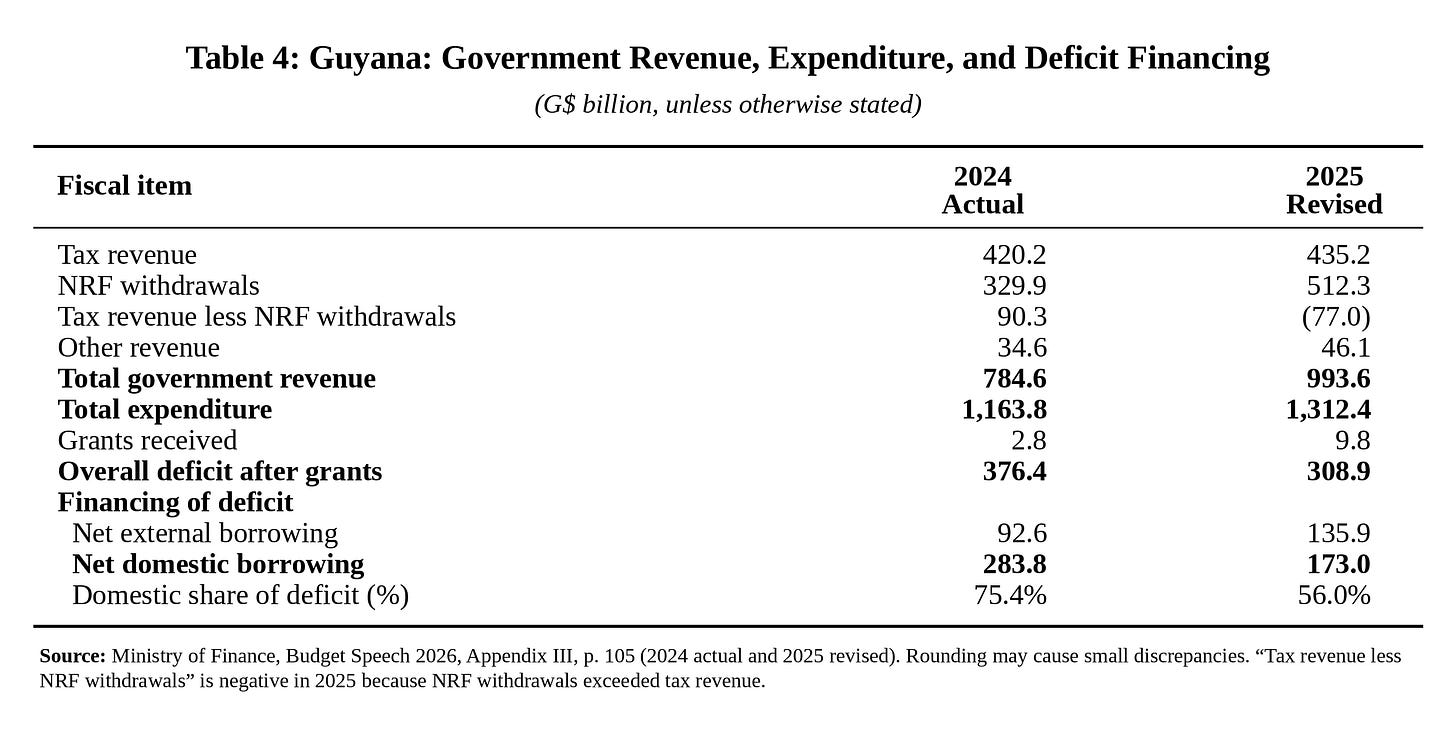
Table 4 documents some of the key statistics in Guyana’s fiscal accounts. Our main claim is that the fiscal deficit, G$308.9 billion in 2025, is too large. Note carefully that more than half of it was financed by net domestic borrowing.
However, as the preceding discussion demonstrates, the legal classification of domestic borrowing does not correspond to its economic substance in Guyana. Moreover, as the Ghanaian case in Table 2 reminds us, this so-called net domestic borrowing also includes direct monetary financing. See here for a decomposition of net domestic financing and the role of central-bank monetisation in Guyana.
Common Ground, and Where Singh Overreaches
We agree with Singh on several points. The fiscal stance is too expansionary and procyclical. The NRF withdrawal rule lets a boom year finance a spending boom the next. The official CPI, with Georgetown-only coverage and weights from 2005/06, cannot bear the weight placed on it.
However, Singh goes too far in treating the method of financing as irrelevant to domestic prices. He writes that “tax revenue drains deposits before it is spent, so tax-financed spending is neutral overall,” and later that spending on non-tradables raises prices “however it is financed.” If taxes or genuine borrowing from savers withdraw purchasing power, then how a deficit is financed matters for prices, not only for the exchange rate.
He argues that the monetisation thesis, if “followed through,” would endorse larger NRF withdrawals. It would not. Our work calls the withdrawal rule too generous. For example, Khemraj’s October 2026 GELI essay calls for a target path for the non-oil deficit and a legislated floor on the Fund’s saved balance.
Singh also notes that an expanding economy needs a growing monetary base. We agree. But Figure 2 shows the broad-money multiplier falling, indicative of excess money balances that help explain the widening premium of the cambio rate over the official rate.
Gampat (2024) is instructive here: he described “the big dilemma Guyana will face if it continues to have such large budgets and such poor tax collections.” The book devotes a chapter to the post-2020 spending spree and insists that the deficit be measured against non-oil GDP to reflect the fiscal stance accurately.
In short, monetisation and the fiscal stance are not alternatives in understanding Guyana’s economic challenges. Monetisation is one of the ways the fiscal stance reaches prices and the FX market.
The Bottom Line
We summarise our claim with a simple question. If we should be concerned about the inflationary consequences of NRF-financed government spending, which is backed by foreign exchange, should we not be at least as concerned about monetary financing, which creates additional domestic purchasing power without FX backing?
In closing, we thank Dr. Singh for his commentary, which has given us the opportunity to share some of our research with a wider audience.
We hope this exchange also encourages closer engagement with existing scholarship and publicly available evidence. That would let public discourse focus more fully on substantive policy questions, rather than on matters the available evidence could resolve.
For readers interested in further commentary, we invite you to subscribe to Tarron Khemraj’s Substack and Collin Constantine’s Substack, and to follow Dr. Gampat’s frequent public engagements.
Monetisation is one of the ways the fiscal stance reaches prices and the FX market.
The data are on the table. The debate is welcome.
Note on Sources
Figures and tables are the authors’, compiled from the Bank of Guyana Statistical Bulletin (December 2025, Tables 7.1 and 7-II) and Annual Report 2025; the Ministry of Finance, Budget Speech 2026, Appendix III; Ghana’s 2011 Budget Statement and Economic Policy; and the IMF’s Guyana: 2025 Article IV Consultation (Country Report No. 25/103).
Research cited: Aiyar, Berg and Hussain (2005), IMF F&D; Constantine (2025), Accounting for the paradox of plenty; Constantine (2026), Forex Shortages in Guyana, Fiscal reporting under fiscal dominance, Dutch disease as a money shock; Constantine and Khemraj (2025), Political pressure and central bank monetization; Gampat (2024), The Guyanese FX Market; Khemraj (2021), MMT-like activities in a managed exchange rate economy; Khemraj (2024), Levy Working Paper No. 1050; Khemraj (2026), Understanding foreign exchange pressure in a booming Guyana and GELI/AN/2026/04.
The work under reply: T. B. Singh (2026), “Guyana’s Cost of Living is both Exogenous and Made at Home: Why Constantine, Khemraj (and Gampat) are Wrong About ‘Monetary Financing’, and Why It Matters,” The Green Institute Monthly Newsletter, October 2026, University of Guyana GREEN Institute, available here.
WITH THANKS TO OUR SPONSORS
Metallica Commodities Corporation
metallicacc.com
Pebble Stream™
pebblestream.com
CISS
caribshipatl.com · 770-322-3111
MCCGUSA
mccgusa.com · 212-269-6126
Our sponsors support independent Guyanese journalism. They have no role in, and no influence over, GBJ’s editorial content.
With thanks to our individual supporters: Courtney Noel | All Te Networks | Corine Locke | Tony Harris | Roderick Alsopp | Dr. Michelle Luard | Clarence Bone
🇬🇾 Support independent Guyanese journalism — donate to GBJ
