
When the Rains Come: A Vision for Guyana’s Future Emerges from Georgetown’s Flooded Streets
The Guyana 2030 and Beyond Webinar,” co-hosted by the Guyana Business Journal and the Roraima Learning Trust, began not with diagrams or statistics, but with memory, evoked through haunting black-and-white photographs of Georgetown as it once was, when the city pulsed with hydraulic logic and civic order. These pristine canals had once run like arteries through the capital, carrying away the Caribbean rains that have always tested this below-sea-level city. But as the screen flickered to present-day footage of clogged drains and stagnant pools, the gulf between past and present became painfully clear.
“This is Carmichael Street with Bishop’s High School,” civil engineer Bert Carter had explained years earlier in archived footage. “This is the beautiful canal looking towards the railway station.” The images showed a Georgetown where water flowed freely through concrete channels, where massive storage vats could hold thousands of gallons, where tramlines crossed bridges over functioning waterways.
Cut to yesterday’s reality: Stanley Ming, a businessman and former political advisor, walks through the flooded streets with a camera, documenting what he calls “the main problem that plagues the drainage of the city of Georgetown”—outfalls completely clogged by decades of neglect.
The Lawlessness of a Nation
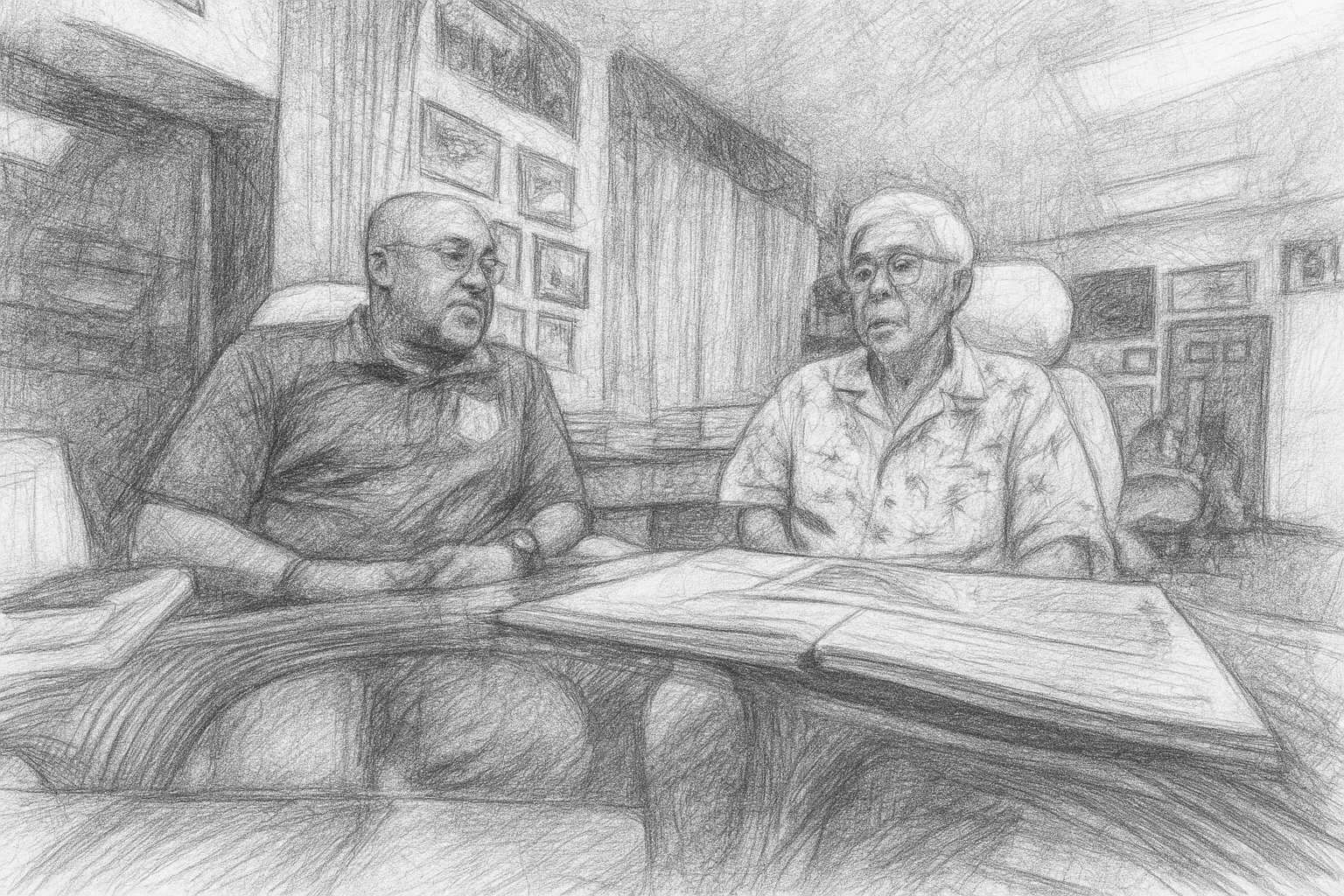
In the virtual discussion room of “Guyana 2030 and Beyond,” co-hosted by the Guyana Business Journal and the Roraima Learning Trust, Ming entered the conversation not as a scold but as a citizen deeply embarrassed by the decay. “As a citizen of Guyana, and more so as a citizen of Georgetown, I am embarrassed by what I see,” he declared to hosts Kojo Paris and Professor Terrence Blackman.
But this wasn’t just about drainage. Ming painted a picture of systemic lawlessness—businesses covering over vital drainage channels to expand their premises, citizens throwing garbage from Mercedes Benz windows, a general disregard for the collective good that makes technical solutions nearly impossible.
“You have situations where you litter the sea wall on a Sunday after all the liming,” Ming explained, his voice carrying decades of frustration. “They just throw it on the ground. I don’t know who they expect is going to pick it up.”
Yet Ming was not there to despair. His message was practical and urgent: Georgetown can be drained—and quickly—if political will and community coordination align. He recalled a survey from the early 2000s, conducted with Bert Carter and others, which mapped the drainage bottlenecks in the city. “If we are serious about it and we want to fix the problem, we can do it before the next rainy season,” he said, outlining a comprehensive plan to clear outflows from Kawan Street to Sussex Street, working backwards from the Demerara River. The fixes are known; what’s lacking is execution.
Beyond the Drains: A Broader Critique
Yet as the evening unfolded, it became clear that drainage was only the entry point. Ming guided his audience through a broader critique of institutions paralyzed by inertia, of sugar estates that bleed public funds while cultivating nostalgia, of an immigration system failing to harness the very talent it needs.
The Numbers That Tell a Story
As the conversation deepened, Ming began reeling off statistics that painted an even starker picture of national decline. Guyana’s population, he noted, should be 4.08 million by 2030 if natural growth had continued from the 1960s. Instead, it hovers around 780,000.
“You cannot develop a country like Guyana with a million people,” Ming declared. “This country right now needs 2 million more people if you want to take advantage of the opportunity.”
The sugar industry’s collapse provided another sobering data point: from 327,000 tons in 1960 to just 47,100 tons in 2024, with the first crop of 2025 yielding only 15,000 tons.
Lessons from Distant Shores
Ming’s travels had shown him what was possible. In 1987, he recalled visiting the Hyatt Hotel’s business center in Singapore, where officials could set up a company, find office space, and complete all paperwork in a single day, from 9 AM to 3 PM.
“That’s what you’re competing against,” he told his audience, contrasting it with Guyana’s bureaucratic maze.
The United Arab Emirates provided another model: a country that grew from half a million people in 1972 to over 10 million today by systematically inviting foreign expertise while training locals, achieving “reverse colonization” where Emiratis designed the future from air-conditioned offices while foreigners built it in the sun.
The Venezuelan Question
Perhaps most controversially, Ming advocated for embracing Venezuelan migrants—many with Guyanese heritage—as part of the solution. He recounted meeting a Venezuelan doctor working as a laborer due to paperwork issues, and three young women who had arrived with just $20 but possessed advanced technical skills that local businesses couldn’t provide.
“Most of us, I remember back in the 60s and the 70s and even the 80s, Guyanese families left this country in droves,” Ming reminded his audience. “They went to Canada, they went to the United States, the Caribbean, and many of the ones that couldn’t go to the north went to Venezuela… And they were received. They were facilitated with jobs.”
Leadership Lessons from the Past
The conversation’s most poignant moments came when Ming reflected on his experiences with Guyana’s political leaders. He recalled Dr. Cheddi Jagan’s response when Ming refused to vote for him in 1992, and how Jagan later gave him business despite the rejection.
“That’s the man. He never held anything against me. He knew I didn’t vote, but that’s the man. There was no vindictiveness,” Ming said.
Similarly, he described confronting President Hugh Desmond Hoyte about the education system, telling him bluntly that “what we’re having, instead of free education at school, is free ignorance.” Within days, Hoyte had announced that private schools could be reestablished and computer hardware would be zero-rated for taxes.
The Constitutional Imperative
As the discussion wound down, Ming returned to Guyana’s Constitution, specifically Article 13, which calls for “increasing opportunities for the citizens in the management and decision-making processes of the state.”
“Are we doing that?” he asked pointedly.
His solution was simple but profound: “You have one half of the society pulling this way, the other half that way. What are you going to get? Divided… What we have to work towards, as I do in business, when I negotiate… I negotiate for win-win.”
A Blueprint for Renewal
Professor Terrence Blackman, summing up the evening, called it “a master class in national re-imagination.” But by the end, both he and Kojo Paris sat nearly overwhelmed—not by hopelessness, but by the scope of the opportunity and the clarity of the prescription. The conversation had moved seamlessly from clogged drains to constitutional reform, from sugar’s decline to Singapore’s rise, from Georgetown’s floods to Guyana’s potential as “the envy of the world.”
Stanley Ming had not merely described Guyana’s challenges; he had laid down a blueprint for renewal: drain the canals, enforce the laws, empower the people, and diversify the economy—not just by mandate, but by design.
Ming’s final challenge was perhaps the most important: to bring together all University of Guyana students—graduates and current students—to write a “Vision 2050” for the country.
“They know a lot more than my generation,” he insisted. “They would make us look very, very poor in terms of capability.”
As the webinar ended and the virtual room emptied, the session had become more than a conversation—it had become a parable. In a country brimming with promise yet threatened by its own mismanagement, Ming had demonstrated that technical problems often mask deeper social fractures, and that the path to national transformation demands both trench-digging and truth-telling.
Ever composed, Ming left his audience with the ultimate reminder: Guyana can be the envy of the world—but only if the nation grows up, wises up, and works together. The rains will come again to Georgetown. The question is whether, by then, Guyana will have found the will to let them flow away.
About the Webinar: “Guyana 2030 and Beyond” is co-hosted by the Guyana Business Journal and the Roraima Learning Trust, featuring discussions on national development challenges and opportunities. This session focused on “Reclaiming Georgetown” with guest Stanley Ming, businessman and former political advisor.
Please see the program here.
Support Independent Analysis
The Guyana Business Journal is committed to delivering thoughtful, data-driven insights on the most critical issues shaping Guyana’s future—from oil and gas to climate change, governance, and development. We invite you to support us if you value and believe in the importance of independent Guyanese-led analysis. Your contributions help us sustain rigorous research, expand access, and amplify the voices of informed individuals across the Caribbean and the diaspora.
📢 Please support the Guyana Business Journal & Magazine today
Thank you for standing with us.
Dr. Terrence Richard Blackman
Guyana Business Journal

1 comment
Good to have someone with experience articulate what some of us know, and present it in one place.
Comments are closed.