
|
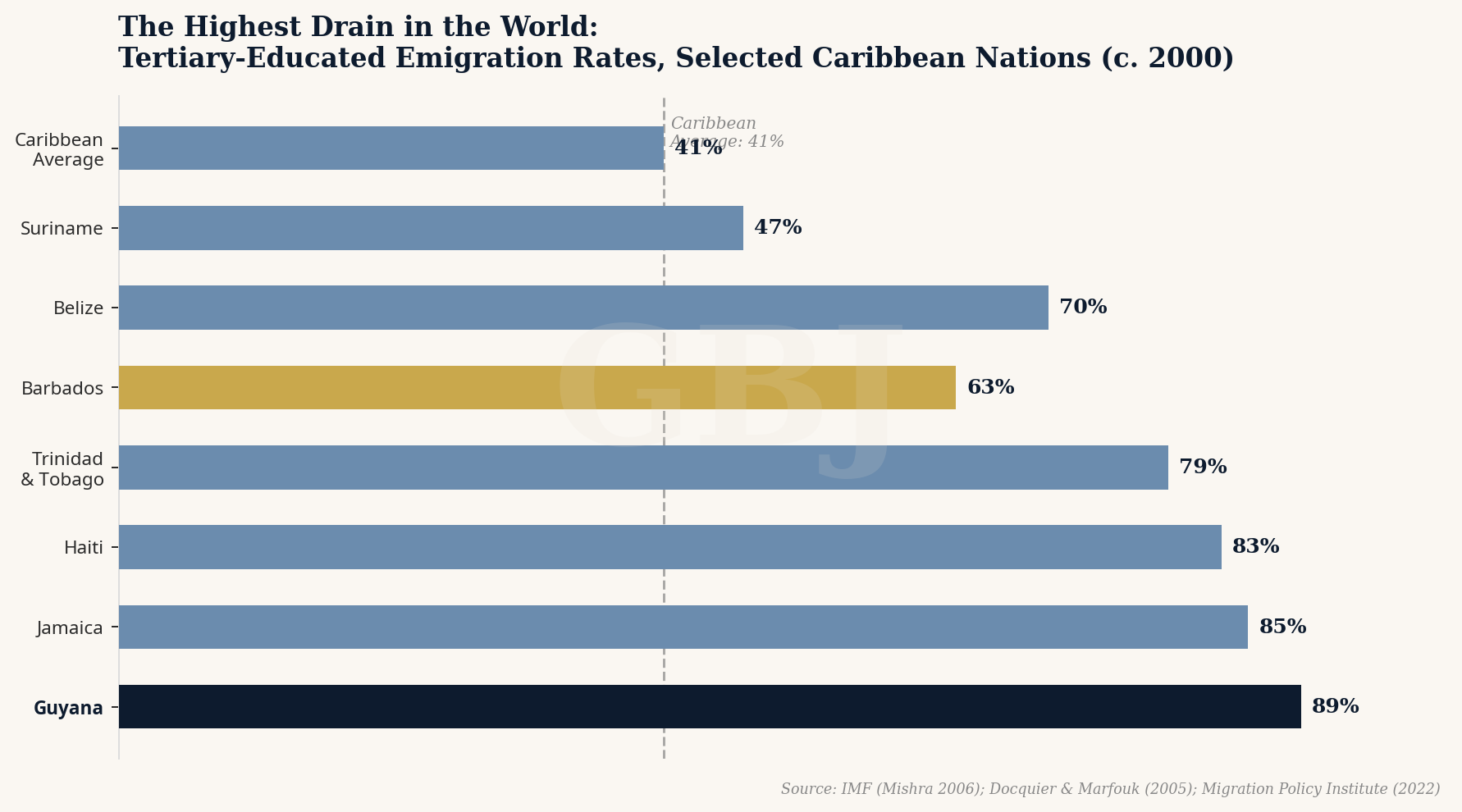
89%
Tertiary-educated Guyanese who emigrated, 1965–2000 — highest rate in the Caribbean
|
0.195
HDI gap between Barbados and Guyana at the year 2000 — one of the largest in the Caribbean
|
1980
Year Guyana’s HDI peaked — it did not recover to that level until the 2000s
|
5 mo.
Duration of the 2020 electoral crisis — a five-month electoral standoff unprecedented in the modern Anglophone Caribbean
|
The responses to last week’s essay arrived from New York and Toronto and London and Atlanta and Accra and Paramaribo. They came from physicists and doctors and lawyers and engineers and teachers, and from people who had none of those titles but who had sat in the same classrooms and carried the same memories. They came, with remarkable consistency, from people who had left.
That fact — the geography of the response — is itself the essay I want to write this week. Not the celebration of what Guyana produced, but the question of where it went. Not the beam that traveled one and a half million kilometers to the edge of the solar system, but the nation that sent it there and could not hold it.
I. The Address That Changed
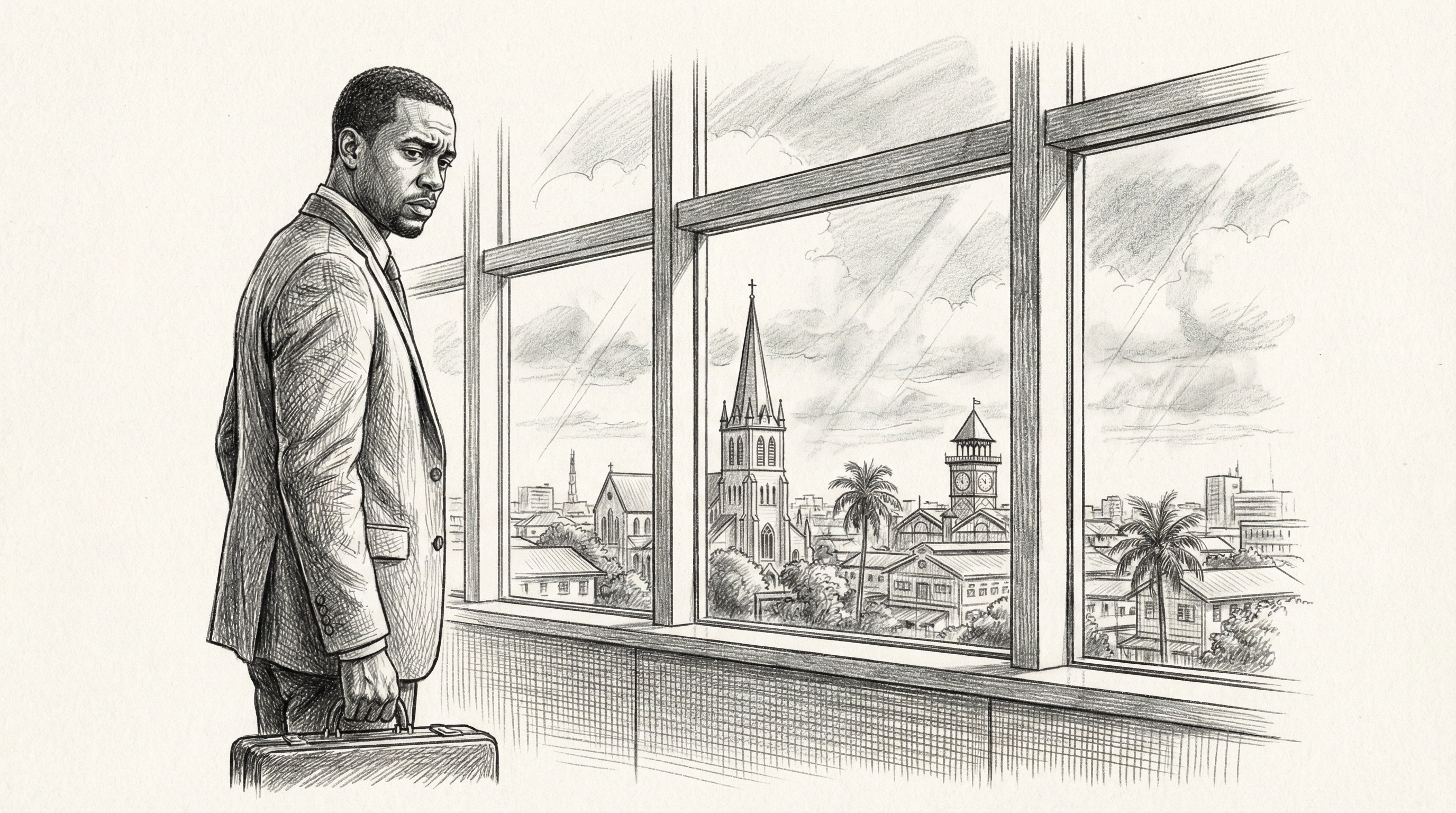
There is a particular kind of Guyanese conversation that happens in diaspora spaces — at alumni reunions in Brooklyn, at cricket matches in Toronto, at academic conferences in Washington — in which the question of return is always present, even when it is not spoken. It sits in the room like a piece of furniture everyone has agreed not to mention. The question is not whether Guyana is home. It is whether home is safe to go back to.
For a generation of Guyanese professionals who left in the 1970s and 1980s, the answer was, for a long time, no. Not safe in the physical sense — though there were periods when that was also true — but safe in the institutional sense. Safe in the sense that a person of talent and ambition could expect to be evaluated on merit rather than on ethnicity or political affiliation. Safe in the sense that the state would not consume what you built. Safe in the sense that the rules would be the same tomorrow as they were today.
The nation that those professionals left was not yet safe to come home to. For many of them, that question has not been fully settled. And the question of why — of what made it unsafe, and what would need to change to make it otherwise — is the question that the oil era has made urgent in a new way.
II. The Barbados Comparison
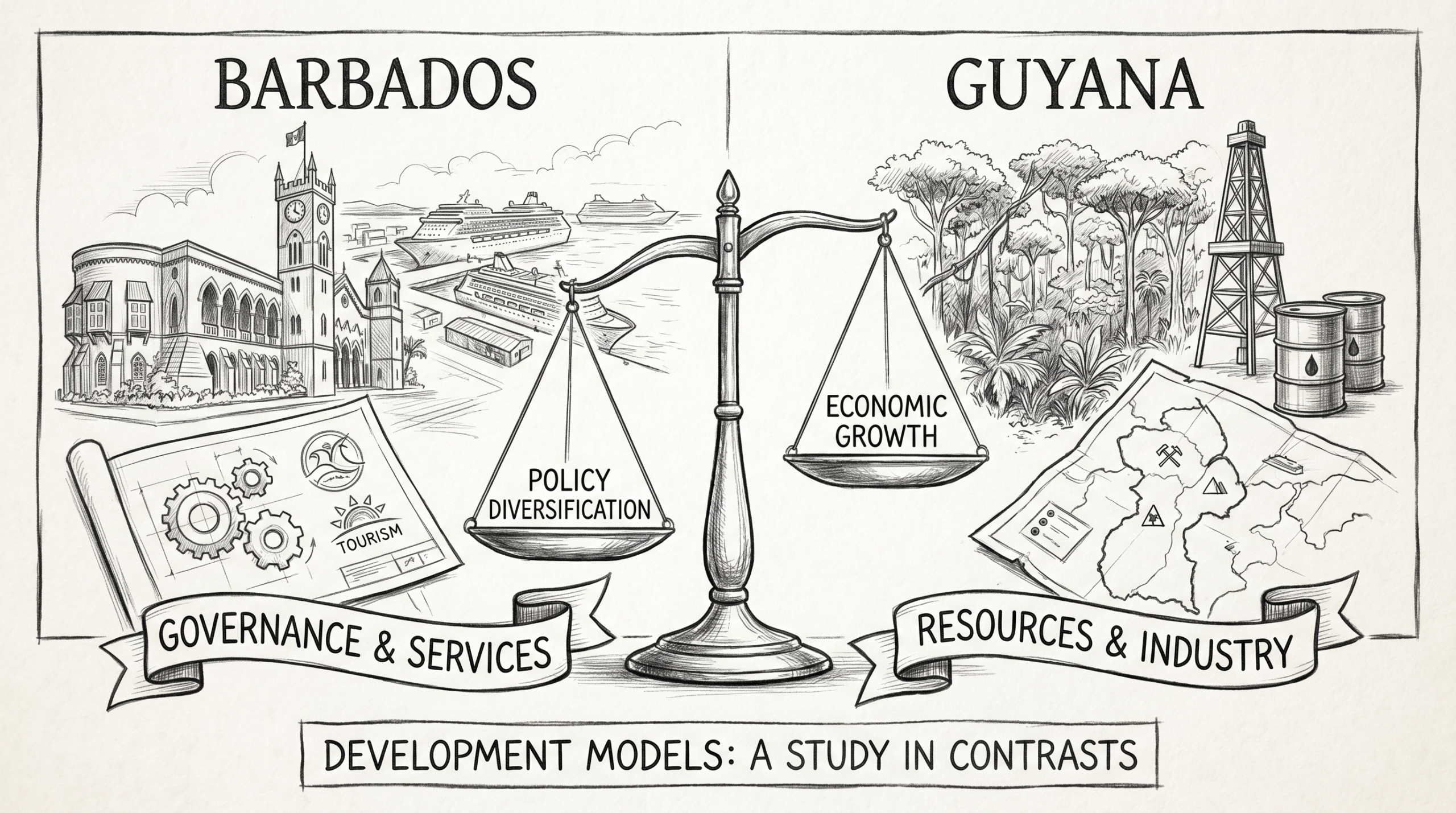
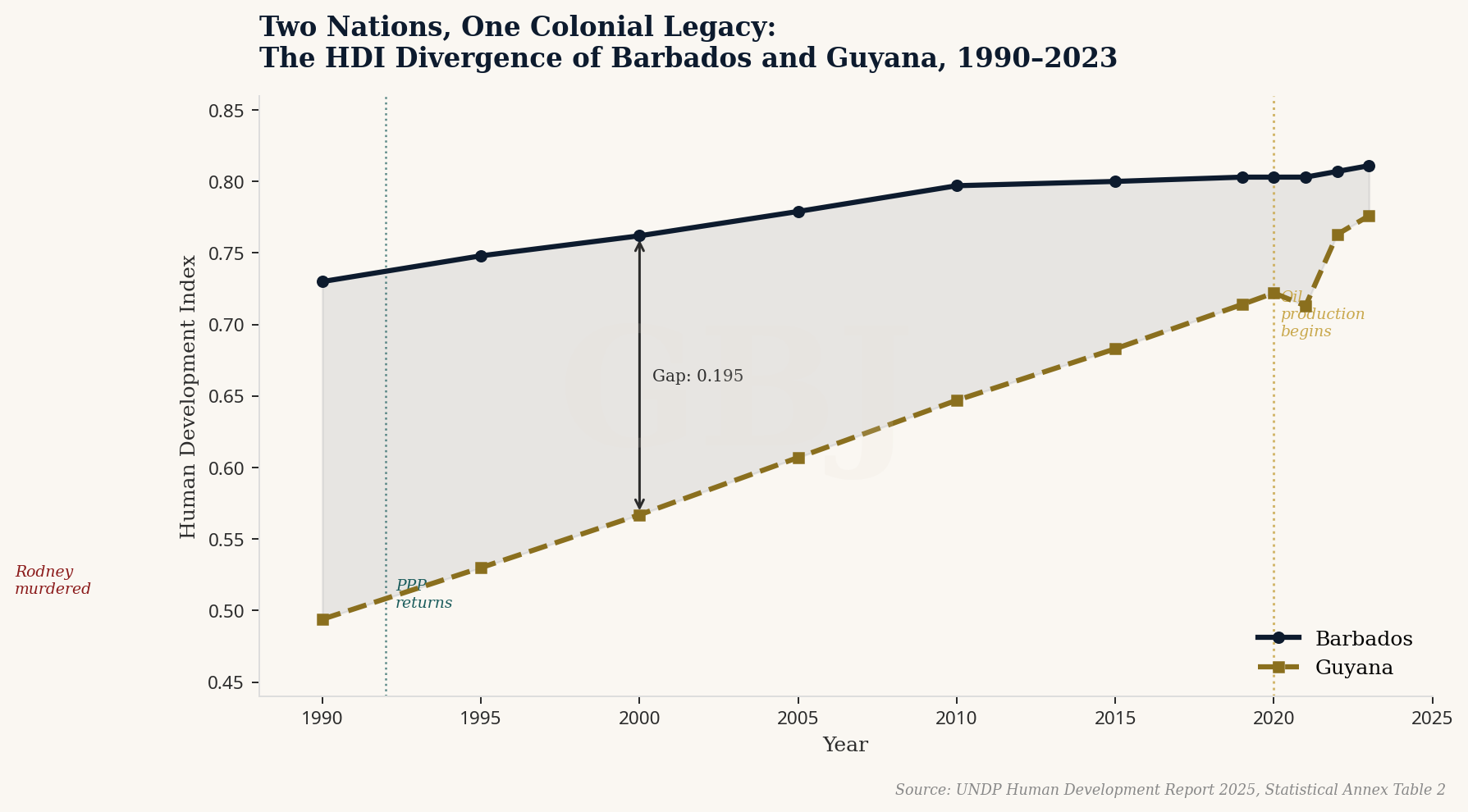
Begin with Barbados, because Barbados is the most instructive comparison available. The two countries share a colonial history, a Caribbean geography, a small population, and a dependence on a single commodity export — sugar, in both cases, for most of the twentieth century. They achieved independence in the same year: Guyana in May 1966, Barbados in November. They had, at independence, roughly comparable levels of human development.
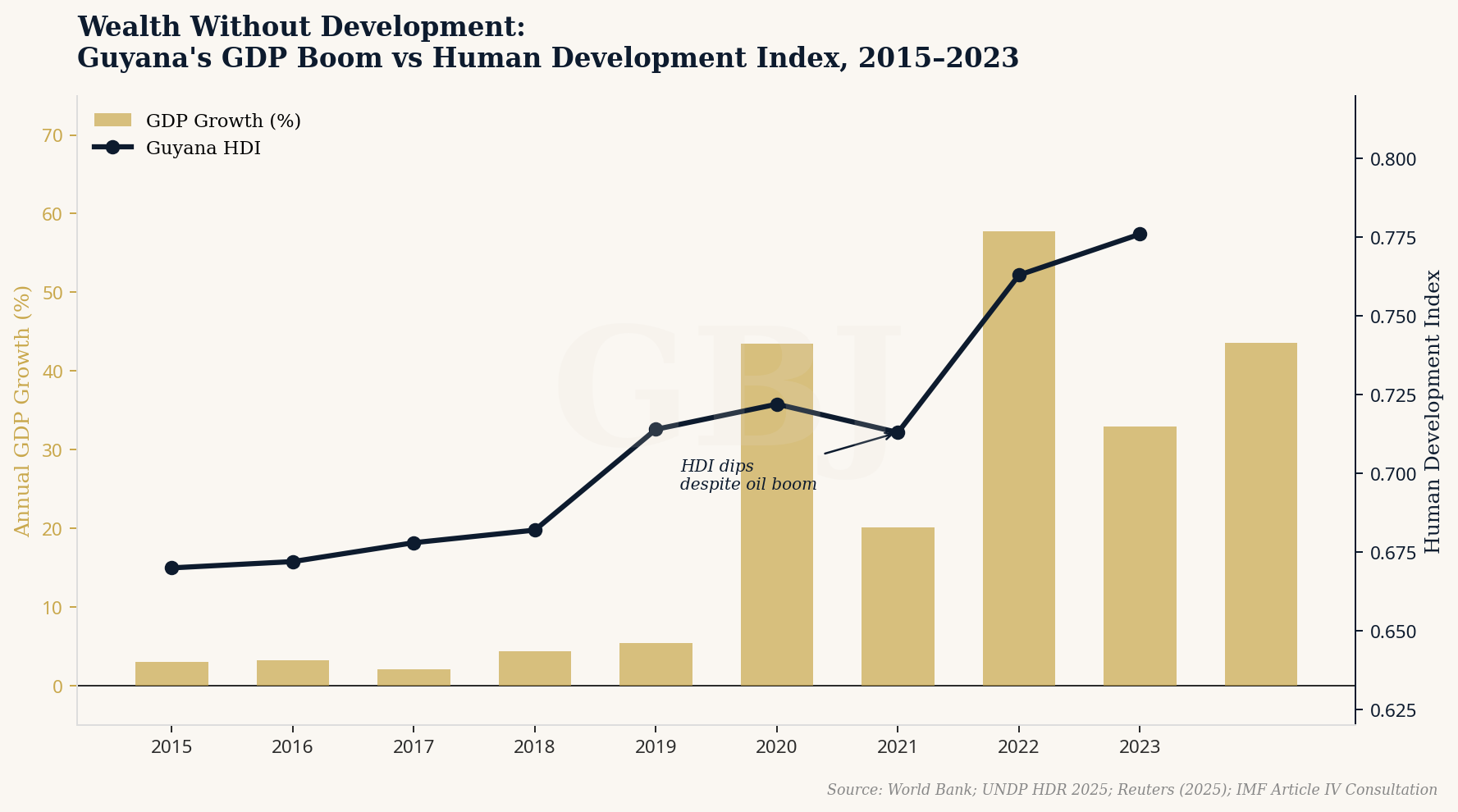
By the early 2000s, Barbados consistently ranked among the top thirty countries in the world on the Human Development Index. Guyana ranked in the bottom third. The gap between them — 0.195 HDI points at its widest — was not a gap between a rich country and a poor one. It was a gap between two countries that started in the same place and made different institutional choices.
The comparison is not exact: Guyana’s ethnic cleavages, territorial scale, and political history made state-building harder. But not so much harder as to explain, on their own, the gulf that emerged.
Barbados built a civil service that was, by regional standards, genuinely meritocratic. It maintained the independence of its judiciary. It did not use state resources as a primary instrument of political consolidation. It did not, in the critical decades after independence, drive out its professional class. The result is visible in the HDI data: a steady, compounding accumulation of human development that Guyana did not achieve.
Guyana made different choices — though the full story of those choices resists the clean verdict that comparative data alone might suggest. The Burnham government was, in its stated ambitions, genuinely visionary. Cooperative socialism, food self-sufficiency, free education from nursery to university, solar energy, indigenous technology, community self-reliance — these were not provincial ideas. They were, in many respects, ahead of their time. A Destiny to Mould and The Sophia Declaration remain serious documents that any honest account of the period must reckon with rather than dismiss. And the context matters: Guyana in the 1970s was navigating Cold War pressures, racial political mobilization inherited from the colonial period, an economy structurally dependent on commodity exports, and the active hostility of external powers uncomfortable with the direction of the government’s ambitions. Simple judgments do not survive contact with that complexity.
What the historical record does allow us to say, with more confidence than blame, is that vision and institution are different things — and it is the second that determines outcomes. Whether by design, by circumstance, or by the compounding pressures of governing a fragile postcolonial state in a hostile international environment, the cooperative economy came to be administered through a state apparatus in which loyalty and political proximity shaped advancement alongside, and sometimes above, competence. The food self-sufficiency program — genuine in its aspiration — encountered implementation conditions that, whatever their causes, ultimately constrained the productive capacity it was designed to harness. The conditions that make education valuable — a stable economy, a civil service that rewards merit, a judiciary capable of protecting professional life — did not develop in step with the expansion of access to schooling itself.
What followed is a matter of demographic record rather than political verdict. The professional class that the colonial education system had produced left. Not all at once, and not all for the same reasons. Some left because of economic conditions, some because of political fear, some because of the particular vulnerabilities that come with belonging to an ethnic community on the wrong side of a polarized political landscape. Their departures, individually comprehensible, accumulated into something that has the quality of a structural outcome. Whether that outcome was the inevitable consequence of deliberate policy, the unintended result of difficult choices made under impossible constraints, or some proportion of both — that question belongs to historians with fuller access to the record than any of us currently have.
What the HDI data measures is not the sincerity of the vision. It records what the institutions produced. Guyana’s economic decline was not driven by policy alone, but by the interaction of policy with persistent political conflict — a compounding dynamic in which each reinforced the other. Barbados’ institutional stability, by contrast, reinforced growth rather than undermining it, widening the developmental gap between the two countries with each passing decade.
“Transitions transfer power. They do not automatically transfer institutional culture.”
III. The Meritocracy That Was Not Built
The brain drain is not primarily a story about individuals who chose to leave. It is a story about an institutional environment that made leaving the rational choice. When the state cannot reliably guarantee that competence will be rewarded, when advancement depends on political proximity rather than on the quality of one’s work, when the conditions that make professional life sustainable are not consistently present — in that environment, the people with the most options will exercise them. And the people with the most options are, by definition, the most capable.
This is the mechanism by which patronage systems destroy themselves over time. They do not simply fail to attract talent; they actively repel it. The most capable people leave, and the system becomes progressively less capable of the reforms that would make it worth returning to. The cycle is self-reinforcing, and it is very difficult to break.
Barbados broke it, or rather, never fully entered it. The institutional choices made in the first decade of independence — the maintenance of a meritocratic civil service, the protection of judicial independence, the refusal to use state resources as a primary instrument of ethnic mobilization — created a different kind of environment. One in which the most capable people had reasons to stay, and reasons to return if they had left.
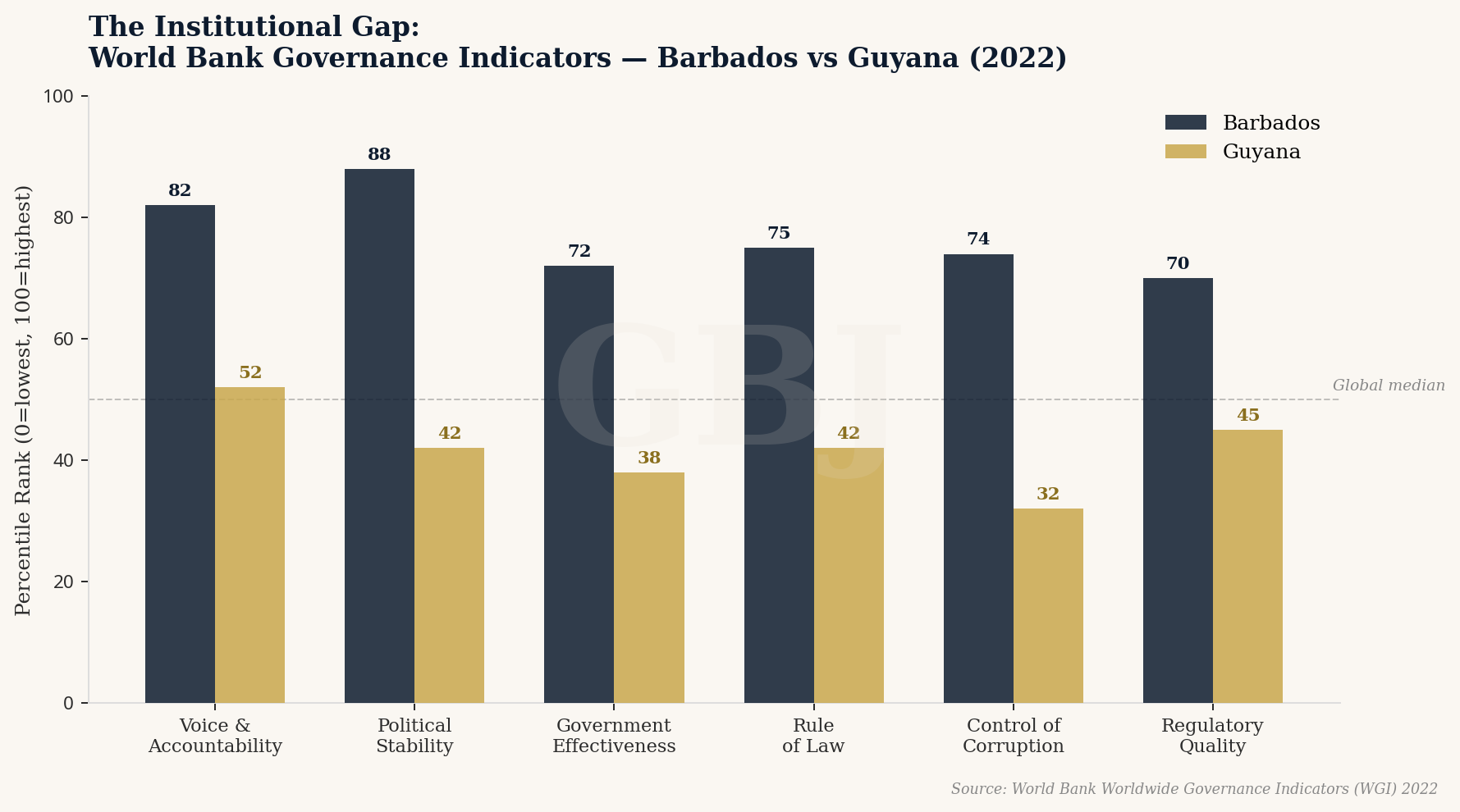
The World Bank’s Governance Indicators (2022) place Barbados above the global median on all six governance dimensions: voice and accountability, political stability, government effectiveness, regulatory quality, rule of law, and control of corruption. Guyana falls below the global median on four of the six. The control of corruption gap is the most striking: Barbados scores at the 74th global percentile; Guyana at the 32nd. This is not a gap in resources. It is a gap in the quality of governance — and it is the direct legacy of the choices made in the decades after independence.
IV. The Transition That Did Not Transition
In 1992, Guyana held its first free and fair election in twenty-eight years. The PPP won. The transition was celebrated internationally as a democratic restoration, and in many respects it was. The formal machinery of democracy — elections, a free press, opposition parties — was restored. The worst excesses of the Burnham era ended.
But transitions transfer power. They do not automatically transfer institutional culture. The patronage architecture that the Burnham government had built — the staffing of the civil service on the basis of loyalty, the use of state resources for political consolidation, the expectation that the state would serve the party rather than the nation — did not disappear when the government changed. It was inherited. And because the institutions that would have made those incentives resistible had not yet been built, the new government faced the same structural temptations as the old one and, with differences of degree and style, responded to them in recognizable ways.
The authoritarian habit had not been cured. It had been interrupted.
This is not a verdict on the intentions of any particular government. It is a structural observation: the incentive to use state resources for political consolidation did not disappear when the government changed, because no one had yet built the institutions — an independent judiciary with genuine enforcement capacity, a civil service insulated from political appointment, a procurement system with real transparency — that would have made those incentives resistible. The architecture survived the transition because dismantling it was not in anyone’s immediate political interest, regardless of party.
V. The Three Stories
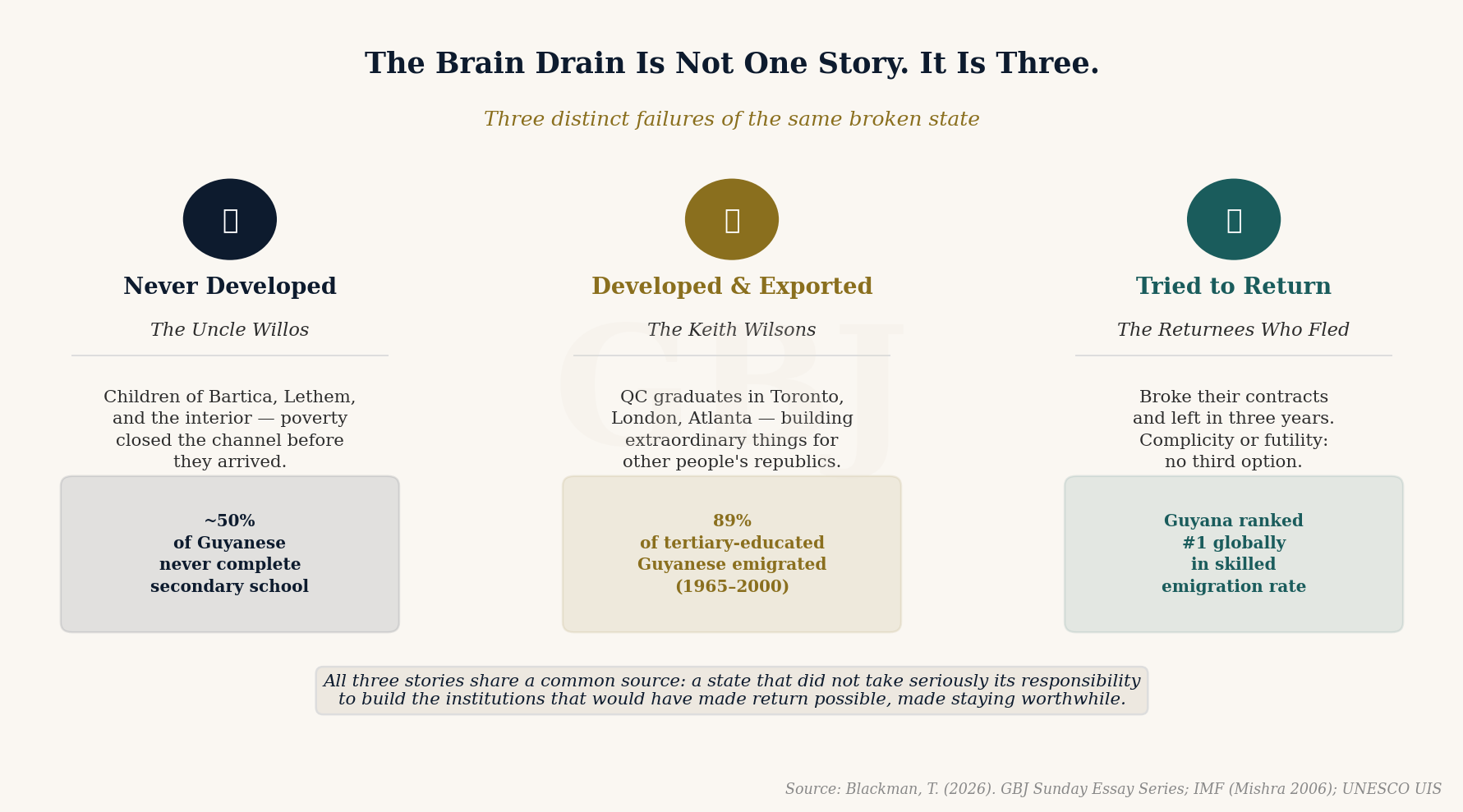
The Guyanese diaspora is not one story. It is at least three, and conflating them produces a distorted picture of both the problem and the solution.
The first story is the story of those who were never developed — who left before they had the chance to build the skills and credentials that would have made them useful to a developing economy. These are the people who emigrated in the 1970s and 1980s as young adults, before the education system had finished with them, driven by economic collapse and political fear. They built lives elsewhere, and they built them well, but they did not take with them the human capital that Guyana needed most. They took with them the potential for it.
The second story is the story of those who were developed and exported — who received the full benefit of Guyana’s educational investment and then deployed it elsewhere. Keith Wilson is the most visible example in this series, but he is not exceptional. IMF research documents that between 1965 and 2000, Guyana lost approximately 89 percent of its tertiary-educated population to emigration. These are the doctors who trained at the University of Guyana and now practice in New York. The engineers who graduated from Queen’s College and now build infrastructure in Canada. The teachers who learned their craft in Georgetown and now teach in London. The nation paid for their education and received, in return, remittances and occasional visits.
A QC alumna who went on to a career in science told the GBJ that she was reminded, at the school’s 180th anniversary celebrations, of the same institutional expectation that Trotz had expressed to Keith Wilson — almost word for word. A senior figure approached her after she had presented as the youngest panelist and said, in the manner of a certain kind of Guyanese elder: “I ain’t going to tell you congratulations and try and swell your head too much, because as a QC girl, that’s what’s expected of you.” The remark is not incidental. It is an institutional posture — a culture of expectation that Queen’s College transmitted across generations and across gender. The question the essay is asking is why that expectation of excellence was so rarely accompanied by an expectation of return.
The third story is the story of those who tried to return — who came back after years abroad, with credentials and experience and a genuine desire to contribute, and found that the institutional environment made contribution difficult or impossible. This is the least-told story, and in some ways the most important one, because it is the story that most directly illuminates what needs to change.
A Guyanese who returned after years abroad told the GBJ: “It’s hard some days to be here, but ultimately I don’t think I want to be anywhere else. So here I am.” That is what the third story looks like when it holds. It is not heroic. It is quiet, and it is hard, and it is present.
“It’s hard some days to be here, but ultimately I don’t think I want to be anywhere else. So here I am.”
VI. The Exam Factory and the Dual Track
The failure was not only in retaining excellence at the top, but in building competence across the whole society.
There is a fourth dimension to this story that the brain drain data does not capture: the students who were never in the pipeline at all. The children of Bartica and Lethem and Mabaruma and the Rupununi, for whom Queen’s College was not a destination but a rumor — a place that existed in Georgetown, for people who were not them.
The education system that Guyana inherited from the colonial period was designed, as I noted last week, to identify and cultivate a small elite. It was not designed to produce a capable citizenry across the full geography of the country. And it has not been redesigned to do so. The result is a system that is, in the language of education policy, highly selective at the top and deeply inadequate at the base — an exam factory that produces a small number of exceptional individuals and fails the majority of the children who pass through it.
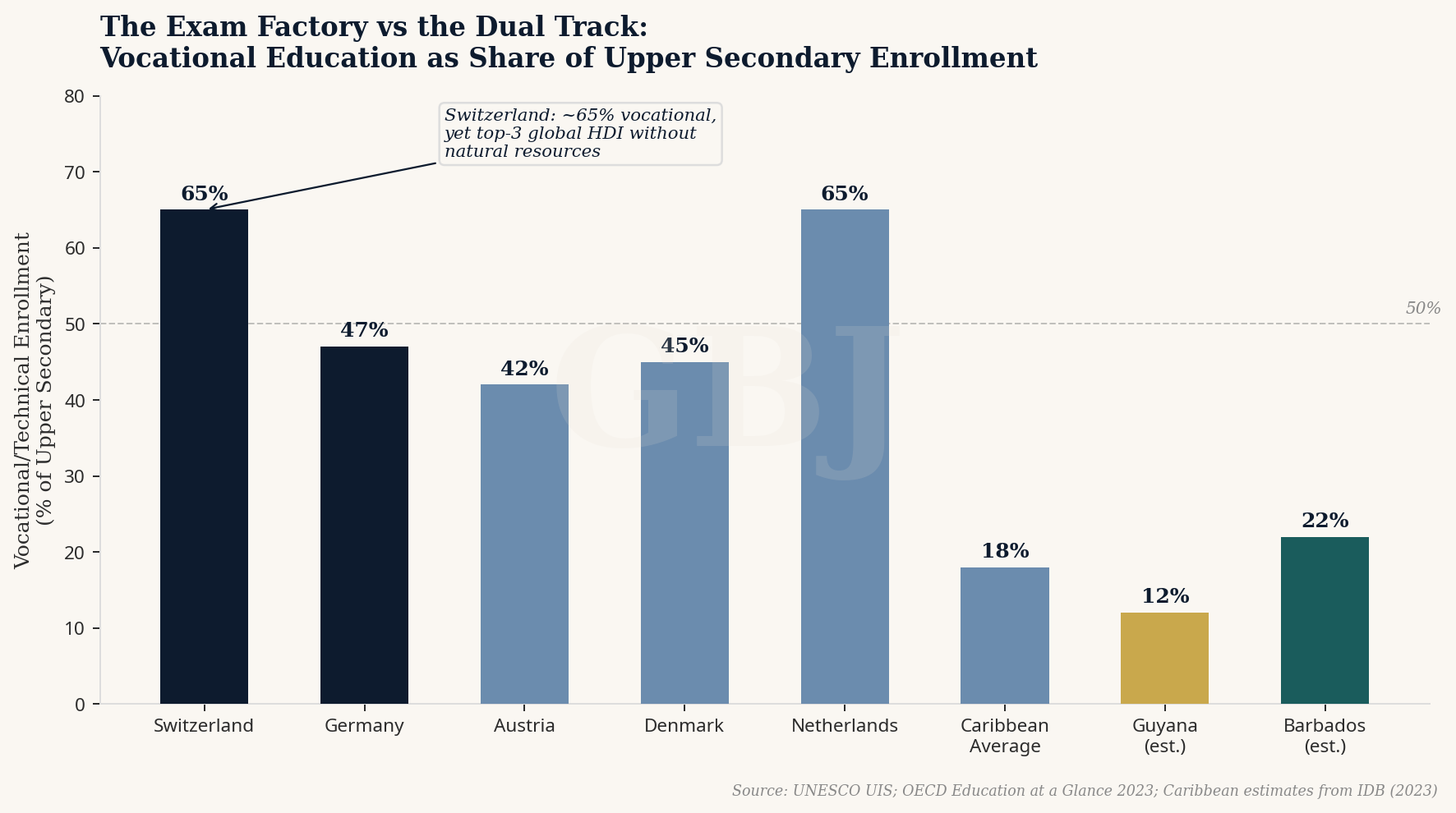
The Swiss and German models offer a different architecture. In Switzerland, approximately 65 percent of upper secondary students are enrolled in vocational education and training. Germany’s figure is 47 percent. These are not consolation-prize tracks. They are the backbone of two of the most productive economies in the world, built on the recognition that a nation’s human capital is not located exclusively in the small percentage of students who can pass a university entrance examination. A Guyanese equivalent — sector-specific, regionally distributed, connected to the actual skills the oil economy and the agricultural economy and the health system need — is not a utopian proposal. It is an engineering problem. One that the oil revenues now make financially solvable, if the institutional will exists to solve it.
Queen’s College has produced extraordinary individuals. Whether it has produced citizens in that deeper sense — people equipped not merely to excel within systems but to build and repair them — is the question its alumni and its leadership are now in a position to answer. The oil era has reopened that question. The answer is not yet written.
VII. What the Oil Era Is Actually Testing
Guyana’s oil revenues — approximately $1.6 billion in 2023 and growing — represent the largest single opportunity for institutional investment in the country’s history. The question is not whether the money is there. It is whether the institutions are there to deploy it effectively.
Building schools without changing what happens inside them produces beautiful monuments to a missed opportunity. Building university campuses in every region without reforming curriculum and pedagogy distributes the same irrelevance more efficiently across the territory. Producing more Queen’s College graduates without asking what obligation the state has to create conditions worthy of their return continues to send Guyana’s best minds to JPL and MIT and the London School of Economics — and calls it success.
What the oil era is actually testing is simpler and harder than any of those proposals. It is testing whether Guyana can build the institutional architecture — the meritocratic civil service, the independent judiciary, the education system oriented toward national need rather than colonial aspiration, the procurement frameworks that reward competence over connection — that would make the nation safe to come home to. Whether the three stories can become one.
“Is there the will to do what needs to be done?”
Mr. Trotz asked his question near the end of our conversation. He said it twice. He said it the way a man says something when he already suspects the answer, but is not yet willing to give up on the question.
Neither am I. But let me be plain about what continuing to avoid the answer costs. Another generation of Guyanese engineers designing infrastructure for other countries. Another cohort of children in Bartica and Lethem waiting for a teacher who is currently in Toronto. Another oil boom that generates revenue without generating the institutions capable of deploying it equitably. The Barbados that Guyana could have been — and, with the right choices made now, might still become.
The resources are there. The human capital, scattered across four continents, is there. The comparison that indicts us is there, in the HDI data, for anyone willing to read it honestly. What is not yet there is the institutional architecture that would allow all three to meet.
Build it. The window will not stay open.
The Guyana Business Journal welcomes responses, reflections, and continued argument. The Sunday Essay series is published weekly. Write to us at terrence.blackman@guyanabusinessjournal.com.
- United Nations Development Programme. (2025). Human Development Report 2025: Statistical Annex — HDI Trends Table. UNDP.
- Mishra, P. (2006). “Emigration and Brain Drain: Evidence from the Caribbean.” IMF Working Paper WP/06/25. International Monetary Fund.
- Docquier, F., & Marfouk, A. (2005). “International Migration by Educational Attainment, 1990–2000.” In C. Özden & M. Schiff (Eds.), International Migration, Remittances, and the Brain Drain. World Bank.
- World Bank. (2022). Worldwide Governance Indicators. Washington, DC: World Bank.
- UNESCO Institute for Statistics. (2023). Education data: Vocational enrollment rates. UNESCO UIS.
- OECD. (2023). Education at a Glance 2023: OECD Indicators. Paris: OECD Publishing.
- World Bank. (2024). Guyana GDP growth data. World Development Indicators.
- Blackman, T. R. (2026). “The Longest Beam: On Clarence Trotz, Keith Wilson, and the Human Capital We Keep Sending Away.” Guyana Business Journal & Magazine.
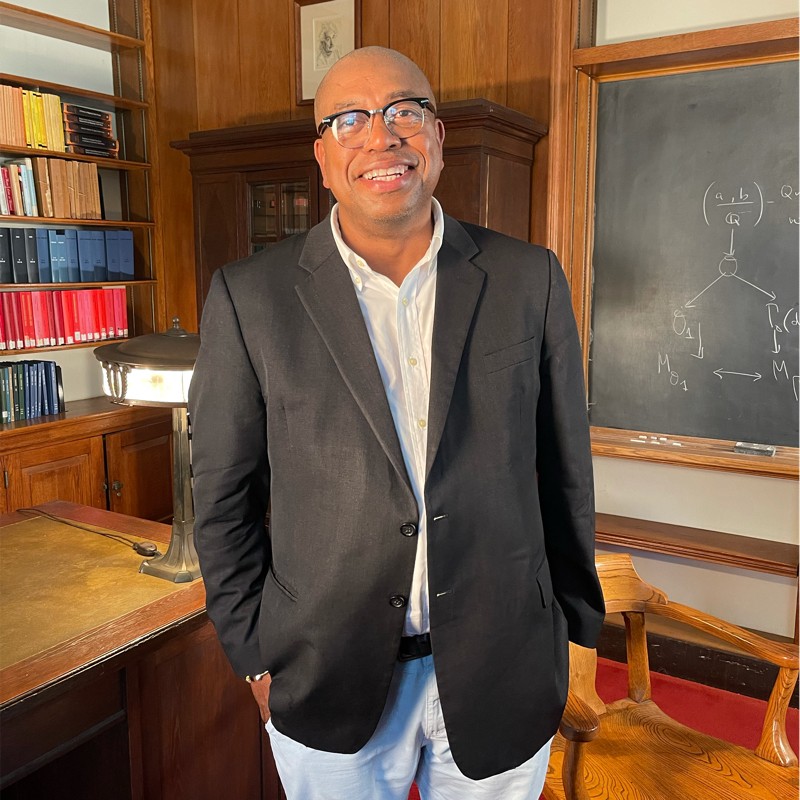
Dr. Terrence Blackman is Professor and Chair of the Department of Mathematics at Medgar Evers College, City University of New York. He is the Founder and Publisher of the Guyana Business Journal and a member of the Caribbean Math Olympiad Network. He is a former Dr. Martin Luther King Jr. Visiting Professor at MIT and Visitor, Institute for Advanced Study, Princeton. His work sits at the intersection of mathematics, education policy, and Caribbean development.
The following organisations make independent journalism at the GBJ possible.
|
Non-Ferrous Metals · Global Markets
Metallica CC
A global commodities firm connecting producers and consumers of non-ferrous metals across the Americas, Africa, and Asia. Offices in New York, Peru, Canada, Tanzania, and Guyana. Paid advertisement. GBJ editorial independence is not affected by sponsorship.
|
Cloud Computing · Enterprise Finance
Pebblestream
A US-based cloud computing company that transforms complex financial models into enterprise-scale applications. Processing over one billion tax calculations monthly. Paid advertisement. GBJ editorial independence is not affected by sponsorship.
|
|
Freight · Logistics · Caribbean & Americas
Carib Ship ATL
A full-service freight and logistics provider with deep roots in the Caribbean basin, offering reliable shipping solutions across the Americas and beyond. Paid advertisement. GBJ editorial independence is not affected by sponsorship.
|
Management Consulting · Project Management
MCCG USA
A premier MBE- and DBE-certified management consulting and project management firm serving clients across the United States, Caribbean, and Latin America since 1990. Paid advertisement. GBJ editorial independence is not affected by sponsorship.
|
STEM Guyana advances science, technology, engineering, and mathematics education across Guyana, building the human capital foundation the nation’s development demands. stemguyana.com
