
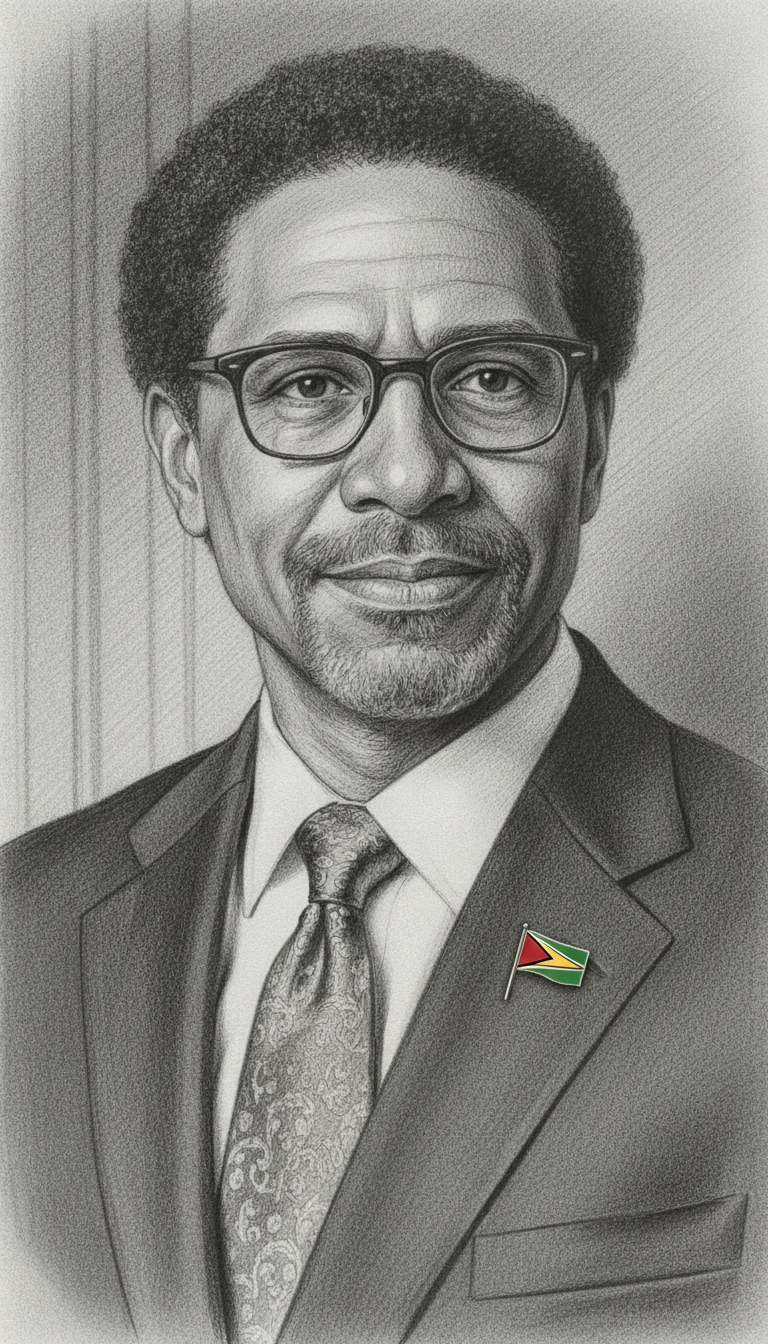
From Corruption to Meritocracy: A Conversation with Dr. Terrence Campbell
By Professor Terrence Blackman, Founder, Guyana Business Journal
When I sat down with Dr. Terrence Campbell, Member of Parliament and Leader of the APNU’s parliamentary delegation, I wasn’t sure what to expect. I knew the outlines of his story—his years in business, his recent turn to front-line politics, and the devastating election that left the APNU with only 12 seats. But I wanted to understand something deeper: what animates his engagement? What sits beneath the public statements about service and country?
After nearly an hour of conversation, that question was answered with surprising clarity. What emerged was the portrait of a man whose political convictions trace back almost four decades, hardened by the discipline of business and now expressed through a demanding, almost relentless, commitment to grassroots political work.
Campbell began in 1988, at 24, as he transitioned from insurance management into entrepreneurship. Guyana at that time—much like today—was saturated with corruption: customs evasions, under-the-table arrangements, a parallel economy that rewarded those willing to skirt the law. Yet he had been shaped by a very different professional culture at Hand-in-Hand under General Manager Walter Spooner, a man he still speaks with today. “We dotted the i’s, crossed the t’s, did everything by the book—and we made a profit.” That lesson became foundational. “You can do everything by the book and still make a dollar.”
It was not idealism. It was a business conclusion. But as he built his enterprises, the corruption he rejected only intensified. And he began to see its consequences clearly: Guyana’s most qualified professionals—those with certifications, degrees, and expertise—were leaving because honesty could not compete with illegality. “Success in Guyana belongs not to the professional class,” Campbell said, “but to the class that is willing to take risks with the rule of law.” That dissonance pushes people away. “Most professionals don’t want to participate in corruption, but they see the widening gap between their circumstances and those of the corrupt elite.” The result is predictable and devastating: emigration of talent.
Campbell offered a striking framework for Guyana’s social reality—three 50% figures: nearly half the population in poverty, half the nation’s youth dropping out of high school, and half of our young people struggling with basic self-esteem. These are not random statistics; they represent the systemic consequences of institutional failure. As he walks the streets during the APNU’s post-election listening tour, he meets young people who “don’t even see themselves” as capable citizens. “Every young person should see themselves as capable of being the president of Guyana,” he insisted, “but many have zero self-esteem.” It reminded me of Karen Abrams of STEM Guyana, and her conviction that Guyana needs elite opportunities for every child, not only for the privileged few. Campbell agreed readily: “Equity in education, health, and economics—these are the great levelers.”
Campbell’s account of Guyana’s much-touted oil economy was sobering. While GDP headlines celebrate growth, the communities he visits tell a different story. “This oil economy is crushing thousands of Guyanese,” he said plainly. He described visiting Plaisance and hearing from residents who felt abandoned. And then came the detail that stayed with me: “I saw weight challenges. Not from too much steak and lobster, but from diets of pure calories—nothing else.” Malnutrition in an oil-rich state.
Even more troubling was a young man who said to him, “I don’t feel we can run this country.” Campbell sees a generation beaten down by a system that has failed them so thoroughly that they cannot imagine themselves as leaders. That should alarm all of us.
After the election, Campbell approached the party’s recovery like an entrepreneur. “The voters are customers,” he explained. “They’ve stopped coming to my store. I want to know why.” The APNU has chosen intensive qualitative engagement—daily outreach, written reports after every session, systematic listening, and we can still see themes emerging.” About fifty outreach events later, the themes are consistent across communities, he said.
The pace has been punishing. His smartwatch’s “body battery” has not climbed above 50% for weeks. “I go to bed tired, and I wake up tired.” I urged him to take care of himself; he shrugged it off with characteristic focus. The work continues.
I asked how a 12-seat opposition can matter against a 36-seat majority. His answer was firm: by being aggressive and thorough. The APNU has advanced more motions, questions, and bills than any previous small opposition bloc, covering national security, local government, GOAL scholarships, biometrics, agriculture, and the Natural Resource Fund. “We will use Parliament to hold the government accountable and to communicate with the people.”
But Campbell also wants cultural change. Too many parliamentarians “go to Parliament and go home.” His goal is to reverse that pattern among APNU MPs. “That’s the only way to win an election.”
A question during the livestream asked about unity among opposition parties. Campbell didn’t pretend this was easy. The APNU, WIN, and Forward Guyana Movement each have leadership ambitions. “Let’s be practical,” he said. “There will be areas of cooperation and areas where each party advances its interests.” But he sees opportunity not only among those who voted against the PPP, but among those who did not vote at all because of the five issues emerging from the listening tour. “Everywhere we go, people say, ‘We’ll give you guys a chance.’ We are determined to rout the PPP by 2030.”
Our discussion of the Natural Resource Fund was one of the most substantive policy conversations I’ve had with a Guyanese politician. Campbell argues that the NRF must support economic stabilization, intergenerational equity, and infrastructure development. He has introduced an NRF bill, despite public cynicism about opposition bills from a 12-seat party. “We must examine legislation on its merits,” he said. “Not reject it because of the messenger.” He pointed to bipartisan cooperation in the U.S. as a model for Guyana’s political maturation.
Campbell sees infrastructure investment as essential—and as benefiting the poor. He spoke vividly about dilapidated inner-city housing that should be rebuilt entirely. Oil funds, he argued, ease pressure on tax revenues, allowing those revenues to support social programs and cash transfers. Above all, he insists on complete transparency. “Oil is non-renewable. Maybe we have 25 years. We must be wise.” At minimum, the public must see exactly how the wealth is being used.
We revisited an analysis the GBJ conducted during the election cycle using a simple metric: which party’s manifesto would reduce poverty for the most people in the shortest time? By that measure, the APNU’s plan ranked highest. I asked whether that remains part of Campbell’s vision. “Absolutely.” The limitation, as he noted, is constitutional—opposition parties cannot introduce bills that place a charge on the Consolidated Fund. But the commitment remains.
Campbell’s focus on entrepreneurship was compelling. He distinguished between “opportunistic entrepreneurs” and “necessity entrepreneurs”—the latter being those who start micro-businesses to survive. They need upskilling and access to financing. He told the story of a Miami supplier—no formal training, but deep technical knowledge—who built an $8 million annual business. “He used the skill he had to remove himself from poverty.”
Then Campbell’s tone shifted. He criticized performative inner-city engagement—“the latest designer shades”—and insisted that the work must come from genuine concern. “What you see has to impact you inside and drive a commitment to help people move out of their circumstances.”
The APNU manifesto included thoughtful proposals: a junior stock exchange with tax exemptions, stipends for vocational trainees, and programs designed to help entrepreneurs scale without surrendering ownership. And Campbell’s commitment to these initiatives is rooted in personal history. Born in poverty in Mahdia in 1964, his own trajectory fuels his belief that structured opportunities must exist for others. “If I ever became president, the Ministry of Human Services would be doubled or tripled.” It was a striking admission—and a declaration of values.
As we spoke about the national vision, he offered a vivid memory from Singapore. He jaywalked at a crossing while thirty others waited; when he looked back, everyone was staring at him in disbelief. It was, he said, the last time he jaywalked in Singapore. He wants a Guyana with that level of respect for the rule of law—not only at traffic lights, but in governance, business, and national life. And he articulated a vision that resonated deeply with me: a Guyana where those who leave for advanced study return immediately because institutions work, opportunities are real, and merit matters.
Reflecting on our conversation, I was struck by several things: the through-line from Campbell’s 1988 decision to pursue ethical business practices; his understanding that Guyana’s crisis is institutional as much as economic; his willingness to confront psychological harm among marginalized youth; the systematic rigor he brings to political rebuilding; his insight into the corrosive effects of corruption; and his detailed thinking on the Natural Resource Fund and entrepreneurship.
His Singapore anecdote distilled his vision: a lawful, equitable, meritocratic society capable of attracting and retaining its brightest minds. Whether that vision takes root will depend on the road ahead—on whether the APNU can rebuild, whether the PNC can adapt, whether opposition parties can find productive alignment, and whether the Guyanese political class can embrace the maturity our moment demands.
Whether Campbell’s vision becomes a national trajectory or remains a solitary call will be determined in the years ahead. But the conversation offered something Guyana urgently needs: depth, seriousness, and a focus on institutional reform over transactional politics—a Guyana where the rule of law prevails, where institutions function, where integrity is not a liability.
That is the Guyana worth returning to. That is the Guyana worth building. And that is why conversations like this matter. Through “Transforming Guyana: New Voices, New Visions,” we aim to create a space where these questions are confronted honestly—where clarity, critique, and hope coexist. The work continues, and so does the conversation.
This conversation was part of the “Transforming Guyana: New Voices, New Visions” series. For more analysis of Guyana’s economic and political development, visit the Guyana Business Journal.
About This Profile
This profile is part of the “Transforming Guyana: New Voices, New Visions” series, produced by the Guyana Business Journal. The series highlights emerging leaders, professionals, and innovators who are shaping Guyana’s future during this unprecedented period of economic transformation.
The profile is based on an interview conducted by Dr. Terrence Richard Blackman, Chair and Professor of Mathematics at Medgar Evers College, City University of New York, and Founder of the Guyana Business Journal.
Contact Information
Guyana Business Journal
Website: https://guyanabusinessjournal.com
Mission: Fostering critical dialogue and thought leadership that contribute to securing an open, prosperous, and inclusive Guyana
November 20, 2025
Support Independent Analysis
📢 Please support the Guyana Business Journal & Magazine today
The Guyana Business Journal is committed to delivering thoughtful, data-driven insights on the most critical issues shaping Guyana’s future—from oil and gas to climate change, governance, and development. We invite you to support us if you value and believe in the importance of independent Guyanese-led analysis. Your contributions help us sustain rigorous research, expand access, and amplify the voices of informed individuals across the Caribbean and the diaspora.
The Guyana Business Journal Editorial Board welcomes reflections and submissions at terrence.blackman@guyanabusinessjournal.com.
