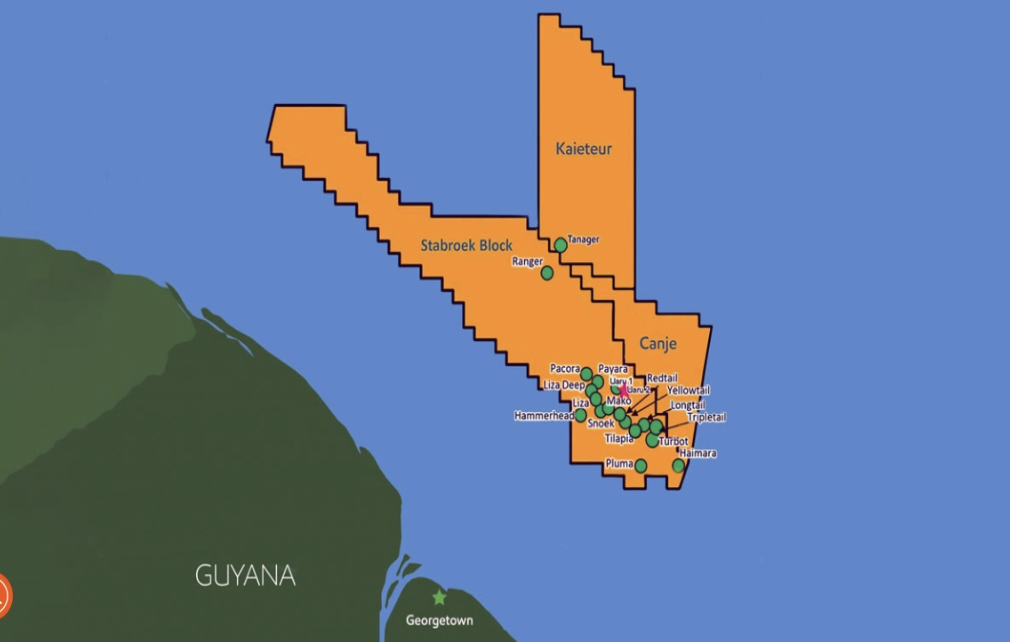
Hess Corporation has discovered a new oil reserve at the Lancetfish-1 well on the Stabroek Block in offshore Guyana. The well, located around 4 miles southeast of the Fangtooth discovery, was drilled by the Noble Don Taylor in 5,843 feet of water and found approximately 92 feet of oil-bearing sandstone reservoir. Additionally, Hess has disclosed that Kokwari-1 exploration well was drilled in the first quarter of the year but did not find commercial quantities of hydrocarbons. Hess has a 30% stake in the Stabroek Block, ExxonMobil is the operator with a 45% interest, and CNOOC holds a 25% stake. In 2023, ten wells are planned for the Stabroek Block.
Private Sector and Business Opportunities
Understanding Guyana’s Central Bank Reserve Balances: An Insider’s Guide
by
Joel Bhagwandin

Summary
The Bank of Guyana’s (BOG) capital and reserve account balances are not the country’s reserve. The reserve balances reflected on the Capital, Liabilities, and Reserves side on the Bank’s balance sheet are part of the institutional capital structure of the Bank. Conversely, the country’s reserves held by the Bank are reflected on the asset side of the Bank’s balance sheet―which constitutes market securities, special drawing rights (SDR) holdings, foreign balances, and gold reserves. Furthermore, it is essential to note that reserve management is one of the core functions of the central bank to meet its objectives which include price stability, meeting inflation targets, and exchange rate stability. Within this framework, it is also important to highlight that central banks exist to achieve the policy objectives prescribed in their respective laws. These cover monetary policy and systemic stability targets in pursuit of broader macroeconomic objectives. Therefore, rather than resource utilization or profitability efficiency, policy effectiveness provides the basis for central bank accountability.
Background
A recent news report posited that the Bank of Guyana’s profit could not meet the country’s reserve. The report cited a negative balance on the bank’s balance sheet as of February 2023, which was $12.1 billion. However, the explanation in the article attributed to this negative balance was without any analysis and, more so―void of an understanding of the purpose and function of the central bank’s reserve.
This article, therefore, seeks to address this issue by attempting to provide a sufficient explanation grounded in academic literature in terms of the purpose and function of the reserves and the implications of a negative balance.
Discussion and Analysis
The Bank of Guyana’s (BOG) capital and reserve account balances are not the country’s reserve. However, the reserve balances reflected on the Capital, Liabilities, and Reserves side on the Bank’s balance sheet are part of the institutional capital structure of the Bank.
Conversely, the country’s reserves held by the Bank are reflected on the asset side of the Bank’s balance sheet―which constitutes market securities, special drawing rights (SDR) holdings, foreign balances, and gold reserves. As of February 2023, the BOG’s total foreign assets stood at G$168.4 billion or US$807 million. This also corresponds to the net international reserve as per the “International Reserves and Foreign Assets” table 3.2 in the bank’s statistical report for February 2023.
Bank of Guyana Capital and Reserves
The capital and reserve balances of the central bank constitute several reserve accounts: the paid-up capital, general reserve fund, revaluation reserves, revaluation for foreign reserves, contingency reserves, and other reserves. Therefore, the referenced news report’s negative balance is attributed to the adjustments made in the revaluation reserve account. However, the revaluation reserves are not to be treated in isolation from the other reserve accounts of the Bank. Instead, it is treated as part of the bank’s total capital and reserve base―that is to say, the computation of the total reserve balance includes the balance in all of the reserve accounts, as previously mentioned. Consequently, any negative balance in the revaluation reserve will be reduced with positive balances in the other reserves, further offset by the net profit generated by the Bank.
While the gazetted statement of assets and liabilities for February 2023 reflected a negative balance of $9.1 billion, the statistical report published by the Bank for that month showed that the “other reserves” balance stood at $4.3 billion in the negative.
The revaluation reserve of the Bank reflects adjustments made for gains or losses derived from changes in the market value for the assets and liabilities of the Bank, specifically foreign assets and liabilities. To maintain the adequate capacity to fulfill its functions, the Bank has adopted a prudent approach to provisioning prescribed in the Bank of Guyana Act. Section 7 of the Act allows for deducting provisions before declaring profit and payment into the Consolidated Fund. The provision is to meet adverse market movements for investments held and other risks (market, credit, and interest rate) which may occur. So, for example, the bank holds gold as part of its total reserves. Gold prices tend to fluctuate based on market conditions which means that the price of gold at the beginning of the financial year may experience an upward or downward movement at the end. Therefore, whatever the market value of this asset at the end of the financial year, the adjustment is made accordingly, which is reflected either as a gain or loss in the revaluation reserves account. The same principle and practice apply to the Bank’s other financial instruments as part of its total foreign asset portfolio.
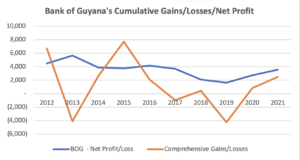
The gains and losses arising from a change in the fair value of available-for-sale assets are recognized directly in equity. However, when the financial assets are sold, collected, or otherwise disposed of, the cumulative gains or losses on the disposal are recognized in the income statement. To demonstrate this point, 2012-2021, 2013, 2017, and 2019 recorded losses of $4 billion, $953 million, and $4.2 billion, respectively. However, the cumulative gains and net profit for the same period amounted to $13.5 billion and $35.6 billion, respectively―as illustrated in the chart below.

Source: Bank of Guyana/Author
Concluding Remarks
Furthermore, it is essential to note that reserve management is one of the core functions of the central bank to meet its objectives which include price stability, meeting inflation targets, and exchange rate stability. Within this framework, it is essential to highlight that central banks exist to achieve the policy objectives prescribed in their respective laws. These cover monetary policy and systemic stability targets in pursuit of broader macroeconomic objectives. Policy effectiveness, rather than efficiency in resource utilization or profitability, provides the basis for central bank accountability.
About the Author
Joel Bhagwandin is a financial, economic, and public policy analyst. He is also an entrepreneur with over fifteen years of experience in the financial sector; corporate finance; financial management; consulting, and academia. He has provided insights and analyses on various public policy, economic, and finance issues in Guyana for the past 6+ years. He has authored more than 300 articles covering a variety of thematic areas. Joel has also written extensively on the oil and gas sector. Joel holds an MSc in business management with a specialism in banking and finance from Edinburgh Napier University. He is currently pursuing his second and third masters: 1) MBA (Finance) (Top-up) through Edinburgh Napier University, and 2) MSc. in Finance (Economic Policy) through the University of London.
References:
- https://www.kaieteurnewsonline.com/2023/03/21/bank-of-guyana-profits-unable-to-maintain-countrys-cash-reserves/.
- https://www.bis.org/publ/othp04_2.pdf.
- https://www.bis.org/publ/bppdf/bispap104.pdf.
- https://mola.gov.gy/sites/default/files/Cap.%208502%20Bank%20of%20Guyana.pdf.
Is Guyana susceptible to the natural resource curse?
By
Joel Bhagwandin
Recently, a Jamaican economist argued that “Guyana could fall victim to the so-called ‘resource curse’ as it moves deeper in developing its oil and gas finds because it lacks strong institutions to prevent corruption. The economist went on to make some other outlandish and callous remarks wherein he argued that “Guyana is going to go nowhere,” political parties will soon start to squabble over the spoils to the detriment of the country, and that unless there are strong institutions―corruption and violence will ensue, etc.
Notwithstanding, the concerns raised by the economist present an opportunity to stimulate some meaningful and critical discussion and analysis on the topic―though, unfortunately, he failed in so doing as an economics lecturer―who lectures at the premier tertiary level educational institution in the Caribbean community.
What is the resource curse?
The paradoxical resource curse is essentially a theory that describes countries with oil or other natural resource wealth―that have failed to grow more rapidly than others without. Wright and Czelusta (2004) contended that the resource curse hypothesis seems anomalous since, on the surface, it has no clear policy implication but stands as a wistful prophecy. The authors argued that countries afflicted with the “original sin” of resource endowments have poor growth prospects.
How weak is weak?
To assert that Guyana’s public sector institutions are weak―is a subjective notion rather than an inference derived from an objective analysis of the evolution of public sector institutions in Guyana over time.
Historical overview of public sector institutions in Guyana
There was a study done in 1994 titled “improving Guyana’s public sector policy implementation capacity to facilitate private investment: an institutional analysis and technical assistance strategy.” This study presented a comprehensive analysis of the state of public institutions in Guyana almost three decades ago. In the report’s introduction, it was stated that “Guyana has only recently begun to emerge from the effects of more than 20 years of state-led socialism following independence from Great Britain in 1966. Guyana’s leadership closely controlled all economic activity, either directly through state-owned enterprises or indirectly through tight price, credit, and foreign exchange controls. The cost of economic mismanagement has been high: weak economic growth (less than 1% per year during 1966-89), massively deteriorated physical infrastructure, capital flight, lack of investment, a significant “brain drain” of human resources, increasing poverty, and a huge accumulation of debt compounded with debt servicing arrears. By the late 1980s, Guyana faced a crisis that its socialist leaders could no longer address with stopgap remedies. Fundamental changes in development strategy were called for, and the Government of Guyana (GoG) turned to the international financial institutions for help”.
The report noted that by 1994, “Guyana has been quite successful in turning the economy around over the past five years (1989-94), largely due to reforms that eliminated the system of government controls that restricted economic activity”. Another important element in facilitating the expansion of private sector investment, according to the report, was the public sector investment program (PSP), which intended to provide the necessary supportive infrastructure to make private investment both effective and, ultimately, profitable. Evidently, the 1994 study has shown that the public sector institutions in Guyana had undergone a complete overhaul in the early 90s, naturally to facilitate the transition from a socialist, centrally command economy to a market economy following the implementation of the Economic Reform Programme (ERP).
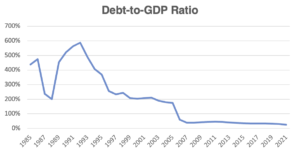
Another important point to note is that historically―during the socialist years that span some two decades, Guyana had, in fact, been a victim of the paradoxical natural resource curse―under the stewardship of the former government based on the foregoing description of the economic and political state of the economy at that time; which ultimately resulted in Guyana becoming a bankrupt state (as shown in the chart below).

Source: Bank of Guyana Reports/Author’s Calculation
It is the incumbent government that successfully reversed the economic prospects of the economy, inter alia, successfully steering the economy out of bankruptcy to economic stability―two decades later. Worthy of note is that this outturn could not have been achieved over the years without the consistent improvement and strengthening of public sector institutions to facilitate the buoyant and broad-based growth of the economy even before the discovery of oil.
Efforts have been made over the years to strengthen our public sector institutions, and the government continues to make the necessary investments. This is paramount. Two major challenges inherently characterize the weaknesses of public sector institutions, namely, human resources and employment of a modern Information Technology (ICT) framework within and across the public sector. The human resources limitations are largely attributed to our historic political and economic challenges wherein there was a lack of opportunities for our people who migrated by the thousands over the last few decades (the brain drain syndrome).
That said, of importance to note is that with the same institutions, it [evidently] depends on which political party is in government that knows how to competently derive the optimum results from these institutions. For example, let’s look at housing: the former government only delivered 7500 house lots in their entire five years term which translates to 1500 per annum. On the other hand, the current government―with the same ministry, and the same human and physical resources, delivered 21,000 house lots and turn-key homes in just over two and half years, which translates to 7,500 per annum―or 5 times more than the former government achieved in their entire five-year term.
Moreover, though the former government delivered 7500 house lots in 5 years, they did not have a proper housing program nor deliver any proper turn-key homes. Instead, the former government experimented with the ‘duplex’ concept, which failed miserably. In this regard, the former government failed to recognize that it would be difficult for any bank to finance the purchase of a duplex and for any insurance company to provide fire insurance coverage―because the design concept necessitated a special legislative framework (which was absent) to enable the banks to collateralize the units and the same for insurance.
Similarly, the same can be said for the other ministries and government agencies responsible for the processing of permits and other forms of approval and applications, which, under the former government, held up billions of dollars in investments that were subsequently unlocked following the change of government in 2020.
In the final analysis, there are inherent institutional limitations that are being addressed on an ongoing basis, and at the same time, despite the limitations, much is achieved as well with the perseverance and hard―around the clock work by the policymakers and the public servants.
There is no denying, however, what constitutes our developmental challenges and limitations. I think we have a deep appreciation and understanding of these realities and a deep understanding of what needs to be done―which is being done tangibly.
On the institutional strengthening side of things, several institutional reforms and capacity-building programs are being undertaken (too many to mention), such as improving the audit capacity of the Guyana Revenue Authority (GRA), the Auditor General’s Office, Ministry of Natural Resources and other government agencies, investment in the information technology infrastructure to modernize the entire public sector―that will aid the overall improvement in the provision of public goods and services efficiently; and thereby improving the ease of doing business. There is also the creation of new institutions to manage the oil and gas sector, such as the Local Content Secretariat, the Petroleum Commission, which will be established in due course, etc. These are just a few examples of some of the institutional capacity-building programs that the government is actively undertaking―but which will take time and resources to develop.
Conclusion
With all of the foregoing in mind, Guyana is not susceptible to the natural resource curse. The economist’s assertion that Guyana will suffer the natural resource curse because of weak institutions is highly unmeritorious and unscholarly. More so, when in fact―the incumbent government has a proven track record of successfully delivering the Guyanese economy out of a historical era of the natural resource curse. The incumbent government has demonstrated, drawing from its successful track record of good economic management, that it is pursuing the right type of economic policies and undertaking the much-needed investment in the economy―specifically in addressing the country’s infrastructure deficit, human resources constraints, education, and health care, energy and food security at the regional level, and ICT to name a few, that will enable the economic transformation to take place from a primary producing economy to a tertiary producing economy.
______________________
https://pdf.usaid.gov/pdf_docs/PNABQ757.pdf.
About the Author
Joel Bhagwandin is a financial, economic, and public policy analyst―and an entrepreneur with more than fifteen years’ experience in the financial sector; corporate finance; financial management; consulting, and academia. He is actively engaged in providing insights and analyses on a range of public policy, economic and finance issues in Guyana for the past 6+ years. He has authored more than 300 articles covering a variety of thematic areas. Joel has also written extensively on the oil and gas sector. Academically, Joel is the holder of an MSc. in business management with a specialism in banking and finance from Edinburgh Napier University. He is currently pursuing his second and third masters: 1) MBA (Finance) (Top-up) through Edinburgh Napier University, and 2) MSc. in Finance (Economic Policy) through the University of London.
Agriculture and the Oil and Gas economy
By
Utamu Belle & Dr. Terrence Blackman
The ninth installment of the Guyana Business Journal (GBJ) and Caribbean Policy Consortium (CPC) webinar series, “Transforming Guyana,” focused on “Guyana’s Agricultural Sector and the Oil and Gas Economy.”
Farming and energy production are seemingly disparate industries, yet they have a bond. Agriculture necessitates utilizing energy resources, like fossil fuels, and producing fertilizers and pesticides. The extraction, transportation, and utilization of fossil fuels can positively and negatively affect agriculture. Because of this interplay, this episode considered the agricultural sector in Guyana and its essential role in Guyana’s emerging Oil and Gas economy.
In his opening remarks, Dr. Lewis reflected on his first visit to the country in 1982, when there was a discussion of the potential for Guyana to become a major food producer in the Caribbean. He pointed out that this transformation did not materialize due to investment needs, technology, infrastructure, and other resource limitations. He defined the present task as leveraging these linkages to contribute to Guyana’s growth and development. He observed, “Because Guyana, regardless of how big and how dominant the oil and gas sector is going to become, beyond the numbers and the statistics, what’s going to happen is the rest of the economy needs to continue to live, and we need to find ways to get that to leverage.”
Dr. Chesney, a leading agricultural professional in the Caribbean who was awarded the Golden Arrowhead of Achievement for his contributions to agricultural development in Guyana and the Caribbean, emphasized that one must understand Guyana’s agrarian sector through its critical link to regional agriculture and food security. Dr. Chesney stressed that Guyana has fully embraced this idea. He noted that in 2020, the nation had taken the initiative of Caricom in agriculture and had been fundamental in accelerating the process, referring to the various farming projects carried out by the present government. Dr. Chesney emphasized that agriculture is not simply providing food and producing primary commodities. Instead, he stated that it is essential for the region’s sustainable progress. Within this context, Dr. Chesney noted that the oil and gas sector provides the opportunity for increasing agricultural activities: “With the proposed refinery and gas-to-shore project, we can produce inputs, whether it be fertilizers, pesticides, et cetera, and better processing capacity because of the cheaper electricity that would be provided.”
He noted that this is a chance to evolve and modify Guyana’s agricultural industry, encouraging individuals to view it as an enterprise rather than an exclusively labor-intensive pursuit. He believes involving traditional farm product exporters would help provide a steady market with fair prices and benefit the region’s overall agricultural sustainability.
Dr. Chesney also called for eliminating current obstacles to regional trading, such as inadequate transportation infrastructure, preventing this sector from being more active. Additionally, Dr. Chesney mentioned that non-tariff limitations, such as food safety standards, financing, communication, and geospatial diversification, must be addressed.
Joel Bhagwandin, a professional in the business and finance industries who has worked for over 15 years in the financial sector, reported that Guyana is progressing toward its aim of being developed by 2025. He stated that if one looks at the agricultural GDP growth of the previous ten years, the nation achieved the most significant growth in 2022 at 12 percent, its highest since 2013.
Bhagwandin remarked that the budget for 2020 to 2023 had grown by 65 percent, taking it to a total of GY$15 billion dollars from GY$9.4 billion dollars. He also highlighted that the agricultural sector makes up 25% of the non-oil GDP. He then explained that the government invested in the industry to increase food production and improve regional food security. However, this should be looked at in context with the other sectors. To further this goal, Bhagwandin asserted that infrastructure investments and energy projects were essential for creating value-added products and decreasing energy costs.
When posed a query by a viewer regarding an opinion piece that declared the Dutch disease was “damaging Guyana’s agricultural industry,” The Dutch disease is an economic term for the negative consequences that can arise from a spike in the value of a nation’s currency. It is primarily associated with the discovery or exploitation of a valuable natural resource and the unexpected repercussions that such a discovery can have on the overall economy of a nation. Bhagwandin denied this was accurate. He highlighted that if the exchange rate were to surge, it would cause agricultural exports to decrease since they would become more expensive, and he noted that this is not occurring. He said that while the government is creating a healthy atmosphere for farming, he believed that Guyana’s corporate sector needed to be more creative to take advantage of the opportunities in the agricultural industry.
Dr. Chesney commented that when agriculture is affiliated with the Caribbean Single Market and Economy (CSME), the migration of skills becomes crucial. He emphasized that “there is a lack of expertise, not necessarily a lack of labor, in addition to a lack of organization. Some of us are collaborating with universities to investigate how their curriculums can be improved to meet the demands of the intersection of the Region’s agricultural and oil and gas sectors. You must start putting in place that training capacity, enhancing the human capacity of the region to be able to provide the skills that are required.” He also pointed out that it would be unfair to suggest Guyana will experience the resource curse, the significant social, economic, and political challenges unique to countries rich in oil, gas, and minerals due to the relatively well-managed oil and gas industry.
In response to a question posed on efforts being made by the government to give investors confidence to enter the market, Bhagwandin said he is unaware of institutional barriers from a governmental perspective to enter the agricultural sector. He noted, however, that some bureaucracy is related to processes such as approvals, processing of licenses, etcetera. He said the government is investing in improving the overall public service delivery.
As highlighted in this month’s episode of Transforming Guyana, there are many ways in which Guyana’s agricultural and oil and gas sectors can leverage each other to contribute to and drive economic growth. Dr. Chesney predicts that the country will see steady growth in this sector in the coming years, with investment in infrastructure, training, international trade agreements, and business-to-business relationships, and he has cautioned us to manage this growth in the best possible way to ensure optimal outcomes for Guyana and the Guyanese people.

Utamu Belle
Utamu Belle is an award-winning Guyanese journalist with a career spanning over a decade. Her experience includes writing for print, television, and online media. In addition, she has worked as a Radio and Television host. She is the Founder of A-to-Z Media (Guyana), a News and Digital Editor with Upscale Magazine, and a Digital Coordinator/News Editor with The Guyana Business Journal and Magazine.
Dr. Terrence Richard Blackman is a member of the Guyanese diaspora. He is an associate professor of mathematics and a founding member of the Undergraduate Program in Mathematics at Medgar Evers College. In addition, he is a former Dr. Martin Luther King Jr. Visiting Professor at MIT and a member of The School of Mathematics at The Institute for Advanced Study. He previously served as Chair of the Mathematics Department and Dean of the School of Science, Health, and Technology at Medgar Evers College, where he has worked for more than twenty-five years. He graduated from Queen’s College, Guyana, Brooklyn College, CUNY, and the City University of New York Graduate School.
Gas to Power and Implications for Economic Diversification in Guyana
MEDIA ADVISORY:
Guyana Business Journal & Caribbean Policy Consortium release a new study, Gas to Power & Implications for Economic Diversification in Guyana, by Dr. Justin Ram, CEO of Justin Ram Advisory & Former Chief Economist of the Caribbean Development Bank.
Please find White Paper here: Guyana Gas to Power_Justin_Ram_GBJ_CPC_03_30_2022
Panelists:
Dr. Justin Ram, Justin Ram Advisory Services, Former Director of Economics at the Caribbean Development Bank
Roger Kranenburg, Eversource Energy
Dr. Lorraine Sobers, University of the West Indies
Dr. Terrence Blackman, Medgar Evers College at the City University of New York, Guyana Business Journal (Moderator)
Dr. David Lewis, Caribbean Policy Consortium & Manchester Trade Ltd. Inc. (Moderator)
Key Quotes:
- “The benefits far outweigh the downsides. The benefits of having a stable, reliable electric grid can really transform Guyana.” – Dr. Terrence Blackman
- “There is no reason, why in the next 5-10 years, Guyana does not develop the most modern, technologically advanced utility in, not only the Caribbean, but globally speaking.” – David Lewis
- “Natural gas can support and complement the process of changing the energy mix to renewable and sustainable sources. It is important to see natural gas as the bridge to renewables and Guyana’s Low Carbon Development Strategy.” – Dr. Justin Ram
- “The use of natural gas for power generation, we really have the opportunity to have broad based benefits being enjoyed throughout the economy.” Dr. Justin Ram
- “I see huge benefits to this, Guyana should get going on the project. The biggest pitfall that I can see is inaction. The near term benefits are so immense.” – Roger Kranenburg
- “The technological risk is very low, these things are already very well understood and are being done all over the world.” – Roger Kranenburg
- “Guyana is an incredible carbon sink. There is great value in being able to say that Guyana’s products are net zero or carbon neutral.” – Dr. Lorraine Sobers
- “Bringing gas to shore is definitely exciting. It’s a part of the energy mix and it’s a fair energy mix for Guyana in addition to hydro and solar. It’s much cleaner than what we have in place right now.” – Dr. Lorraine Sobers
Executive Summary:
Guyana discovered offshore oil reservoirs in 2015, and the first barrel of oil was produced in December 2019. Guyana’s new oil sector will transform the structure of the economy, including boosting Guyana’s export earnings. Guyana has been here before with the exploitation of its other natural resources, but this has nottranslated into significant benefits for the people of Guyana. This time could be different, with Guyana’s GDP per capita expected to increase from US$6,953 per capita in 2020 to US$15,153 per capita in 2023, and the country could become the world’s largest oil producer in per capita terms by 2030. However, if the benefits are to be equitably distributed, significant investment in human capital and physical infrastructure is required, including within the hinterland and rural areas.
Guyana’s plan to improve the reliability of its electricity and lower the cost of electricity through a gas-to-power project could be a critical pillar that ensures that the benefits of natural resource exploitation are broad-based this time around. The gas-to-power project has two phases:
- A minimum of 50 million standard cubic feet of gas per day will be transported via the offshore to onshore pipeline by 2024, with a maximum capacity of 130 million cubic feet. The expectation is that the associated gas from this phase 1 will be utilized for power generation.
- The second phase will start after phase one, with gas production expected to take the supply to 2040.
Although Guyana is following an overall low carbon development plan, the gas to power project can be an essential bridge to a low carbon future, since natural gas replaces more polluting hydrocarbons such as diesel and heavy fuel oil, while the country invests in and develops its renewable energy potential in hydropower, wind power, ocean power, and solar power.
The gas to power project could alleviate many worrying statistics that plague Guyana’s electricity supply. These include the most power outages in the Caribbean (8 per month compared to 2 per month in Suriname), duration of outages (3.4 hours compared to 1.8 in Jamaica), and an estimated 1.6% of sale losses due to power outages compared to 0.3% in Suriname. Gas to power could reduce the cost of electricity from US$0.25/0.36 per kWh to US$0.06/0.07 per kWh.
Combining these benefits of the gas to power project and the overall growth in the economy from oil and gas production, it is likely that electricity demand will increase by 100% over the next decade (Brugman 2018)[1].
The gas to power project will have significant transformational benefits for Guyana:
- Affordable, accessible, and more reliable electricity;
- Economic diversification and job creation;
- Savings in foreign exchange;
- Environmental benefits
The gas to power project is expected to support diversification and a competitive economy. Investment in gas to power generation to lower electricity prices could foster development in new industries and sectors. The project also presents opportunities for investment and expansion in
manufacturing, particularly in agro-processing and new products. This can support
broad-based job creation and inclusive growth. As rents from the new hydrocarbon sector are spent, the currency could appreciate leading to Dutch Disease effects; however, investment in gas to power generation will lower electricity prices, potentially drive development in new industries and sectors, and offset these effects.
International and regional experience shows that there could be pitfalls as Guyana follows this development path. To avoid costly errors, including Dutch Disease, Guyana should consider the following policy imperatives:
- Adequate grid infrastructure, policy, and legislative changes are required to ensure that all Guyanese benefit from the gas to power project.
- Avoid gas oversupply and unnecessary government liabilities by ensuring that the fiscal incentives, purchase agreements for gas and power purchase agreements should be grounded in comprehensive demand and supply analysis.
- Given the government’s commitments under the Paris Climate Change accord and the desire to follow a low carbon development path, gas to power should be considered as a bridge to a low carbon future while renewable energy is developed.
- Gas to power must benefit the most deprived populations living in the hinterland and rural communities, directly or financing decentralized grids.
- Gas to power, including ancillary services and latent economic activity, should be compatible with the government’s local content legislation.
- Any adverse environmental and social implications from the project should be mitigated as far as possible.