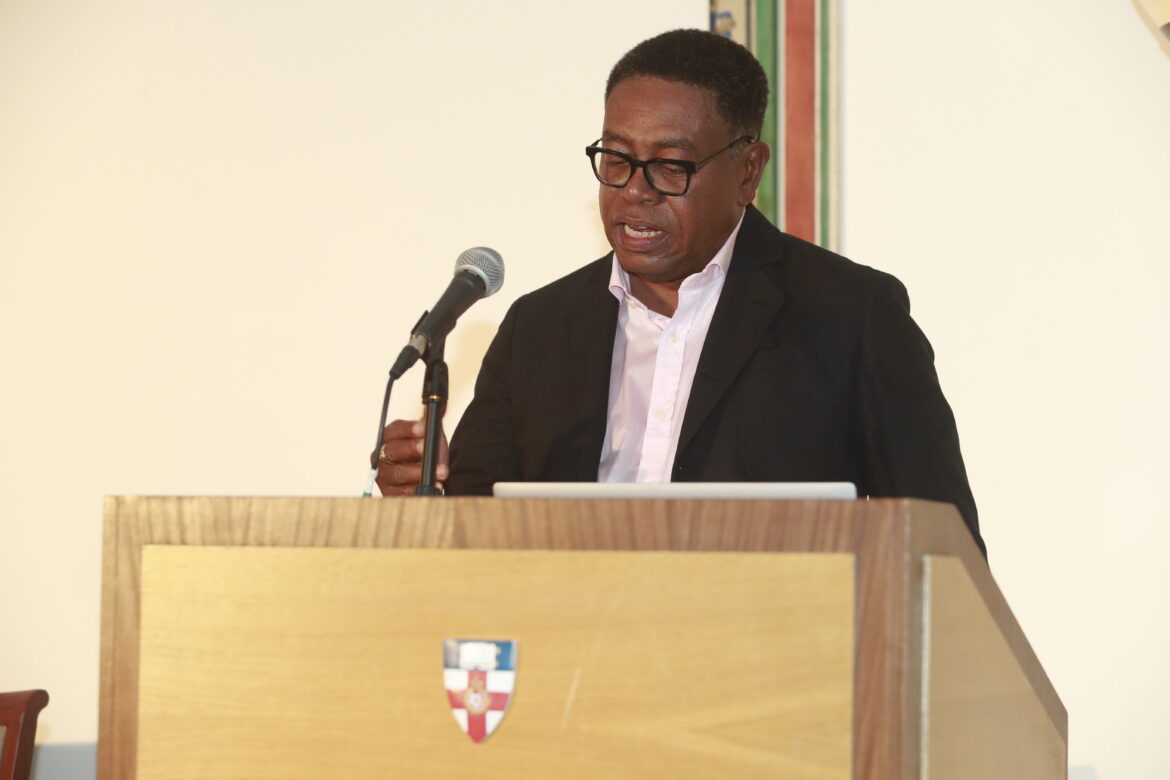
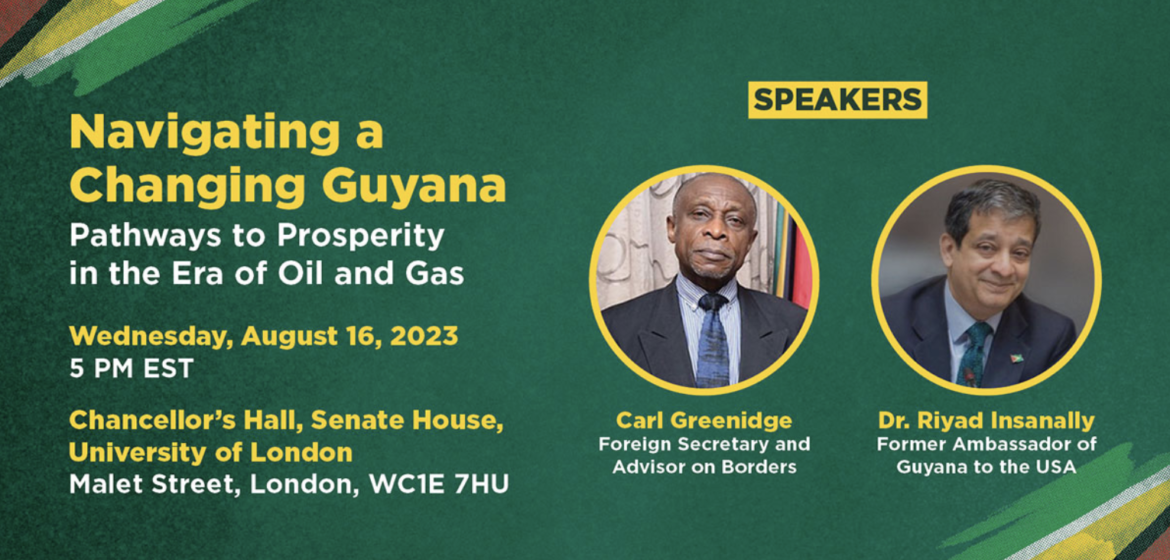
Guyana stands to earn tens of billions of US dollars over the next two decades from developing the burgeoning oil and gas sector. What does this mean for Guyana and, importantly, the hundreds of thousands in the Diaspora? What are the pathways to our collective prosperity? To answer some of these questions, The Guyana Association of Georgia (GAOG) and the Guyanese Business Journal & Magazine (GBJ), with the support of the Caribbean Policy Consortium, hosted a public forum Navigating a Changing Guyana: Pathways to Prosperity in the Era of Oil and Gas, and cocktail reception on Wednesday, May 24th, 2023, from 4.30 p.m. at the AEI Startup Factory · 7310 Stonecrest Concourse, Lithonia, GA 30038. The free event brought together experts from the private and public sectors in Guyana and the Diaspora to engage the audience and share views on these questions. Representatives of ExxonMobil shared a Diaspora Oil & Gas Update, and our two panels examined Pathways to Prosperity & Skills Migration and Emerging Business Opportunities. Panelists included Dr.Ivelaw Griffith, Dr. Riyad Insanally, Dr. Ulric Trotz, Stacey Mollison, and Oslene Carrington.
Oil Sector Policy
Media Advisory: Transforming Guyana, Episode XII, Digitization & Guyana’s Emerging Oil and Gas Economy
Production of the Guyana Business Journal & Caribbean Policy Consortium.
The Guyana Business Journal (GBJ) & Caribbean Policy Consortium host Transforming Guyana Episode XII, Empowering the Future, Guyana’s Youth and the Oil & Gas Economy, on Wednesday, May 10, 2023, at 10:30 AM EST.
Speakers
- Terrence Blackman: Founder, Guyana Business Journal
- David E. Lewis: VP, Manchester Trade Ltd. Inc. & Co-Chair, Caribbean Policy Consortium
- Lance Hinds, Chief Executive, BrainStreet Group & Director, DreamSpace Foundation
- Eldon Marks, Tech Entrepreneur & Innovator
- Mike Singh, Chair, Guyana ICT Tech & Innovation Council, Multidimensional Cybersecurity Expert
- Erika Piirmets, Digital Transformation Adviser, e-Estonia
Relevant Quotations:
David Lewis
- “Guyana is poised…to really leverage the economic growth from the oil and gas boom in the technology sectors.”
- “If we cannot discern and differentiate the political, social, cultural human rights issues, development issues between linkages with China versus linkages with the West. If we cannot assimilate the fact that the Caribbean is in the West, then we are going to be in serious trouble, and the cyber technology issue is just one of it.”
Erika Piirmets
- “Digital services can offer minimizing the entry barrier to businesses. This has led Estonia to be a sort of Silicon Valley of Europe…As a side effect of digitalizing different services, thousands of years of working time is saved thanks to the interoperability of the backbone of our digital state.”
- “More than 25 years, Estonia has been building the society to be digitally capable but all while building the technological infrastructure, we have been supporting form the government level all our user group through public and private courses that have now led to 80% of the population using some sort of digital service.”
- “It’s not about turning everything digital and saying that we use the maximum technology that we can. So we don’t fetishize technology but we seek to improve people’s life quality.”
Lance Hinds
- “There are core things to be done, of course. Certainly on the legislative side…there is a data protection bill that is out for comment which, when I look at other legislation in the Caribbean, this one is forward looking. It follows the GDPR model of the European Union in terms of structural intent, and I think it is a good one to comment on and encourage them to take to next stages.”
- “This is where national planning really comes into effect in terms of making sure that all citizens buy in, all citizens understand that this is to their benefit…The whole concept of showing citizens in Guyana that this is about providing convenience and access…”
Eldon Marks
- “One of the issues we’re still facing today is that we’re hemorrhaging a lot of valuable talent year after year…When it comes to finding talent within the local tech ecosystem to keep it driven that is, again, a shared issue among all of the various entities locally.”
- “Much of the students that I’ve worked with over the years, and the fledgling entrepreneurs along the way, I find that the recurring theme is that they have big dreams but they rarely ever extend beyond the shores of Guyana. Exposure fixes that.”
- “Change management is absolutely necessary. Vision and oversight, critical even more so…The ability to have individuals access an environment that permits them to learn technologies, learn the processes to deliver on those technologies, and then have opportunities to do so – absolutely critical.”
- “Because we have multi-faceted problems [in Guyana], we need a multi-faceted steering body – a visioning body comprising of individuals who understand the big picture and are specialized in their own right with representation across the public sector, private sector, and civil society, to compliment an overarching vision for development.”
Mike Singh
- “Why we need to have a cohesive industry body is so we can bring global best practices to the fore and these global best practices emanate from the collective world of experience and work that’s being done at the International Telecommunications Union.”
- “Cybersecurity in Guyana is not something they’ve given enough attention to, either through a lack of exposure, a lack of adequate tools; it’s a work in progress. But in my opinion, it’s not being done fast enough.”
- “My advice for the government of Guyana…you need to rip out every piece of Huawei gear and equipment…Let me be clear, they’re going to attack the oil and gas network here – not if, but when. If you’re transmitting data on networks that have Huawei equipment, you’re leaving yourself wide open for abuse and more than likely total shutdown.”
Terrence Blackman, Ph.D., Founder & CEO Guyana Business Journal terrence.blackman@guyanabusinessjournal.com
Dr. David E. Lewis, Fellow and Co-Chair, Caribbean Policy Consortium DavidLewis@ManchesterTrade.com
Transforming Guyana, Episode XII: Digitization and the emerging Guyanese Oil and Gas Economy Wed, May 10, 10:30 AM
The Guyana Business Journal (GBJ) & Caribbean Policy Consortium welcome you to Episode XII of the Webinar Series, Transforming Guyana, Wednesday, May 10, 2023, at 10:30 AM EST.
Panelists:
Livestream
Essential Questions
Episode XII of Transforming Guyana looks at Guyana’s digitization strategy. We shine a light on the following areas:
1. A needs assessment – identify the primary sectors that need digitization and understand the current state of digital infrastructure, internet connectivity, and digital literacy levels across the country.
2. Priority sectors for digitization – based on the needs assessment, prioritize the sectors to be digitized. It could be healthcare, education, government services, or others.
3. Develop a comprehensive digitization plan – specific goals, timelines, and budgets.
4. Building digital infrastructure: Create and improve physical, digital infrastructure such as internet connectivity, power supply, data centers, and cloud infrastructure, among others.
5. Providing e-services and applications – implement electronic government services and applications that reduce bureaucracy and streamline operations. For example, digitizing tax collection, e-voting, etc.
6. Supporting digital literacy and education – access to digital education, training, and resources to teach people how to use digital tools, apps, and services.
7. Promoting e-commerce – incentives for e-commerce, including reducing taxes on e-commerce businesses and encouraging the acceptance of digital payments.
8. Investing in research and development – support for research and development in technology, especially in artificial intelligence, big data, and robotics.
9. Monitoring and evaluating success- collecting data to ensure that the digitization strategy is successful and meets the needs of the people in the country.
Moderators
Dr. David Lewis & Dr. Terrence Blackman.

Guyana: Economic Diversification Key to Long-Term Development
By
Meredith Arnold McIntyre
This is the second in a series of articles on economic and development policy to protect Guyana from experiencing “Dutch Disease.”
The rapidly expanding oil sector and associated rising oil revenues have placed Guyana on a path of economic transformation. However, the experience of other resource-rich countries urges caution.
In some cases, the “Dutch-Disease” can diverge a country from a robust growth and employment path. Dutch Disease occurs when a resource boom reduces the internal incentives to produce and/or the international competitiveness of domestically produced non-resource tradable (exportable and importable) goods. The term comes from the Netherlands, which saw a massive influx of foreign currency after discovering large gas fields in the 1960s. While that surge made the country wealthy, it made many exports in other sectors less competitive abroad.
Rising foreign exchange inflows from oil revenues to support increased public spending to meet development needs can also result in inflationary pressures if not carefully managed. Inflationary pressures and rising domestic costs will adjust relative prices between the tradable and non-tradable sectors, resulting in an adjustment in the real exchange rate and a loss of international competitiveness, and declining output and exports.
But none of these outcomes are inevitable. The Netherlands reinvested its oil wealth and forged a path to lasting prosperity even after its gas production stagnated. Conventional wisdom suggests combining monetary and fiscal policies to contain spending and inflation pressures, potentially negating Dutch Disease. However, economic diversification and reduced dependence on the “booming” commodity sector is vital to maintaining economic stability and achieving stronger long-term growth.
Guyana’s Commodity Sectors: Limited Linkages
Before the onset of oil production, Guyana’s mining sector – primarily bauxite and gold – had few linkages with the rest of the domestic economy. Robust growth in mining did not stimulate growth in other economic sectors. The oil sector, like mining, has few links to the non-oil economy, suggesting that stimulating broad-based economic expansion over the medium to long term will require policy intervention to promote inter-sectoral linkages and economic diversification. As stated earlier, this will reduce dependence on oil and contribute to mitigating Dutch Disease.
Diversification Strategy
Many resource-rich countries have attempted to reduce their dependence on natural resources by pursuing economic diversification strategies focused on creating local linkages and productive employment, thereby reducing the potential for Dutch Disease. The results have been mixed. Oil producers in the Gulf Cooperation Council (GCC)[1], like Bahrain, Kuwait, Oman, Qatar, Saudi Arabia, and the United Arab Emirates, have diversified into capital-intensive sectors such as finance and telecommunications, as well as oil-related downstream value chains such as petrochemicals and energy-intensive heavy industry. In the Caribbean, Trinidad and Tobago’s diversification strategy promoted new industries, notably refining fuels, LPG, petrochemicals, and other downstream activities from gas (e.g., methanol). Utilizing the energy supply, the manufacturing sector expanded to supply various products, particularly consumer goods, to the Caribbean Community (CARICOM) regional market.
The government has clarified that economic diversification is a medium to long-term policy priority. The economy-wide impediments to investment and growth must be addressed to support diversification. These include: First, closing the infrastructure and skills gaps.
The country’s road density (0.024) is far below the LAC average (0.462), and the limited road network constrains the movement of goods and people. Transportation infrastructure is weakest in the interior, which limits access to public services and economic opportunities and contributes to deep regional disparities. Investments here are likely to have large economic impacts on the productivity of all sectors.
In addition, the lack of a deep-water port reduces Guyana’s export capacity. Increased electrification will require significant investment in grid rehabilitation and modernization. Importantly, Guyana’s oil reserves could provide cheaper and cleaner electricity by enabling it to use natural gas to supplant its current reliance on carbon- and pollution-intensive heavy fuel oil.
Second, with the low base in education in Guyana, a concerted effort will be needed to build human capital – knowledge, skills, creativity, and well-being through significant investments in the education and health systems. However, this issue can only be overcome in a medium- to long-term timeframe. For this reason, to fill the specialized labor gaps in the short term, the country will need to reattract the Guyanese diaspora that have left the country and attract foreign professionals, as many Gulf countries, including Kuwait who pursued successful diversification strategies.
Third, a supportive business climate will be essential to promote investment and facilitate economic diversification. Business facilitation reforms to reduce or eliminate bureaucratic delay and ‘red tape’ and with increased digitization of processes and the establishment of e-government. These reforms will rely heavily on improving labor force skills to utilize modern information and communication technology.
Diversifying and modernizing the agricultural sector also offers potential activities for economic diversification. Strengthening the agricultural sector will benefit from the investments in road infrastructure. Rural producers have limited access to markets and public services and face high transportation costs. A stronger agricultural sector requires high-quality transportation infrastructure capable of moving goods quickly and reliably in large volumes and at low cost.
In conclusion, developing and implementing an economic policy framework that protects Guyana from Dutch Disease includes adopting an appropriate fiscal and monetary policy to contain inflation, mitigating pressures on the real exchange rate, and maintaining economic stability. Macroeconomic policies need to be supported by structural policies that, over the medium to long term will support economic diversification, reducing dependence on the dominant oil sector and contribute to muting Dutch Disease that could result from the “booming” oil sector.
Dr. Meredith Arnold McIntyre has been an economist for over 30 years. He has worked in a variety of Caribbean regional institutions including the Caribbean Development Bank, Organization of Eastern Caribbean States, and the Caribbean Regional Negotiating Machinery in the 1990’s. Dr. McIntyre joined the International Monetary Fund (IMF) in February 2001 and worked on countries in Africa and the Caribbean including leading IMF country team missions to Guyana. Dr. McIntyre has published a book and a variety of articles on issues in macroeconomic and trade policy in small states. He is currently an Associate, Manchester Trade Ltd and a Fellow with the Caribbean Policy Consortium.
[1] Members of the GCC include Bahrain, Kuwait, Oman, Qatar, Saudi Arabia, and the United Arab Emirates (UAE).
Guyana’s Oil and Gas Boom – A Less Gloomy Outlook!
By
Wilberne Persaud
April 26, 2023
Dashan Hendricks, Jamaica Observer’s Business Content Manager, sought Economist Damien King’s opinion on Guyana’s development prospects based on windfall oil and gas returns. The March 17, 2023 result: “‘Mark my words’… King fears resource curse could strike Guyana”, is an entirely gloomy oil painting.
It begins with conclusions from core views: “ECONOMIST Dr Damien King said Guyana could fall victim to the so-called ‘resource curse’ as it moves deeper in developing its oil and gas finds because it lacks strong institutions to prevent corruption.”
‘Mark my words’ is prelude to robust, strongly held views. King didn’t speculate on what ‘could’ happen. Rather, he predicted an outcome!
In commenting on these opinions, let me first invoke a caveat. It is a hazardous endeavor to engage in critical discourse based on reports or snippets of a discussion with, between, or among experts. One must assume recall and rendering of arguments, positions held and/or set forth, are accurate. We do that here.
The following quote however, makes such concerns irrelevant: “You mark my words, Guyana is going to go nowhere,” King told the Jamaica Observer, citing that the oil revenues could cause corruption to increase in the country and make it worse off than it was before.
“It’s worth bearing in mind that very few countries in the world have grown from poverty to wealth, having done so on the basis of natural resources. Very, very few,” he continued, pointing out that oil-rich countries like “Venezuela is a basket case and Nigeria is a joke.”
Buttressing his argument, he invokes resource-poor Singapore and Switzerland as examples of countries becoming wealthy through good governance. One problem here is that King, along with many commentators in our region over the years ignores completely, ‘geographical location’ as a ‘resource’, particularly in the case of Singapore. Adjacent economic activity, trade and supply chain requirements linked to British interests bear no mention in that comparison.
More importantly though, King conflates the economic concept and predictable impact of ‘Dutch Disease’ or ‘Resource Curse’ with the negative consequences of wide-spread corruption. The Economist coined this term in its 1977 analysis of the Netherlands’ deteriorating manufacturing sector after the 1959 discovery and exploitation of its Groningen natural gas field.
This proposition – theorem if you prefer – often called the Balassa–Samuelson hypothesis, predicts that the mechanism by which economies adjust to windfalls in its traded sector is appreciation of the real exchange rate. Oil and gas exports generate foreign exchange. Guyana’s currency could appreciate and non-oil and gas exports decline. Whole sections of the economy could deteriorate.
The negative exchange rate adjustment impact on the economy’s non-oil sectors occurs, independent of corruption. Attenuation of this ‘scourge’ may be countered by appropriate economic policy. Such action rests directly in the hands of the Guyana government.
Additionally, perhaps the most glaring and consequential omission in King’s full-bodied prediction is lack of attention to geopolitical influences to which colonial British Guiana was subject. There is no consideration of racial/ethnic issues exploited by the former colonial interests in the politics of British Guiana.
This omission causes, or rather allows King to overlook, indeed completely ignore major proximate causes of the weak institutional infrastructure he credits with enabling destructive political and other forms of debilitating corruption to emerge. The consequential ethnic divide that overhangs all politics and political decisions in the country therefore have no place in his discussion.
Surely these omissions are worthy of the label “economists’ mal-practice”! I want to suggest that the plainly known risk of ‘Dutch Disease’ or ‘resource curse’ – economic decay amidst unexpected windfall riches – could rather, precipitate the change that leads to building robust institutional infrastructure.
The simmering brew that led to turmoil in mid-1960s British Guiana was ethnic rivalry amidst mutual distrust amongst the population. Inter-racial strife, public disturbances and targeted partisanship fueled despair and external migration of critically required skills and talent – the brain drain – which decimated the potential bulwark of civil society opinion and action. Much of this migration of talent directly accounts for Guyana’s major flaw of weak institutional infrastructure.
There’s no way however, to understand Guyana’s current condition of institutional anemia without reference to, and a knowledgeable grasp of these influential factors. Omitting consideration of causation in the genesis of this condition prohibits even the conception of positive, purposeful remedial change!
Currently, there are signs that civil society in Guyana has had a rebirth. Indeed, a major element of the impulses for this seems to be oil and gas! Indeed, new or previously dormant civil society organizations in Guyana are now actively engaged in monitoring the government’s use of oil revenues while advocating for transparent and accountable management of the country’s newfound wealth.
Such groups act on environmental issues, political, electoral and constitutional reform. The government is considering and embarked upon the long-recognised possibility of Guyana becoming the food breadbasket of CARICOM.
Resource Curse is not an inevitability if strong institutions and effective governance to manage oil and gas revenues and prevent corruption are created. Guyana has established a sovereign wealth fund, the Natural Resource Fund, to manage proceeds from oil sales and royalties.
These are positive steps towards ensuring transparency and accountability. The fund’s management is subject to oversight by an independent body, the Public Accountability and Oversight Committee, which includes civil society representatives. These measures are designed to prevent misappropriation of oil revenues while promoting transparency and accountability.
Additionally, Guyana has benefited from international support and technical assistance for both creation and strengthening institutions and regulatory frameworks. These include assistance from the World Bank, the International Monetary Fund, and the Extractive Industries Transparency Initiative (EITI) to strengthen the legal and regulatory framework for managing oil resources while promoting transparency and accountability.
The country recorded significant growth since production began in 2019 and projections indicate the economy will continue expansion in the near term. This provides prospects for investment in infrastructure, human development, agricultural diversification through further deployment of what in the Burnham years was pitched as ‘crop diversification’. All the latter would assist in reducing poverty and inequality.
Enhancing these possibilities, the Caribbean Development Bank (CDB) recently approved financing initiatives to explore Maritime Cargo Services among Barbados, Grenada, Guyana, and Trinidad and Tobago, particularly for shipping agricultural products.
We agree that Dutch Disease or ‘resource curse’ is a real, clear, and present risk. Yet, there exist several indications that Guyana can avoid this fate. With the support of civil society organizations, fostering strong institutions and regulatory frameworks, and a commitment to transparency and accountability, Guyana can use its newfound oil wealth to drive sustainable development and improve the lives of its citizens – and peripherally, of the CARICOM region.
Noteworthy are efforts to address underlying issues that historically, have contributed to political instability and turmoil. One of prime importance is the electoral system – a source of controversy and tension between the major ethnic groups in the country.
The possibility of constitutional reform, particularly if twinned with mechanisms of power-sharing, incorporation of a more diversified and forward-looking cadre of both government and private sector actors in positions of influence and decision making are viable possibilities.
Such initiatives require promoting political arrangements allowing different ethnic groups to share power and resources fairly, rather than continuing the dominance of one over others. This approach, the very notion of which some view as distasteful, unthinkable, or just plain taboo, has succeeded elsewhere and may well be a viable solution for Guyana.
So yes, significant risks accompany oil and gas windfall returns. It is certainly not inevitable though, that Guyana falls victim to Dutch Disease. With effective governance, committed to investing in infrastructure and human development, Guyana has the potential to avoid the resource curse and achieve sustainable economic growth.
While only time will tell, we may in conclusion, anticipate Dutch Disease giving way to replication of a different ‘Dutch’ impact. Their technology that enabled the very existence of then British Guiana as a land, the coastal plain of which was, and remains below sea level yet, for centuries to create untold riches generated by control of flowing waters by the ‘Back Dams’ and ‘Kokers’, and the ‘Sea Wall’ of that pioneering Dutch engineering spirit of Low Countries’ innovation!
It seems King’s robustly gloomy prediction may just as well be countered by its antonym: a bright socioeconomic future. Who knows? I remain certain of one thing: positive change is undeniably possible!
Wilberne Persaud is a writer, Op-Ed Columnist and Economist, formerly Senior Lecturer and Head, Department of Economics, The University of the West Indies, Mona, Kingston, Jamaica. His latest publication: “Jamaica: Post-Colonial Struggles for Dignity, Equity and Development – Wilberne Persaud Selected Columns 1976-2013” is available on Amazon, in both Kindle and Paperback Versions.
Hess Corporation has discovered a new oil reserve on the Stabroek Block in offshore Guyana.
Hess Corporation has discovered a new oil reserve at the Lancetfish-1 well on the Stabroek Block in offshore Guyana. The well, located around 4 miles southeast of the Fangtooth discovery, was drilled by the Noble Don Taylor in 5,843 feet of water and found approximately 92 feet of oil-bearing sandstone reservoir. Additionally, Hess has disclosed that Kokwari-1 exploration well was drilled in the first quarter of the year but did not find commercial quantities of hydrocarbons. Hess has a 30% stake in the Stabroek Block, ExxonMobil is the operator with a 45% interest, and CNOOC holds a 25% stake. In 2023, ten wells are planned for the Stabroek Block.
Media Advisory: Transforming Guyana, Episode XI, Empowering the future, Guyana’s Youth & The Emerging Oil and Gas Economy
Production of the Guyana Business Journal & Caribbean Policy Consortium.
The Guyana Business Journal (GBJ) & Caribbean Policy Consortium host Transforming Guyana Episode XI, Empowering the Future, Guyana’s Youth and the Oil & Gas Economy, on Wednesday, April 12, 2023, at 10:30 AM EST.
Speakers:
- Terrence Blackman: Founder, Guyana Business Journal
- David E. Lewis: VP, Manchester Trade Ltd. Inc. & Co-Chair, Caribbean Policy Consortium
- Elson Low: Economic and Youth Policy Advisor to the Leader of the Opposition, Guyana
- Karen Abrams: Founder, STEMGuyana
- Ronald Austin Jr.: Columnist, Researcher, Historian
- Florence Alexi Larose: Consultant |Sustainable Development| Community Building| Rural Development| Indigenous Peoples|
- Please note Ms. Larose was unable to attend.
Relevant Quotations:
- Dr. David Lewis:
- “The people who are above that age [30 years] and are now sort of riding this wave, eventually will move on. But the new generation is the one that’s really going to be the one-hundred percent technology generation and new energy generation in Guyana, just as has happened here in the USA with the technology generation.”
- “What’s going to equalize Guyana in a flat world is not just the money from oil and gas. It is how Guyana uses that money from oil and gas to really leverage financial resources and invest in the new areas such as technology, invest in the new geniuses and really move up.”
- Elson Low:
- “…we could find quite a bit more oil before all of this is said and done. So there is a strong possibility that Guyana will become the country with the most barrels of oil per person in the entire world. And I know that that might sound, to some, astonishing but I’d like to remind them that right now, Guyana is the country with the second most barrels of oil per person in the entire world. That, to me, really means we have to take a step back and evaluate what the future will look like and what young people’s role will be in this radically, radically different future.”
-
- “This really is quite a train that is leaving the station and it is a great opportunity for young people, but it poses some very serious challenges for young people as well.”
-
- “How do we get from the current situation where you have various crises and various concerns, to a situation where you have a wealthy society where young people benefit hugely? First of all, training and education…In addition to that, the acquisition of housing and assets is something we need to pay close attention to ensure young people have the opportunity to acquire assets. If we’re thoughtful, if we recognize the types of challenges – and if we design specific interventions to deal with those challenges – we can move from being a country where there’s a lot of anxiety about the future… to a society in which young people have tremendous opportunities and capacities.”
-
- “If we don’t provide them [young entrepreneurs] that opportunity to scale, that opportunity to compete, that opportunity to build their businesses, it will be very difficult for them to be able to compete with any corporations that are established. We need to make sure bright and innovative young people have access to capital.”
- Karen Abrams:
- “What we [STEMGuyana] looked at is what was going on in the country and we identified an employment mismatch. Not in numbers – raw numbers – we have enough people to work in the oil and gas or any industry here. The problem is young people with the requisite skills…We have this growing oil economy, but it’s not just the oil economy – it is the fact that agriculture needs talent; mining needs talent; education needs talent; the healthcare industry needs talent.”
-
- “We have billions of dollars today and will have many more billions tomorrow. We need to get enough young people in the pipeline so that in 5, 10, 15 years they can be contributing meaningfully to the development of Guyana.”
-
- “You can’t optimally develop an economy in a small society, tiny population and then have a significant portion [females] of your young people not contributing to the development of the country…Technology in the hands of girls helps to break the cycle of poverty, helps to solve problems impacting the community, and, again, girls make up half the population – it’s just the right thing to do.”
-
- “I am not confident that innovation is done well through government…I want the government to provide a solid infrastructure and to provide a level playing field and be willing to connect in a meaningful way with innovators. Provide the infrastructure for innovators to come in and do amazing things.”
- Ronald Austin Jr.:
- “When I consider youth development in any context, especially oil and gas, I think you have to have several steps in place. First, I think it is important you come up with a developmental master plan which would receive buy-in from the entire society…In my view, you have to consider that youth cannot be seen in an isolated circumstance; it is connected to your development master plan, it is has to be considered an important part of the process.”
-
- “If you’re going to have a framework, within which you come up with policies directed to youth connected to a master plan, there has to be continuity. In my estimation, for you to have that there has to be a) buy-in and b) you have to have some legislative protection insofar as that is possible in the Guyana context. The second thing is you have to consider the structure of this intervention. And as you do that, I’m of the view that you have to do a serious, serious situation analysis and you have to, from a policy standpoint, have the ages of youth. You have to pin that down.”
-
- “If you have your development vision, your interventions have got to be connected. If your eventual vision is where you’re using the revenues from the oil and gas economy to develop a knowledge-based economy then your interventions have to go mirror that aim or objective.”
Terrence Blackman, Ph.D., Founder & CEO Guyana Business Journal terrence.blackman@guyanabusinessjournal.com
Dr. David E. Lewis, Fellow and Co-Chair, Caribbean Policy Consortium DavidLewis@ManchesterTrade.com
ExxonMobil has announced the arrival of the Prosperity FPSO, Guyana’s third oil production vessel, which will commence production in the Payara field of the Stabroek Block later this year. The production manager of ExxonMobil Guyana, Mike Ryan, expressed his excitement about contributing to the energy future of Guyana and creating opportunities for the nation’s growth and prosperity. The Prosperity, constructed by SBM Offshore, has an initial production capacity of approximately 220,000 barrels of oil per day and a storage volume of two million barrels.
The Prosperity FPSO joins the Liza Destiny and Liza Unity FPSOs, which currently produce more than 380,000 barrels daily. Production from the Prosperity vessel is expected to push daily production to some 600,000 barrels daily in 2024.
Navigating the Futuristic Crossroads: Should We Keep Up the Momentum or Phase Out Future Developments in Oil & Gas?
Re: Intelligently spacing out oil & gas developments
By
Joel Bhagwandin
Dear Editor,
I thank the Economic Advisor to the Leader of the Opposition for engaging me in the aforementioned topical debate. Readers would recall that in sections of the media, it was reported that the opposition is proposing the phasing out of oil and gas development or slowing down the pace of development. However, in his response to the undersigned’s article that appeared in certain sections of the media, he’s clarified that the opposition’s position is to “intelligently space out” future oil and gas developments. It remains unclear, however, as to what exactly this means for the opposition and how they propose to do so.
The Economic Advisor failed to illustrate by way of any analysis or economic modeling, at least at a high level, how intelligently spacing out future developments would work in practice―without disrupting the economy’s momentum. Notwithstanding, since the opposition’s clarification on this matter has proved unhelpful―the opportunity is presented to further develop the argument in support of the Government’s strategy to ramp up the pace of development in the sector over the medium term.
As explained in the undersigned’s recent column, the project lifecycle in the oil and gas industry includes three stages―namely, exploration, development, and production, spanning, on average, 30-40 years. In the case of Guyana, for example, exploration before the discovery of oil in commercial quantities lasted fifteen (15) years, followed by the development stage, which spanned another five (5) years before moving into production. And according to the terms of the production license, this is another twenty (20) years to produce the resource. In other words, it took twenty years before a single barrel of crude oil was produced to generate revenue from the sale/monetization of the resource in the Stabroek Block.
With this in mind, given the nature of the industry―that is, the petroleum geology of the fields, the engineering, and the economics, among other factors, developments in the industry are naturally and sufficiently spaced out. Bearing in mind that the geology and economics of each field are often times not the same. The aim, therefore, is to encourage and facilitate ongoing exploration in the sector. In so doing, should there be future commercial finds, by the time those new discoveries are developed, these should start to produce simultaneously―or to coincide with the decline curve of the currently producing fields.
In other words, if the Government opts to “intellectually space out” future developments, whatever this means if, for instance, it means that new exploration will be permitted every five years and new production licenses will be issued every three-four years, then the current producing fields will eventually start to decline. Hence, in the absence of new developments on stream, by the time production starts to decline, the country will have to endure declining production, which would translate into a loss of revenue to the national treasury and an overall decline in economic activities across the oil and gas value chain.
To the contrary, there are case studies of other petroleum-producing countries in the region, namely, Trinidad and Tobago and Venezuela, that, for various reasons, did not facilitate undisrupted ongoing exploration. The result in both cases is a declining economy, thus engendering a plethora of economic problems and challenges in these two countries. Additionally, there are several other global factors to consider that sufficiently justify the need to maintain the current pace of development. These are:
- In the Global oil outlook to 2040 report (2021) by McKinsey & Company, it is projected that new oil drilling is needed to meet demand by 2040. It states that by 2040, exploration and production companies need to add 38 MMb/d if new crude production from unsanctioned projects is to meet new demand. The newest production is expected to come from offshore and shale resources.
- Even in an accelerated energy transition scenario, McKinsey sees the need for new oil drilling by 2040. While most offshore regions will be under pressure in an accelerated energy transition scenario, the sector will still require new production of nearly 23 MMb/d to meet demand by 2040. Demand in a 1.5oC-pathway will force shut-ins.
The implications for Guyana based on scenarios (a) and (b) above are such that Guyana could lose out on the opportunity to be part of the global supply chain during this period―after which (beyond 2040, i.e.) the uncertainties in the global crude market will only deepen.
- By spacing out future developments to benefit from higher profit oil in the short-term (theoretically); having regard for the risks and volatility of the industry, capital raised for future developments may have to come from external sources versus internal sources of financing. This can be problematic in terms of the cost of capital for oil and gas development and scarcity of capital for oil and gas development in the future, which would only compound the cost of capital.
The current and future developments are financed from the operating cash flows from current operations, which is enabled by the lack of ring-fencing, viz-á-viz, the 75% cost recovery ceiling. Consequently, the cost of this form of financing is cheaper than raising capital externally through debt and equity financing.
That said, it should be noted that there are two types of ring-fencing: one relates to the geology and commercial viability of the wells―in terms of whether the exploration cost for a dry well is allowed to be recovered from another commercially viable well within the same field, or should it be disallowed and treated as a sunk cost. The other type of ring-fencing- the more contentious form―relates to the fiscal regime. For tax purposes, ring-fencing typically applies in determining the taxable income per field, thereby effectively disallowing future field developments to be financed from the operating cash flows generated from other existing/producing fields.
It is against this background that the proposal by the opposition to “intelligently space out” future developments in oil and gas has not been thoroughly informed. Accordingly, the case is made out herein, demonstrating that the opportunity cost to the country, in the long-term, is likely to far exceed the benefit.
Yours sincerely,
Joel Bhagwandin
Financial and Public Policy Analyst
Navigating the Futuristic Crossroads: Should We Keep Up the Momentum or Phase Out Future Developments in Oil & Gas?
Dear Editor,
I note with disappointment comments by a certain Joel Bhagwandin, in which he attempts to argue that the Opposition’s plan to phase out future developments is ill-advised. The problem is that the Opposition has no plan to phase out future developments and has never said anything to that effect. Compounding his confusion, Mr. Bhagwandin presents two scenarios from his imagination: oil production climbs to 1,000,000 barrels daily, and oil production is frozen at 350,000 barrels daily. He proceeds to demonstrate that under the scenario of only producing 350,000 barrels of oil daily, Guyana would have less revenue than if 1,000,000 barrels of oil per day were produced. It doesn’t take a genius to tell you that.
What is amusing is that Mr. Bhagwandin seems to have put so much effort into an analysis that has nothing to do with the opposition’s advocacy. It is possible that he did not read the Opposition’s remarks on this issue or did not understand them in his rush to respond. We never said that all future oil developments should be “phased out,” but rather that through intelligently spacing them out, we can increase the share of profit oil the country receives. This is because as each existing development is gradually paid off from cost oil, the percentage of profit oil rises. When other developments come on stream, at a slower rate than the current mad rush, we will be able to maintain a higher rate of profit oil because costs are incurred at a slower rate. I am disappointed to see Mr. Bhagwandin respond to something he perceives rather than what I said. It cuts the conversation short, denying the Guyanese people the opportunity to engage in intelligent dialogue. I would advise him to read more slowly on the next occasion. It may serve him well.
Yours,
Elson Low,
Economic and Youth Policy Advisor to the Leader of the Opposition