
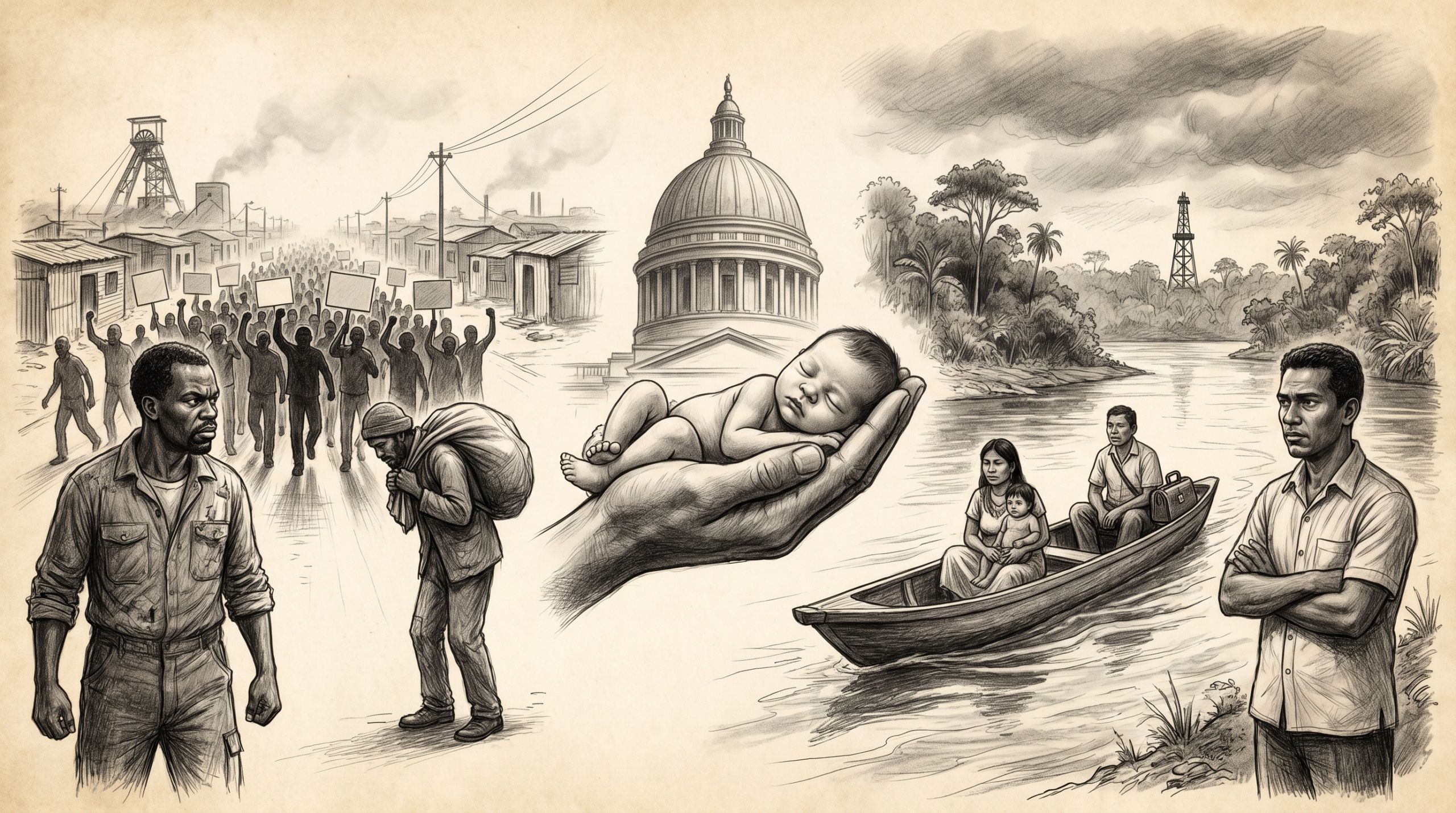
Commentary · Migration, Institutions & Political Economy
A Letter from America, in the week it turned two hundred and fifty — on South Africa’s expulsion deadline, Guyana’s newcomers, and a birthright ruling that asked, days before the fireworks, who belongs.
By Terrence Richard Blackman, Ph.D. · July 5, 2026
“Thou shalt neither vex a stranger, nor oppress him: for ye were strangers in the land of Egypt.”
— Exodus 22:21[1]
I. Looking Sideways
Every economy of sudden wealth makes a promise; every promise manufactures a creditor. When the wealth arrives, and the distribution does not — when the rig comes online, or the regime falls, and ordinary life stays stubbornly unchanged — the creditor begins to look for whoever owes him. A society reveals its moral architecture in the direction of that gaze. He may look upward, at the structures that captured the wealth before it reached him. Or he may look sideways, at someone poorer and more easily found. Almost always, he looks sideways.
This past week, South Africa looked sideways. A citizen movement that calls itself March and March had set the thirtieth of June — this past Tuesday — as the date by which the country’s undocumented migrants were to be gone,[3] and as the deadline came the marches multiplied across Johannesburg, Tshwane, and Durban.[2] Its organizers called it community protection — a response to crime, to unemployment, to public services that have failed. This is the first thing to understand, and the most uncomfortable: the grievance underneath is not invented. The unemployment is real. The promise of liberation, thirty years on, remains materially unkept for the Black majority in whose name it was made. What is invented is only the address to which the grievance has been sent.
The mechanism is old enough to have a name. Fanon called it horizontal violence[7] — the rage of the dispossessed, unable to reach the structures that dispossessed them, turning instead upon those beside them in the dust. The Zimbabwean trader, the Somali shopkeeper, the Mozambican laborer: each becomes a screen onto which a structural failure is projected and, briefly, made legible. The migrant is not the cause of the wound. He is the cause made small enough to strike.

“The migrant is not the cause of the wound. He is the cause made small enough to strike.” — T.R.B.
It is worth saying plainly what follows, because the whole argument turns on it. Xenophobia is not caused by migration. It is caused by a broken promise — by the distance between what a state owes its people and what it has delivered. Migration only supplies that failure with a face. Where the contract between a government and its people holds, the newcomer is absorbed; where it has broken, the newcomer is blamed. The stranger is the occasion. He is never the cause.
What should trouble us is not that crowds believe this, but that the state has begun to ratify it. In late May, senior ministers received the leadership of these movements at the Union Buildings — the seat of government itself — to discuss the migrant question.[4] The membrane between the street and the ballot is dissolving: politicians have been accused of taking up the movement’s cause with local elections months away,[2] and its online networks now overlap with established party structures.[5] A vigilantism the government itself calls unlawful — no unauthorized person, a minister insisted, may demand another’s documents[6] — proceeds anyway, because a rule without enforcement is only paper. The state, unable to keep its promise, has discovered that it can borrow legitimacy by lending its silence to those who name a smaller debtor.
Here the mathematician should be permitted a word, because the dynamics are not mysterious. Thomas Schelling taught us, half a century ago, that a society can tip into total separation without anyone in it being an extremist — that mild preferences, left to cascade across a threshold, produce outcomes no one chose.[8]
Xenophobia obeys the same arithmetic. It does not require a xenophobic majority; it requires only a tolerant majority unwilling to pay the cost of intervening, and a mobilized minority willing to set the terms. The South African online surge, when analysts mapped it, proved not a spontaneous public mood but the work of tightly coordinated networks reposting the same hashtags and influencers in synchronized bursts[5] — manufacturing the look of consensus while, in the same season, the largest single share of South Africans still described their view of foreign nationals as neutral.[9] That the majority is not mobilized is precisely the danger. Equilibria are set at the margin, by those who show up. The threshold, once crossed, is not crossed back.
It is worth naming where this road ends — not because Guyana is near its end, but because the end tells us what kind of road it is. Rwanda in 1994 was not a quarrel between nations; it was the work of a state and its radio upon its own people, a people first made foreign in the imagination before they were made corpses in fact.[10] The machinery did not need actual foreigners, only a category: colonial race science had recast the Tutsi as alien invaders from elsewhere, and the génocidaires inherited the fiction and called them inyenzi — cockroaches — until a man could raise a blade against his neighbor and believe he was clearing vermin.[11] I raise it because that same word already circulates in the South African feeds the platforms were documented approving,[12] and because we know where that particular reduction has led before. Guyana is not Rwanda; South Africa is not Rwanda; to say otherwise would be both false and obscene. It is a bearing, not a forecast — the direction the needle points once a people has been persuaded that its neighbor is not a rival but a species apart. The distance still to be travelled is enormous. That distance is exactly what institutions are built to keep.
II. The Right to Have Rights
I write on the fifth of July, the morning after the nation’s two hundred and fiftieth birthday. Yesterday America marked the Semiquincentennial of the Declaration that told a candid world all men are created equal — the founding proposition that membership is not granted by a sovereign but owed to the person as a birthright. Even the celebration became an argument about who counts: the anniversary arrived amid a public quarrel over whose contributions the nation would commemorate — which stories struck onto its coins, and which struck from them.[13] It is worth sitting with the timing. On the thirtieth of June — the same Tuesday South Africa’s ultimatum came due — the nation about to sing its own founding had first to answer, in its highest court, a question the Declaration might have thought settled: whether children born on American soil are citizens at all.
It answered in the opposite direction from the marchers of Durban. In a decision on the constitutional question itself, the Supreme Court struck down the executive order that would have denied citizenship to children born on American soil to parents without permanent standing — holding, five to four, that the Fourteenth Amendment means what it has long been taken to mean: birth on the soil, not the status of the parents, confers membership.[14] The Chief Justice called citizenship the right to have rights.
The phrase is not the Court’s; it is Hannah Arendt’s, who used it to name what the stateless person has lost[15] — not this or that liberty, but the prior standing to claim any liberty at all, the membership without which rights are only words. It names exactly what is at stake in the marches of Durban and the mining camps of the Cuyuni alike: the migrant stripped of standing is not merely poor or unwelcome, but returned to Arendt’s condition, present in a place, subject to its dangers, and outside its promises. Whether a society extends that standing or withholds it is not a technical question of immigration policy. It is the whole moral question, wearing a bureaucratic coat.

What the Court’s ruling makes plain — and what the marches in Durban make equally plain, in the opposite register — is that this question is not peculiar to the United States or to South Africa. It is the question of the age, and it is arriving in Georgetown with the same force it arrived in Washington and Johannesburg, dressed differently but carrying the same weight. The ruling in Trump v. Barbara settled, for now, that America will not condition belonging on the circumstances of one’s birth. The marches settled, for now, that South Africa’s street will try to condition it on the circumstances of one’s nationality. Guyana has not yet been asked to settle anything. That is not a reprieve. It is an interval — and the interval is the only time in which the answer can be chosen rather than merely suffered.
The three cases are not analogies. They are the same case at different stages of the same disease. South Africa is downstream of the threshold Schelling described; Washington held the line, this week, at its own version of that threshold; and Guyana stands upstream of both, watching the current and not yet fully understanding that it is standing in the same river. To see the South African marches as a foreign spectacle, and the American ruling as a foreign precedent, is to mistake the address on the envelope for the contents inside. The letter is addressed to all of us.
One Question, Three Answers
III. Could It Happen Here?
It is comfortable — from Brooklyn, from Georgetown — to file both of these under other people’s histories: the South African wound, the American argument, each belonging to a nation not ours. The comfort is a luxury, and I do not think we can afford it. Because the question a Guyanese ought to ask, watching the marches from a distance, is not whether South Africa has failed some moral test the rest of us would pass. It is colder than that. Could it happen here? And the honest answer is that the preconditions are not absent in Guyana. They are assembling — quietly, and in the order in which they always assemble.
It is one of the quieter ironies of our condition that Guyana arrives at this question from the opposite direction. South Africa fears the stranger because it has too little to go around. Guyana is about to fear the stranger because, for the first time in its history, it has too much.
For seven generations we were the ones who left. The Guyanese is a diasporic figure by long habit — in Brooklyn and Brixton, in Toronto and Schenectady, and not least in the islands, where for decades the Guyanese was precisely the foreigner, the one whose accent was marked, whose work was wanted and whose presence was resented — the makwerekwere, to borrow South Africa’s word for the unwanted foreigner, of someone else’s prosperity. We know the inside of this experience. We have been the screen onto which another society projected its anxieties. That is not a small thing to have forgotten, and we have very nearly forgotten it.
Oil has reversed the current. One of the fastest-growing economies on earth does not export labor; it pulls it in. More than twenty-three thousand Venezuelans are now counted in Guyana by the United Nations’ regional platform[16] — roughly three percent of the population,[17] and almost certainly an undercount, since the tally reflects official government reporting and misses those without regular status. They have settled into the informal economy and into the interior, selling, barbering, vending, mining for wages that would be derisory anywhere but are a fortune measured against what they fled.
The myth has already arrived ahead of the resentment. The director of the International Centre for Migration and Diaspora Studies at the University of Guyana has had to say plainly that the idea migrants are taking Guyanese jobs is exactly that — a myth, since the work is overwhelmingly informal,[18] the labor the formal economy does not want.[19] The myth never needed to be true to be useful. It only needs to be available.
And here Guyana’s danger exceeds South Africa’s, in a way that should sober anyone inclined to watch the marches with detachment. South Africa’s migrants come from countries that claim nothing of it. Ours come from the country that claims two-thirds of us.[21] The Venezuelan who crosses into the Essequibo — often Warao, often Indigenous, very often fleeing the same regime whose maps would swallow the land beneath his feet[18] — arrives carrying a nationality that has been made, in our politics, a synonym for existential threat.[20] The refugee and the aggressor share a passport. It requires no great feat of demagoguery to collapse the distinction between them; it requires only the ordinary laziness of fear. The victim, read as the fifth column. The fleeing as the infiltrating.

“The refugee and the aggressor share a passport. It requires only the ordinary laziness of fear to collapse the distinction between them.” — T.R.B.
We should not pretend the infrastructure for that collapse is hypothetical. It has already been laid, at least in outline. As the border crisis sharpened in late 2023, the opposition Alliance for Change called — in the name of security and sovereignty — for barring Guyanese citizens of Venezuelan origin from voting and for halting new grants of citizenship:[21] a category of person defined by origin, a politics organized around their exclusion. It is, almost exactly, the move the Supreme Court in Washington had, this past week, declined to make[14] — the conditioning of membership on the circumstances of one’s parentage rather than the fact of one’s presence.
That the immediate military danger appears to have receded — Maduro was captured and flown out in January,[22] and the threat to Guyanese sovereignty went with him — changes less than it appears. It removes the army. It does not remove the twenty-three thousand. The soldier has gone home; the stranger remains, and the question of what a sudden-rich society owes him has not been answered, because it has not yet been seriously asked.
IV. The Creditor Among Us
This is the threshold Schelling warned us about, and Guyana, for the moment, sits below it. That is not cause for comfort. It is the entire reason for urgency. Xenophobia is not a fire one extinguishes; it is an equilibrium one prevents from forming, and the prevention must be institutional, because sentiment will not hold. South Africa is instructive here precisely in its failure: its national plan against xenophobia is, by the account of those who have read it, a plan with almost no plan in it[23] — a catalogue of dialogues and goodwill events that does nothing to erode the power of those who profit from the fear. Goodwill is not an institution. The thing that holds an equilibrium is law that is enforced, registration that confers standing, courts whose orders are not paper, and — as Washington reminded us this past week — a settled principle of belonging that the passions of a single administration cannot revoke. These are buildable things. They are buildable now, in the years before the cascade, and they are very nearly unbuildable after.
Which returns the question to us, and “us” is the word I mean to insist on. The Guyanese reading this in Queens, who was himself once the unwanted accent in another man’s country, is now a citizen of a nation that has become, almost overnight, a destination. We who were the makwerekwere are being handed the older role — the host, the one who decides who belongs. There is a moral memory available to us that South Africa, for its own tragic reasons, could not summon: we know what it is to be the creditor’s chosen debtor, because we have been him. The question is whether that memory will function as conscience or merely as something we are relieved to have escaped.
There is a further irony we ought not to miss. Many of us are the parents of birthright citizens — our children are Americans by the same principle the Court reaffirmed this past week,[14] members by the soil of their birth and not by any permission granted to us. That standing was meant to be unearned and unrevoked: not a reward for the parents’ virtue, but a refusal to visit the parents’ circumstances upon the child. To accept that gift for our own and then to deny its logic to the Venezuelan child born in Port Kaituma would be to pull the ladder up behind us — to keep the right to have rights for our own and ration it to the stranger.
Today, the fifth of July, in yards across all fifty states, Americans are carrying dishes to shared tables — a nationwide potluck to close the birthday weekend, neighbor invited to neighbor.[13] It is the best instinct a country can have, the open table, and it is worth asking, on a full stomach, who is seated at it. The instruction beneath the gesture is older than the republic that keeps it — the oldest law’s insistence that you shall not wrong the stranger, for you were strangers yourselves. A nation that remembers the second half of that sentence sets a different table than one that forgets it.
Walter Rodney understood that the wound dividing Guyanese from Guyanese was never natural — that it was engineered, maintained, and useful to those it served, and that the only politics worth the name was the one that refused it. He died attempting that refusal.[24] It would be a grim inheritance to take the wealth he did not live to see and use it to open a second wound beside the first — to let the oil that might finally have united the nation’s working people instead purchase a new and convenient stranger to fear. The oil is a moral test, as I have said before and will keep saying. This is the part of the test that arrives disguised as someone else’s problem.

“The marchers in Durban are not merely a foreign spectacle. They are a mirror held at a distance, and the face in it is not yet ours.” — T.R.B.
The marchers in Durban are therefore not merely a foreign spectacle. They are a warning seen early enough to matter. Whether we heed it is not a matter of our virtue but of our vigilance — of what we build, and how soon, and whether we can be persuaded to build it while the threshold is still ahead of us rather than behind. The creditor is already among us, and he is deciding where to look.
Walk good.
Terrence Richard Blackman, Ph.D., is Professor and Chair of Mathematics at Medgar Evers College, CUNY, and Founder and Publisher of the Guyana Business Journal. He writes the GBJ Sunday Essay. The views expressed are the author’s own and do not represent Medgar Evers College or the City University of New York.
References
- Exodus 22:21 (King James Version). Bible Gateway. biblegateway.com
- Reuters. “South African cities shuttered ahead of anti-migrant protests.” June 30, 2026 (via U.S. News & World Report). usnews.com
- “March and March.” Wikipedia (founding, Operation Dudula / Patriotic Alliance association, and the 30 June 2026 deadline first issued December 2025). wikipedia.org
- Haffejee, Ihsaan. “Government scrambles to deal with anti-immigration protests.” GroundUp, May 29, 2026. groundup.org.za
- Daily Maverick. “How South Africa’s xenophobic online machine was rebooted in 2026.” June 1, 2026. dailymaverick.co.za
- Semafor. “S. Africa on edge ahead of anti-migrant deadline.” June 29, 2026. semafor.com
- Fanon, Frantz. The Wretched of the Earth (Les Damnés de la Terre, 1961; trans. Constance Farrington, Grove Press, 1963), on “horizontal” violence among the colonized.
- Schelling, Thomas C. “Dynamic Models of Segregation,” Journal of Mathematical Sociology 1 (1971): 143–186; and Micromotives and Macrobehavior (W. W. Norton, 1978).
- GeoPoll. “South Africa Social Tensions Survey 2026.” June 2026. geopoll.com
- Mamdani, Mahmood. When Victims Become Killers: Colonialism, Nativism, and the Genocide in Rwanda (Princeton University Press, 2001).
- Des Forges, Alison. Leave None to Tell the Story: Genocide in Rwanda (Human Rights Watch, 1999). hrw.org
- Global Witness & Legal Resources Centre. “‘We need to kill them’: Xenophobic hate speech approved by Facebook, TikTok and YouTube.” globalwitness.org
- United States Semiquincentennial (America250). america250.org · wikipedia.org
- Trump v. Barbara, No. 25-365 (U.S. June 30, 2026). CBS News · SCOTUSblog · opinion
- Arendt, Hannah. The Origins of Totalitarianism (Harcourt, Brace & Co., 1951), esp. the discussion of statelessness and “the right to have rights.”
- Inter-Agency Coordination Platform for Refugees and Migrants from Venezuela (R4V, co-led by UNHCR and IOM). Refugees and Migrants from Venezuela (Guyana: 23,412 as of Sept. 2024). r4v.info
- The Borgen Project. “Migration to Guyana.” borgenproject.org
- The New Humanitarian. “‘There is no food’: Venezuelan migrants neglected in oil-rich Guyana.” November 28, 2024. thenewhumanitarian.org
- Pulitzer Center. “Guyana’s Oil Wealth Drives Tensions With Venezuela.” December 2025. pulitzercenter.org
- DevelopmentAid. “Venezuelan migrants reportedly in legal limbo in Guyana.” developmentaid.org · wikipedia.org
- Demerara Waves, Nov. 4, 2023 (AFC leader Khemraj Ramjattan). demerarawaves.com · Jamaica Gleaner / CMC
- CNN, “Maduro in US custody,” January 3, 2026. cnn.com · news.usni.org
- Institute for Security Studies (ISS Africa). “Anti-migrant myths that have been allowed to fester in South Africa.” June 2026. issafrica.org
- National Security Archive, George Washington University. “The Walter Rodney Murder Mystery in Guyana, 40 Years Later.” June 13, 2020. nsarchive.gwu.edu
Supported By
We are grateful for the partnership and support of individuals and organisations committed to advancing Guyanese and Caribbean development and human capital investment. Sponsors support the GBJ Sunday Essay as a whole; they play no role in commissioning, reviewing, or approving its content, and the analysis and conclusions are solely the author’s.
Metallica Commodities Corporation
For over two decades, Metallica Commodities Corporation has connected producers and consumers of non-ferrous metals across the Americas, Africa, and Asia. Headquartered in New York with offices in Peru, Canada, Tanzania, and Guyana, MCC brings institutional expertise and global reach to resource-rich markets, with a deep understanding that sound governance determines whether natural wealth generates broad-based prosperity.
The GBJ Sunday Essay is supported by MCC and is not written on its behalf. The views expressed are those of the author.
METALLICACC.COM ↗Pebble Stream™
Pebble Stream™ is a US-based cloud-computing company that transforms complex Excel models into secure, enterprise-scale cloud applications through patented “pebblization” technology. Founded by Bediako George and backed by over 25 years of financial and accounting expertise, the company processes one billion tax calculations monthly and counts a Big Four accounting firm among its clients. For Guyanese and Caribbean businesses, Pebble Stream offers the scalability a rapidly growing economy demands.
This GBJ article is sponsored by Pebble Stream™ and is not written on its behalf. The views expressed are those of the author.
PEBBLESTREAM.COM ↗Caribbean International Shipping Services
Ship with Confidence: Your Trusted Logistics Partner
For over 30 years, Caribbean International Shipping Services has been the trusted choice for businesses and individuals shipping from the Southeast USA to the Caribbean and Latin America. Specialising in household relocations, commercial goods, and online order consolidation, their experienced team delivers weekly ocean and air freight services to over 20 destinations — reliably and stress-free.
📞 770-322-3111
CARIBSHIPATL.COM ↗MCCGUSA
Management Consulting, Project Management, Real Estate
Founded in 1990, MCCGUSA (formerly Management Consulting and Controls Group) is a premier consulting and project management firm serving clients across the United States and internationally. A Certified MBE, DBE & Hub Zone Business, MCCGUSA provides management consulting, project management, financial advisory, and real estate services — with national affiliates and international representation in the Caribbean and Latin America.
📞 212-269-6126
MCCGUSA.COM ↗Individual Supporters Courtney Noel | All Te Networks | Corine Locke | Tony Harris | Roderick Alsopp | Dr. Michelle Luard | Clarence Bone
🇬🇾 Please support the Guyana Business Journal & Magazine today
