
Sunday Essay · Institutional Design & Conservation
On institutions, coordination, and the rules that survive success — a lesson for Guyana.
By Terrence Richard Blackman, Ph.D. · June 14, 2026
40%
Island acreage permanently conserved [3]
4,238
Acres conserved by Land Bank (2025) [10]
2%
Real-estate surcharge funding the Land Bank [9]
$1.6M
Median home sale price, 2024 [17]
43.6%
Guyana GDP growth, 2024 [18]
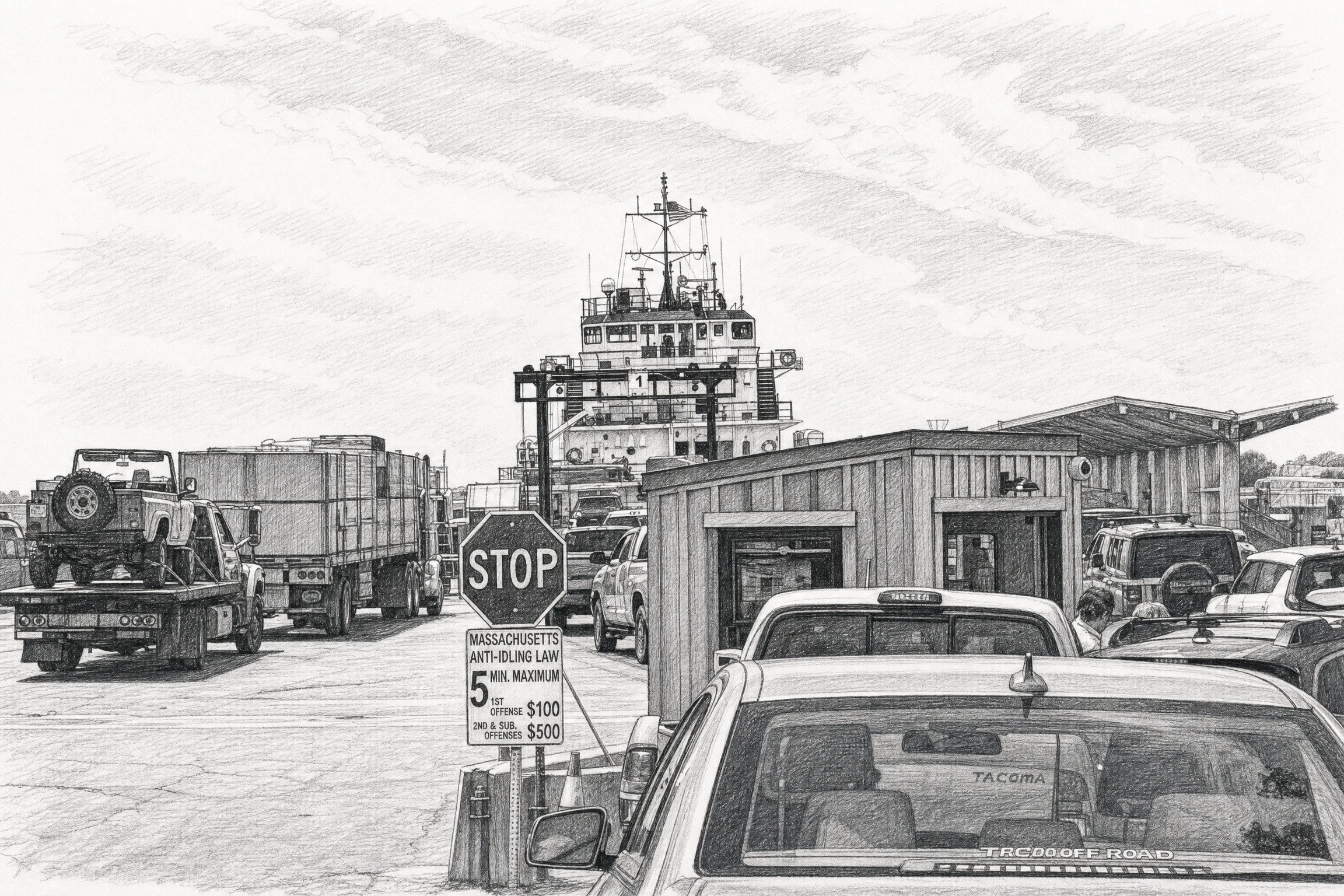
The ferry from Woods Hole takes forty-five minutes, and in that crossing something happens that no traveler quite registers until later. You leave a coastline of strip malls and arrive at one without a single chain store. No McDonald’s. No billboard. No traffic light — not one, anywhere on an island of twenty thousand winter residents and two hundred thousand summer ones.[1] The harbor at Vineyard Haven looks substantially as it looked when my children were small, and substantially as it looked when their grandparents’ generation first crossed.
I have been coming here for years, and this weekend, watching the gingerbread cottages of Oak Bluffs hold their improbable Victorian colors against another June, the question finally organized itself: why? Why has Martha’s Vineyard remained Martha’s Vineyard? The American coastline is a long testament to what money does to beautiful places. From the Jersey Shore to the Florida Panhandle, the pattern is so reliable it reads as natural law: beauty attracts capital, capital builds, building destroys the beauty that attracted it.[2] The Vineyard sits some eighty-five miles from Boston and two hundred fifty from New York, awash for a century in precisely the money that erased a thousand other shorelines. And yet approximately forty percent of the island’s 57,000 acres is permanently conserved.[3] Only about a third is developed at all.

This did not happen by luck, and it did not happen by virtue. It happened by design — and, crucially, by design that arrived early. The Vineyard built its protective rules before the full force of the money did. That sequence, as we will see, is the whole game. The island is one of the most instructive case studies I know of how a place builds rules that endure — and like all such case studies, it is most useful when read honestly, shadow included.
I. The Coordination Problem Solved
Institutions are rarely built in calm weather. The Vineyard’s founding moment came as a threat. In 1972, Senator Edward Kennedy introduced the Nantucket Sound Islands Trust bill, which would have placed the islands under a form of federal trusteeship to halt the development boom then gathering force, a period when the island was seeing dozens of subdivisions and more than 700 new houses each year.[4] Islanders revolted — some towns threatened, half-seriously, to secede from Massachusetts — and the bill died in Congress. But the threat did its work. It forced six small towns, each jealous of its prerogatives, to confront a truth they could no longer evade: the development wave would not respect town lines, and no town could hold it back alone.
The result, in 1974, was the Martha’s Vineyard Commission — a regional planning agency created by special act of the Massachusetts legislature, with powers almost unheard of in American local government.[4] The Commission can review and reject “developments of regional impact” regardless of which town approved them, and can designate “districts of critical planning concern” where stricter rules apply. In the language of game theory, the MVC solved a coordination problem. Thomas Schelling would have recognized it instantly: six players, each with an incentive to defect — to approve the subdivision, take the tax revenue, and let the island absorb the cost — bound themselves to a referee empowered to say no.[5] The towns surrendered a measure of sovereignty to preserve the thing that made sovereignty worth having.
The Caribbean reader will feel a sting of recognition here, inverted. Six Vineyard towns did in two years what fifteen CARICOM states have spent half a century declining to do. The Revised Treaty of Chaguaramas built a single market on paper; the famous “implementation deficit” is simply the coordination problem unsolved — each member retaining the right to defect, to cut the side deal, to delay the protocol, and so each does.[6] We even built the referee — the Caribbean Court of Justice — and then declined to use it: only five of fifteen members accept its appellate jurisdiction.[7] The West Indian Federation collapsed in 1962 on precisely this question; Eric Williams’s bitter arithmetic — one from ten leaves nought — was really a theorem: a union any member can costlessly exit is not a union but a meeting.[8] The Martha’s Vineyard Commission is, in miniature, the institution CARICOM has never permitted itself to become — a body its own members empowered to tell them no.
| Institution | Year Established | Coordination Mechanism | Outcome |
|---|---|---|---|
| Martha’s Vineyard Commission | 1974 | Binding regional review; empowered to override town approvals | Development controlled; ~40% of island conserved |
| CARICOM Single Market | 1973 (revised 2001) | Treaty-based; no binding override of member-state decisions | Persistent “implementation deficit” |
| Caribbean Court of Justice | 2005 | Regional appellate court; voluntary acceptance | Only 5 of 15 members accept appellate jurisdiction |
| West Indian Federation | 1958–1962 | Federal union; member exit permitted | Collapsed; any costlessly exitable union is a meeting, not a union |
Note the sequence, because it matters for everything that follows: the external threat created the political window; local actors used the window to build a domestic institution; the institution outlived both the threat and the actors. Crisis opened the door. Design walked through it — and walked through before the speculative tide reached its height. By the time the great booms of the 1980s and the hedge-fund era arrived, the referee was already on the field. Places that wait until the boom to build the rules discover that the coalition for extraction is by then richer, better organized, and more patient than the coalition for preservation. The Vineyard never had to fight from scratch, because the essential rules had already been settled in quieter years.
II. The Self-Executing Fund
The Commission could regulate, but regulation alone preserves nothing; it only slows the losing. The second layer came in 1986, in the teeth of the Reagan-era building boom, when island voters created the Martha’s Vineyard Land Bank — and here is where the design becomes genuinely elegant.[9]
The Land Bank is funded by a two percent surcharge on most real estate transactions on the island.[9] Every time the market that threatens the Vineyard turns over a property, it automatically finances the Vineyard’s protection. The mechanism is self-executing. There is no annual appropriations battle, no minister’s discretion, no budget line to be quietly starved in a lean year or raided in a fat one. The hotter the market burns, the more it pays to cool itself. Over four decades the fee has yielded hundreds of millions of dollars and conserved 4,238 acres for public use as of 2025 — beaches, moraines, sheep pastures, the great glacial boulder at Waskosim’s Rock where, legend holds, the boundary between English and Wampanoag land was first drawn.[10]
“The deepest question in public finance is not how much money flows but who decides, and how hard it is to change the deciding.”
— Terrence Richard Blackman
Students of Guyana’s Natural Resource Fund will see where I am going. The deepest question in public finance is not how much money flows but who decides, and how hard it is to change the deciding. The Land Bank’s genius is that nobody decides — the formula decides, and the formula was set by referendum and statute, beyond the reach of any single election cycle. It is a small, local, fully realized example of what economists call a commitment device: the present binding the future, because the present knew the future would be tempted.[5]
III. The Deeper Strata
Beneath these two public institutions lies older sediment. Sheriff’s Meadow Foundation, founded in 1959 by Henry Beetle Hough, editor of the Vineyard Gazette, began the private conservation tradition; the Trustees of Reservations, Mass Audubon, the Vineyard Conservation Society, and the Wampanoag Tribe of Gay Head (Aquinnah) each added their own holdings and their own logics.[11] Hough deserves a paragraph in any honest account, because he illustrates a category our region knows too little of: the civic institution disguised as a business. For sixty years his small-town newspaper functioned as the island’s conscience, making conservation respectable before it was fashionable and holding each generation of selectmen to a standard they had not asked for. Institutions, it turns out, include newspapers — when newspapers choose to be institutions.
And beneath even the conservation strata lies the bedrock: geography itself, weaponized. The ferry is friction, and friction, properly understood, is policy. The island has never permitted a bridge, and the Steamship Authority’s boats remain the only way to bring a car across. Every developer’s pro forma must price in the moat. Modern planning assumes that every friction is a problem to be engineered away; the Vineyard understood that some frictions are assets to be preserved. That single inversion — treating inconvenience as a commons worth defending — may be the most transferable idea on the island.
IV. The Highlands of Oak Bluffs
Now the thread that, for me, transforms this from a planning story into something larger. The strongest evidence that institutions — not culture, not luck — preserved this island is written in the Highlands of Oak Bluffs.
Black families began buying property here in the late nineteenth century, when the Methodist campground culture and a handful of willing sellers made deeds available to people whom Newport and the Hamptons turned away. What they built on those deeds was a parallel civic order of remarkable density. Shearer Cottage opened in 1912 as the island’s first Black-owned inn, hosting Adam Clayton Powell Jr. and Ethel Waters.[12] The Polar Bears have been swimming off the Inkwell at half past seven every summer morning since the 1940s. And Dorothy West, last survivor of the Harlem Renaissance, wrote her Oak Bluffs column for Hough’s Gazette — the Black literary tradition and the island’s conservation conscience sharing a masthead.[13]
Here is the comparative fact that should arrest every reader of this Journal. Nearly every other Black leisure community founded in that era was destroyed — not by markets, but by institutions turned hostile. Bruce’s Beach in California, confiscated by eminent domain in 1924 — the land returned to the Bruce family only in 2022, a century too late for the community it had anchored, and sold back to Los Angeles County within the year.[14] American Beach in Florida, carved apart following Hurricane Dora and integration.[15] Seabreeze in North Carolina, erased by erosion and development.[16] The pattern was national and it was systematic: where the rules of the game were captured against Black landowners, Black property did not survive prosperity. Oak Bluffs survived because stable town governance first, then the Commission and the Land Bank, suppressed the speculative waves that elsewhere became the very instrument of dispossession — and protected Black deeds with the same indifference they extended to all deeds.
The result is among the rarest artifacts in American life: Black generational wealth in land, compounding undisturbed across more than a century. The difference between Oak Bluffs and Bruce’s Beach is not ambition, thrift, or family structure. It is institutional design. Readers of this column will recognize the argument, because it is the argument I have made about Guyana for years: dysfunction is structural before it is cultural, and so is flourishing.
V. The Shadow
A case study that omits its costs is a sermon, and the Vineyard’s costs are real. The Land Bank itself concedes that its holdings amount to only about seven percent of the island — most of the conserved forty percent came from older money and older norms, which are not replicable on demand.[3] More seriously: the same engineered scarcity that preserved the landscape has produced a housing crisis of genuine cruelty. The teachers, nurses, fishermen, and tradespeople who operate the island increasingly cannot live on it. The median home sale price on the Vineyard reached $1.6 million in 2024, creating an affordability gap of $610,500 even for households earning 150 percent of the area median income.[17] And the shadow falls on the Highlands too. Houses bought for four figures are assessed at seven; heirs’ property tangles multiply; every summer, some family must decide whether the cottage is heritage or liquidity. The rules that preserved the island now strain the very communities that gave preservation its meaning.
So the deepest question the Vineyard poses is the one it has not yet finally answered: do institutions preserve communities, or only landscapes? The Polar Bears in the water at dawn are evidence for communities. The real estate listings are evidence for doubt. That the island is still arguing about it — in town meetings, in the Gazette, in the Land Bank’s Monday public-comment sessions — may itself be the most important institution of all.
VI. Three Lessons for Guyana
Lessons That Travel Well Across the Water
Coda
Every generation inherits two landscapes: the physical one it can see, and the institutional one it usually cannot. Martha’s Vineyard preserved the first because earlier generations deliberately built the second — and paid for it, and argued about the price, and are arguing still. The lesson for Guyana is not how to save an island. It is how to leave behind rules that can survive success.
Terrence Richard Blackman, Ph.D. is Professor and Chair of Mathematics at Medgar Evers College, CUNY, and Founder and Publisher of the Guyana Business Journal. He writes the GBJ Sunday Essay. This essay was written in Brooklyn — and, this week, from Oak Bluffs. The views expressed are the author’s own and do not represent Medgar Evers College or the City University of New York.
References
- Stackpole, T. (2024). “Martha’s Vineyard Is Being Gutted by Skyrocketing Housing Costs. Yes, You Should Care.” Mother Jones.
- Gillis, J. R. (2012). The Human Shore: Seacoasts in History. University of Chicago Press.
- Martha’s Vineyard Commission. (2023). “Martha’s Vineyard Statistical Profile, 2023.”
- Martha’s Vineyard Commission. “Background & Mission.” About the MVC.
- Schelling, T. C. (1960). The Strategy of Conflict. Harvard University Press.
- International Monetary Fund. (2020). “Is the Whole Greater than the Sum of its Parts? Strengthening Caribbean Regional Integration.”
- Caribbean Court of Justice. “Who we are.”
- CARICOM. “The West Indies Federation.”
- Martha’s Vineyard Land Bank Commission. “About the Land Bank.”
- Martha’s Vineyard Land Bank Commission. (2025). “2025 Annual Report.”
- Sheriff’s Meadow Foundation. “Our History.”
- National Trust for Historic Preservation. (2019). “Shearer Cottage and the Rich African American Heritage of Martha’s Vineyard.”
- Radcliffe Institute for Advanced Study at Harvard University. “Dorothy West.”
- County of Los Angeles, Anti-Racism, Diversity & Inclusion Initiative. “Bruce’s Beach.”
- Stephens, R. J. (2014). “American Beach, Jacksonville, Florida (1936– ).” BlackPast.org.
- Stephens, R. J. (2014). “Freeman Beach-Seabreeze, Wilmington, North Carolina (ca. 1885– ).” BlackPast.org.
- Genter, E. (2025). “Housing Crisis Hits Middle Income Earners.” Vineyard Gazette.
- Reuters. (2025). “Oil output, exports drove Guyana economy’s growth of 43.6% in 2024.”
- Guyana Business Journal. (2024). “Balancing Accountability and Flexibility: Lessons from Guyana’s Natural Resource Fund.”
- Best, L., & Levitt, K. P. (2009). Essays on the Theory of Plantation Economy: A Historical and Institutional Approach to Caribbean Economic Development. University of the West Indies Press.
Supported By
We are grateful for the partnership and support of individuals and organisations committed to advancing Guyanese and Caribbean development and human capital investment. Sponsors support the GBJ Sunday Essay as a whole; they play no role in commissioning, reviewing, or approving its content, and the analysis and conclusions are solely the author’s.
Metallica Commodities Corporation
For over two decades, Metallica Commodities Corporation has connected producers and consumers of non-ferrous metals across the Americas, Africa, and Asia. Headquartered in New York with offices in Peru, Canada, Tanzania, and Guyana, MCC brings institutional expertise and global reach to resource-rich markets, with a deep understanding that sound governance determines whether natural wealth generates broad-based prosperity.
The GBJ Sunday Essay is supported by MCC and is not written on its behalf. The views expressed are those of the author.
METALLICACC.COM ↗Pebble Stream™
Pebble Stream™ is a US-based cloud-computing company that transforms complex Excel models into secure, enterprise-scale cloud applications through patented “pebblization” technology. Founded by Bediako George and backed by over 25 years of financial and accounting expertise, the company processes one billion tax calculations monthly and counts a Big Four accounting firm among its clients. For Guyanese and Caribbean businesses, Pebble Stream offers the scalability a rapidly growing economy demands.
This GBJ article is sponsored by Pebble Stream™ and is not written on its behalf. The views expressed are those of the author.
PEBBLESTREAM.COM ↗Caribbean International Shipping Services
Ship with Confidence: Your Trusted Logistics Partner
For over 30 years, Caribbean International Shipping Services has been the trusted choice for businesses and individuals shipping from the Southeast USA to the Caribbean and Latin America. Specialising in household relocations, commercial goods, and online order consolidation, their experienced team delivers weekly ocean and air freight services to over 20 destinations — reliably and stress-free.
📞 770-322-3111
CARIBSHIPATL.COM ↗MCCGUSA
Management Consulting, Project Management, Real Estate
Founded in 1990, MCCGUSA (formerly Management Consulting and Controls Group) is a premier consulting and project management firm serving clients across the United States and internationally. A Certified MBE, DBE & Hub Zone Business, MCCGUSA provides management consulting, project management, financial advisory, and real estate services — with national affiliates and international representation in the Caribbean and Latin America.
📞 212-269-6126
MCCGUSA.COM ↗Individual Supporters
Courtney Allen | All Te Networks | Corine Locke | Tony Harris | Roderick Alsopp | Dr. Michelle Luard | Clarence Bone
🇬🇾 Please support the Guyana Business Journal & Magazine today
