
Infrastructure | Governance & Transparency
The Authority Problem: A Governance Architecture for Flood Management in Guyana
By Guyana Business Journal Data Desk · June 2, 2026

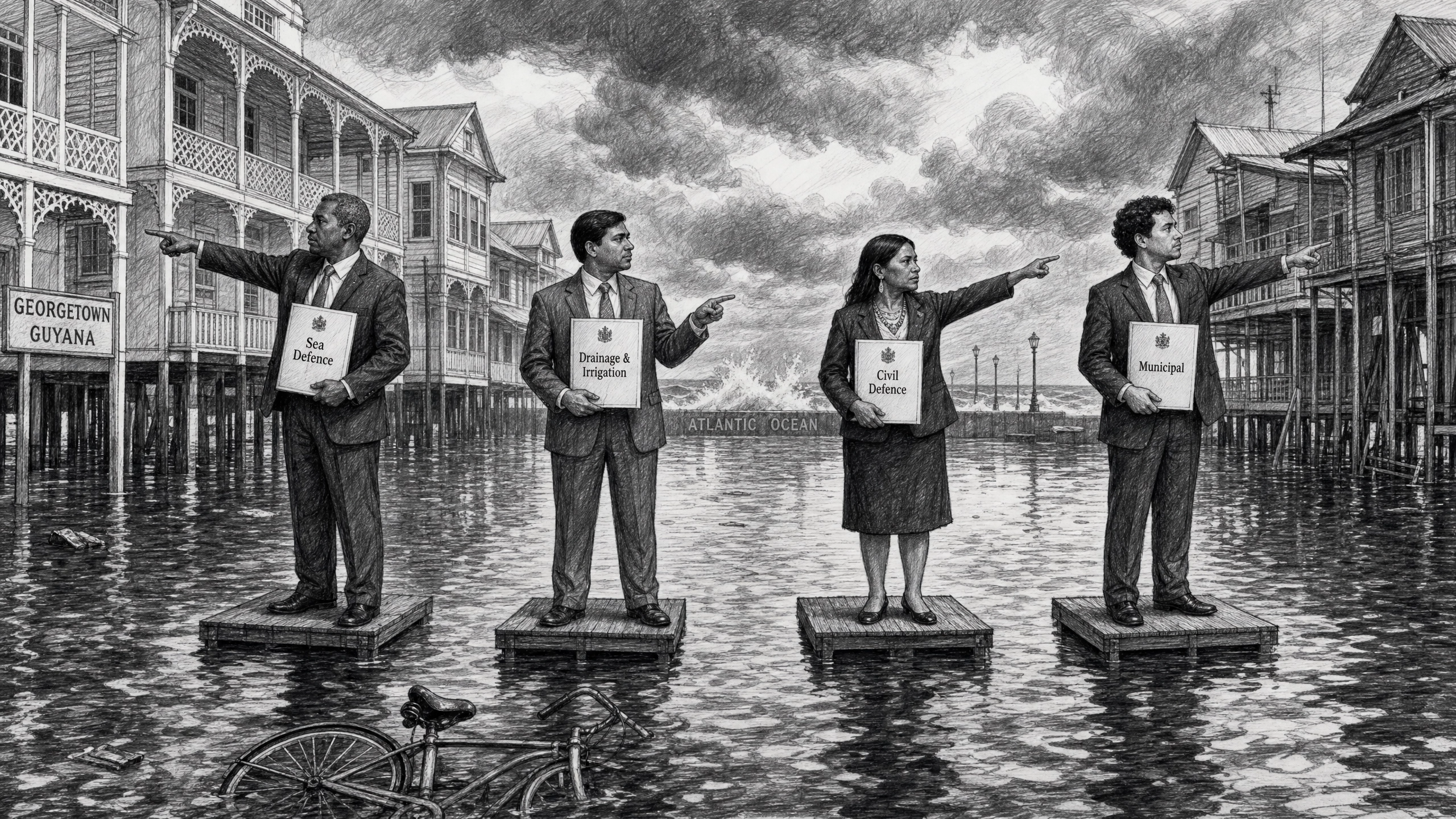
Georgetown does not flood because no one is responsible. It floods because everyone is — and no one is accountable.
0.22
Max Drainage Capacity (in/hr)
0.95
Peak Intensity (Feb 2026)
11.8%
iGOPP DRM Score (2017)
G$240B
Drainage Spend (2020–25)
In “The Hourly Intensity Problem,” we argued that Georgetown floods not because it rains too much but because rain falls too fast: inundation is governed by the inequality R(t) > D, where rainfall intensity outruns drainage capacity 1. The hard conclusion was that we must decouple flooding from failure — a perfectly operated system will still flood when intensity exceeds roughly 0.22 inches per hour 1. That argument was about hydraulics. This one is about institutions, and it makes the harder claim. The failure that is ours to fix is not the rain, and not even the pumps. It is that no single entity owns the flood. Guyana has assembled, at considerable expense, a great deal of flood-control infrastructure. What it has never built is a coherent flood-governance architecture. The result is the institutional analogue of R(t) > D: authority is fragmented and accountability is diffuse, so the system overflows at exactly the moment it is asked to perform.
A Flood with Four Landlords
Trace a single drop of rain falling on Georgetown during a high-intensity storm, and watch how many jurisdictions it crosses before it reaches the Atlantic — or fails to. It first encounters the sea and river defence system, the seawall and revetments that hold back an ocean now sitting above the city at high tide. That system was historically governed by the Sea Defence Act 2, but has been consolidated under the modern Sea and River Defence Act of 2024, administered through the Ministry of Public Works — an entirely separate legal and administrative universe from the drainage that carries rain away 3.
The same drop, unable to exit at high tide, is meant to be stored in the East Demerara Water Conservancy (EDWC) — the shallow reservoir that doubles as flood buffer and as the source of roughly 60 percent of the capital’s drinking water 4. The EDWC and its relief works, including the Hope Canal, are operated by the National Drainage and Irrigation Authority (NDIA) under the Drainage and Irrigation Act of 2004, within the Ministry of Agriculture 5. Note the framing: the law that governs the country’s principal flood-control body defines its mission as the conservation and distribution of water for agricultural purposes 5. Flood safety for half a million coastal residents is, statutorily, a by-product.
That same drop, once on a city street, enters secondary and tertiary drainage — the alleyways and roadside channels that residents actually watch fill up. Much of that network falls to municipal and neighbourhood-democratic-council responsibility, not to NDIA at all, producing the recurring “declared versus undeclared” gap in which no agency clearly owns the drain in front of your house. When the water finally rises into homes, the response — evacuation, shelter, relief, the public bulletins — is the work of the Civil Defence Commission (CDC), which sits under the Office of the President, in a third centre of executive authority 6. One drop. Four statutes or instruments. Four ministries or offices. No single owner. This is not a maintenance problem; it is a design problem, and it predates every blocked canal we are tempted to blame.

The Missing Law
The most consequential fact about Guyana’s flood governance is what does not exist: a single, modern, framework law for disaster risk management. The CDC — the body the public reflexively looks to during a flood — was established in 1982 and has operated for more than four decades largely on the strength of Cabinet resolutions and plans rather than primary legislation 6. An Inter-American Development Bank (IDB) assessment found no formal normative framework for comprehensive disaster risk management in Guyana, noting that the governing policy rested on Cabinet instruments not even available for public consultation 7. In other words, the lead coordinating agency for national emergencies has been improvising its legal authority 7.
This has been recognized — and unaddressed — for an extraordinarily long time. Work on a Disaster Risk Management Bill began in 2013. A European-Union-funded expert team ran nationwide consultations and, by 2019, had produced two draft bills: one to consolidate and modernize the outdated sea-and-river-defence legislation, and one to create a comprehensive DRM framework giving statutory authority to a national architecture under the CDC, with defined regional and local tiers 8. The first of those bills became law — the Sea and River Defence Act, No. 9 of 2024 3. The second, the comprehensive DRM framework, did not. That asymmetry is the whole story: the state proved able to consolidate a single domain under a single ministry, but balked at the cross-cutting law that would bind Agriculture, Public Works, and the Office of the President into one accountable system. It enacted the easy law and shelved the necessary one. As recently as January 2025, the Prime Minister described the reform as still “ongoing” 9.
Sit with that timeline. A framework to govern the single greatest physical threat to Guyana’s most populous region has been in drafting for more than a decade — through the 2021 floods that triggered a national disaster declaration and affected over 48,000 households 10, and through the oil-financed budget expansion that has poured more than G$240 billion into drainage since 2020 11. We have found the money for pumps. We have not found the will for a law.

Spending Without a Spine
The cost of governing by fragment is not abstract. It shows up as money moving without a coherent accountability structure behind it. NDIA’s own budget has expanded dramatically in the oil era, and the country has commissioned headline assets — the Liliendaal “Bullet” pump, capable of moving 152 cubic feet per second, among them 12. Yet the state auditor’s review of NDIA covering 2021 to 2024 reported a lack of accountability and poor documentation 13. That is precisely the failure mode an unintegrated structure produces: large capital flows directed at individual structures, with no end-to-end owner answerable for whether the system — defence, conservancy, primary, secondary — actually clears water faster than it arrives 13. Capacity without coherence is just expensive fragmentation. We are buying horsepower for a vehicle that has no single driver.

From Infrastructure to Architecture: Four Layers
A cohesive governance structure means consolidating the flood pathway under one roof. Today’s fragmentation is not a coordination failure to be patched with committees and protocols; it is a structural error to be corrected by merger. The flood is a single hydraulic system — Atlantic to alleyway — and it should be governed by a single authority built to match it. Four layers would do it.
First, a statutory foundation is required. Enact the long-drafted DRM framework law — the cross-cutting framework the 2024 Sea and River Defence Act left unbuilt. This is the precondition for everything else: until the architecture rests on statute rather than discretionary Cabinet resolution, every reform below is reversible at will and unenforceable in practice. Twelve years of drafting is enough.
Second, a single consolidated authority must be established. Create a National Flood Risk Management Authority (NFRMA) and vest in it the operational functions now scattered across the system: the drainage and conservancy mandate currently held by NDIA, the administration of the sea and river defences, and the flood-specific response and coordination functions now exercised by the CDC. This is not a coordinating committee layered over the existing bodies — that is the half-measure that fails. It is a merger. One authority, one budget line, one chief executive answerable to Cabinet for a single question: does water move from the Atlantic to the alleyway faster than it arrives? The agencies organized by infrastructure type — defence here, drainage there, emergency response elsewhere — are reorganized into divisions of one body organized around the pathway itself. The one design question consolidation must resolve honestly is the agricultural-irrigation function: NDIA also distributes water to farms nationwide, a mission distinct from flood control. That function can be carved out to a successor irrigation unit or retained as a separate division, but it cannot be allowed to keep flood safety subordinate to it, as the 2004 Act does today. Guyana already has a body called the Authority. It has never had an authority over the flood.
Third, end-to-end operational command is necessary. Within the new authority, the pathway’s segments — Atlantic defence, conservancy storage and relief, primary drainage, and the secondary and tertiary networks that today fall between NDIA and local government — become divisions under one operational command rather than the property of separate institutions. The “declared versus undeclared” gap that leaves the drain in front of your house belonging to no one is closed not by negotiating a protocol between agencies but by absorption: every segment of the pathway now sits inside a single remit and is activated as one system against forecast intensity. Where municipal and neighbourhood councils retain a role in local channels, they operate under standards the authority sets and an audit it enforces, not as independent fiefdoms.
Fourth, a shared data, standards, and transparency backbone must be built. Here the two articles meet. The intensity-based monitoring “The Hourly Intensity Problem” called for needs an institutional home: a single hydromet-fed system that triggers pump scheduling against forecast peak intensity rather than reactive operation, engineering standards rebuilt around peak hourly loads rather than historical averages, and public dashboards plus a binding audit regime so that the next G$240 billion is traceable to outcomes. Measurement reform and governance reform are the same reform.
The objection writes itself: merging functions that today sit under three different arms of the executive is a vast machinery-of-government undertaking, and skeptics will note that it would fold away the very Sea and River Defence Board the 2024 Act has just modernized. But a board modernized within a single domain is still a board that cannot govern across domains — and the flood pathway is nothing if not cross-domain. The disruption of consolidation is real, but it is one-time; the disruption of fragmentation is permanent, and it arrives with every storm. Guyana has already proven it can build the easy institution. The question is whether it will build the necessary one.

The Argument, Restated
The first article asked us to change variables — from totals to rates — so we would stop mistaking physics for negligence 1. This one asks us to change structures — to consolidate fragmented authority into a single one — so we stop mistaking spending for governance.
Both arguments converge on the same uncomfortable truth. Guyana, newly wealthy, has been treating flooding as a procurement problem: buy more pumps, dig more canals, commission more channels. But you cannot purchase your way out of an institutional vacuum. Until one authority owns the flood from the Atlantic to the alleyway — not coordinates it, owns it — grounded in law rather than resolution, the country will keep doing what it does best in the oil era: spending magnificently on a system that no one, in the end, is responsible for making work. The water is governed by an inequality. So, it turns out, is the state. We have learned to measure the first. It is past time to redesign the second.

References
- Guyana Business Journal Data Desk. (2026, March 30). “The Hourly Intensity Problem: A Data-Driven Approach to Flood Management in Georgetown.” Guyana Business Journal. Available at: guyanabusinessjournal.com
- Government of Guyana. (1998). Sea Defence Act, Chapter 64:02. Laws of Guyana. Available at: faolex.fao.org
- Parliament of Guyana. (2024, May 17). Sea and River Defence Act, No. 9 of 2024. Laws of Guyana. Available at: informea.org
- Wikipedia Contributors. (2026). “East Demerara Water Conservancy (EDWC).” Wikipedia, The Free Encyclopedia. Available at: en.wikipedia.org
- Parliament of Guyana. (2004). Drainage and Irrigation Act, No. 10 of 2004. Laws of Guyana. Available at: opsaa.iica.int
- Civil Defence Commission of Guyana. (2026). “About the Civil Defence Commission.” CDC Official Website. Available at: cdc.gy
- Lacambra Ayuso, S., Hori, T., Chakalall, Y., Jaimes, I., Sanahuja, H., Torres, A. M., & Visconti, E. (2019). Index of Governance and Public Policy in Disaster Risk Management (iGOPP): National Report Guyana. Inter-American Development Bank (IDB) Technical Note IDB-TN-1607. DOI: 10.18235/0002020. Available at: publications.iadb.org
- NIRAS Group. (2019, October 29). “Guyana revamps its sea and river defence and disaster risk management legislation.” NIRAS News. Available at: niras.com
- Staff Reporter. (2025, January 7). “Disaster risk management reform on the cards — PM.” Guyana Chronicle. Available at: guyanachronicle.com
- Caribbean Disaster Emergency Management Agency (CDEMA). (2021, June 28). Flooding in Guyana — Situation Report No. 3. Available at: cdema.org
- Ministry of Agriculture / National Drainage and Irrigation Authority. National budget allocations for drainage and irrigation, 2020–2025 (cumulative); see most recently, Budget 2025: $73B to expand drainage, irrigation this year. Government of Guyana (17 January 2025). Available at: agriculture.gov.gy
- World Bank Group. (2025, April 7). “The ‘Bullet’ Pump: Modernizing Flood Management in Guyana.” World Bank Feature Story. Available at: worldbank.org
- Stabroek News Reporter. (2025, November 5). “Audit office finds lack of accountability, poor documentation at NDIA for 2021 to 2024.” Stabroek News. Available at: stabroeknews.com
Supported By
We are grateful for the partnership and support of individuals and organisations committed to advancing Guyanese and Caribbean development and human capital investment.
Metallica Commodities Corporation
For over two decades, Metallica Commodities Corporation has connected producers and consumers of non-ferrous metals across the Americas, Africa, and Asia. Headquartered in New York with offices in Peru, Canada, Tanzania, and Guyana, MCC brings institutional expertise and global reach to resource-rich markets, with a deep understanding that sound governance determines whether natural wealth generates broad-based prosperity.
The GBJ Sunday Essay is supported by MCC and is not written on its behalf. The views expressed are those of the author.
METALLICACC.COM ↗Pebble Stream™
Pebble Stream™ is a US-based cloud-computing company that transforms complex Excel models into secure, enterprise-scale cloud applications through patented “pebblization” technology. Founded by Bediako George and backed by over 25 years of financial and accounting expertise, the company processes one billion tax calculations monthly and counts a Big Four accounting firm among its clients. For Guyanese and Caribbean businesses, Pebble Stream offers the scalability a rapidly growing economy demands.
This GBJ article is sponsored by Pebble Stream™ and is not written on its behalf. The views expressed are those of the author.
PEBBLESTREAM.COM ↗Caribbean International Shipping Services
Ship with Confidence: Your Trusted Logistics Partner
For over 30 years, Caribbean International Shipping Services has been the trusted choice for businesses and individuals shipping from the Southeast USA to the Caribbean and Latin America. Specialising in household relocations, commercial goods, and online order consolidation, their experienced team delivers weekly ocean and air freight services to over 20 destinations — reliably and stress-free.
📞 770-322-3111
CARIBSHIPATL.COM ↗MCCGUSA
Management Consulting, Project Management, Real Estate
Founded in 1990, MCCGUSA (formerly Management Consulting and Controls Group) is a premier consulting and project management firm serving clients across the United States and internationally. A Certified MBE, DBE & Hub Zone Business, MCCGUSA provides management consulting, project management, financial advisory, and real estate services — with national affiliates and international representation in the Caribbean and Latin America.
📞 212-269-6126
MCCGUSA.COM ↗Individual Supporters
Courtney Allen | All Te Networks | Corine Locke | Tony Harris | Roderick Alsopp | Dr. Michelle Luard | Clarence Bone
🇬🇾 Please support the Guyana Business Journal & Magazine today
