
The Sunday Essay · Education & Nation-Building
The Window on Thomas Road
What a school teaches when nobody is teaching
The old west wing at Queen’s College had to come down. What went up in its place satisfies eight directives and answers no question. On the enduring importance of the aesthetic, and on what a building says to a child for sixty years.
By Dr. Terrence Richard Blackman · Brooklyn, New York · September 2026
I was not a well-behaved student in every particular. I looked out of the window.
The classrooms at Queen’s College had long banks of them along the Thomas Road side, and on a bright morning the light came from the direction of the Atlantic, not far beyond the sea wall, and catalyzed the imagination. A child of ten attending to something else could rest his eyes at the far end of that light and think about what lay on the other side of it.
I want to be exact about this, because it is the argument of the whole essay. I was not daydreaming instead of learning. I was learning what the building was built to teach, which the curriculum could not teach and did not try to. I was learning that there was an outside. That the room I sat in was not the size of the world. That the horizon was a real place, that other people were standing on it, and that there was, in principle, a way to get there.
I went from that window to Brooklyn College, to the Graduate Center, to Medgar Evers, to MIT, to the University of Denver, to the Institute for Advanced Study and back to Medgar Evers College. I do not claim the window did that. I claim I could not have imagined it without one.
I entered that building in Form 1A in September 1979, ten years old and young for my class. I still have the program for the Prize-Giving Exercise of Friday, 6 December 1985 — typewritten, mimeographed, one line hand-corrected, the cover scrawled over with the signatures of the Upper Sixth. The QC Steel Band played “We Are The World.” Dr. Ulric Trotz was the guest speaker. My name is on page four, under Lower Sixth, Mathematics, and again beside Tracy Gravesande’s for the Luckhoo Debating Prize. I mention it not for the prizes but for the document. Somebody typed it, somebody stenciled it, somebody thought a Friday evening in December was worth a program. Forty-one years later it is the thing that survives, and the auditorium and the wing in which that evening took place does not.
They took down the old west wing because they found it structurally unsafe. Nothing in this essay disputes that it had to come down. My subject is what went up in its place.
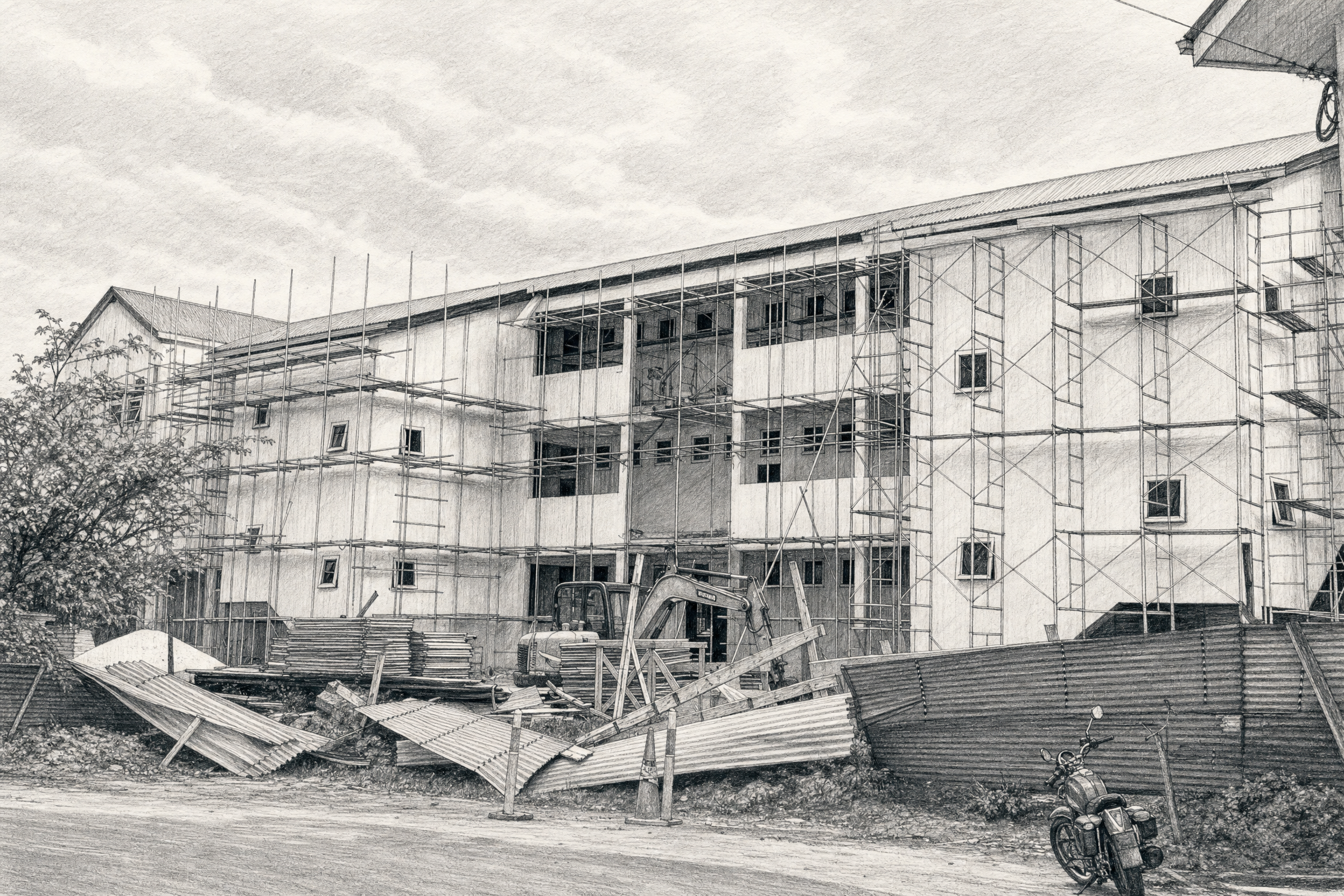
A photograph now shows the new wing as it rises. Three stories, flat white panel, a red roof, small, regularly spaced windows set into a wall that does little else. A construction photograph is not a final judgment; landscaping, interiors and use can change how a building is experienced. But the principal decisions about mass, proportion and openings have already been made, and it is those decisions I am writing about.

I want to be careful here, because the easy thing is to blame the architect and the engineers, and the easy thing is wrong.
Before construction began, I put two buildings before people close to the project — Kunlé Adeyemi’s Makoko Floating School in the Lagos lagoon, a celebrated prototype that collapsed in 2016 but widened the conversation about building and learning on water all the same, and the Green School in Bali. Neither was a proposal. Both were arguments: that a school in a hot, wet climate, even under severe material constraints, can be the most imaginative building for a hundred miles, and that this is as much a matter of intention as of budget. I urged that the project take its time, and that it open a wider conversation with the Queen’s College community in Georgetown, London, Toronto and New York.
The answer that came back, in substance, was that such concepts would raise a great many questions if introduced on the Queen’s College campus. That was not a refusal. It was a forecast, and it proved accurate. The problem was never a shortage of ideas at the drawing board. It was the set of instructions surrounding them.
I have seen the brief itself. It consisted of eight directives, each identified by the constituency it came from. The old students asked that the new wing preserve the character of the old building, retain the large window banks on Thomas Road, and leave the external spaces undisturbed. Parents asked for air conditioning in the classrooms, laboratories and library, and for modern, maintainable washrooms. The Ministry of Education asked for a larger library, provision for a future link between the east and west wings, and durable design for minimum future maintenance.
That is the whole of it. That is what a nation with a sovereign wealth fund asked, in the brief as I have seen it, of the rebuilding of its premier secondary school. I will come back to those eight.
What follows is not about taste, and not about nostalgia. It is about what a building teaches when nobody is teaching.
I. The lesson that runs for sixty years
Every school teaches twice.
The first lesson is the one on the timetable, delivered by people paid to deliver it, examined, revised, forgotten and occasionally remembered. The second is delivered by the fabric of the building itself, continuously, silently, to every child who passes through, for as long as the building stands. It is never examined. It is never forgotten either.
The second lesson is short. It says: this is what you are worth.
A child does not have the vocabulary to articulate it and does not need to. She absorbs it the way she absorbs an accent. She can tell the difference between a place that was built and a place that was provided.
This is not merely sentiment. People read dignity, neglect, seriousness and indifference from the places institutions make for them. Whether a child then grows toward the estimate she has been handed is harder to demonstrate, and I will not pretend the research settles it; too much else moves at the same time. But few people who have taught in both kinds of room will doubt that the room is doing something.
So when we ask whether Guyana can afford beauty in its schools, we have asked a confused question. The building will teach either way, continuously, for decades. The only question genuinely on the table is what we want it to say.
If the exterior now visible accurately expresses the finished building, the new west wing will say, to every cohort that enters it until the 2090s: we did what was necessary, and no more. It will say this cheerfully, cleanly, in good repair, with the air conditioning running. And a child from Sophia or Albouystown, told all her life that she is fortunate to be there, will look around and receive quiet confirmation that fortune, in her case, extends exactly as far as the necessary.
II. Hardy’s objection, and Ruskin’s
I want to bring my own discipline into this, because mathematicians have an answer to the utilitarian that most people do not know we have.
G. H. Hardy, in A Mathematician’s Apology, held that beauty is the first test of a piece of mathematics, and that ugly mathematics has no permanent place in the world. He is often read as a snob saying something decorative. He was not. He was describing how the discipline behaves.
Two proofs of the same theorem are equally correct; a machine checking them cannot tell them apart. Yet mathematicians consistently prefer one to the other, teach it, remember it, name it. Why, if correctness is the whole of the job? Because it is not. Elegance often signals that a proof has found something deeper than a route to the immediate result — some structure capable of reappearing elsewhere. This is no theorem about theorems. It is the accumulated judgment of a discipline that has learned, across centuries, to distinguish an argument that merely arrives from one that illuminates. Beauty in mathematics is not a coating applied to truth after the fact.
Now transpose that. The utilitarian tells us that a school needs rooms, light, ventilation and plumbing that works, and that everything beyond this is indulgence. He believes he is the practical man in the room, and he has misunderstood even utility. He has optimized for the next repair, and produced the building that closes the subject. What he cannot produce by that method is the building that keeps paying: the one worth restoring in eighty years, that alumni will fund, that a city organizes itself around, that a child carries out of the country and back into it.
Beauty is not the opposite of utility. It is utility measured on the longest horizon. This is why the wish for minimum future maintenance so often produces buildings that nobody troubles to maintain.
Beauty is not the opposite of utility. It is utility measured on the longest horizon. — T.R.B.
Ruskin, writing in 1849, put sacrifice first among his seven lamps of architecture: architecture begins where you do more than is required. Not more than you can afford. More than is required — a building aimed, as he put it, at an effect on the mind, and not merely at a service to the human frame. Set that beside the eighth directive: durable design for minimum future maintenance. The two need not be enemies; reconciling them is most of what good architecture is. I do not think the Ministry understood that it was taking a philosophical position, and that is exactly the difficulty. It believed it was being prudent with public money, which is a duty and not a vice. But every institution we revere is one that somebody kept giving to after it was finished.
III. What the honest pipe reveals
One more detail I have thought about more than any other. A reader sent me a photograph of another recently rebuilt school. Toilet pipes ran down the outside of the building. Near the fence stood a structure that looked, in the reader’s exact words, like an afterthought. When I asked, I was told the Ministry prefers exposed external plumbing: cheaper to maintain, easier to reach, and less disruptive when a leak occurs.
I have found no published standard that states this, and I report it as it was reported to me — one experienced professional’s account of what the client wants. It concerns another school, and I do not offer it as evidence against this one. I offer it for what it discloses.
A distinguished architectural tradition treats exposed structure and services as a form of candor. But an architectural principle asks what a building ought to express; a maintenance calculation asks how quickly a worker can reach the leak. The two may produce the same pipe. They have not produced the same building. This was not an aesthetic decision carelessly made. It was an aesthetic consequence accepted in advance, because ease of repair had already been given priority over any question of appearance. The pipe is honest in a sense its defenders may not intend: it discloses a philosophy in which the school is imagined first as a future maintenance problem and only afterward as a present human environment.
When maintainability is promoted from one constraint among several to the governing objective, every other value must defend itself against the charge of indulgence. Light must justify itself. Proportion must justify itself. Beauty must justify itself, in a language it does not speak, before an audience holding a calculator. The pipe alone is presumed innocent. And an assumption that never has to be argued is an assumption that can never be defeated.
An assumption that never has to be argued is an assumption that can never be defeated. — T.R.B.
IV. The ranking a child can read
Drive from Thomas Lands toward the Kingston foreshore and look at what the boom has built. Glass. Atria. Double-height lobbies. Careful landscaping. Lighting designed by somebody who thought about lighting. This country has no shortage of the capacity to build beautifully. It is simply that the imagination is deployed where the visitor will see it.
I do not want to make this a cheap point. Hotels compete, and schools are accounted for; the incentives genuinely differ, and no conspiracy is required. But the child can read the result, and the result is a ranking. When a state builds spectacularly for the guest and adequately for the child, it has said something about the order of its affections, and it has said it in the most durable medium available. No policy document will ever say it. The skyline says it every day, and will still be saying it in fifty years.
There is a further irony I would rather not have to write. The old building at Queen’s College, which opened at Thomas Lands in 1951 and was raised by a colonial administration not principally concerned with the flourishing of a child like me, gave that child his bank of windows and his light off the Atlantic. The empire built generously for reasons that were not generous: to project permanence, to impress, to make its authority look inevitable. The child got the light anyway.
Independence was supposed to mean that we would finally build generously on purpose, for our own reasons, for our own children. Instead we narrowed the windows and filed the decision under maintenance.
Independence was supposed to mean that we would finally build generously on purpose, for our own children. — T.R.B.
That is not an argument for the empire. It is a far more uncomfortable argument. The old building records a colonial state’s conviction about its own permanence. The new wing risks recording our uncertainty about what public architecture should ask of itself — and a building is an honest instrument that records the difference.
V. What was on the other side of that light
One more thing about the window, and then I am finished.
Most of Guyana’s people live on a narrow coastal plain below sea level, behind sea defenses, facing the ocean. That ocean is not scenery. It is part of the route by which many of the peoples who made modern coastal Guyana arrived — across oceans from West Africa, India, Madeira and southern China, in chains and in indenture — and the route by which so many have gone out again to Brooklyn and Toronto and Tottenham. Recently I wrote about the newest arrivals, from Dhaka. The Atlantic is one of the country’s central historical facts, and it lies just beyond the wall from that classroom.
A child looking out of a window at Queen’s College was looking toward the thing that made him. He was looking at the arrival and the departure at once. He did not know that at ten. He knew it later, and he could only know it later because the building had let him look at all.
You cannot legislate that experience. You cannot guarantee it in a brief.
But a brief can make it possible. Heat, glare, energy and weather are design problems, not arguments against imagination, and solving them is what we hire designers for. It requires, above all, that when we build for our children, somebody in the room asks what the building will let them see.
VI. The question we did not ask
Return to the eight directives. Every one was defensible. Several were admirable. Together they formed what a mathematician recognizes immediately as an optimization problem with a full set of constraints and no objective function.
Constraints tell you what a solution must satisfy. The objective tells you what it is trying to achieve. Without one, there is no basis for choosing the best among the merely feasible. Something else chooses instead: whatever criterion is already operating in the room, unnamed and therefore unchallenged. Here that criterion appears to have been cost and ease of repair. Nobody had to argue for it. It was simply the last thing left standing when the arguing stopped.
None of this argues against cost. It is an argument about what cost is for. A brief that treats the window as a line item to be trimmed has quietly reversed the order of things, so that the building serves the budget when the budget was only ever meant to serve the child in the room. The corrective is not rejecting the ledger. It is the recognition that the ledger exists for something. Cost, procurement and maintenance are instruments; the child’s flourishing is the objective.
Some economists have lately taken to calling that outlook market humanism — Eric Beinhocker and Nick Hanauer’s phrase for an economy judged by the human flourishing it produces — and I intend to return to it in these pages. At Thomas Lands we might say it more plainly: Queen’s College was built for the child at the window. Everything else was always supposed to be a means.
Eight constraints. No objective. Nobody wrote down what the building was meant to produce in the imagination of a child.
Nobody said: this building must make a ten-year-old from Sophia believe she is standing somewhere consequential. Nobody said: the building itself must teach. Nobody said: in eighty years this must still be worth photographing. Nobody said: keep the child’s eye on the ocean.
The old students bear their share of this, and I write as one of them — 1A of 1979, on the record on page four of the 1985 program. Three of the eight directives were ours, and all three looked backward: preserve the character, retain the windows, leave the grounds undisturbed. Not one said build something our grandchildren will fight to protect. I argued for a wider conversation and did not convene one. The diaspora brought memory and opinion. It did not bring an organized mandate for ambition.
And yet the second directive was the best of the eight. The old students asked specifically that the large window banks on Thomas Road be retained, and I suspect the men and women who asked could not have said why, beyond that they remembered the light. Something of that instruction may survive in the repeated openings. From what can be seen so far, it did not survive as light. I cannot imagine a child standing at one of them and receiving the Atlantic as we received it.

Coda
The building is not finished, and some of what matters may still be recoverable without reopening the principal structure or greatly enlarging the budget. Publish the brief and the drawings, and let the country read the eight directives and decide whether they were the right eight. Convene the alumni now, late as it is — Georgetown, London, Toronto, New York — on the interiors, the library, the courtyard, the walls. Commission the artwork; a wall is cheap, and a wall that says something is not much dearer.
And for the next school, and there will be a next school, write the objective before the constraints. One sentence is enough. What should this building make possible in the life and imagination of a child?
We are pouring an argument about who we think we are into concrete, and we have not stated the objective function. The buildings going up this year will still be teaching in the 2090s. They will teach whatever we put in them, including nothing.
As a child at a window on Thomas Road, I looked toward the Atlantic and was told by a building that the world was larger than the room. Everything I have done since began somewhere in that view.
We have more capacity now than we have ever had. Whether any of it reaches a school wall is a question of priorities, and priorities are chosen.
We had better decide what we are trying to maximize, and decide it before the concrete sets.
Dr. Terrence Richard Blackman is Dean (Interim) of the School of Science and Allied Health and Professor of Mathematics at Medgar Evers College, CUNY, and Founder and Publisher of the Guyana Business Journal. A Queen’s College alumnus, he served on the planning committee for the Medgar Evers College School of Science, Health and Technology, and is a former Member of the Institute for Advanced Study, Princeton.
The views expressed here are his own and do not represent Medgar Evers College or the City University of New York.
A note on sources. The eight directives are quoted from the design brief for the west wing rebuild as the author has seen it, identified by the constituency each came from. The description of the new wing is drawn from a construction photograph and may not reflect the finished building. The account of the Ministry of Education’s preference for exposed external plumbing is reported as it was reported to the author; the Journal has found no published standard stating it. The author has the 1985 Prize-Giving program.
Supported By
We are grateful for the partnership and support of individuals and organizations committed to advancing Guyanese and Caribbean development and human capital investment. Sponsors support the Guyana Business Journal as a whole; they play no role in commissioning, reviewing, or approving its content, and the analysis and conclusions are solely the author’s.
Metallica Commodities Corporation
For over two decades, Metallica Commodities Corporation has connected producers and consumers of non-ferrous metals across the Americas, Africa, and Asia. Headquartered in New York with offices in Peru, Canada, Tanzania, and Guyana, MCC brings institutional expertise and global reach to resource-rich markets, with a deep understanding that sound governance determines whether natural wealth generates broad-based prosperity.
This GBJ Sunday Essay is supported by MCC and is not written on its behalf. The views expressed are those of the author.
METALLICACC.COM ↗Pebble Stream™
Pebble Stream™ is a US-based cloud computing company that transforms complex Excel models into secure, enterprise-scale cloud applications through its patented “pebblization” technology. Founded by Bediako George and backed by over 25 years of financial and accounting expertise, the company processes one billion tax calculations monthly and counts a Big Four accounting firm among its clients. For Guyanese and Caribbean businesses, Pebble Stream offers the scalability a rapidly growing economy demands.
This GBJ Sunday Essay is sponsored by Pebble Stream™ and is not written on its behalf. The views expressed are those of the author.
PEBBLESTREAM.COM ↗Caribbean International Shipping Services
Ship with Confidence: Your Trusted Logistics Partner
For over 30 years, Caribbean International Shipping Services has been the trusted choice for businesses and individuals shipping from the Southeast USA to the Caribbean and Latin America. Specializing in household relocations, commercial goods, and online order consolidation, their experienced team delivers weekly ocean and air freight services to over 20 destinations — reliably and stress-free.
📞 770-322-3111
CARIBSHIPATL.COM ↗MCCGUSA
Management Consulting, Project Management, Real Estate
Founded in 1990, MCCGUSA (formerly Management Consulting and Controls Group) is a premier consulting and project management firm serving clients across the United States and internationally. A Certified MBE, DBE & Hub Zone Business, MCCGUSA provides management consulting, project management, financial advisory, and real estate services — with national affiliates and international representation in the Caribbean and Latin America.
📞 212-269-6126
MCCGUSA.COM ↗Individual Supporters: Courtney Noel | All Te Networks | Corine Locke | Tony Harris | Roderick Alsopp | Dr. Michelle Luard | Clarence Bone
🇬🇾 Please support the Guyana Business Journal & Magazine today
