
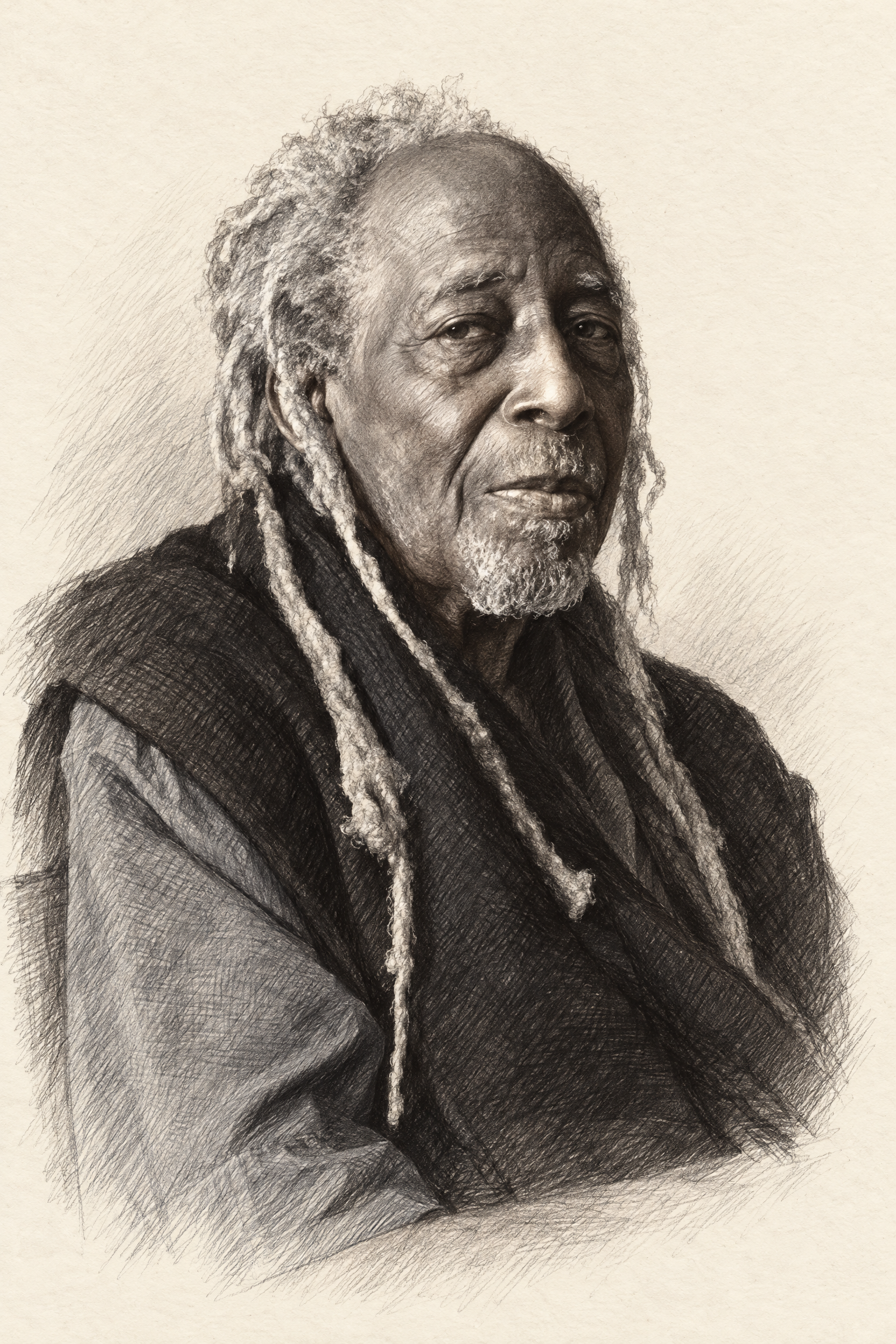
The Sunday Essay · In Memory of Eusi Kwayana, 1925–2026
From Cubana to Barima: Memory and the Duty to Account
Two mass deaths of Guyanese in transit, half a century apart; what the state owed the dead after each; and the man who spent a hundred and one years insisting that it pay.
On 6 October 1976, eleven Guyanese died in the Atlantic off Barbados when a bomb brought down Cubana Flight 455. Fifty years later, the Commission of Inquiry into the sinking of the MV Barima — the deadliest maritime disaster in modern Guyanese history — is preparing to begin public hearings on 14 October. And on Saturday, between the Cubana anniversary and the opening of the hearings, Eusi Kwayana died at 101. This essay asks what a nation that has remembered so faithfully now owes the dead it must account for, and it asks it in the name of the Guyanese who held that standard longest.
By Terrence Richard Blackman, Ph.D. · Sunday, 11 October 2026
Brooklyn, New York
Until the system changes, whoever wins, Guyana loses.
— Moses Bhagwan and Eusi Kwayana, open letter to the leaders of Guyana’s parties, 9 March 2020
They shall grow not old, as we that are left grow old: / Age shall not weary them, nor the years condemn. / At the going down of the sun and in the morning / We will remember them.
— Laurence Binyon, “For the Fallen” (1914)
Vale
Eusi Kwayana died on Saturday 10 October 2026, at 101. He was born Sydney King on the East Coast of Demerara in April 1925. He sat in the first elected cabinet of 1953 until the British suspended the constitution and detained him. Across eighty years of public life he was a teacher, a playwright, a historian, a founder of ASCRIA and then, with Walter Rodney, of the Working People’s Alliance — and, through all of it, the conscience of the country.
He took a name that means Black Man of Guyana and then proceeded to become exactly that. He walked alongside Burnham, Jagan and Rodney and never, through any of it, compromised his moral core. Incorruptible as corruption became a staple of our politics, he was a persistent example that a human being can remain whole in the arena. That is the rarest kind of proof: not theoretical, but lived.
I met him for the first time in June 2019, at his home in Atlanta, with Menes de Griot and Nigel Killikelly. To stand in his presence was to understand, with the clarity that only proximity to greatness provides, what Guyana is capable of being.
This essay was already written when the news came. It is about the state’s duty to account for its dead — a duty Baba Eusi spent his whole public life insisting upon, in print, in Parliament, in Buxton, and in the open letter he and Moses Bhagwan wrote in March 2020 when the country stood on the edge of violence over an election count. It is offered now in his memory, because the argument is his before it is mine.
I. The Names
There is a photograph that circulates every October. Eleven faces in newsprint grey, arranged in three rows. Several of them are still teenagers. One of them is nine.
Raymond Persaud. Rawle Thomas. Jacqueline Williams. Rita Thomas. Eric Norton. Gordon Sobha. Ann Nelson. Margaret Bradshaw. Violet Thomas. Sabrina Harripaul. Seshnarine Kumar. These are the Guyanese who boarded Cubana Flight 455 in Guyana on 6 October 1976, bound for Havana by way of Trinidad, Barbados and Kingston. Six of them were students travelling to Cuba to study. Gordon Sobha was an economist. Margaret Bradshaw is identified in contemporary reporting as the wife of a Guyanese diplomat. Sabrina Harripaul, nine years old, was travelling with Violet and Rita Thomas, her relatives.
Two bombs exploded shortly after the aircraft left Seawell Airport in Barbados. A 2012 Stabroek News account says the pilots, under Captain Wilfredo Pérez Pérez, turned toward the sea, apparently to avoid the beach. All seventy-three aboard — fifty-seven Cubans, eleven Guyanese and five nationals of the Democratic People’s Republic of Korea — died.
We know the names. We have known them for fifty years. They are cut into the monument at the University of Guyana’s Turkeyen campus, unveiled on 15 October 2012, where 6 October wreath-layings have been recorded in the years since. At the 2022 CARICOM–Cuba Summit the region’s heads of government agreed to observe the date as CARICOM–Cuba Day Against Terrorism. At the unveiling, Dr. Melisha Singh, a graduate of the Guyana–Cuba scholarship programme, read every name aloud. We taught ourselves to say them.
Now consider a second set of names, from this past July. The MV Barima — a state-owned ferry reported to have been built in 1939, serving the Georgetown–Port Kaituma route — capsized off the Essequibo coast late on 18 July 2026, overnight into the 19th. Officials estimated about 179 people aboard, including crew. By 28 July, Guyanese reporting put the toll at 73 dead, 76 rescued and about 30 unaccounted for; the manifest, officials acknowledged, was inaccurate.
Officials released preliminary lists of the manifested, the rescued and the missing, and said at the time that they were incomplete and subject to revision. The arithmetic can be made to close. The record has not been: nearly three months later, nothing in the public reporting shows that the state has published a final, verified account of who sailed, who was rescued, who was recovered and who is still missing — by name.
I cannot write about this at a distance. A distant relative of mine, Edith Garraway Gordon, died on the Barima. Three days after the sinking, News Room published Alisha Atkinson’s account of the stranger who handed her a roll of vinolay flooring so that she and her baby might float, and then disappeared beneath the water. News Room said his identity was unknown, and this journal wrote about him in August. The nine-year-old on the Cubana flight has had her name spoken aloud for half a century; those who went down off the Essequibo coast in July do not yet appear in a complete, reconciled official record.
The distance worth measuring is not between 1976 and 2026. It is between what the state could do for the dead of Cubana and what it owes the dead of the Barima.
II. What 1976 Taught
Terror from outside is morally legible. That is the first thing Cubana taught us, and it is the reason the lesson has held for fifty years.
The men suspected of doing it could be named within days. Trinidad and Tobago’s official account has the two Venezuelans, Hernán Ricardo Lozano and Freddy Lugo, boarding Flight 455 in Port of Spain, leaving it in Barbados and returning to Trinidad, where they were detained. The Trinidad police deposition records Lugo’s account that Ricardo had spoken of bombing a Cubana aircraft, and Ricardo’s own description of how such a bomb would be built. Declassified United States intelligence records set the attack within a wave of militant anti-Castro exile violence and implicated Luis Posada Carriles and Orlando Bosch, who were arrested and charged in Venezuela — allegations and assessments, not a verdict.
The target was Cuba. But in late 1975 Guyana had let Cuban military flights bound for Angola refuel on its soil after Barbados and Trinidad refused them. Henry Kissinger had appealed to Burnham not to facilitate the airlift, and Guyanese officials experienced Washington’s displeasure as pressure, as this journal set out in May in “What the Flour Cost”.
A Ministry of the Presidency memorial synopsis, reported in 2015, attributes to Forbes Burnham, then Prime Minister, a sentence that has outlived him: “They died because there are some in this world, and more particularly in this hemisphere, who do not accept the right of a people to fashion their own destinies and to dictate their own goals.”
A state can do a great deal with legibility of that kind. It can mourn without ambivalence. It can build a monument and keep an anniversary. It can hold its course — and Guyana did, keeping the diplomatic, educational and technical ties with Cuba that it had built, medical training among them, despite American objection to the Angola transit. Whatever one thinks of the Burnham years, and this journal has written plainly about them, the response to Cubana was the response of a country that knew what had been done to it.
It is worth being precise about the one thing 1976 did not deliver, because it sets the standard for what follows. Accountability was partial, contested, and it came from elsewhere. The Inter-American Commission on Human Rights records a 1980 first-instance acquittal in Venezuela on the principal charges and years of unresolved review. Press reports from 1986 say Ricardo and Lugo were eventually convicted and sentenced to twenty years. Bosch was acquitted and died in Miami in 2011. Posada escaped from Venezuelan custody in 1985, entered the United States without authorization in 2005, and died in Miami in 2018. Neither man was ever convicted of the bombing. For half a century we have been able to recite, with bitter exactness, who was never held to account for Cubana.
Hold on to that ledger. We could keep it because the suspects had names and the bomb had a provenance. The question of the Barima is whether we can keep one when the facts must be established by our own institutions, about our own institutions.
III. What 2026 Reveals
Responsibility for a maritime disaster is a different kind of thing to establish. There is no bomb, no Venezuelan passport, no confession. There is a hull reported to date from 1939. There is a former captain on that run, Andrew Donald, who has alleged publicly that managers at times controlled loading and sailing times while the master carried the liability, that the vessel lacked an operational bilge pump, and who questioned whether its bilge alarms were installed and working. There is a manifest that did not count the people on the boat. And there is a replacement vessel, the MV Ma Lisha, commissioned in April 2023 for the Port Kaituma run and kept from it, through this spring, by port-facility upgrades and structural problems at the new wharf.
Each of those is an allegation or a reported fact, not a finding. Where responsibility lay — ashore, aboard, or across both — is for the inquiry to trace, not for this essay to assign; and the Gazette directs the Commission to examine all of it: the bilge systems and alarms, the dry-docking and maintenance history, the loading and dispatch arrangements, the accuracy of the manifest, and the regulatory responsibilities of the Maritime Administration and the Ministry of Public Works.
On 28 July, ten days after the sinking, Captain Kevin Price, Chief Mate Rondell Dwayne Roberts and Goods Superintendent Delon Granderson were charged with murder and remanded. Counsel for Price and Granderson have sought a stay on abuse-of-process grounds, arguing among other things that a marine-accident investigation should precede a criminal prosecution. Roberts is separately represented. The application is pending, with a magistrate’s ruling scheduled for 19 October. Whatever the criminal proceedings establish about those three men, they cannot by themselves answer the questions facing the institutions that owned, maintained, loaded, crewed and certified the vessel.
In 2026 the accountable are within reach: they are its own departments, its own certifiers, its own ministers.
— T.R.B.
The instrument built to answer those questions is the Commission of Inquiry — five members appointed by instrument gazetted on 30 July 2026, chaired by Justice Godfrey Phillip Smith of Belize. It may examine systems, individual conduct and possible criminality, and recommend referrals. It may not determine criminal guilt or finally adjudicate civil liability. Through August its work was not visible. On 2 September the Forward Guyana Movement said thirty-three days had passed without a named witness or a public milestone. The Commission’s notices of 1 and 2 September answered, in part: records were being acquired and analysed, a secretariat had been at work since early August, and the public was invited to come forward. The criticism was fair for the five weeks it described. It does not describe this week.
On 6 October, the day of the Cubana anniversary, the Commission’s secretary announced that formal evidence hearings were scheduled to open on 14 October and estimated that the work could take about six months — well beyond the two months the gazetted instrument allowed.
On 7 October Justice Smith held preliminary public proceedings, met approximately 120 relatives and survivors, and promised to follow the evidence “wherever it leads”; asked whether the ministers responsible for the sector — Public Works Minister Bishop Juan Edghill, responsible for the Transport and Harbours Department, and Minister of Public Utilities and Aviation Deodat Indar, whose ministry oversees the Maritime Administration — would be called, he declined to prejudge the witness list. On 8 October the commissioners made preparatory visits to the Kingston wharf, its records and CCTV room, and the Ma Lisha, and met privately with the Maritime Administration’s director-general, Captain Stephen Thomas. That is an inquiry moving, and it deserves to be said plainly.
So the question for Wednesday is not whether the inquiry will sit, nor even whether a minister takes the stand. It is whether the Commission examines the decisions made at every level — the certificates, the docking schedule, the loading orders, the supervision above them — obtains the documents and witnesses it needs to do so, and says in its report what it could not obtain and why. It is also whether the government commits itself now to publishing the findings and answering the recommendations.
Set the two Octobers side by side. In 1976 the state could not reach the guilty, so it kept their names and their crime in public memory for fifty years. In 2026 the accountable are within reach: they are its own departments, its own certifiers, its own ministers. Whether the evidence is allowed to lead there is the test of whether we can keep a ledger when the failure is our own.
IV. Memorial and Accountability
The Barima lies in soft mud off the Essequibo coast, in thirteen to fifteen metres of water. In July the government entertained leaving her there: on 28 July Prime Minister Mark Phillips said the families’ wishes would be taken into account, a memorial on the seabed among the options, even if the wreck held evidence useful to the inquiry.
Salvage procurement followed nonetheless. The Maritime Administration advertised for expressions of interest from 2 to 14 August, requiring bidders to say how they would protect and document forensic evidence. Three firms bid in September, and the National Procurement and Tender Administration’s register records a G$1.034 billion award to BK International on 6 October. Commissioner Andrzej Jasionowski, a naval architect, has assessed that the wreck will retain nearly all of its forensic value. Recovery, then, is in preparation. What the public is still owed is a published plan for it: how the wreck will be raised, how human remains will be treated, how evidence will be preserved and by whom.
At a protest on 24 September, the Indigenous-rights activist Laura George called for the wreck to be raised with the evidence intact. The principle beneath that call is the one this essay rests on. Families may need a place of remembrance long before the questions are answered, and they are entitled to it. But a memorial must never become the state’s excuse for leaving its other duties unfinished.
We have written here before that the public works no private party will build — the third of Adam Smith’s duties of the sovereign — is the duty Guyana’s oil era most neglects.
What caused the Barima to sink is for the inquiry to say. What the state owed its passengers before it sank is not in doubt, and the questions write themselves. How did a ferry reported to have been completed in 1939 remain a principal Georgetown–Port Kaituma connection in 2026, other vessels on the wider Region One route notwithstanding? Why had the MV Ma Lisha, commissioned in 2023 for North West service, still not made its first call at Port Kaituma by July, after soil movement damaged sections of the new wharf built to receive it? And what does it say about priorities that the National Assembly could approve GY$496.3 million this year toward a proposed state-owned bottled-water plant? That last is a political comparison, not an accounting one: the appropriation could not have been spent on a ferry, and nothing here says the ferry’s age sank it.
Remembering the dead will cost us a plaque. Honouring them will cost us a fleet — and the berths, the maintenance and the crews to run it.
At the civil-society consultation convened by Transparency Institute Guyana in July, this writer proposed that every recommendation of any inquiry carry a named owner, a timeline and a means of enforcing implementation, and that replacement of the coastal and riverine fleet be among them. TIGI subsequently proposed that each recommendation be assigned to a responsible public office with implementation deadlines and progress reports.
The Commission’s own terms of reference, gazetted on 30 July, go some way toward it: they ask the Commission to recommend “public accountability and implementation-monitoring mechanisms” and to report on whether earlier safety recommendations were ever carried out. That is to the Commission’s credit. But a recommendation is not a commitment. Nothing in those terms binds the government to act on what the Commission recommends, or to say publicly when it will. A report that lists failures and recommends reforms, and is then shelved, is a memorial in prose.
A report that lists failures and recommends reforms, and is then shelved, is a memorial in prose.
— T.R.B.
The people on the Barima were the working people of Region One — farmers, miners, shopkeepers, mothers taking children home for the holidays — the people in whose name Kwayana’s party was founded and for whom he kept asking the state to answer. So the measure of accountability is not the Commission’s report. It is what the state does now and what it binds itself to do after. The two are different in kind.
Full causal findings will take the Commission something like the six months its secretary estimates, and it should have them. Identification, passenger safety and transparency cannot wait on them — and the Commission’s own terms say as much, directing it to establish, so far as ascertainable, the number and identity of everyone aboard, and allowing it to issue urgent safety recommendations at any time where there is a continuing risk to life. These are this journal’s proposed standards, and we will hold the government to them:
- Now, not after: a reconciled list of the dead, the rescued and the missing, by name, published and maintained by the state, so that every name is spoken as the Cubana names are spoken — and an inspection and life-saving-equipment audit of every vessel still carrying passengers on the North West and Essequibo routes, published within thirty days of the hearings opening on 14 October, with any urgent defect corrected at once.
- Within fourteen days of delivery: the Commission’s findings published in full — not summarised, not excerpted, not held for a convenient week — including its account of what it could not obtain and from whom.
- Within thirty days of publication: a government response to every recommendation, stating whether each is accepted, modified or rejected and why; a named official and a deadline for each one accepted; and quarterly progress reports to the National Assembly thereafter.
- Before the first anniversary, 18 July 2027: a published programme for the coastal and riverine fleet that covers not only vessels but the berths they need, their maintenance and crewing, and the dates on which each enters service — with the first contract signed. The Ma Lisha has already taught us that a ship without a wharf is not a service.
Any decision about the wreck must respect the bereaved, preserve evidence and rest on a published technical assessment. A memorial can honour the dead while the work continues. It cannot certify that the state has fulfilled its responsibilities. That is what the Turkeyen stone tells the truth about: what was within our power, and what was not.
V. The Sixtieth Anniversary
Burnham’s sentence deserves to be read once more, and read inward. The Cubana dead died, the statement attributed to him says, because there are those who do not accept the right of a people to fashion their own destinies. We have spent fifty years claiming that right against outsiders. The Barima asks what the claim obliges us to do among ourselves. A people entitled to chart its own course is a people responsible for keeping its citizens alive on its own rivers. Sovereignty is not only the freedom to let Cuban aircraft refuel at Timehri over American objection. It is the duty to inspect a hull, count every passenger, replace a ferry — and to tell the public the truth about whichever of those was not done.
On the sixtieth anniversary, in October 2036, the wreath will be laid at Turkeyen and the names will be read. Someone will note, as someone always does, that Bosch and Posada died without convictions for the bombing. We will be right to say it.
The question this essay leaves is what will be said that morning about the Barima. Whether there will be a list, and a report, and a fleet — or a plaque, and a wreck on the seabed, and a Commission’s findings in a drawer. Whether we will have proved that we can hold ourselves to the standard we have held the world to for fifty years. Or whether, having remembered so faithfully what was done to us, we will have evaded what our own institutions must answer for.
Eusi Kwayana will not be at Turkeyen in 2036. He will not see the Barima hearings either; he died in the week they were announced. But he spent eighty years teaching this country the thing the Barima now requires of it: that a state answers to its working people, in full and in public, or it is not yet the state we fought for.
In March 2020, at 94, he and Moses Bhagwan put it in one sentence that the parties did not want to hear and the country could not forget — until the system changes, whoever wins, Guyana loses. A ferry is a system. A manifest is a system. A Commission whose recommendations bind no one is a system. He would have wanted the sentence read inward too.
We need him still — not as a symbol of what was, but as a living argument for what is still possible. The best memorial we can build him is not a plaque. It is a list with every name on it, a report with every finding in it, and a fleet that a nine-year-old can board without her mother counting the life jackets.
We will remember them. The harder promise is that we will account for them.
Vale, Baba Eusi.
Be well.
Terrence Richard Blackman, Ph.D. is Dean (Interim) of the School of Science and Allied Health and Professor of Mathematics at Medgar Evers College, CUNY, a former Visitor in the School of Mathematics at the Institute for Advanced Study, Princeton, and the Founder and Publisher of the Guyana Business Journal. The views expressed are his own and do not represent those of Medgar Evers College or the City University of New York.
Note on Sources
Eusi Kwayana: death on 10 October 2026 at 101 from Demerara Waves and Kaieteur News (10 Oct 2026); birth as Sydney King in April 1925, the 1953 cabinet, ASCRIA and the WPA from David Hinds’s biographical sketches (Demerara Waves, 5 Apr 2024; Kaieteur News, 5 Apr 2025); the WPA’s statement gives the Swahili meaning of his name as Black Man of Guyana. The March 2020 open letter with Moses Bhagwan is quoted from its published text.
Cubana 455: the eleven Guyanese names follow the Department of Public Information’s 2020 list (which gives “Eric Norton” and “Harripaul”; other published lists read “Harold” and “Harrypaul”); the 57/11/5 breakdown and route sequence from CARICOM’s commemoration and the DPI; the turn toward the sea, the 15 October 2012 unveiling and the reading of the names from Stabroek News (16 Oct 2012); later wreath-layings from DPI/Stabroek reports of 2015, 2016 and 2020; the CARICOM–Cuba Day Against Terrorism from CARICOM (Dec 2022). The suspects’ route and the deposition language are from the Trinidad and Tobago Ministry of National Security document published by the National Security Archive; the Posada and Bosch allegations from FRUS 1969–76 vol. E-11 (d322); the Angola transit and Kissinger’s appeal from FRUS d374 and d380; the Venezuelan procedural history, including the 1980 first-instance acquittal, from the IACHR, Case 9058; the 1986 convictions of Ricardo and Lugo as reported by AP/NYT; Posada’s 1985 escape, 2005 entry and 2018 death from BBC reporting. Burnham’s statement is as given in a Ministry of the Presidency memorial synopsis reported by Stabroek News (7 Oct 2015); no original transcript has been located. Guyana–Cuba ties: FRUS and Stabroek News (8 Feb 2026).
MV Barima: the 179 estimate and the acknowledged manifest inaccuracy from the DPI; the 28 July tally from News Room; the preliminary lists from Kaieteur News (20 July); the charges from the Guyana Chronicle (29 July) and the stay application from the Guyana Chronicle (29 Sept); Alisha Atkinson’s account from News Room (21 July); the 14 October hearings from News Room (6 Oct); the 7 October proceedings from the DPI and the 8 October visits from the DPI and the Guyana Chronicle; the Prime Minister’s 28 July remarks from Demerara Waves; the three bids from Demerara Waves (9 Sept); the BK International award from the NPTA register; Jasionowski’s assessment from Demerara Waves (7 Oct); Laura George’s 24 September call from HGP Nightly News; the Ma Lisha and the Port Kaituma wharf from Kaieteur News (21 July) and other Region One vessels from the DPI; the bottled-water approval from Kaieteur News (2 Aug); Andrew Donald’s allegations from his public statement as reported by Kiskadee Watch (July 2026); the TIGI proposal from Village Voice’s report of the consultation. The Commission’s instrument and Terms of Reference are in the Official Gazette (Extraordinary) of 30 July 2026, Legal Supplement B, Nos. 75–81 of 2026, pp. 841–868 (Parts C.1(e), C.12, D, F.1 and H(m)).
Our Sponsors
Metallica Commodities Corporation
Global trading in metals and commodities.
metallicacc.com
Sponsorship supports the Guyana Business Journal’s independent publishing. Sponsors have no role in editorial decisions.
Pebble Stream™
pebblestream.com
Sponsorship supports the Guyana Business Journal’s independent publishing. Sponsors have no role in editorial decisions.
CISS — Caribbean International Shipping Services
caribshipatl.com · 770-322-3111
Sponsorship supports the Guyana Business Journal’s independent publishing. Sponsors have no role in editorial decisions.
MCCGUSA
mccgusa.com · 212-269-6126
Sponsorship supports the Guyana Business Journal’s independent publishing. Sponsors have no role in editorial decisions.
With thanks to our individual supporters: Courtney Noel | All Te Networks | Corine Locke | Tony Harris | Roderick Alsopp | Dr. Michelle Luard | Clarence Bone
🇬🇾 Support independent Guyanese journalism: guyanabusinessjournal.com/donate/
