
A GBJ Note · The Economy
Uses Are Not Sources
On Guyana’s Foreign Currency Shortage
Why the country can be short of dollars in the middle of its largest dollar windfall — and why counting where the dollars go will never tell us.
By Terrence Richard Blackman, Ph.D. · Brooklyn, New York · October 4, 2026
The queue is not the cause
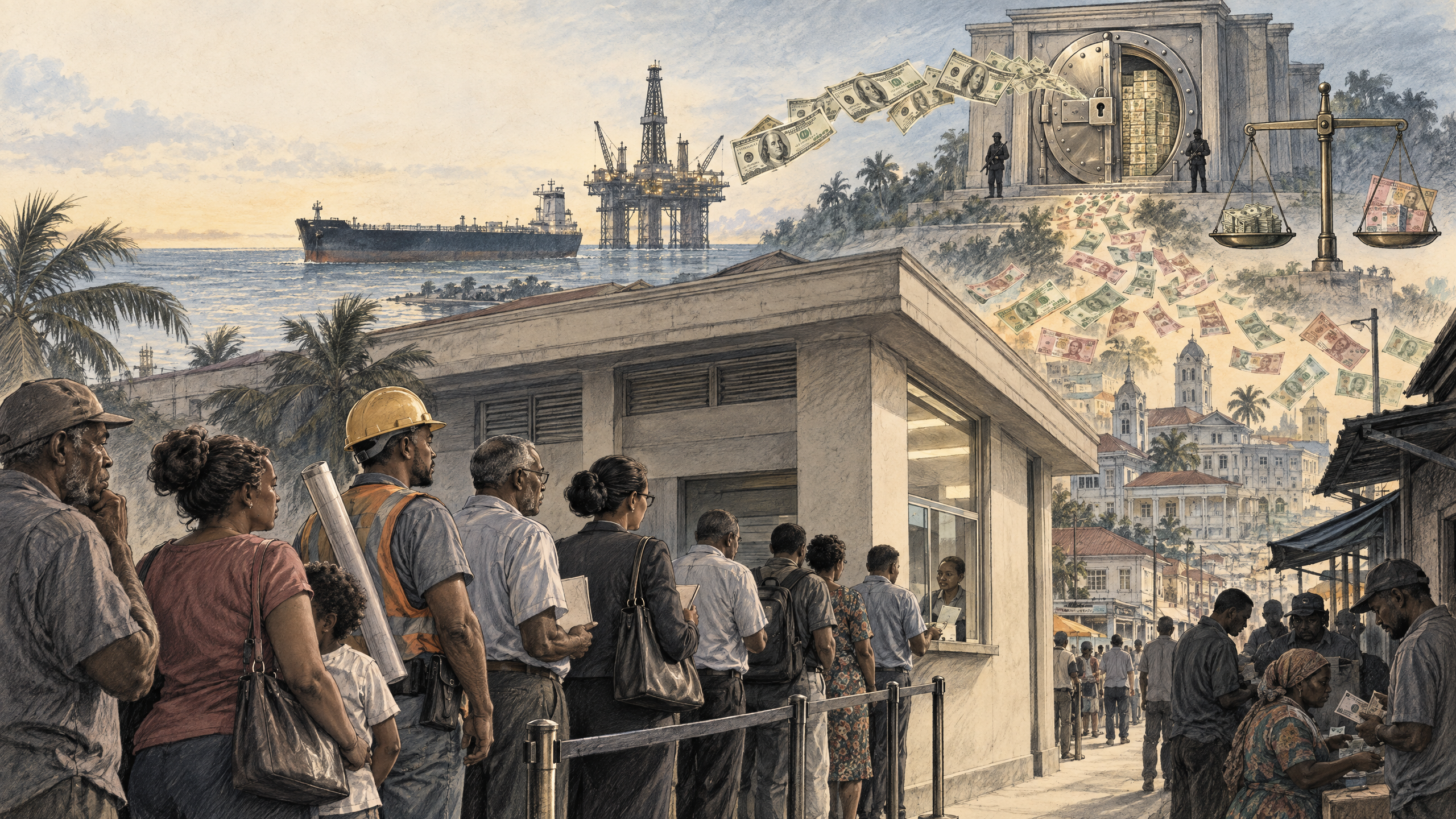
Guyana is short of foreign exchange in the middle of the largest foreign-exchange windfall in its history. Oil now makes up most of what the country exports, the Natural Resource Fund has disbursed billions, and official reserves are healthy. Yet importers queue at the banks, cambios ration, and the street rate drifts away from the Bank of Guyana’s peg of roughly G$208.50 to the US dollar.
The economist Ramesh Gampat has assembled a careful compilation of causes, dated 4 October 2026. We have also added some observations of our own. His catalogue is the backbone of what follows, and we are grateful for it. What we add is a single distinction to organise it. Collin Constantine stated it plainly in a note on the compilation. We must not confuse the uses of foreign exchange with the sources of the shortage.
The story on the street
The public argument about this has settled into a familiar shape, and it has its own local colour. Western Union in Georgetown stops accepting outbound transfers by about nine in the morning. The day’s dollars are gone before the day has started. From there the story writes itself. The boom has made Guyana a nation of importers. The imports have a high non-productive content: not machinery for the factory but the Chinese stores. Then come Wendy’s, Burger King, Domino’s, Papa John’s, KFC and Church’s, each franchise fee and supply chain sending the little foreign exchange that reaches the street straight back out. As for the reserves, the street version is that they go to pay debt and a little sits in the sovereign wealth fund. In the harsher tellings, someone steals the rest. In any telling, none of it reaches Guyana.
Someone then counts the ways dollars leave: credit-card spending abroad, consumer imports, remittances by foreign workers, debt service, property purchases in Florida. The list is long and each item is real. The conclusion then follows almost automatically: these are the causes, so the state must police them. Hence the invoice checks, card monitoring, import prioritisation and exporter surveys.
That inference is the error this note is about. It confuses the uses of foreign exchange with the sources of the shortage. A list of where dollars go is only an accounting of outflows. It tells us nothing, by itself, about why demand at the official rate outruns the dollars the formal market releases. An identity is not an explanation; a ledger is not a diagnosis. We should not let the one stand in for the other.
A paradox of plenty
The clearest statement of the distinction we know of is in Collin Constantine‘s July 2026 brief, Forex Shortages in Guyana: The Paradox of Plenty. His question is the right one. How can firms and households face a dollar shortage while the country runs a balance-of-payments surplus? Inflows have exceeded outflows year after year since 2003.
His answer runs in three steps. First, a surplus puts upward pressure on the Guyana dollar. Second, to hold the peg, the Bank of Guyana must buy the excess dollars and bank them as reserves. That keeps the formal market in balance rather than flooded. Third, the central bank finances a large share of government spending by creating Guyana dollars. In 2025 it financed about G$196 billion of a G$309 billion fiscal need. It did so directly and by swapping excess bank reserves for government bonds. That new purchasing power then chases dollars the peg will not release. Demand exceeds supply at the official rate, and the shortage appears as queues and a street premium.
What the evidence shows
The evidence is not subtle. Constantine’s measure of the shortage becomes recurrent after 2012, and it tracks monetary financing of public spending with a correlation of 0.89. By contrast, net credit growth and errors and omissions show no comparable pattern. Nor is the government hoarding the Fund. In 2025, selected official outflows came to 91.5% of the US$2.46 billion withdrawn, including US$1.62 billion sold to the commercial banks.
The main policy message on page 4 follows directly. It is the sentence we should carry into every debate on this subject. Non-oil imports and credit-card spending are uses of foreign exchange, not the source of the purchasing power that generates excess demand for it. In short, the shortage reflects an incompatibility between the peg and monetary financing. Measures that audit the queue or redistribute access to it do not close the gap. They leave in place the purchasing power the central bank created.
Non-oil imports and credit-card spending are uses of foreign exchange, not the source of the purchasing power that chases it. Auditing the queue is not the same as closing the gap.
— after Collin Constantine
Uses, sources, and symptoms
With that distinction in hand, the familiar list of “causes” sorts itself into three piles. Most of what passes for explanation lands in the third.
What creates the gap
Sources determine how many dollars reach the formal market. They also determine how much Guyana-dollar purchasing power exists to chase them.
- Oil earnings mostly never enter the local market. The consortium of ExxonMobil, Hess (now Chevron) and CNOOC keeps cost recovery and its share of profit oil offshore. The government’s share goes to the Natural Resource Fund at the Federal Reserve Bank of New York. Headline export figures therefore vastly overstate the dollars that reach Guyanese banks and cambios. This is an enclave economy, and the supply side of the shortage begins here.
- Monetary financing of public spending. The demand-side source is the portion of the budget the Bank of Guyana finances by creating Guyana dollars. It is not the portion that Fund withdrawals cover. Fund-financed spending brings dollars in as it sends them out. Central-bank-financed spending brings only the demand.
- The peg. Held near G$208–210 for years, the exchange rate cannot rise to clear the market. A floating rate would resolve the imbalance in price. Under the peg, the market resolves it in quantity instead: rationing, queues, and a parallel premium. The peg also teaches everyone to expect an eventual devaluation, which is why people hold dollars rather than sell them.
- Weak non-oil exports. Sugar has largely collapsed. Rice, bauxite and timber have not kept pace with imports, and a large share of gold leaves through informal channels. This is a supply weakness, not a demand story, and it is the opposition’s strongest point about diversification.
Where the dollars go
Uses are where the dollars go once purchasing power exists. They make the gap larger; they do not create it.
- Imported inputs for roads, bridges, housing and the gas-to-energy project: steel, cement, machinery, fuel, vehicles.
- Consumer imports rising with incomes, and credit-card spending abroad.
- Outward remittances by foreign contractors, consultants and workers, and oil-sector service payments.
- Foreign-currency debt service: external debt reached US$3.3 billion by mid-2026, with the US-dollar share rising from 58.5% to 69.8% in a year. The government also expects demand of US$385–436 million a month in late 2026.
- Higher import prices since 2022, so that each container needs more dollars than it did.
What the shortage looks like
Symptoms are what the shortage looks like from the outside, and people routinely mistake them for its cause.
- Hoarding and dollarisation: households and businesses keeping US dollars as a store of value and a hedge. The Vice President has accused some firms of buying dollars outside the system and sitting on them. He is probably right about the behaviour. He is wrong about its place in the causal chain. People hoard a currency they expect to appreciate. The hoarding is the market pricing the peg.
- The street premium, the queue at the bank, the importer’s monthly allocation.
Every item on the “uses” and “symptoms” lists is real, and some of them, debt service above all, are serious. But a policy that targets them is still a policy that manages the queue.
Structural, not merely distributional
Some analysts, including voices at OilNOW, argue that the shortage is about distribution and access rather than a true lack of dollars. They point to healthy official reserves. There is something to this, and Constantine’s figures support part of it: the government is not hoarding the Fund, and the banks are not simply refusing to sell. But “distribution” is the wrong word for what is happening, and it leads to the wrong remedy.
The shortage is structural because its two engines are structural. On the supply side, Guyana earns its foreign exchange in an enclave. Contract terms and the design of the Fund set the share of those earnings that touches the domestic market. On the demand side, the state finances a growing share of a growing budget by creating money. At the same time, it defends a fixed rate against the demand that money creates. Neither engine is a matter of who gets served first at the counter. Both would keep running under perfect invoice compliance and a flawless allocation formula.
Put plainly, Guyana has an oil-enclave economy that earns large sums of foreign currency. It holds or spends them in ways that keep most of those dollars out of the domestic market. Fiscal expansion paid in local currency and a fixed exchange rate keep pushing demand for dollars higher. Distribution plays a role at the margin, but it is not the mechanism.
What follows for policy
If the diagnosis is right, the order of operations is clear. It is almost the reverse of the current public conversation.
First, routine central-bank financing of the budget should end. This is Constantine’s central implication and we endorse it. The Fund exists precisely so that dollars back oil-era spending. Spending beyond what the Fund and genuine borrowing can carry is the engine of the shortage, whatever the money buys.
Second, the peg has to be reconsidered, but only after the first step and not instead of it. Adjusting the rate while monetary financing continues would trade a shortage for rapid depreciation and inflation. That sequence is the part policymakers are most likely to get wrong under pressure.
Third, the supply side deserves the attention the opposition has been giving it. Non-oil exports matter, as do formalising the gold trade and the terms on which oil earnings reach the domestic market. In the long run, these determine how many dollars Guyana actually has to spend at home.
Fourth, we should understand the monitoring measures now in vogue for what they are: tools for policing a queue. Invoice checks, card monitoring and sectoral surveys may reduce fraud and improve allocation. They will not close the gap. A government that presents them as the answer is describing the symptom while leaving the disease untreated.
The line at the bank
We should expect the argument to keep returning to the uses. The uses are visible and the sources are not. A credit-card statement is a photograph; a central-bank balance sheet is a theorem. The discipline this moment asks of us is to insist on the theorem. The question for every proposed measure is not “which outflow does this restrain?” but “which source does this remove?” Until the answer is one of the four above, we are managing the line at the bank, not the shortage.
A credit-card statement is a photograph. A central-bank balance sheet is a theorem.
Insist on the theorem.
Note on Sources
Collin M. Constantine, Forex Shortages in Guyana: The Paradox of Plenty, MFI Non-Technical Brief, July 2026 (Macro-Finance Intelligence, collinconstantine.com), drawing on Bank of Guyana reports, including the 2025 fiscal-financing and NRF-withdrawal figures and the 0.89 correlation cited above. Ramesh Gampat, compilation of the causes of Guyana’s FX shortage, 4 October 2026, with the author’s additions; the external-debt (US$3.3 billion, 58.5% → 69.8% US-dollar share) and monthly FX-demand (US$385–436 million) figures are as reported there for mid- and late 2026. The 9 a.m. Western Union cutoff and the franchise examples are drawn from Georgetown street experience and are offered as illustration, not measurement.Terrence Richard Blackman, Ph.D., is Dean (Interim), School of Science and Allied Health, and Professor of Mathematics at Medgar Evers College, CUNY, and the Founder and Publisher of the Guyana Business Journal. He is a former Visitor in the School of Mathematics at the Institute for Advanced Study, Princeton, and a former Dr. Martin Luther King Jr. Visiting Assistant Professor at MIT. The views expressed here are his own.
The Guyana Business Journal is supported by Metallica Commodities Corporation (metallicacc.com), Pebble Stream™ (pebblestream.com), CISS (caribshipatl.com · 770-322-3111) and MCCGUSA (mccgusa.com · 212-269-6126). Sponsors have no editorial role. Individual supporters: Courtney Noel | All Te Networks | Corine Locke | Tony Harris | Roderick Alsopp | Dr. Michelle Luard | Clarence Bone.
🇬🇾 Support independent Guyanese analysis: guyanabusinessjournal.com/donate/
