
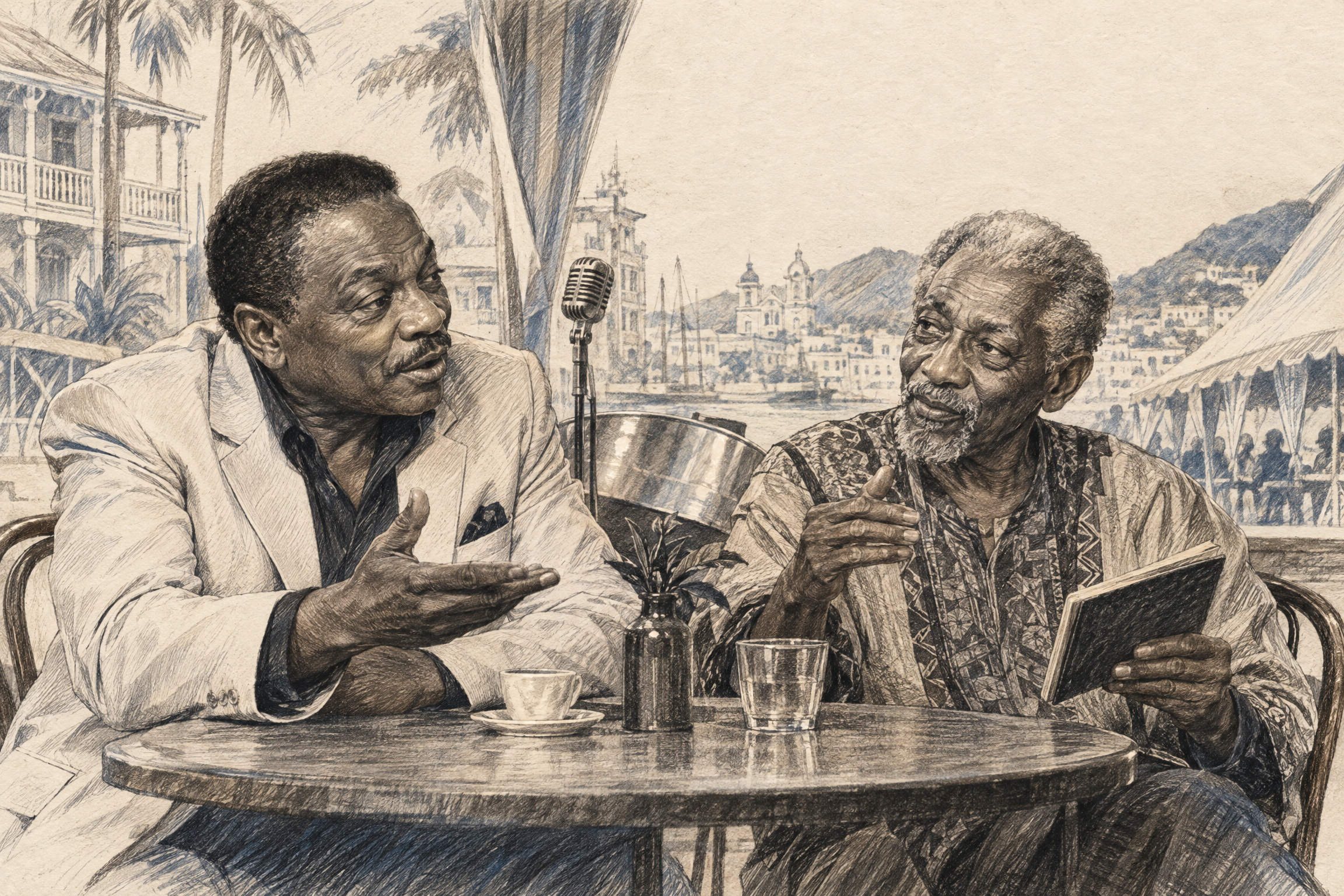
The Sunday Essay · Culture
Two Arrivals, 1956: An Appreciation of the Mighty Sparrow
What the Calypso King taught a boy from Alexander Village about a country
An appreciation of Slinger Francisco, the Mighty Sparrow (1935–2026), and of the two voices that filled a North Ruimveldt house.
By Terrence Richard Blackman, Ph.D. · Sunday, 4 October 2026 · Brooklyn, New York
In This Piece
I. Two Arrivals, 1956
In 1956, two things happened in two capitals of a connected Caribbean, and it took me most of a lifetime to see that they belonged to the same story. In Port of Spain, a twenty-year-old Grenadian-born chorister who already sang as the Mighty Sparrow took “Jean and Dinah” to the Calypso King title and the Road March. In Georgetown, at the Astor Cinema, a twenty-five-year-old bass pannist and arranger named Winston Lewis led the Invaders steel band against Trinidad All Stars and, as Herman Lowes remembers it, won. The crowd lifted him and carried him out into the street. He was my great uncle. We called him Uncle Charlie.
Sparrow died on Sunday, 27 September, in New York, at ninety-one. Uncle Charlie died last year, in Canada, at ninety-four. Both men left the Caribbean, and both men died in it, because the Caribbean, by the end of their lives, had come to include Flatbush and Scarborough.
I grew up on Third Street, Alexander Village, and on Ozama Street in North Ruimveldt, in a house where calypso was not a taste but an inheritance. My father had two favorite calypsonians, and he held to them the way a man holds to a cricket team. The first was Sparrow. The second was Chalkdust, the Trinidadian schoolteacher Hollis Liverpool, who sang history and later earned a doctorate in it. The singer and the schoolmaster. I did not understand then that my father was choosing, in those two men, the two halves of what he wanted for his son.
What I understood even less was that the music on the radio had been made, in part, by people at our own table. Uncle Charlie’s father, Grazette, was a Trinidadian who carried calypso to British Guiana in his luggage. By Lowes’s count, Uncle Charlie arranged more than fifty songs by Herman Lowes, the Mighty Bread, who became Calypso King of Guyana in 1972. So when my father turned up the radiogram for Sparrow, he was not a fan admiring a foreign master. He was a Guyanese listening to the family trade practiced at its highest level.
Guyana has a stake in Sparrow, and a debt to the generation that made him possible.
— T.R.B.
II. Georgetown as Proving Ground
Trinidad made calypso, but it did not make it alone. From the 1940s, British Guiana carried its own tent of first-rate calypsonians: Lord Coffee, Panther, Canary, Lord Inventor, Fighter, Monica Chopperfield. Dance bands like the Luckies, Al Seales’s Washboards and the Syncopators gave them accompaniment that Port of Spain would have recognized as serious. And there was a practice, remembered by the men who lived it, that ought to be better known: Trinidadian calypsonians came to Georgetown to try out new songs. A Georgetown audience was hard to please and quick to tell you why. What survived it went home to Trinidad polished.
Sparrow was on that circuit, and the records prove it. The Guyanese scholar Gordon Rohlehr, in his tribute to him, records that after the 1955 Carnival Sparrow toured Guyana and came home with his performance improved beyond recognition, a year before “Jean and Dinah.” The discography fills in what he did while he was here. In 1955, Gems, Al Seales’s label on Robb Street and the pioneer of Guyana’s recording industry, issued a 78 with Lord Melody’s “Can-Can” on one side and King Sparrow’s “Give the Youngsters a Chance” on the other, both backed by the Caribbean All Stars under Basie Thomas. By 1956, Sparrow had cut five sides for Gems and one more, “Sailor Man,” for its Georgetown rival Vee-Jay. Some of the earliest records to carry his name were Guyanese. The late Godfrey Chin, in his Robb Street nostalgia, went further and placed “Jean and Dinah” itself at Gems; the surviving discographies put that record on the Kay label in Trinidad, so I leave the claim with Chin. The rest is enough. In the year before Sparrow became King, Guyana was part of his apprenticeship, and part of his catalog.
In the year before Sparrow became King, Guyana was part of his apprenticeship, and part of his catalogue.
— T.R.B.
The calypso world of that decade was not a capital and its provinces. It was a circuit, and Georgetown was a station on it, one where Guyanese arrangers could and did beat the best of Trinidad on a good night, and where a young Trinidadian could learn something about his own trade. Sparrow’s first monarchy and Uncle Charlie’s victory at the Astor came from the same soil, worked by the same kind of men: choirboys, schoolboys, pannists, sons of migrants, who took colonial music and made it sovereign before the colonies were.
Guyana’s steel band and calypso scenes began to thin after the 1970s, amid economic hardship, political instability and migration. The circuit frayed, and much of it reassembled in Toronto and Brooklyn. What stayed constant in the house was the radiogram and the LPs, and on the radiogram was Sparrow. My father’s loyalty to him was, among other things, loyalty to a Caribbean that had once included us as equals.
III. The Grenadian Who Became Trinidad
Trinidad’s voice was born somewhere else. Slinger Francisco was born on 9 July 1935 in Grand Roy, a fishing village on Grenada’s west coast. His parents took him to Trinidad in 1937, before he was two. He learned to sing in the choir of St. Patrick’s Roman Catholic Church and at Newtown Boys’ RC School, and before he ever entered a tent, he sang Nat King Cole and Frankie Laine at private parties for people who wanted American radio in their living rooms. Older calypsonians gave him the name Little Sparrow, reportedly as a joke about his restless stage movement; they stood still and sang. He made the name his own, which is a very Caribbean thing to do with a mockery.
What the mockers missed was that the movement was the point. Sparrow sang the way he moved: the words came fast and clean, every syllable placed so that a crowded tent could follow the joke, and then, at the line that mattered, he would drop out of melody into something close to speech, lean on the vowel, and let the tent finish the thought for him. It is why his songs are quoted like proverbs. He built them to be repeated.
His family moved from Grenada to Trinidad for work. Uncle Charlie’s father, Grazette, moved from Trinidad to British Guiana for the same reason. Both were part of the same current: the great internal migration of the English-speaking Caribbean between the wars, when the region moved itself around in search of wages and, without anyone planning it, mixed its music.
Then came 1956, and then seven decades of work: eight Calypso Monarch titles; an honorary Doctor of Letters from the University of the West Indies in 1987; the Chaconia Gold Medal in 1993; the Order of the Caribbean Community in 2001; the Order of the Republic of Trinidad and Tobago in 2014; an OBE in 2015. He died in New York, surrounded by family, after what they called a brief illness.
IV. The Political Economist in the Tent
Sparrow was one of the Caribbean’s great popular political economists, and he published in verse. Every Carnival a man stood up in a tent in Port of Spain and told the people what their money was doing, who was taking it, and why. Rohlehr, in his monumental Calypso and Society in Pre-Independence Trinidad, showed that calypso had long been this: the people’s newspaper, their editorial page, and their audit. A Guyanese gave that tradition its most thorough scholarship. Sparrow’s voice gave it its practice, and it is his voice, not always his pen, that I mean: like every King, he sang the work of others as well as his own. Six of Sparrow’s songs, in five groups, will make the case, with one of Chalkdust’s set beside them. Each title below is a link; play them as you read.
“Jean and Dinah” (1956). The song that made him is a song about the political economy of an extractive foreign presence. The Americans had built their base at Chaguaramas during the war and filled Port of Spain with dollars. When they drew down, the dollars went with them, and the song is about what a small economy looks like the morning after the money leaves. It is also, and an honest appreciation must say so, a song of male triumph over the women whose bargaining power the dollars had briefly raised: the local man gets his turn, and gets it cheaper. Sparrow could expose one hierarchy while enjoying another, and the mischief is inseparable from the analysis.
“Federation” (1962). The West Indies Federation lasted from 1958 to 1962. Jamaica’s referendum of September 1961 was the decisive break; Trinidad and Tobago then withdrew, and Eric Williams delivered his famous arithmetic that one from ten leaves nought. Sparrow’s song is the region’s own post-mortem, angrier and more honest than the official ones. Everything we have built since, from CARICOM to the Caribbean Court of Justice, is an attempt to answer the question that song asked: can these islands and this mainland hold together when the money says otherwise?
Chalkdust’s counterpoint, years later: “Three Blind Mice” (mid-1970s). My father played this one after “Federation” the way a teacher plays the second half of a lesson. Sparrow had sung the funeral of the Federation; Chalkdust sang what the mourners did next. In 1973, Trinidad, Jamaica and Guyana agreed to build a jointly owned aluminum smelter, a project that might have joined Jamaica’s bauxite, Guyana’s bauxite and Trinidad’s gas into a single Caribbean industry. Then the oil crisis left Trinidad rich and its partners under strain; the governments fell out over what part outsiders, Venezuela among them, should play, and the scheme was abandoned. Chalkdust stages the quarrel as a dialogue and puts the epitaph in Eric Williams’s mouth: Williams tells Manley, Burnham and Barrow that he has oil and “oil don’t spoil,” that Burnham can keep his rice, and that the three of them are blind mice running about with Venezuela’s knife at his back.
Then the song turns. Manley answers that the real blind mice are Williams’s own deputies, men of straw who will not stand up to him. Chalkdust lets nobody off, which is why the song has lasted, and why the Guyanese columnist Indranie Deolall could reach for it in 2019, with oil coming, and ask which verse her country would end up in. The Federation did not die once, in 1962. It died again every time a leader with a resource decided he could go it alone, and again whenever nobody around him would say so. A Guyanese in 2026, holding the resource this time, should hear his own country’s name in both verses.
“Dan Is the Man” (1963) and “Education a Must” (1967). Here is the Sparrow my father, and the mathematics chair his son became, cared about most. The first song demolishes the colonial primary curriculum: the nursery rhymes and imperial readers that taught a Caribbean child everything except his own country. The second is its answer: the plain insistence that a child who does not learn will pay for it, and that the classroom is a door out of the yard that stays open. Between them they set a demanding standard for a poor country: look hard at what the children are taught, and make sure every one of them gets to learn. I have spent thirty years at Medgar Evers College trying to live up to it.
“Wanted Dead or Alive” (recorded 1979). The song opens by naming its year, and 1979 was the year the tyrants fell: Idi Amin out of Uganda, Somoza out of Nicaragua, Bokassa out of his empire, and the Shah of Iran out of Tehran. Sparrow put them all on one wanted poster and sang the roll call with relish. It is his most cheerful song about the end of regimes, and the Shah is the one Guyana should sit up for: a man who built a petro-state on oil money and mistook the money for consent. We are still living in the ripples of his fall, and a country building its future around oil should listen to this one twice.
“Capitalism Gone Mad” (1983). Trinidad had an oil boom in the 1970s. By the early 1980s, it was ending, and the song is a household budget set to music: prices doubled, wages stayed flat, and a man in a supermarket wondered what happened. Every Guyanese who has priced a bag of rice in Bourda Market this year knows what it is about. Winsford “Joker” Devine wrote it, Art de Coteau arranged it, and Sparrow sang it. The tradition that runs from Lloyd Best’s Tapia House through Rohlehr’s seminar room took calypso seriously as thought. Sparrow is a large part of the reason it could.
Read together, the songs describe a nation’s life cycle: foreign money arrives and leaves; the region tries and fails to federate; the school is a durable asset; the strongman who confuses oil for consent is driven out; the boom ends and the people pay. That is not a discography. It is a syllabus in Caribbean development, sung by a man who never sat an economics examination.
The Federation did not die once, in 1962. It died again every time a leader with a resource decided he could go it alone, and again whenever nobody around him would say so.
— T.R.B.
V. The Arranger and the Schoolmaster
The King does not stand alone. My father, without saying so, knew it. Beside Sparrow on his radiogram stood Chalkdust. And in our house, whatever the tents of Port of Spain knew of him, the craft beneath the voice had a name and a face: Uncle Charlie.
Behind every voice a nation remembers there is an arranger it has forgotten.
— T.R.B.
Chalkdust is the calypsonian as historian. Hollis Liverpool taught school in Trinidad, took the name of the dust on his hands, and sang songs that were footnoted arguments about the country’s past and its politicians, and won the Calypso Monarch title more often than anyone. He went on to a doctorate in history and ethnomusicology and to professorships at the University of the Virgin Islands and the University of Trinidad and Tobago. Sparrow and Chalkdust were both witty, and both learned; the difference is one of method. Sparrow’s argument arrived as a punch line. Chalkdust’s arrived with its sources showing, as in “Three Blind Mice” above, where the joke is a footnote to a failed smelter. A boy who grew up hearing both learned early that a claim about a nation had to be entertaining and true, and that the second is harder.
Uncle Charlie is the calypsonian as arranger, the craft beneath the voice. An arranger hears a melody and a lyric and decides what the pans will do with them: which voice carries the line, where the harmony thickens, how the rhythm must move so that a crowd will follow a band down Camp Street on a Saturday night. Lowes says Uncle Charlie arranged more than fifty of his songs and worked with other singers besides. When the scheduled calypsonians failed to arrive for a show in Bartica, young Lowes was encouraged to step forward and sing three Lord Melody numbers, and that was the beginning. That is the whole ecology of the music in one anecdote: the voice gets the applause, the arrangement makes the voice possible, and generosity is what keeps the arrangement in the family.
My father chose the singer and the schoolmaster. His uncle was the man in between: the one who made the singing sound like that, and who taught younger men how. I think now that this is the real inheritance. Not a taste for Sparrow, which anyone can have, but a family knowledge that the King does not stand alone, that behind every voice a nation remembers there is an arranger it has forgotten.
VI. Vale
The golden generation left for work and opportunity, carrying the music with them; now that generation is dying where it landed. Sparrow in New York, Uncle Charlie in Canada: the King and the arranger, the two ends of the same craft, gone within a year of each other, both far from the towns that made them. In 1969 Sparrow answered a rumor of his own death with a song that mocked the mourners. This time the rumor is true, and the mourners are the whole Caribbean, which now stretches from Grand Roy to the Grand Concourse.
I write this from Brooklyn, in the city where he died. I imagine that tonight, somewhere on Flatbush Avenue, a car window is down and a man of my father’s generation has the volume up.
Here is what I want to ask Guyana. Sparrow was our auditor, in verse, of a Caribbean political economy that lurched from foreign money to federation to oil boom to bust. He is gone, and the lurching is not. We have oil now. We have a region still arguing about whether it can hold together. Who is singing the audit?
In February 2025, the Junior Calypso Monarch title in Georgetown went to Kenesha Fraser, daughter of the Mighty Believer, for “Price Control,” a song about inflation, the household budget, and the ordinary Guyanese in the wake of that year’s national budget. That is the audit. A young woman sings it on Main Street, having learned the trade at her father’s side, as I learned to listen at mine. So the question is not whether Guyana has a Sparrow. It is whether Guyana is listening: whether there is a tent for her to fill, an arranger she can pay, a radio that will carry her past Mashramani week, and an audience that will do for her what my father did for Sparrow, which is to hold to her the way a man holds to a cricket team.
My father listened. I inherited. She is singing.
What we owe her is the crowd.
Note on Sources
Biographical details of Slinger Francisco are drawn from the family statement of 27 September 2026 and the obituaries in NBC News, CBC News, Rolling Stone and Kaieteur News. Sparrow’s 1955 Guyana tour, his 1956 victory and the 1969 date of “Sparrow Dead” are from Gordon Rohlehr’s tribute in UWI Today (September 2013). Honors: honorary doctorate (1987), Chaconia Gold Medal (1993), Order of the Caribbean Community (2001), and OBE (2015) per UWI St Augustine; Order of the Republic of Trinidad and Tobago (2014) per the Office of the President of Trinidad and Tobago and Stabroek News. Sparrow’s 1955–56 recordings for the Georgetown labels Gems and Vee-Jay are documented on Discogs (GEMS SM-003, Guyana, 1955) and in the standard discographies; Godfrey Chin’s “Entrepreneurship on Robb Street Yesteryear” (Stabroek News, 26 June 2011) is the source for Gems and Al Seales, though its placing of “Jean and Dinah” at Gems is not borne out by the discographies, which give the Kay label (Trinidad). The Federation chronology follows CARICOM. Song dates follow the licensed releases: “Dan Is the Man” (1963), “Education a Must” (1967), “Wanted Dead or Alive” (recorded 1979; album released 1980), “Capitalism Gone Mad” (recorded 1982, released 1983; composition credited to Winsford Devine by the Trinidad and Tobago Ministry of Culture and by UWI; arrangement Art de Coteau). “Three Blind Mice” (Chalkdust, arr. Art de Coteau, mid-1970s) and the 1973 smelter agreement are discussed by Indranie Deolall in Stabroek News, “Men of straw” (7 March 2019); Chalkdust’s professorial career per Caribbean Life. Kenesha Fraser’s 2025 Junior Calypso Monarch win with “Price Control” is reported by News Room Guyana. Gordon Rohlehr, Calypso and Society in Pre-Independence Trinidad (Port of Spain, 1990); Lawrence Waldron’s reading of “Jean and Dinah” informs the paragraph on the song’s sexual politics.
The Guyanese steel band and calypso history, including Winston Lewis’s 1956 victory at the Astor Cinema as recalled by Herman Lowes, the Invaders steel band, and Trinidadian calypsonians performing before Georgetown audiences, is from the author’s “The Golden Era of Guyanese Music” (GBJ, 12 October 2025), which rests on Lowes’s funeral tribute and Al Creighton’s Stabroek News columns. What is said here of Uncle Charlie, Grazette, and the author’s father is family testimony, offered as such.
Recordings linked in the text: “Jean and Dinah,” “Federation,” “Dan Is the Man” and “Sparrow Dead” from the Ice Music remasters (1992); “Education a Must” from Sparrow at the Hilton ’67; “Wanted Dead or Alive” from Soca Anthology: Dr. Bird (VP, 2005); “Capitalism Gone Mad” from The Greatest (1983). The Ministry of Culture’s Winsford Devine page records the Devine credit. The origin of the stage name is described in the New York Times obituary (27 September 2026).
Terrence Richard Blackman, Ph.D., is Founder and Publisher of the Guyana Business Journal; Dean (Interim), School of Science and Allied Health, and Professor of Mathematics at Medgar Evers College, CUNY; a former Visitor in the School of Mathematics at the Institute for Advanced Study, Princeton; and an alumnus of Queen’s College, Georgetown. He writes from Brooklyn, New York. The views expressed here are his own and do not represent Medgar Evers College or the City University of New York.
The Sunday Essay is made possible by our sponsors
Sponsor
Metallica Commodities Corporation
Sponsorship supports the Guyana Business Journal’s work and does not influence its editorial content.
Sponsor
Pebble Stream™
Sponsorship supports the Guyana Business Journal’s work and does not influence its editorial content.
Sponsor
Caribbean International Shipping Services (CISS)
caribshipatl.com · 770-322-3111
Sponsorship supports the Guyana Business Journal’s work and does not influence its editorial content.
Sponsor
MCCGUSA
Sponsorship supports the Guyana Business Journal’s work and does not influence its editorial content.
With thanks to our individual supporters: Courtney Noel | All Te Networks | Corine Locke | Tony Harris | Roderick Alsopp | Dr. Michelle Luard | Clarence Bone
🇬🇾 Independent journalism for Guyana’s oil era depends on readers. Support the Guyana Business Journal.
