
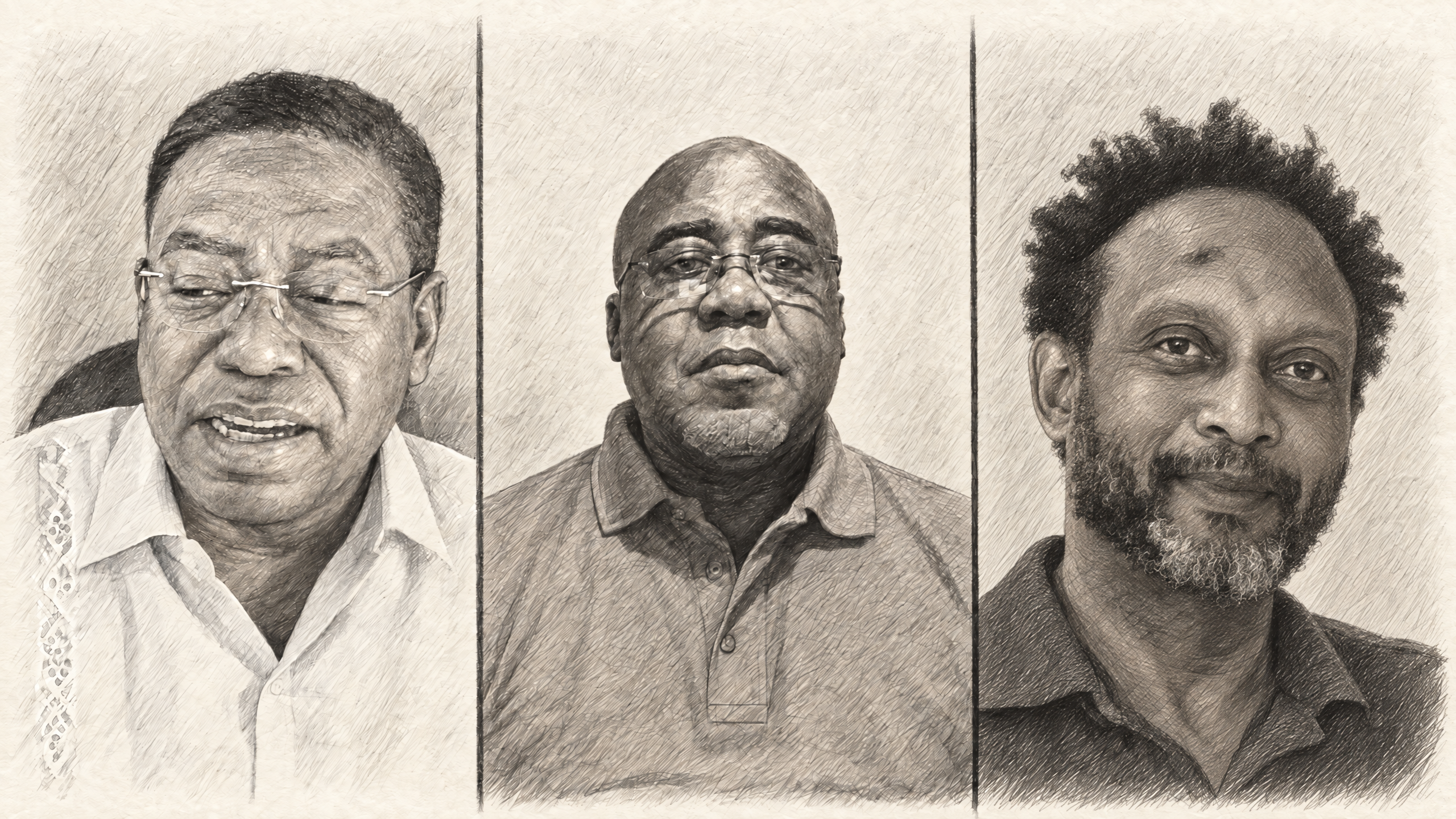
Transforming Guyana · Season 4, Episode 1
The Courage to Become Unnecessary: A Conversation on Power, Succession and Guyana’s Institutions
Kojo M. Parris and Ruel Johnson on leadership, institutional strength, and what the oil era demands of those who govern—and those who are governed
By Terrence Richard Blackman, Ph.D. · Brooklyn, New York · Sunday, 27 September 2026
Season four of Transforming Guyana opened ahead of its planned October launch. Dr. Rory Fraser, our planned opening guest, now joins us next month. But two recent columns by Kojo M. Parris, “The Courage to Become Unnecessary” and “From Manufacturing Consent to Manufacturing Discontent”, raised questions we felt deserved an open conversation. They concern the exercise of power, the preparation for succession, and whether Guyana’s institutions grow stronger as its revenues grow.
Parris read engineering at Cambridge, then worked with Booker Tate and in consulting and banking in Zimbabwe and South Africa. He later served as Guyana’s Honorary Consul to South Africa and founded the Roraima Learning Trust.
To examine his arguments from another perspective, we invited Ruel Johnson. A creative writer and cultural policy expert, Johnson currently serves as Adviser to the President of Guyana. A two-time Guyana Prize for Literature winner, he won Best First Book of Fiction for Ariadne and Other Stories and Best Book of Fiction for Collected Fictions. His work also spans international literary programmes and cultural policy initiatives with CARICOM and the Government of Guyana.
Before the discussion, we paused to acknowledge the passing of the Mighty Sparrow, whose art made power answerable to the wit and judgment of ordinary Caribbean people.
Why speak now?
We began with the question many readers had put to us. Parris first met Bharrat Jagdeo in 2002 and subsequently served as Honorary Consul during his presidency. He also counts the greater inclusion of Indo-Guyanese and Amerindian communities in national life as a major post-1992 achievement. Why, then, had he chosen this moment to speak publicly?
When he returned to Guyana after the pandemic, he said, he encountered substantial new wealth moving through weak institutions. He also found an uneasiness about discussing politics openly. After three decades in Africa, both conditions felt familiar.
He recalled asking a minister how long the Vice President would remain central to the government’s work. The answer was that the party could not do without him. That language of indispensability, Parris said, reminded him of how people spoke about Forbes Burnham in the 1980s. His own test for leadership came from his father. Are you relevant to the nation, to your party, and to your own legacy?
The architecture of power
Parris traced part of today’s concentration of power to the PNC’s 1974 Declaration of Sophia. There, Burnham proclaimed the “paramountcy of the party” as a political doctrine. He also pointed to the far more powerful executive presidency that the 1980 Constitution created. The PPP, he then argued, retained important elements of that architecture in office.
He acknowledged, however, that he could not offer hard evidence for his account of who now makes the decisions. Instead, his argument rested on his own observations. It also drew on a perception he described as widespread among the people he meets in Guyana.
In contrast, Johnson said the Vice President had been less involved in day-to-day administration since 2020. Instead, he saw a role focused more on major policy. He questioned how much weight anecdotal evidence could bear. He suggested local elections as a fairer test.
Johnson also placed the debate in a longer constitutional history: Guyana’s transition to a republic in 1970, the ending of Privy Council appeals, the contested 1978 referendum, and subsequent reform efforts. Both speakers agreed that successive governments had often delayed reform or left it incomplete.
“Access theatre”
The sharpest exchange concerned ministerial outreaches.
Parris described them as “access theatre”: public displays of responsiveness that reveal how poorly routine institutions function. In his account, citizens should not need a minister’s intervention to obtain services that public agencies exist to provide. He also argued that these events can become campaigning at public expense.
His alternative was sustained engagement. A minister would spend a full day in a community, listening and learning in the spirit of Walter Rodney’s grounding.
Johnson, however, drew on his own experience of the outreaches to defend their value. In his view, they expose ministers to direct criticism and bring agency staff face to face with citizens. They also take officials beyond the insulation of their offices.
Still, both recognised that the demand for such meetings tells us something about institutional capacity. Their disagreement concerned what follows from it. Do the outreaches help repair that weakness? Or do they risk making personal intervention a permanent substitute for reliable public service?
Where they met
The conversation also revealed substantial common ground.
First, both questioned how much the familiar Afro/Indo framing explains a changing electorate. They pointed to younger voters, more mixed identities, and often transactional political allegiances. Both also regarded a weak opposition as dangerous for the country. Finally, both resisted the assumption that most people enter politics intending harm.
For Parris, however, good intentions cannot settle the question of performance. Citizens must judge governments by what their decisions make possible in people’s lives. He therefore distinguished developments, meaning roads, buildings and other visible projects, from development. The latter means people more at ease in their country, and graduates who see a future worth staying for.
We asked each speaker to name a Guyanese institution that functions without a heavy hand at the centre. Both named the Guyana Revenue Authority. Parris suggested that revenue authorities built on international models can develop professional cultures that partly resist political pressure.
Johnson’s broader argument, meanwhile, was that institutional reform and active citizenship must advance together. Where the opposition is weak, civil society and credible media carry a greater responsibility to scrutinise government. That scrutiny, he added, must also include people like himself who serve within it.
The test ahead
The disagreement matters because it concerns how Guyana will govern its new wealth.
As oil revenues grow, can citizens obtain fair treatment through dependable procedures? Can public institutions exercise their responsibilities without waiting for personal intervention? Can political parties prepare for succession without treating any individual as indispensable?
These questions extend beyond any judgment of Bharrat Jagdeo. Rather, they concern the standards by which we assess every administration. They also concern the habits we accept in our own dealings with the state.
The courage to become unnecessary requires leaders to build institutions that can outlast their authority. It also requires citizens to value fair procedures even when personal access might offer a quicker result. Finally, it requires a public culture in which disagreement can sharpen judgment without becoming a presumption of bad faith.
That is what we hoped this conversation would make room for: serious differences examined openly, with the country’s future held in common.
Parris has indicated that a third column is forthcoming. Our pages remain open to considered replies from every quarter.
Watch the full conversation
Join us in October for Season 4, Episode 2 with Dr. Rory Fraser.
A Note on This Recap
This recap summarises the live conversation of 27 September 2026 and paraphrases the speakers’ remarks. The full recording is the authoritative record. The views of Kojo M. Parris and Ruel Johnson are their own, not those of the Guyana Business Journal.
Parris’s two columns first appeared in Kiskadee Watch on 10 and 24 September 2026. The GBJ republished the second at the author’s request.
Corrections and dissent are welcome.
Dr. Terrence Richard Blackman is Interim Dean of the School of Science and Allied Health and Professor of Mathematics at Medgar Evers College, City University of New York, and the Founder and Publisher of the Guyana Business Journal. He hosts the GBJ’s Transforming Guyana series. The views expressed here are his own and do not represent the positions of Medgar Evers College or the City University of New York.
With Thanks to Our Sponsors
Metallica Commodities Corporation
Pebble Stream™
Caribbean International Shipping Services
caribshipatl.com · 770-322-3111
MCCG USA
mccgusa.com · 212-269-6126
Sponsors support the Journal’s work and have no role in its editorial judgments.
Individual supporters: Courtney Noel | All Te Networks | Corine Locke | Tony Harris | Roderick Alsopp | Dr. Michelle Luard | Clarence Bone
🇬🇾 Support the Guyana Business Journal
