
The Sunday Essay · Energy & the Public Purse
Turkish Powerships and Their Discontents
A bridge is judged not only by what it costs, but by whether it gets you to the other side
Two Turkish powerships were hired in 2024 as a bridge to the Wales gas plant. Twenty-eight months on, the bridge still stands, the rent has risen, September’s blackouts happened with both ships running, and the contracts have never been published. An essay on what an emergency costs when the emergency is not ended.
By Terrence Richard Blackman, Ph.D. · Sunday, 27 September 2026
There is a particular quality to a Guyanese blackout. The fans stop first, then the fridge shudders and falls silent, and then, in the pause before the neighbours’ generators clear their throats, you can hear the quiet and the sea. It is not an unpleasant sound. It is the sound of a country remembering that electricity was never a birthright, only an arrangement.
Freud, in Civilization and Its Discontents, argued that every arrangement that makes us secure extracts a price we would rather not examine. He was thinking of the instincts we surrender to live among other people. He might as well have been thinking of the two Turkish ships that sit in our rivers, humming.
The bridge
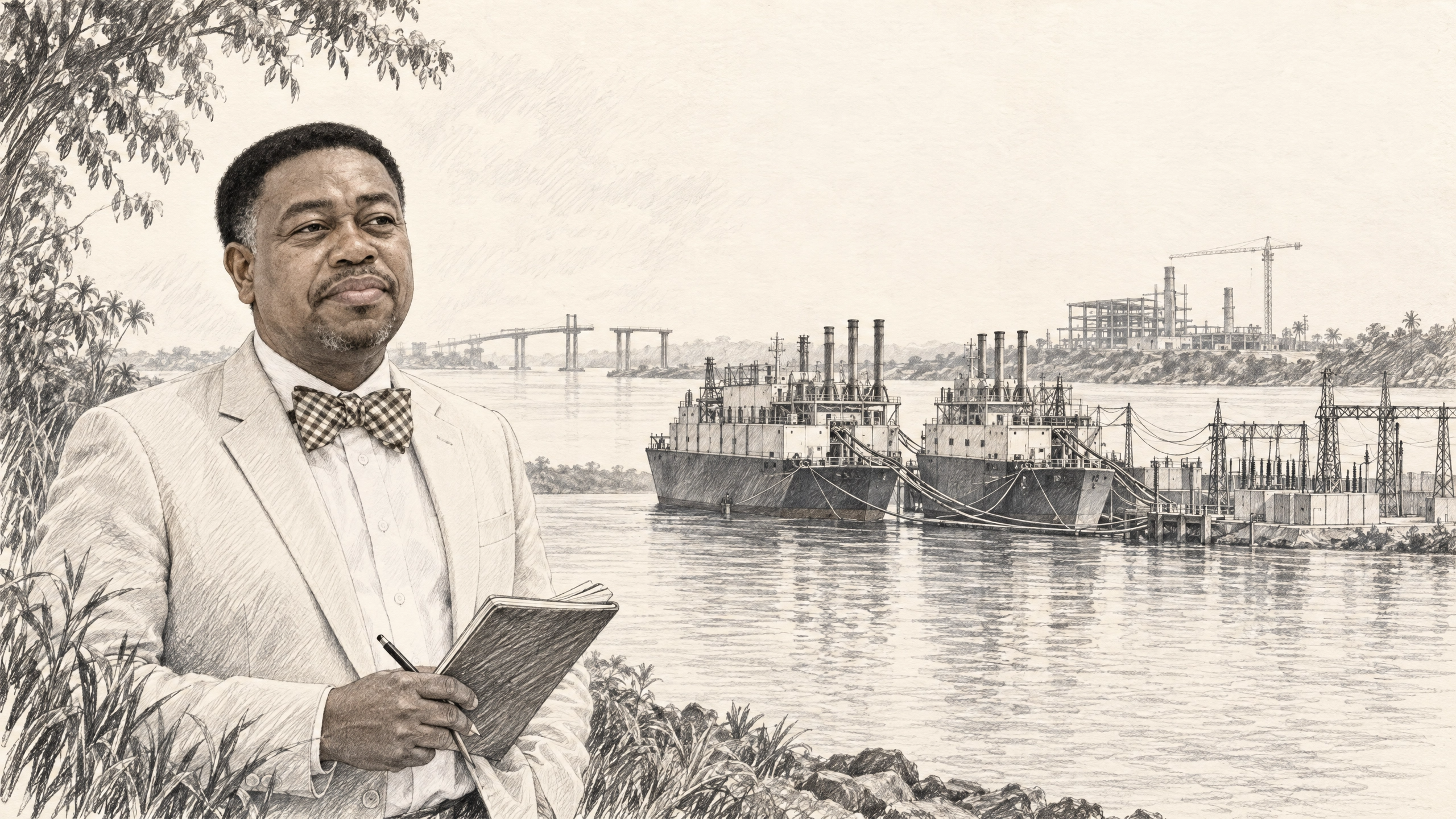
They arrived as guests. On April 13, 2024, Guyana Power and Light chartered a 36-megawatt powership from an affiliate of the Turkish operator Karpowership for two years at 7.60 US cents per kilowatt-hour, plus a million dollars to persuade it to leave Cuba. GPL, meanwhile, supplies the fuel. In November, a second, larger vessel arrived for the Demerara at 9.50 cents, and by Christmas both were running.
Guests are welcome because they are leaving. These were to leave when Lindsayca finished the 300-megawatt plant at Wales, contracted for US$759 million and promised for the end of 2024. The ships were the bridge. The bridge is still standing because the far bank has not arrived. The soil in Wales required eighteen months of persuasion. The contractor now promises the first turbine by the end of this year and the full plant by June 2027, which means we have asked the guests to stay for a third Christmas and have graciously raised their rate.
This is the thing about emergency infrastructure. It is worth what the time it buys is worth. If the country uses the time to end the emergency, it was a bargain. If the time is merely spent, it becomes something else, a rent paid on a delay, and the delay becomes the tenant.
If the time is merely spent, it becomes something else, a rent paid on a delay, and the delay becomes the tenant.
— T.R.B.
The arithmetic
Nobody has published what the ships have cost. So we did what mathematicians do when someone withholds a number: we assumed 96 percent availability, multiplied by the disclosed rates, and wrote down what fell out. Treat it as an estimate of capacity, not of cheques cashed.
The Berbice vessel earns about US$23 million a year at its original rate, roughly US$57 million so far, counting the increase since July. In addition, the Demerara vessel adds roughly US$84 million. The rent is then about US$140 million. That is the price of the ships before buying a drop of fuel.
Fuel, however, is another matter. The Vice President has put the all-in cost at 20 to 30 cents a kilowatt-hour, and on something like 1.6 billion kilowatt-hours that comes to US$320 million to US$480 million, with US$400 million near the middle. Admittedly, much of that oil would have burned anyway in GPL’s own engines. Fuel is not rent. It is only the price of the light.
Set the midpoint beside Wales. The contract there was US$759 million and, after this year’s soil settlement, is US$856 million. At the midpoint, Guyana’s estimated spend on the temporary arrangement is approaching half the revised contract price of the permanent plant. Whether the ship contracts contain take-or-pay clauses, whether we have promised to buy electricity we do not consume, no one outside GPL can say, because no one has published the contracts. A meditation on their contents would be a meditation on a locked room, and the law, as we shall see, has views about locked rooms.
The lesson of May 25
Economists have a dry name for what happens when you depend on someone who knows it: the hold-up problem. The name is more polite than the experience.
In March, GPL’s management expected to renew the Berbice contract at the same rate. It expired on May 21. Government asked for thirty days. The operators offered seven, in a letter that made one price for both ships a condition of the lights staying on. On July 1, the Government announced a new agreement at 9.5 cents, a quarter more than before.
Of course, it would be satisfying to be indignant at the company. But the company did nothing unusual. It read the room. The room had one door, and Guyana was standing in it.
It read the room. The room had one door, and Guyana was standing in it.
— T.R.B.
The right to know
A quieter discontent underlies all of this, and it has nothing to do with megawatts.
The Access to Information Act of 2011 gives every Guyanese citizen the right to access official documents held by public authorities, and it counts among those authorities any company owned or controlled by the State. Guyana Power and Light is such a company. The Constitution protects the freedom to receive information without interference. These are not aspirations. They are law.
The law is not naive. The Act allows exemptions, among them commercially sensitive information and material whose release might prejudice a public authority’s negotiations, and it gives a Commissioner of Information the task of weighing such claims against the public interest. Those exemptions might justify withholding particular clauses. They do not explain why the Government has never shown the public what it may lawfully disclose, nor why the renewed Berbice agreement, promised in July, has not appeared, nor why press bodies report that requests to the Commissioner’s office go unanswered. A right that cannot be exercised is a decoration.
This is not a small thing to set beside the arithmetic. The estimate above exists only because the documents do not. A citizen should not have to be a mathematician to learn what his electricity costs.
A right that cannot be exercised is a decoration.
— T.R.B.
Three weeks in September
And then the month that ought to settle what a ship can and cannot buy.
On the night of Saturday, September 5, a transformer at the Kingston substation failed. The protection system did what protection systems do: it protected the equipment by abandoning the customers. Generators tripped; Garden of Eden followed; the darkness spread across two counties. On Monday morning another disturbance struck the system; GPL initially said its cause was still under investigation. By mid-month the opposition was calling the blackouts daily, which was less a political claim than a description of the calendar.
GPL was, to its credit, candid. Peak demand had touched 257 megawatts against 265.6 available, a margin of eight, roughly the output of a very large hotel. But the generation, it insisted, was sufficient; the feeders were overloaded and the transformers “taxed,” and much of the network is radial, a tree rather than a ring, so a failure at the trunk is a failure everywhere. The company asked citizens to set their air conditioners to 25 degrees rather than 16, and not to enlarge their fuses without asking. One pictures a nation in its bedrooms, sweating for the grid.
No spinning reserve
A week later the President called the outages unacceptable and, in the way of presidents, told the truth more bluntly than his utility had. There was “absolutely no spinning reserve” on any coast. Generators were past their overhaul dates, yet GPL could not take them down, because the grid needed every one of them. Asked whether a third ship was coming, he declined to say.
Hold the two statements together. The utility says the wires are failing. The President says the generation is stretched to the last engine. Both are true. And through every one of these blackouts, two Turkish ships, 111 megawatts under contract, sat in the rivers with their lights on. A ship adds power at the dock. It cannot add a transformer at Kingston. It cannot turn a tree into a ring.
A ship adds power at the dock. It cannot add a transformer at Kingston. It cannot turn a tree into a ring.
— T.R.B.
The pattern abroad
We are not the first to keep guests this long. In 2023, Karpowership switched off Freetown and Bissau over unpaid bills. Ghana kept its 450-megawatt vessel for a decade and, by 2019, was using less than 40 percent of all the take-or-pay capacity it had contracted, the ship among it; the country’s relief came when it switched the vessel to its own gas, the one remedy our delay withholds from us. Similarly, a World Bank-funded study in Lebanon concluded, with the calm of hindsight, that building the permanent plant would have been cheaper.
In short, the lesson repeats with the patience of a tide. An emergency measured in months acquires consequences measured in years.
The third ship
On September 20, Kaieteur News reported, citing unnamed sources, that a third vessel is under negotiation, some 300 megawatts, to be moored at Wales. Unnamed sources are unnamed for a reason, and readers should take the report with a grain of salt.
But indulge the image. A rented plant, tied up beside the unfinished permanent one, matching it megawatt for megawatt, larger than the whole grid’s recorded peak. At the current rate and 96 percent availability, its rent alone would approach US$240 million a year, by our arithmetic, not anyone’s quotation. And it would feed the same radial grid that September showed cannot carry what it already has.
What is owed
None of this is to say the need is imagined. Demand grew 18 percent in two years, five times the regional pace, and the consultants project something like 138 percent more by 2029. Indeed, a country that grows this fast will need more power than it has. That was never the question.
The questions are quieter. Will the Government publish the contracts, or, at minimum, identify what it says must lawfully remain confidential and release the rest? Will the Government put a third ship out to open tender? Have we promised to pay for electricity we do not use? What does the contractor at Wales owe us for the dependence its lateness created? And since the utility itself says the month’s darkness began in a substation and in the feeders, what portion of the next dollar goes to making power, and what portion to the humble wires that carry it home?
Freud’s point was that discontent is the price of civilisation, and that the mature thing is not to stop paying but to keep looking at the bill. In Guyana, the bill is ours to scrutinise.
Guyana can afford the ships.
What it cannot afford is to stop counting, or to be told it may not.
A Note on the Figures
Neither GPL nor the Government has published a cumulative cost for the powerships. The rental estimates use the disclosed rates (7.60 US¢/kWh for the 36 MW Berbice vessel from May 2024, 9.50 US¢/kWh since July 2026; 9.50 US¢/kWh for the Demerara vessel at 60 MW dispatched from late December 2024), an assumed 96 percent availability, and the disclosed US$1 million mobilisation fee.
Billing is per kilowatt-hour generated, so lower dispatch would lower the rent unless the contracts carry minimum-offtake terms. The all-in range applies the Vice President’s stated 20 to 30 US¢/kWh to roughly 1.6 billion kWh; GPL’s own plant would have burned much of that fuel regardless. The Wales figure is the Lindsayca EPC contract, US$759 million, revised to US$856.152 million by the May 2026 soil-stabilisation settlement; government has said the wider Gas-to-Energy project may reach US$1.1 billion including contingency. The US$240 million scenario for a 300 MW vessel assumes 9.5 US¢/kWh and 96 percent availability. “111 megawatts” is contracted capacity (36 + 75), not confirmed dispatch during the outages. All estimates are the Journal’s own.
Sources
Primary sources: GPL’s April 2024 and November 2024 charter announcements (OilNOW); the May 25, 2026 operators’ letter as reported by Caribbean360 and Kaieteur News; Demerara Waves on the July 1 renewal; GPL’s September 7 statement and briefing on the DBIS outages; the President’s September 14 remarks; Kaieteur News, September 20; the Access to Information Act, No. 21 of 2011; the Inter American Press Association’s April 2026 Guyana report; Semafor (2023) on Sierra Leone and Guinea-Bissau; Energy Voice (2019) on Ghana’s gas conversion; amaBhungane (2021) on Lebanon.
The Freud framing, the bridge metaphor and the arithmetic are the author’s own. Corrections and dissent are welcome; a reader with access to the contracts is especially welcome.
Dr. Terrence Richard Blackman is Dean (Interim) of the School of Science and Allied Health and Professor of Mathematics at Medgar Evers College, City University of New York, and the Founder and Publisher of the Guyana Business Journal. The views expressed here are his own and do not represent the positions of Medgar Evers College or the City University of New York.
With Thanks to Our Sponsors
Metallica Commodities Corporation
Sponsors support the Journal’s work and have no role in its editorial judgments.
Pebble Stream™
Sponsors support the Journal’s work and have no role in its editorial judgments.
Caribbean International Shipping Services
caribshipatl.com · 770-322-3111
Sponsors support the Journal’s work and have no role in its editorial judgments.
MCCG USA
mccgusa.com · 212-269-6126
Sponsors support the Journal’s work and have no role in its editorial judgments.
Individual supporters: Courtney Noel | All Te Networks | Corine Locke | Tony Harris | Roderick Alsopp | Dr. Michelle Luard | Clarence Bone
🇬🇾 Support the Guyana Business Journal
