
A GBJ Series · Beyond the Resource Curse
Article 12 of 12
The case for a National Development University, argued from a whole life.
This essay is part of the twelve-part series “Beyond the Resource Curse.” Read the foreword, “The Autonomous Imagination.”
I am an old man now, seventy-three, and I have spent this whole series telling you what I watched. The flag come down. The nationalizations curdle. Three resources rise and fall without leaving behind what they should have. Friends disappear through an airport gate, one at a time. An estate die that raised generations of my mother’s people. A fund that has already shown it can bend. And a school system that hands out seats without yet building the trust a nation actually needs. If you have read this whole series, you have read a life. Now let me tell you what I think has to come next. An old man who only diagnoses and never prescribes has wasted his readers’ time.
Why Every Piece in This Series Points Here
Go back through everything I have told you and notice the shape of it. My uncle the bookkeeper knew the company but was never taught to run it — a training gap. The nationalized industries lost their technical staff and never rebuilt that expertise fast enough — a training gap. Gold and timber were governed too thinly to protect the people and the land around them — an institutional capacity gap. The ones who left did not lack loyalty. They lacked a place to use what they knew — an opportunity gap.
Sugar’s workers never got a real transition. And Local Content’s success or failure rests on whether Guyanese firms actually have the expertise to compete for the work the law reserves for them. The same gap again. The fund needs citizens sharp enough to read its reports and loud enough to defend its rules — that gap too. And the education system, even strengthened, is producing access. It is not yet producing what this series has called the autonomous imagination — the thing a nation actually needs.
Every single piece of this series, without my planning it quite so neatly at the start, keeps arriving at the same missing institution. Not a missing law. Not a missing fund — we have a fund, however imperfect. A missing university. Not the university we have, which does real and honourable work within real constraints. A university built specifically, deliberately, at national scale, to close the gap this whole series has traced.
What Such a University Would Actually Have to Do
I am not talking about another campus offering the same degrees the same way. I am talking about an institution built around a few commitments this series has earned the right to insist on.
It would need to be financed the way the resource fund itself needs to be protected — through a dedicated, constitutionally insulated stream. So a change in government cannot starve it the way political pressure has already once bent the fund’s own rules. It would need a footprint that reaches past Georgetown, into the regions where the CSEC data shows the widest gaps. A child in the hinterland must not be permanently behind a child on the coast before either of them turns eighteen. It would need to actively recruit from the diaspora, treating the very people who left through that airport gate not as a loss to mourn but as a resource to reclaim. It would need to offer them a genuine reason — not just a salary, but real institutional standing — to bring their expertise home.
A Curriculum for a Whole Mind
And it would need to teach more than the engineering and the petroleum economics and the accounting the oil economy genuinely requires. It would also need to teach, alongside them, the things this series has argued matter just as much. The record-keeping and radical accountability that let a citizen audit a state. The forest policy that can actually hear what Wilson Harris called the living text of the land. The history that produced Martin Carter and Philip Moore and Aubrey Williams, sitting on the same syllabus as the technical disciplines. So that no graduate of this university ever mistakes a skill for a whole mind.
The Two Instruments, Together
I called the resource fund a vault earlier in this series, and I stand by that. But a vault only protects what you put into it, and money alone was never going to be enough. Indeed, this whole series has been one long demonstration of exactly that truth, told four different ways across four different resources. The university is the other instrument. It converts what the vault protects into something no boom or bust can take back once it exists. Trained people. Functioning institutions. A citizenry that knows how to ask its own government the hard question and expects, reasonably, to get an honest answer.
Plant It, and Tend It
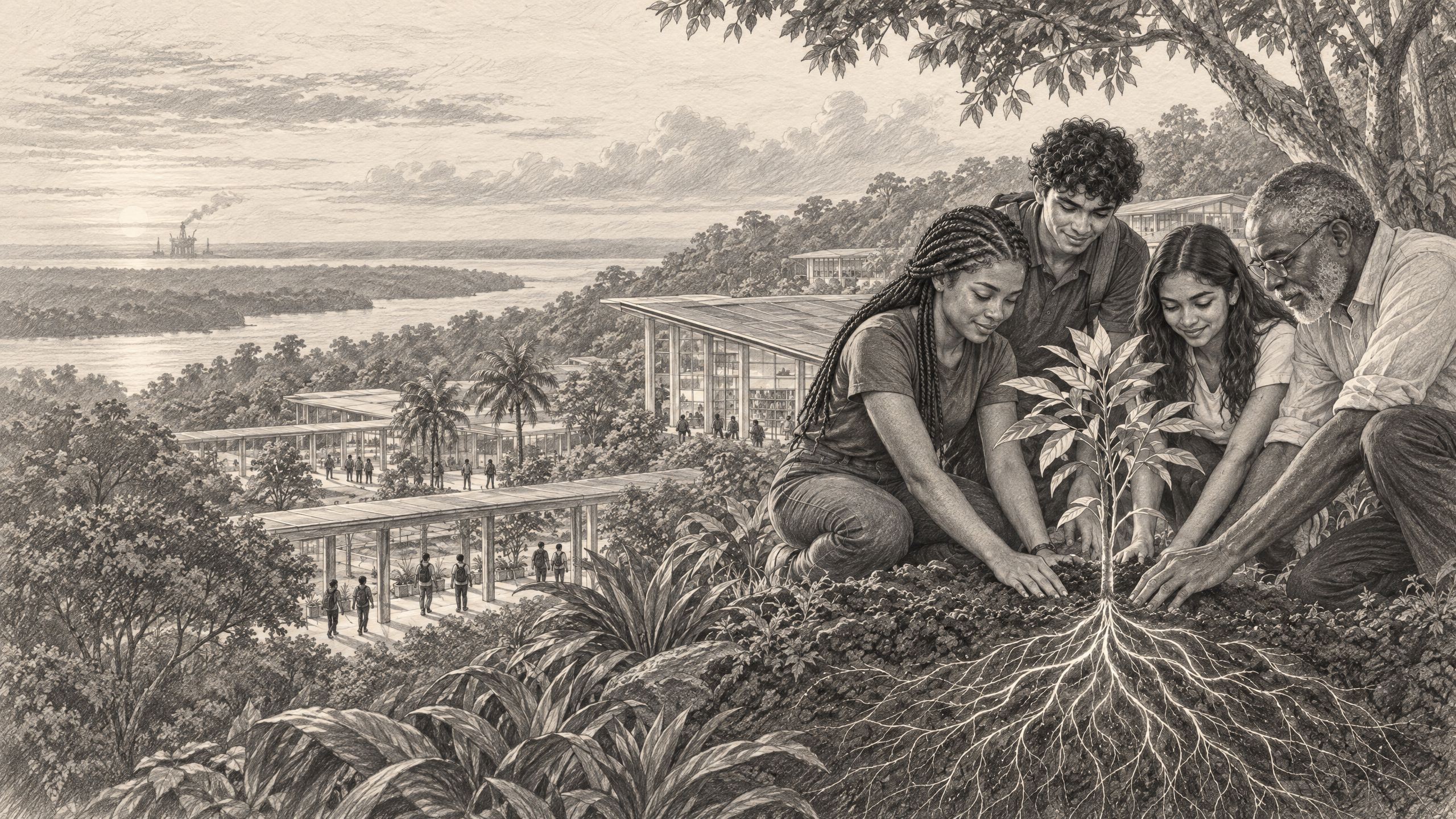
I do not know if I will live to see this university built the way I believe it needs to be built. I am seventy-three, and institutions of this size move slower than an old man’s remaining years. But I have watched this country make exactly one honest attempt to break this pattern before — the forest agreement I told you about, imperfect and unfinished but genuinely imaginative. So I know we are capable of imagination when we choose to use it.
That is where this series began, back at its start, with a claim I still believe more firmly now than I did when I wrote it. The future does not belong to the politicians or the foreign investors. It belongs to the collective imagination of the people.
I chose to call that imagination sovereign at first, borrowing Lamming’s own word, because it is the truest starting point there is. But sovereignty alone, this series has shown you again and again, was not enough. In the end, it could not stop a new landlord from moving into the same house the old one vacated. What has to get built, in the fund and in a university that does not fully exist yet, is something autonomous — answerable to no one’s script, coloniser’s or countryman’s. Above all, it must be strong enough to outlast me, outlast this government, and outlast the oil itself. Plant it, and tend it. For once in this country’s long relationship with what lies beneath its ground, let something we grow outlast what we dug up.
Let something we grow outlast what we dug up.
— N.P.
This concludes the twelve-part series. Read it from the beginning, starting with the foreword, “The Autonomous Imagination”.
Beyond the Resource Curse — A GBJ Series
The Guyana Business Journal is supported by:
Metallica Commodities Corporation
metallicacc.com
Sponsorship supports independent Guyanese analysis; sponsors play no role in the Journal’s editorial decisions.
Pebble Stream™
pebblestream.com
Sponsorship supports independent Guyanese analysis; sponsors play no role in the Journal’s editorial decisions.
Caribbean International Shipping Services
caribshipatl.com · 770-322-3111
Sponsorship supports independent Guyanese analysis; sponsors play no role in the Journal’s editorial decisions.
MCCGUSA
mccgusa.com · 212-269-6126
Sponsorship supports independent Guyanese analysis; sponsors play no role in the Journal’s editorial decisions.
…and by individual supporters of independent Guyanese analysis: Courtney Noel | All Te Networks | Corine Locke | Tony Harris | Roderick Alsopp | Dr. Michelle Luard | Clarence Bone
